Science Explorer Back to mapMap

GenVec

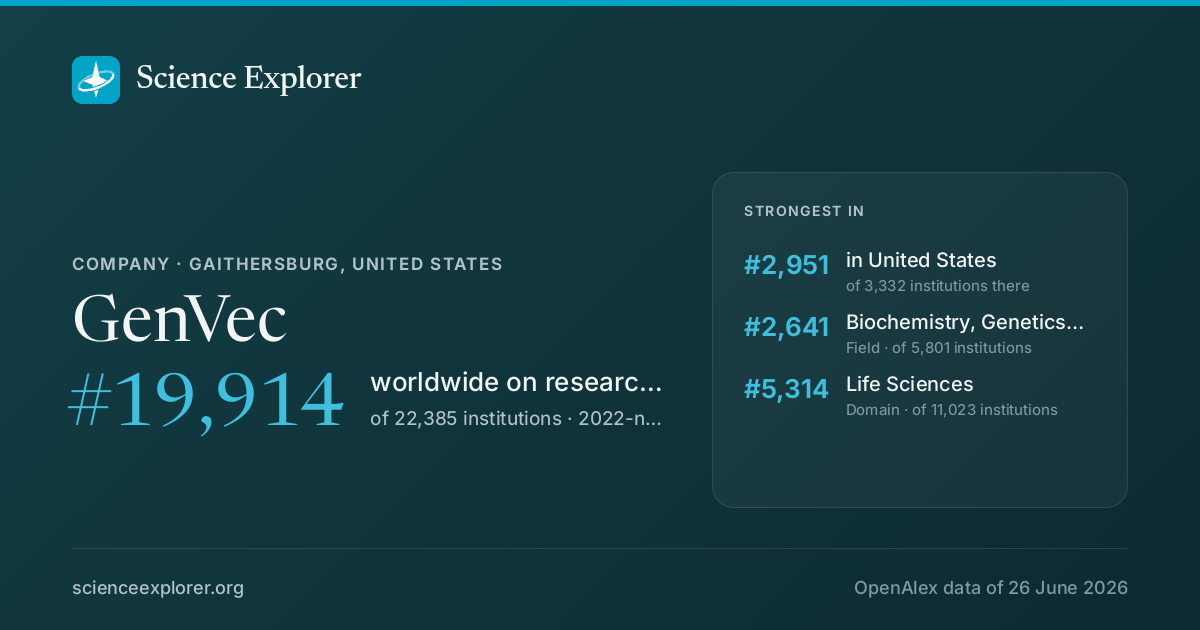
In research, GenVec stands highest in Biochemistry, Genetics and Molecular Biology (#2,641 of 5,801 worldwide) and Life Sciences (#5,314 of 11,023 worldwide), over all time.

World rank, 2022-now
#19,914
of 22,385 · #14,568 all time
Rank in United States
#2,951
of 3,332
Research works
425
▲ 15% vs 2018-21
Citations
16k
38.1 per fractional work
Top-10% rate
9.3%
all institutions 10.0%
vs its own fields
0.96×
1.00× is exactly expected
Open access
46%
world 40%
International
26%
world 18%

What is GenVec known for in research?

The fields where it stands highest, over all time, ranked among every institution above the floor in each field.

FieldWorld rankWhere that sitsTop-10% rateWorks
Biochemistry, Genetics and Molecular BiologyField #2,641 of 5,801 15.5%139
Life SciencesDomain #5,314 of 11,023 14.7%174

Each strip is that field's whole ranked pool, with the notch where GenVec sits in it, in the colour of the band that rank falls in. The track under the rate is the rate itself: it carries no average mark, because the average differs by field (from about 6% in Dentistry to 21% in Economics).

Which fields of science does GenVec work in?

In 2022-now, 33% of research at GenVec is in Life Sciences, 23% in Physical Sciences. Its largest fields are Biochemistry, Genetics and Molecular Biology (23%), Medicine (19%), Social Sciences (12%). It does 2.2× the world's share of Life Sciences.

Life Sciences: 25 fractional works · 33.3% of its workBiochemistry, Genetics and Molecular Biology: 18 fractional works · 23.2% of its workMolecular Biology: 8 fractional works · 11.1% of its workGenetics: 7 fractional works · 9.0% of its workCancer Research: 1 fractional works · 0.8% of its workBiophysics: 1 fractional works · 0.8% of its workMolecular Medicine: 0 fractional works · 0.6% of its workCell Biology: 0 fractional works · 0.4% of its workEndocrinology: 0 fractional works · 0.4% of its workSmaller subfields together: 0 fractional works · 0.3% of its workAgricultural and Biological Sciences: 3 fractional works · 3.6% of its workPlant Science: 2 fractional works · 2.1% of its workFood Science: 1 fractional works · 0.8% of its workInsect Science: 0 fractional works · 0.3% of its workAnimal Science and Zoology: 0 fractional works · 0.2% of its workSmaller subfields together: 0 fractional works · 0.0% of its workImmunology and Microbiology: 2 fractional works · 2.7% of its workImmunology: 2 fractional works · 2.4% of its workSmaller subfields together: 0 fractional works · 0.3% of its workNeuroscience: 2 fractional works · 2.6% of its workCellular and Molecular Neuroscience: 1 fractional works · 1.6% of its workCognitive Neuroscience: 0 fractional works · 0.7% of its workNeurology: 0 fractional works · 0.2% of its workSmaller subfields together: 0 fractional works · 0.1% of its workPharmacology, Toxicology and Pharmaceutics: 1 fractional works · 1.2% of its workPharmacology: 1 fractional works · 0.7% of its workPharmaceutical Science: 0 fractional works · 0.4% of its workPhysical Sciences: 17 fractional works · 22.8% of its workChemistry: 4 fractional works · 5.8% of its workAnalytical Chemistry: 3 fractional works · 3.4% of its workSpectroscopy: 2 fractional works · 2.3% of its workEngineering: 4 fractional works · 5.7% of its workAerospace Engineering: 1 fractional works · 1.4% of its workBiomedical Engineering: 1 fractional works · 1.1% of its workArchitecture: 1 fractional works · 0.9% of its workElectrical and Electronic Engineering: 0 fractional works · 0.6% of its workMedia Technology: 0 fractional works · 0.6% of its workMechanical Engineering: 0 fractional works · 0.5% of its workComputational Mechanics: 0 fractional works · 0.3% of its workControl and Systems Engineering: 0 fractional works · 0.2% of its workSmaller subfields together: 0 fractional works · 0.2% of its workComputer Science: 2 fractional works · 2.7% of its workArtificial Intelligence: 1 fractional works · 1.4% of its workComputer Science Applications: 0 fractional works · 0.7% of its workComputational Theory and Mathematics: 0 fractional works · 0.4% of its workComputer Vision and Pattern Recognition: 0 fractional works · 0.2% of its workMaterials Science: 2 fractional works · 2.3% of its workMaterials Chemistry: 1 fractional works · 1.2% of its workSurfaces, Coatings and Films: 0 fractional works · 0.6% of its workBiomaterials: 0 fractional works · 0.4% of its workSmaller subfields together: 0 fractional works · 0.1% of its workMathematics: 2 fractional works · 2.0% of its workTheoretical Computer Science: 1 fractional works · 1.3% of its workStatistics and Probability: 0 fractional works · 0.5% of its workSmaller subfields together: 0 fractional works · 0.2% of its workPhysics and Astronomy: 2 fractional works · 2.0% of its workAstronomy and Astrophysics: 1 fractional works · 0.9% of its workAtomic and Molecular Physics, and Optics: 0 fractional works · 0.4% of its workRadiation: 0 fractional works · 0.3% of its workSmaller subfields together: 0 fractional works · 0.4% of its workEnvironmental Science: 1 fractional works · 1.4% of its workEcology: 0 fractional works · 0.5% of its workIndustrial and Manufacturing Engineering: 0 fractional works · 0.3% of its workEnvironmental Chemistry: 0 fractional works · 0.2% of its workSmaller subfields together: 0 fractional works · 0.3% of its workEarth and Planetary Sciences: 1 fractional works · 0.9% of its workAtmospheric Science: 0 fractional works · 0.6% of its workGeochemistry and Petrology: 0 fractional works · 0.2% of its workSmaller subfields together: 0 fractional works · 0.1% of its workSocial Sciences: 17 fractional works · 22.8% of its workSocial Sciences: 9 fractional works · 12.3% of its workSociology and Political Science: 2 fractional works · 3.3% of its workGender Studies: 1 fractional works · 1.7% of its workEducation: 1 fractional works · 1.6% of its workCommunication: 1 fractional works · 0.9% of its workCultural Studies: 1 fractional works · 0.9% of its workLinguistics and Language: 1 fractional works · 0.9% of its workUrban Studies: 1 fractional works · 0.9% of its workPolitical Science and International Relations: 0 fractional works · 0.7% of its workHealth: 0 fractional works · 0.6% of its workSafety Research: 0 fractional works · 0.5% of its workDemography: 0 fractional works · 0.2% of its workLaw: 0 fractional works · 0.2% of its workPsychology: 3 fractional works · 3.4% of its workClinical Psychology: 2 fractional works · 2.3% of its workExperimental and Cognitive Psychology: 0 fractional works · 0.5% of its workDevelopmental and Educational Psychology: 0 fractional works · 0.4% of its workSmaller subfields together: 0 fractional works · 0.2% of its workArts and Humanities: 2 fractional works · 3.2% of its workHistory: 1 fractional works · 1.3% of its workHistory and Philosophy of Science: 0 fractional works · 0.4% of its workLanguage and Linguistics: 0 fractional works · 0.4% of its workVisual Arts and Performing Arts: 0 fractional works · 0.4% of its workArcheology: 0 fractional works · 0.3% of its workLiterature and Literary Theory: 0 fractional works · 0.2% of its workBusiness, Management and Accounting: 2 fractional works · 2.5% of its workOrganizational Behavior and Human Resource Management: 1 fractional works · 0.9% of its workAccounting: 1 fractional works · 0.7% of its workStrategy and Management: 0 fractional works · 0.6% of its workManagement of Technology and Innovation: 0 fractional works · 0.2% of its workSmaller subfields together: 0 fractional works · 0.1% of its workDecision Sciences: 1 fractional works · 1.4% of its workStatistics, Probability and Uncertainty: 1 fractional works · 1.1% of its workManagement Science and Operations Research: 0 fractional works · 0.3% of its workEconomics, Econometrics and Finance: 0 fractional works · 0.0% of its workHealth Sciences: 16 fractional works · 21.1% of its workMedicine: 14 fractional works · 18.9% of its workOncology: 3 fractional works · 4.4% of its workPathology and Forensic Medicine: 2 fractional works · 2.0% of its workPublic Health, Environmental and Occupational Health: 1 fractional works · 1.9% of its workSurgery: 1 fractional works · 1.7% of its workEpidemiology: 1 fractional works · 1.4% of its workCardiology and Cardiovascular Medicine: 1 fractional works · 0.9% of its workObstetrics and Gynecology: 1 fractional works · 0.8% of its workPsychiatry and Mental health: 0 fractional works · 0.6% of its workHematology: 0 fractional works · 0.6% of its workHepatology: 0 fractional works · 0.6% of its workEndocrinology, Diabetes and Metabolism: 0 fractional works · 0.5% of its workGenetics: 0 fractional works · 0.5% of its workPulmonary and Respiratory Medicine: 0 fractional works · 0.4% of its workRadiology, Nuclear Medicine and Imaging: 0 fractional works · 0.4% of its workPhysiology: 0 fractional works · 0.4% of its workInfectious Diseases: 0 fractional works · 0.3% of its workReproductive Medicine: 0 fractional works · 0.3% of its workRheumatology: 0 fractional works · 0.2% of its workBiochemistry: 0 fractional works · 0.2% of its workSmaller subfields together: 0 fractional works · 0.5% of its workHealth Professions: 1 fractional works · 1.4% of its workGeneral Health Professions: 1 fractional works · 1.2% of its workSmaller subfields together: 0 fractional works · 0.3% of its workNursing: 0 fractional works · 0.4% of its workNutrition and Dietetics: 0 fractional works · 0.4% of its workDentistry: 0 fractional works · 0.4% of its workALL ITS WORKGenVec76fractional works, 2022-now
Life Sciences33%Physical Sciences23%Health Sciences21%Social Sciences23%

Each ring splits the one inside it: the four domains of science, their fields, their subfields. Size is fractional works in 2022-now. Every slice is a page; the interactive view zooms down to single topics and colours each by how much more of it this institution does than the world.

Its 4 domains and 24 fields, with their numbers
    1. Biochemistry, Genetics and Molecular Biology1823.2%
    2. Agricultural and Biological Sciences33.6%
    3. Immunology and Microbiology22.7%
    4. Neuroscience22.6%
    5. Pharmacology, Toxicology and Pharmaceutics11.2%
    1. Chemistry45.8%
    2. Engineering45.7%
    3. Computer Science22.7%
    4. Materials Science22.3%
    5. Mathematics22.0%
    6. Physics and Astronomy22.0%
    7. Environmental Science11.4%
    8. Earth and Planetary Sciences10.9%
    9. Energy00.0%
    1. Social Sciences912.3%
    2. Psychology33.4%
    3. Arts and Humanities23.2%
    4. Business, Management and Accounting22.5%
    5. Decision Sciences11.4%
    6. Economics, Econometrics and Finance00.0%
    1. Medicine1418.9%
    2. Health Professions11.4%
    3. Nursing00.4%
    4. Dentistry00.4%
All of science, and how each field's share has moved since 1950: the Science domain explorer

Field profile

Location quotient across every field it publishes in: outside the ring is more than an institution of this size would be expected to publish, inside it is less.

Agricultural and Biological Sciences: 0.75× its world share, 3 worksAgricultural and Bio…Biochemistry, Genetics and Molecular Biology: 4.36× its world share, 18 worksBiochemistry, Geneti…Immunology and Microbiology: 2.72× its world share, 2 worksImmunology and Micro…Neuroscience: 1.58× its world share, 2 worksNeurosciencePharmacology, Toxicology and Pharmaceutics: 3.32× its world share, 1 worksPharmacology, Toxico…Chemistry: 3.69× its world share, 4 worksChemistryComputer Science: 0.34× its world share, 2 worksComputer ScienceEarth and Planetary Sciences: 0.58× its world share, 1 worksEarth and Planetary …Energy: 0.01× its world share, 0 worksEnergyEngineering: 0.38× its world share, 4 worksEngineeringEnvironmental Science: 0.28× its world share, 1 worksEnvironmental ScienceMaterials Science: 0.67× its world share, 2 worksMaterials ScienceMathematics: 1.71× its world share, 2 worksMathematicsPhysics and Astronomy: 0.90× its world share, 2 worksPhysics and AstronomyDentistry: 0.72× its world share, 0 worksDentistryHealth Professions: 0.55× its world share, 1 worksHealth ProfessionsMedicine: 0.98× its world share, 14 worksMedicineNursing: 0.84× its world share, 0 worksNursingArts and Humanities: 1.11× its world share, 2 worksArts and HumanitiesBusiness, Management and Accounting: 0.77× its world share, 2 worksBusiness, Management…Decision Sciences: 1.44× its world share, 1 worksDecision SciencesEconomics, Econometrics and Finance: 0.01× its world share, 0 worksEconomics, Econometr…Psychology: 1.11× its world share, 3 worksPsychologySocial Sciences: 0.97× its world share, 9 worksSocial Sciences1×world share
more than its size predictsabout as predictedless

Rings at 0.5×, 1× and 2×. Widest outward: Biochemistry, Genetics and Molecular Biology, 4.4×. Every wedge is a field page.

All 24 fields, with their numbers
  1. Biochemistry, Genetics and Molecular Biology4.36×18 works
  2. Chemistry3.69×4 works
  3. Pharmacology, Toxicology and Pharmaceutics3.32×1 works
  4. Immunology and Microbiology2.72×2 works
  5. Mathematics1.71×2 works
  6. Neuroscience1.58×2 works
  7. Decision Sciences1.44×1 works
  8. Arts and Humanities1.11×2 works
  9. Psychology1.11×3 works
  10. Medicine0.98×14 works
  11. Social Sciences0.97×9 works
  12. Physics and Astronomy0.90×2 works
  13. Nursing0.84×0 works
  14. Business, Management and Accounting0.77×2 works
  15. Agricultural and Biological Sciences0.75×3 works
  16. Dentistry0.72×0 works
  17. Materials Science0.67×2 works
  18. Earth and Planetary Sciences0.58×1 works
  19. Health Professions0.55×1 works
  20. Engineering0.38×4 works
  21. Computer Science0.34×2 works
  22. Environmental Science0.28×1 works
  23. Energy0.01×0 works
  24. Economics, Econometrics and Finance0.01×0 works

Who are the top researchers at GenVec?

Ranked on the quality score, C. Richter King, Thomas J. Wickham and Imre Kovesdi lead among researchers whose main affiliation is GenVec.

  1. 1 C. Richter King United States · #83,735 worldwide 13k citations · 174 works
  2. 2 Thomas J. Wickham United States · #94,400 worldwide 11k citations · 134 works
  3. 3 Imre Kovesdi United States · #464,991 worldwide 13k citations · 156 works
  4. 4 Lisa L. Wei United States · #891,446 worldwide 4.5k citations · 96 works
  5. 5 Douglas E. Brough United States · #1,420,744 worldwide 4.7k citations · 85 works
  6. 6 Jeremiah H. Li United States · #1,454,598 worldwide 453 citations · 29 works
  7. 7 Alena Lizonová United States · #1,502,187 worldwide 3.7k citations · 49 works
  8. 8 David A. Einfeld United States · #1,735,989 worldwide 1.5k citations · 20 works
  9. 9 Melissa M. Hamilton United States · #1,823,150 worldwide 739 citations · 28 works
  10. 10 Agatha Zawadzka United States · #1,829,608 worldwide 1.6k citations · 22 works
All ranked researchers at GenVec

What are the most cited papers from GenVec?

The most cited paper from GenVec is "Loss-of-function mutations in the gene encoding filaggrin cause ichthyosis vulgaris" (Frances J.D. Smith, Alan David Irvine, Ana Terron-Kwiatkowski et al., 2006), with 1,044 citations. Next come "The process chemometrics approach to process monitoring and fault detection" (854) and "ACMG recommendations for standards for interpretation and reporting of sequence variations: Revisions 2007" (834).

Most cited papers
#PaperReleasedCitations
1 Loss-of-function mutations in the gene encoding filaggrin cause ichthyosis vulgaris Frances J.D. Smith, Alan David Irvine, Ana Terron-Kwiatkowski et al. · Nature Genetics 29 Jan 2006 1,044
2 The process chemometrics approach to process monitoring and fault detection Barry M. Wise, Neal B. Gallagher · Journal of Process Control Dec 1996 854
3 ACMG recommendations for standards for interpretation and reporting of sequence variations: Revisions 2007 C. Sue Richards, Sherri J. Bale, Daniel B. Bellissimo et al. · Genetics in Medicine Open access Apr 2008 834
4 Auditory hair cell replacement and hearing improvement by Atoh1 gene therapy in deaf mammals Masahiko Izumikawa, Ryosei Minoda, Kohei Kawamoto et al. · Nature Medicine 13 Feb 2005 739
5 Angiogenesis Gene Therapy Todd K. Rosengart, Leonard Y. Lee, Shailen R. Patel et al. · Circulation Open access 3 Aug 1999 662
All 59 most cited papers, with filters and sorting

Which keywords describe research at GenVec?

By fractional works in 2022-now, weighted toward what it does more of than the world: Cancer Immunotherapy, Hyperspectral Imaging, Quality Assessment, Food Authentication, CAR T Cells, Chimeric Antigen Receptor, Principal Component Analysis and Multivariate Calibration.

▲ more of its work than of the world's◆ about the world's share▼ less than the world's

Size is fractional works in 2022-now in the topics tagged with each word; colour is the word's share of this institution's work against its share of the world's. The 40 words are chosen for being large and distinctive. Each links to the topic it comes from most.

All 40 words, with their numbers
  1. Cancer Immunotherapy3▲ 28×3 topics
  2. Machine Learning3▲ 1.31×12 topics
  3. Hyperspectral Imaging3▲ 15×3 topics
  4. Quality Assessment3▲ 21×3 topics
  5. Food Authentication2▲ 31×2 topics
  6. Immunotherapy2▲ 4.3×2 topics
  7. CAR T Cells2▲ 41×1 topic
  8. Chimeric Antigen Receptor2▲ 41×1 topic
  9. Multivariate Calibration2▲ 42×1 topic
  10. Near-Infrared Spectroscopy2▲ 31×1 topic
  11. Principal Component Analysis2▲ 21×2 topics
  12. Genetic Variants2▲ 14×1 topic
  13. Sequence Interpretation2▲ 64×1 topic
  14. Gene Expression2▲ 3.7×11 topics
  15. Gene Therapy2▲ 11×2 topics
  16. Genetic Testing2▲ 18×4 topics
  17. Knowledge Management2▲ 3.5×5 topics
  18. Mass Spectrometry2▲ 13×3 topics
  19. Liquid Chromatography1▲ 31×2 topics
  20. Support Vector Machines1▲ 5.9×5 topics
  21. Antibiotic Resistance1▲ 4.4×5 topics
  22. Cancer Risk1▲ 7.6×2 topics
  23. Chirality1▲ 28×2 topics
  24. Genomic Integration1▲ 30×2 topics
  25. Glycosylation1▲ 16×2 topics
  26. Social Isolation1▲ 8.6×2 topics
  27. Teaching Methods1▲ 11×2 topics
  28. AAV1▲ 40×1 topic
  29. Cervical Cancer1▲ 15×2 topics
  30. Microsatellite Instability1▲ 51×1 topic
  31. Molecular Characterization1▲ 8.8×1 topic
  32. Viral Vectors1▲ 40×1 topic
  33. Biopharmaceutical Production1▲ 35×2 topics
  34. Chiral Separation1▲ 35×1 topic
  35. Gas Chromatography1▲ 35×1 topic
  36. Quarantine1▲ 9.9×1 topic
  37. Raman Spectroscopy1▲ 7.2×4 topics
  38. Dendritic Cells1▲ 15×2 topics
  39. Historical Sources1▲ 77×1 topic
  40. Monoclonal Antibody1▲ 25×2 topics

Which research topics does GenVec publish most on?

By volume in 2022-now: CAR-T cell therapy research, Spectroscopy and Chemometric Analyses, Genomics and Rare Diseases and Virus-based gene therapy research.

  1. 1 CAR-T cell therapy research Oncology 2 works
  2. 2 Spectroscopy and Chemometric Analyses Analytical Chemistry 2 works
  3. 3 Genomics and Rare Diseases Genetics 2 works
  4. 4 Virus-based gene therapy research Genetics 1 works
  5. 5 Genetic factors in colorectal cancer Pathology and Forensic Medicine 1 works
  6. 6 COVID-19 and Mental Health Clinical Psychology 1 works
  7. 7 Analytical Chemistry and Chromatography Spectroscopy 1 works
  8. 8 Cancer Immunotherapy and Biomarkers Oncology 1 works
  9. 9 Infrared Target Detection Methodologies Aerospace Engineering 1 works
  10. 10 Viral Infectious Diseases and Gene Expression in Insects Molecular Biology 1 works

How open and international is its research?

Against the world's own shares: the tick on each track. Both are shares of its output, so they sit on one scale and can be read against each other as well as against the world.

openly available45.9%not open54.1%

World: 40% of research is openly available.

with international co-authors26.0%domestic only74.0%

World: 18% is written across borders.

How has GenVec's research output changed?

Output in 2022-2025 was 15% higher than in 2018-2021.

still counting1990200020102020
grewheldshrank

The same series as a ribbon: one cell per year, darker for more. The line above answers how much; this answers when.

Its share of all research

Growing output can still be a shrinking share: all of science grows. This is GenVec as a percentage of every work published that year, 0.00019% in 2024.

still counting0.00050%0.0010%0.0015%GenVec0.00036% in 202519801990200020102020

Fractional works of GenVec over all fractional works that year. How the balance of science has shifted.

Other research institutions in Gaithersburg

All research institutions in Gaithersburg

Share GenVec's ranking

GenVec on Science Explorer

A card with GenVec's standing and the fields it leads in, for a post or a slide. A link to this page previews as the same card.

Download the card

1200 × 630 PNG, sized for social posts, drawn from the latest snapshot.

Badges for a website1Each links back here and updates with every snapshot

Research measures only: rankings here say nothing about teaching, admissions or student experience. Comparable institutions and collaboration partners have tabs of their own, above.

Discussion

Ask a question or share a note about GenVec. Posts are plain text and can be reported.