Impact
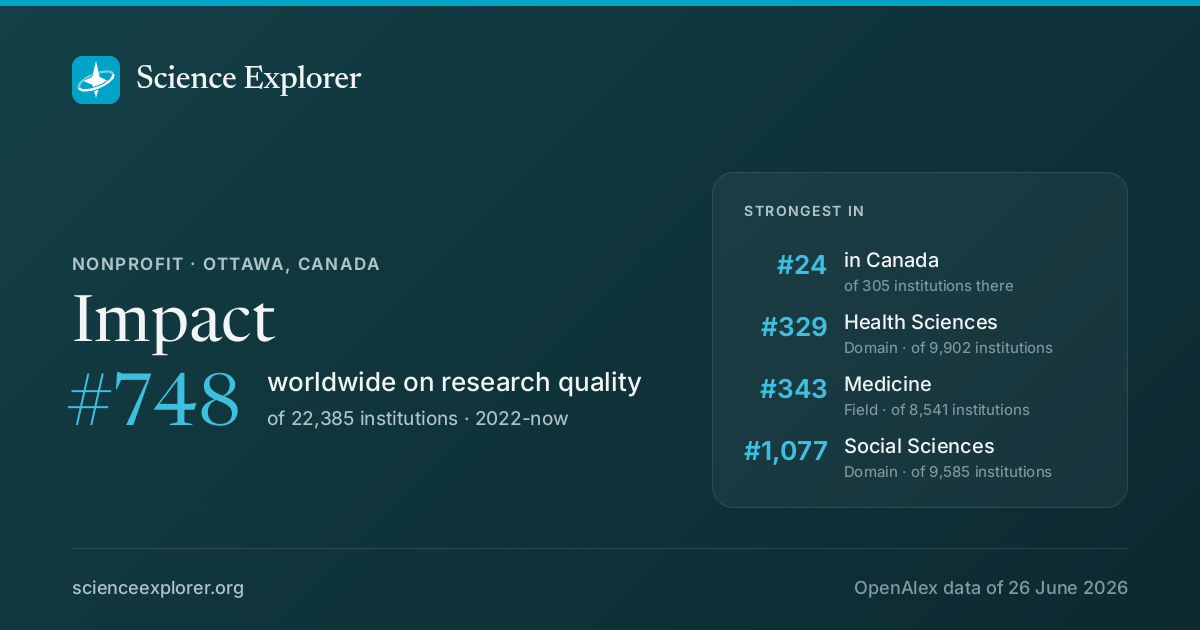
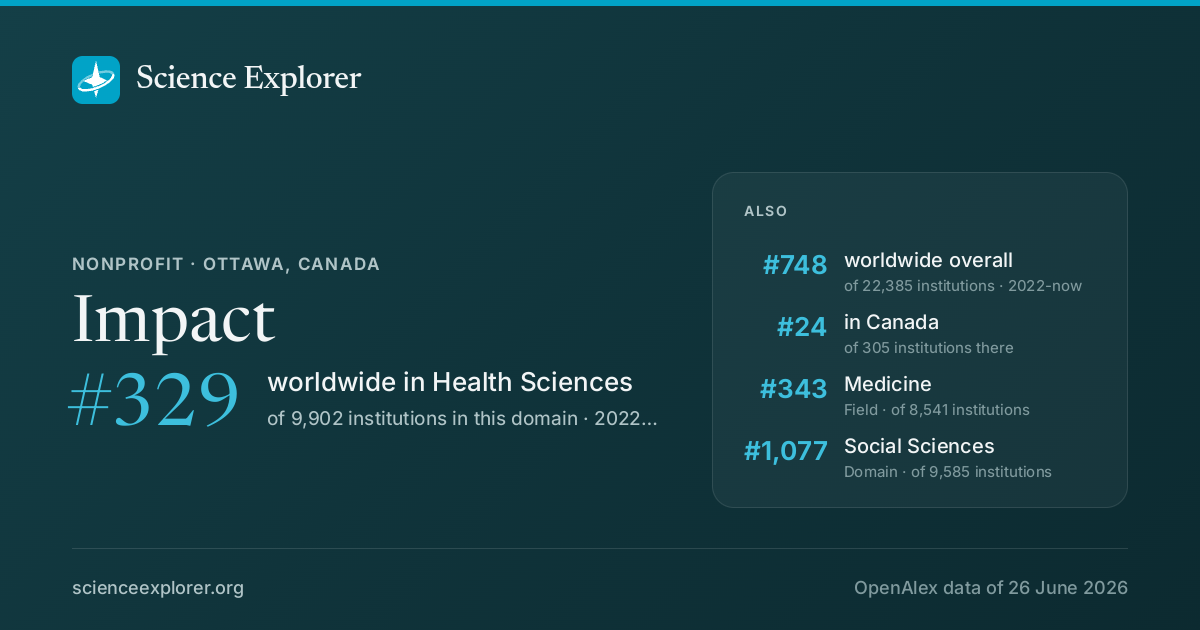
In research, Impact stands highest in Health Sciences (#329 of 9,902 worldwide), Medicine (#343 of 8,541 worldwide) and Social Sciences (#1,077 of 9,585 worldwide), 2022-now. Relative to its size it is most specialised in General Health Professions (General Health Professions is 4.7× its share of world research).
- World rank, 2022-now
- #748 of 22,385 · #1,016 all time
- Rank in Canada
- #24 of 305
- Research works
- 3.6k ▼ 4% vs 2018-21
- Citations
- 61k 17.2 per fractional work
- Top-10% rate
- 14.1% all institutions 10.0%
- vs its own fields
- 1.42× 1.00× is exactly expected
- Open access
- 65% world 40%
- International
- 51% world 18%
What is Impact known for in research?
The fields where it stands highest, 2022-now, ranked among every institution above the floor in each field.
| Field | World rank | Where that sits | Top-10% rate | Works | All time |
|---|---|---|---|---|---|
| Health SciencesDomain | #329 of 9,902 | 18.3% | 549 | #520 | |
| MedicineField | #343 of 8,541 | 19.2% | 434 | #531 | |
| Social SciencesDomain | #1,077 of 9,585 | 13.2% | 286 | #1114 | |
| Life SciencesDomain | #924 of 6,403 | 13.8% | 87 | #1392 | |
| Health ProfessionsField | #289 of 1,895 | 13.8% | 101 | #566 | |
| Social SciencesField | #1,062 of 5,988 | 10.5% | 126 | #1077 | |
| Physical SciencesDomain | #1,961 of 10,670 | 8.2% | 170 | #2456 | |
| General Health ProfessionsSubfield | #262 of 944 | 12.6% | 74 | #420 |
Each strip is that field's whole ranked pool, with the notch where Impact sits in it, in the colour of the band that rank falls in. The track under the rate is the rate itself: it carries no average mark, because the average differs by field (from about 6% in Dentistry to 21% in Economics).
Which of those standings moved
The same fields on both windows: where it stood over the whole record, and where it stands in 2022-now. The distance is the story, and it is the one thing the two rank columns above cannot show.
- Health Sciences#520 #329
- Medicine#531 #343
- Social Sciences#1,114 #1,077
- Life Sciences#1,392 #924
- Health Professions#566 #289
- Social Sciences#1,077 #1,062
- Physical Sciences#2,456 #1,961
- General Health Professions#420 #262
A dot further right is a better standing. Fields it was not ranked in over the whole record are left out.
Which fields of science does Impact work in?
In 2022-now, 46% of research at Impact is in Health Sciences, 28% in Social Sciences. Its largest fields are Medicine (36%), Social Sciences (12%), Health Professions (9%). It does 2.0× the world's share of Health Sciences.
Each ring splits the one inside it: the four domains of science, their fields, their subfields. Size is fractional works in 2022-now. Every slice is a page; the interactive view zooms down to single topics and colours each by how much more of it this institution does than the world.
Its 4 domains and 26 fields, with their numbers
- Health Sciences60146.2%
- Medicine47036.2%
- Health Professions1158.8%
- Nursing100.8%
- Dentistry50.4%
- Veterinary10.1%
- Social Sciences36628.2%
- Social Sciences15812.1%
- Economics, Econometrics and Finance584.5%
- Business, Management and Accounting534.1%
- Psychology524.0%
- Decision Sciences312.4%
- Arts and Humanities151.1%
- Physical Sciences21016.1%
- Environmental Science665.1%
- Engineering634.9%
- Computer Science362.8%
- Mathematics131.0%
- Earth and Planetary Sciences100.8%
- Materials Science80.6%
- Energy60.4%
- Chemistry50.4%
- Physics and Astronomy20.2%
- Chemical Engineering00.0%
- Life Sciences1229.4%
What does Impact specialise in?
Where its research is concentrated relative to its size: General Health Professions takes 4.7× the share of its output that it takes of world research.
- General Health ProfessionsSubfield · 83.8 works4.7×
Location quotient, a volume reading rather than an impact one. It surfaces small, lopsided specialities.
Field profile
Location quotient across every field it publishes in: outside the ring is more than an institution of this size would be expected to publish, inside it is less.
Rings at 0.5×, 1× and 2×. Widest outward: Health Professions, 3.4×. Every wedge is a field page.
All 26 fields, with their numbers
- Health Professions3.35×114 works
- Decision Sciences2.45×31 works
- Economics, Econometrics and Finance2.09×58 works
- Medicine1.88×470 works
- Nursing1.59×10 works
- Pharmacology, Toxicology and Pharmaceutics1.44×7 works
- Psychology1.32×52 works
- Business, Management and Accounting1.26×53 works
- Environmental Science1.03×66 works
- Social Sciences0.96×158 works
- Agricultural and Biological Sciences0.90×55 works
- Immunology and Microbiology0.89×12 works
- Mathematics0.84×13 works
- Dentistry0.73×5 works
- Biochemistry, Genetics and Molecular Biology0.54×37 works
- Neuroscience0.54×11 works
- Earth and Planetary Sciences0.51×10 works
- Veterinary0.47×1 works
- Energy0.46×6 works
- Arts and Humanities0.39×15 works
- Computer Science0.36×36 works
- Engineering0.32×63 works
- Chemistry0.26×5 works
- Materials Science0.17×8 works
- Physics and Astronomy0.07×2 works
- Chemical Engineering0.03×0 works
- Health Professions 3.4×
- Decision Sciences 2.5×
- Economics, Econometrics and Finance 2.1×
- Medicine 1.9×
- Nursing 1.6×
- Pharmacology, Toxicology and Pharmaceutics 1.4×
- Psychology 1.3×
- Business, Management and Accounting 1.3×
- Environmental Science 1.0×
- Social Sciences 1.0×
- Agricultural and Biological Sciences 0.9×
- Immunology and Microbiology 0.9×
- Mathematics 0.8×
- Dentistry 0.7×
- Biochemistry, Genetics and Molecular Biology 0.5×
- Neuroscience 0.5×
- Earth and Planetary Sciences 0.5×
- Veterinary 0.5×
- Energy 0.5×
- Arts and Humanities 0.4×
- Computer Science 0.4×
- Engineering 0.3×
- Chemistry 0.3×
- Materials Science 0.2×
- Physics and Astronomy 0.1×
- Chemical Engineering 0.0×
Who are the top researchers at Impact?
Ranked on the quality score, Victor L. Fulgoni, JONATHAN C. HELLER and Darly Dash lead among researchers whose main affiliation is Impact.
- 1
Victor L. Fulgoni
 Canada · #409,237 worldwide
15k citations · 496 works
- 2
JONATHAN C. HELLER
Canada · #1,071,842 worldwide
392 citations · 31 works
- 3
Darly Dash
Canada · #1,286,436 worldwide
589 citations · 47 works
- 4
Marla R. Orenstein
Canada · #1,375,882 worldwide
1.3k citations · 36 works
- 5
Karl E. Wiegers
Canada · #2,206,005 worldwide
2.2k citations · 53 works
- 6
M.J. Voskuilen
Canada · #2,544,061 worldwide
25 citations · 26 works
- 7
Ahmad Firas Khalid
Canada · #2,649,439 worldwide
189 citations · 30 works
- 8
Hamed Darabi
Canada · #2,679,051 worldwide
1.2k citations · 41 works
- 9
Tanja de Koeijer
Canada · #2,783,721 worldwide
72 citations · 24 works
- 10
Olivia Rauscher
Canada · #2,832,182 worldwide
0 citations · 55 works
Which keywords describe research at Impact?
By fractional works in 2022-now, weighted toward what it does more of than the world: Epidemiology, Quality of Life, Public Health, Sustainability, Sustainable Development, Quality Assessment, Mental Health and Inflammation.
- Investment
- Cost-effectiveness Analysis
- Sepsis
- Mortality Risk
- Evidence Synthesis
- Diagnostic Accuracy
- Evidence-Based Practice
- Aging
- Primary Care
- Clinical Trials
- Biodiversity
- Mortality
- Meta-Analysis
- Depression
- Artificial Intelligence
- Cardiovascular Disease
- Climate Change
- Inflammation
- Public Health
- Sustainability
- Epidemiology
- Quality of Life
- Sustainable Development
- Mental Health
- COVID-19
- Risk Factors
- Pandemic
- Qualitative Research
- Quality Assessment
- Management
- Obesity
- Digital Transformation
- Policy
- Publication Bias
- Research Methodology
- Elderly Patients
- PRISMA Statement
- Behavior Change
- Economic Evaluation
- Health Utility Measures
Size is fractional works in 2022-now in the topics tagged with each word; colour is the word's share of this institution's work against its share of the world's. The 40 words are chosen for being large and distinctive. Each links to the topic it comes from most.
All 40 words, with their numbers
- Epidemiology100▲ 1.94×123 topics
- Sustainability62▲ 1.94×79 topics
- Quality of Life53▲ 2.8×57 topics
- Public Health52▲ 2.7×52 topics
- Sustainable Development49▲ 2.4×42 topics
- Inflammation49▲ 1.77×68 topics
- Mental Health43▲ 2.3×38 topics
- Climate Change42▲ 1.20×86 topics
- COVID-1937▲ 2.2×29 topics
- Cardiovascular Disease32▲ 2.2×36 topics
- Risk Factors32▲ 2.2×35 topics
- Artificial Intelligence30▲ 1.61×24 topics
- Pandemic28▲ 2.2×12 topics
- Depression28▲ 2.4×24 topics
- Qualitative Research28▲ 2.5×23 topics
- Meta-Analysis26▲ 3.4×19 topics
- Quality Assessment26▲ 11×4 topics
- Mortality25▲ 3.3×13 topics
- Management24▲ 2.3×30 topics
- Biodiversity23▲ 2.4×19 topics
- Obesity23▲ 2.3×24 topics
- Clinical Trials23▲ 2.6×19 topics
- Digital Transformation22▲ 3.1×14 topics
- Primary Care21▲ 4.4×14 topics
- Policy21▲ 7.5×10 topics
- Aging20▲ 2.9×14 topics
- Publication Bias19▲ 31×3 topics
- Evidence-Based Practice18▲ 10×6 topics
- Research Methodology18▲ 22×4 topics
- Diagnostic Accuracy18▲ 19×3 topics
- Elderly Patients17▲ 7.8×4 topics
- Evidence Synthesis17▲ 50×1 topic
- PRISMA Statement17▲ 50×1 topic
- Mortality Risk16▲ 5.2×6 topics
- Behavior Change16▲ 8.2×4 topics
- Sepsis15▲ 6.3×7 topics
- Economic Evaluation13▲ 8.8×3 topics
- Cost-effectiveness Analysis13▲ 13×1 topic
- Health Utility Measures13▲ 13×1 topic
- Investment13▲ 8.5×3 topics
Which research topics does Impact publish most on?
By volume in 2022-now: Meta-analysis and systematic reviews, Health Systems, Economic Evaluations, Quality of Life, Health Policy Implementation Science and Community Development and Social Impact.
Area is fractional works; colour is the subfield each topic belongs to.
- 1 Meta-analysis and systematic reviews Statistics, Probability and Uncertainty 17 works
- 2 Health Systems, Economic Evaluations, Quality of Life Economics and Econometrics 13 works
- 3 Health Policy Implementation Science General Health Professions 12 works
- 4 Community Development and Social Impact Finance 9 works
- 5 Clinical practice guidelines implementation Public Health, Environmental and Occupational Health 8 works
- 6 Environmental Sustainability and Education Management, Monitoring, Policy and Law 7 works
- 7 COVID-19 and Mental Health Clinical Psychology 7 works
- 8 Economic and Social Issues Sociology and Political Science 7 works
- 9 Frailty in Older Adults Geriatrics and Gerontology 7 works
- 10 Bioeconomy and Sustainability Development General Agricultural and Biological Sciences 6 works
How open and international is its research?
Against the world's own shares: the tick on each track. Both are shares of its output, so they sit on one scale and can be read against each other as well as against the world.
World: 40% of research is openly available.
World: 18% is written across borders.
How has Impact's research output changed?
Output in 2022-2025 was 4% lower than in 2018-2021.
The same series as a ribbon: one cell per year, darker for more. The line above answers how much; this answers when.
Its share of all research
Growing output can still be a shrinking share: all of science grows. This is Impact as a percentage of every work published that year, 0.0052% in 2024.
Fractional works of Impact over all fractional works that year. How the balance of science has shifted.
How much of it reaches the world top 10%
Year by year, against all institutions in the same year.
Of each year's output, the share that reached the world's 10% most cited for its field and year. Peak 16.0% in 2022.
Other research institutions in Ottawa
- University of Ottawa
- Carleton University
- National Research Council Canada
- Agriculture and Agri-Food Canada
- Natural Resources Canada
- Environment and Climate Change Canada
- Atomic Energy (Canada)
- Fisheries and Oceans Canada
Compare Impact with
- vs
 Universidade da Coruña
- vs
 University of Salerno
- vs
 Southwest University of Science and Technology
- vs
 University of Tsukuba
- vs
 University of Colorado System
- vs United States Geological Survey
Share Impact's ranking


Research measures only: rankings here say nothing about teaching, admissions or student experience. Comparable institutions and collaboration partners have tabs of their own, above.
Discussion
Ask a question or share a note about Impact. Posts are plain text and can be reported.