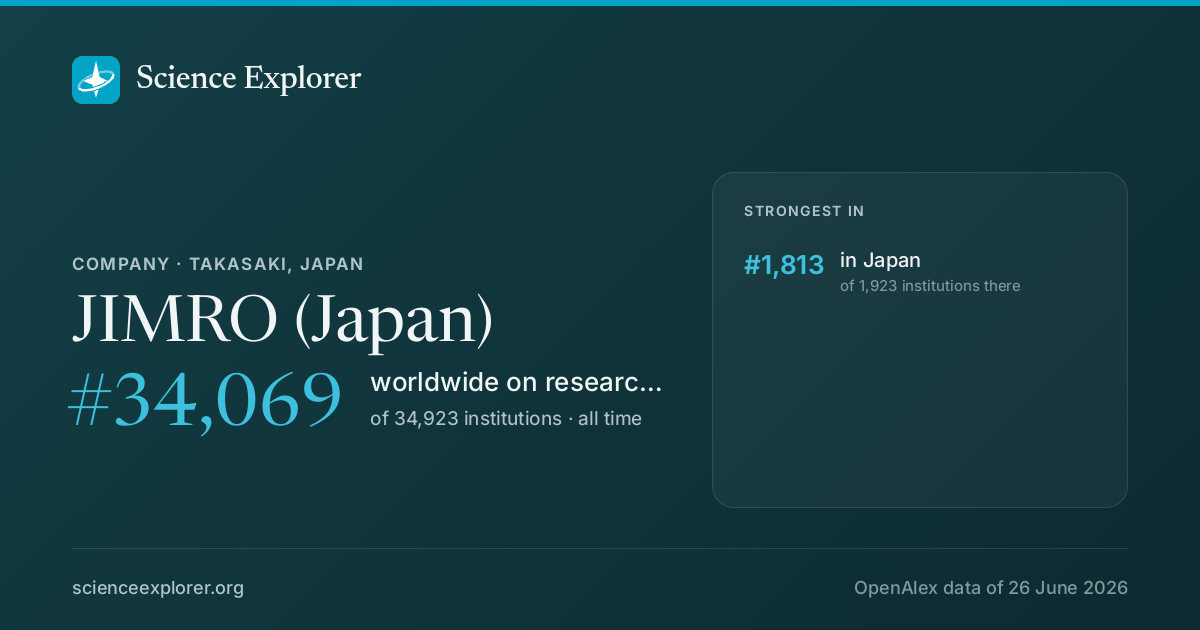
- World rank, all time
- #34,069 of 34,923
- Rank in Japan
- #1,813 of 1,923
- Research works
- 178 ▲ 31% vs 2018-21
- Citations
- 4.1k 23.2 per fractional work
- Top-10% rate
- 8.1% all institutions 10.0%
- vs its own fields
- 0.86× 1.00× is exactly expected
- Open access
- 38% world 40%
- International
- 13% world 18%
Which fields of science does JIMRO (Japan) work in?
In all years, 43% of research at JIMRO (Japan) is in Health Sciences, 38% in Life Sciences. Its largest fields are Medicine (40%), Biochemistry, Genetics and Molecular Biology (21%), Immunology and Microbiology (12%). It does 2.4× the world's share of Life Sciences.
Each ring splits the one inside it: the four domains of science, their fields, their subfields. Size is fractional works in all years. Every slice is a page; the interactive view zooms down to single topics and colours each by how much more of it this institution does than the world.
Its 4 domains and 23 fields, with their numbers
- Health Sciences7743.3%
- Medicine7240.3%
- Nursing52.6%
- Dentistry00.2%
- Health Professions00.2%
- Veterinary00.1%
- Life Sciences6838.5%
- Physical Sciences3117.5%
- Engineering126.7%
- Chemistry95.3%
- Environmental Science52.8%
- Materials Science21.3%
- Chemical Engineering10.8%
- Energy00.3%
- Computer Science00.2%
- Earth and Planetary Sciences00.1%
- Physics and Astronomy00.0%
- Social Sciences10.7%
- Psychology10.4%
- Decision Sciences00.1%
- Economics, Econometrics and Finance00.1%
- Social Sciences00.1%
Field profile
Location quotient across every field it publishes in: outside the ring is more than an institution of this size would be expected to publish, inside it is less.
Rings at 0.5×, 1× and 2×. Widest outward: Nursing, 7.9×. Every wedge is a field page.
All 8 fields, with their numbers
- Nursing7.91×0 works
- Immunology and Microbiology4.49×0 works
- Biochemistry, Genetics and Molecular Biology3.44×2 works
- Medicine2.43×4 works
- Agricultural and Biological Sciences1.59×1 works
- Environmental Science1.56×1 works
- Psychology0.95×0 works
- Engineering0.55×1 works
Who are the top researchers at JIMRO (Japan)?
Ranked on the quality score, Takamitsu Nakano, Abbi R. Saniabadi and Abby R. Saniabadi lead among researchers whose main affiliation is JIMRO (Japan).
- 1
Takamitsu Nakano
 Japan · #1,587,028 worldwide
5.3k citations · 80 works
- 2
Abbi R. Saniabadi
Japan · #3,222,535 worldwide
1.1k citations · 38 works
- 3
Abby R. Saniabadi
Japan · #3,689,721 worldwide
3k citations · 79 works
- 4
Izumi Takai
Japan · #4,104,686 worldwide
387 citations · 16 works
- 5
Nobuhito Kashiwagi
Japan · #4,279,939 worldwide
1.1k citations · 37 works
- 6
Toshimitsu SAITO
Japan · #4,280,149 worldwide
502 citations · 19 works
- 7
Katsuya Hiraishi
Japan · #4,761,826 worldwide
698 citations · 31 works
- 8
Yoshikazu Hasegawa
Japan · #5,378,201 worldwide
195 citations · 23 works
- 9
Masakazu Adachi
Japan · #5,710,748 worldwide
3.5k citations · 180 works
- 10
Mineo Kunihara
Japan · #6,301,132 worldwide
258 citations · 43 works
Which keywords describe research at JIMRO (Japan)?
By fractional works in all years, weighted toward what it does more of than the world: Inflammation, Oxidative Stress, Cancer, Atherosclerosis, Cholesterol, Diabetes, Statins and Insulin Resistance.
- Toll-like Receptors
- Extracellular Matrix
- Hemostasis
- Autoimmunity
- Cardiovascular Disease Prevention
- Thrombosis
- C-Reactive Protein
- Lifestyle Intervention
- Immunity
- Immune System
- Transcriptional Regulation
- Glucose Metabolism
- Glycosylation
- Reactive Oxygen Species
- Insulin Resistance
- Obesity
- Metabolic Syndrome
- Cholesterol
- Epidemiology
- Oxidative Stress
- Inflammation
- Cancer
- Atherosclerosis
- Diabetes
- Cardiovascular Disease
- Statins
- Antioxidant
- Angiogenesis
- Metabolism
- Immune Response
- Genetics
- Global Prevalence
- Innate Immunity
- Genetic Variants
- Cancer Progression
- Hypercholesterolemia
- Cholesterol-lowering
- Inflammatory Bowel Disease
- Cancer Immunotherapy
- Fatty Acid Synthase
Size is fractional works in all years in the topics tagged with each word; colour is the word's share of this institution's work against its share of the world's. The 40 words are chosen for being large and distinctive. Each links to the topic it comes from most.
All 40 words, with their numbers
- Inflammation23▲ 5.5×39 topics
- Oxidative Stress18▲ 5.5×34 topics
- Cancer14▲ 5.6×16 topics
- Epidemiology12▲ 1.64×36 topics
- Atherosclerosis11▲ 17×10 topics
- Cholesterol10▲ 30×5 topics
- Diabetes8▲ 9.2×9 topics
- Metabolic Syndrome8▲ 5.5×12 topics
- Cardiovascular Disease8▲ 4.2×16 topics
- Obesity8▲ 5.8×7 topics
- Statins8▲ 54×2 topics
- Insulin Resistance7▲ 8.9×7 topics
- Antioxidant7▲ 5.7×8 topics
- Reactive Oxygen Species7▲ 7.8×10 topics
- Angiogenesis6▲ 8.0×7 topics
- Glycosylation6▲ 14×2 topics
- Metabolism6▲ 4.9×11 topics
- Glucose Metabolism5▲ 29×2 topics
- Immune Response5▲ 4.8×13 topics
- Transcriptional Regulation5▲ 12×5 topics
- Genetics5▲ 3.8×6 topics
- Immune System5▲ 8.7×5 topics
- Global Prevalence5▲ 28×1 topic
- Immunity5▲ 7.9×6 topics
- Innate Immunity5▲ 7.6×7 topics
- Lifestyle Intervention5▲ 32×1 topic
- Genetic Variants5▲ 12×3 topics
- C-Reactive Protein4▲ 30×2 topics
- Cancer Progression4▲ 11×4 topics
- Thrombosis4▲ 11×4 topics
- Hypercholesterolemia4▲ 47×2 topics
- Cardiovascular Disease Prevention4▲ 29×1 topic
- Cholesterol-lowering4▲ 46×1 topic
- Autoimmunity4▲ 11×4 topics
- Inflammatory Bowel Disease4▲ 21×4 topics
- Hemostasis4▲ 14×4 topics
- Cancer Immunotherapy4▲ 15×3 topics
- Extracellular Matrix4▲ 8.4×3 topics
- Fatty Acid Synthase4▲ 52×1 topic
- Toll-like Receptors4▲ 12×4 topics
Which research topics does JIMRO (Japan) publish most on?
By volume in 2022-now: Cancer, Hypoxia, and Metabolism, Radioactive contamination and transfer, SARS-CoV-2 and COVID-19 Research and Viral Infections and Immunology Research.
Area is fractional works; colour is the subfield each topic belongs to.
- 1 Cancer, Hypoxia, and Metabolism Cancer Research 1 works
- 2 Radioactive contamination and transfer Global and Planetary Change 0 works
- 3 SARS-CoV-2 and COVID-19 Research Infectious Diseases 0 works
- 4 Viral Infections and Immunology Research Cardiology and Cardiovascular Medicine 0 works
- 5 Natural Antidiabetic Agents Studies Endocrinology, Diabetes and Metabolism 0 works
- 6 Ear and Head Tumors Oncology 0 works
- 7 Pancreatic function and diabetes Surgery 0 works
- 8 Cancer and Skin Lesions Dermatology 0 works
- 9 Shoulder and Clavicle Injuries Epidemiology 0 works
- 10 Nonmelanoma Skin Cancer Studies Epidemiology 0 works
How open and international is its research?
Against the world's own shares: the tick on each track. Both are shares of its output, so they sit on one scale and can be read against each other as well as against the world.
World: 40% of research is openly available.
World: 18% is written across borders.
How has JIMRO (Japan)'s research output changed?
Output in 2022-2025 was 31% higher than in 2018-2021.
The same series as a ribbon: one cell per year, darker for more. The line above answers how much; this answers when.
Its share of all research
Growing output can still be a shrinking share: all of science grows. This is JIMRO (Japan) as a percentage of every work published that year, 0.000027% in 2024.
Fractional works of JIMRO (Japan) over all fractional works that year. How the balance of science has shifted.
Other research institutions in Takasaki
- Noguchi Hospital
- Takasaki University of Health and Welfare
- Takasaki City University of Economics
- National Hospital Organization Takasaki Medical Center
- Gumma Paz College
- Kurosawa Hospital
- Ikuei Junior College
- University of Creation Art, Music & Social Work
Share JIMRO (Japan)'s ranking
Badges for a website1Each links back here and updates with every snapshot

Research measures only: rankings here say nothing about teaching, admissions or student experience. Comparable institutions and collaboration partners have tabs of their own, above.
Discussion
Ask a question or share a note about JIMRO (Japan). Keep it to the research: no personal attacks, advertising or links. Any reader can report a post, which collapses it for everyone until it is opened.