Mentor Technologies
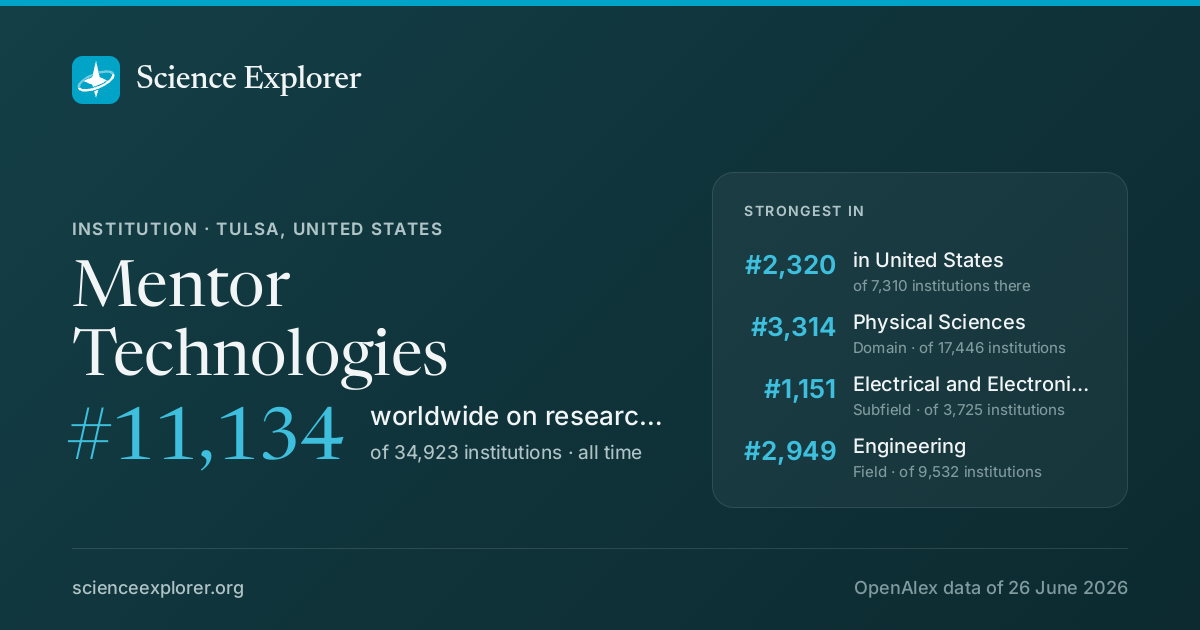
In research, Mentor Technologies stands highest in Physical Sciences (#3,314 of 17,446 worldwide), Electrical and Electronic Engineering (#1,151 of 3,725 worldwide) and Engineering (#2,949 of 9,532 worldwide), over all time.
- World rank, all time
- #11,134 of 34,923
- Rank in United States
- #2,320 of 7,310
- Research works
- 889 ▼ 96% vs 2018-21
- Citations
- 12k 13.0 per fractional work
- Top-10% rate
- 5.1% all institutions 10.0%
- vs its own fields
- 1.02× 1.00× is exactly expected
- Open access
- 3% world 40%
- International
- 34% world 18%
What is Mentor Technologies known for in research?
The fields where it stands highest, over all time, ranked among every institution above the floor in each field.
| Field | World rank | Where that sits | Top-10% rate | Works |
|---|---|---|---|---|
| Physical SciencesDomain | #3,314 of 17,446 | 9.8% | 864 | |
| Electrical and Electronic EngineeringSubfield | #1,151 of 3,725 | 8.8% | 389 | |
| EngineeringField | #2,949 of 9,532 | 8.9% | 558 | |
| Computer ScienceField | #2,992 of 6,336 | 12.2% | 249 | |
| Hardware and ArchitectureSubfield | #212 of 363 | 13.6% | 149 |
Each strip is that field's whole ranked pool, with the notch where Mentor Technologies sits in it, in the colour of the band that rank falls in. The track under the rate is the rate itself: it carries no average mark, because the average differs by field (from about 6% in Dentistry to 21% in Economics).
Which fields of science does Mentor Technologies work in?
In all years, 97% of research at Mentor Technologies is in Physical Sciences, 2% in Social Sciences. Its largest fields are Engineering (63%), Computer Science (28%), Materials Science (4%). It does 2.4× the world's share of Physical Sciences.
Each ring splits the one inside it: the four domains of science, their fields, their subfields. Size is fractional works in all years. Every slice is a page; the interactive view zooms down to single topics and colours each by how much more of it this institution does than the world.
Its 4 domains and 15 fields, with their numbers
- Physical Sciences86497.2%
- Engineering55862.8%
- Computer Science24928.0%
- Materials Science404.5%
- Physics and Astronomy101.2%
- Environmental Science30.4%
- Mathematics20.3%
- Earth and Planetary Sciences10.1%
- Social Sciences202.2%
- Life Sciences40.4%
- Health Sciences10.2%
- Medicine10.2%
Field profile
Location quotient across every field it publishes in: outside the ring is more than an institution of this size would be expected to publish, inside it is less.
Who are the top researchers at Mentor Technologies?
Ranked on the quality score, John E. Hershberger, Nagesh Tamarapalli and Janusz Rajski lead among researchers whose main affiliation is Mentor Technologies.
- 1
John E. Hershberger
 United States · #279,226 worldwide
8.1k citations · 217 works
- 2
Nagesh Tamarapalli
United States · #349,380 worldwide
1.7k citations · 24 works
- 3
Janusz Rajski
United States · #569,856 worldwide
2.8k citations · 72 works
- 4
Janusz Rajski
United States · #787,794 worldwide
6.7k citations · 251 works
- 5
Ismail S. K. Bustany
United States · #1,188,391 worldwide
715 citations · 40 works
- 6
Mark Kassab
United States · #1,320,389 worldwide
2.1k citations · 67 works
- 7
Yu Huang
United States · #1,509,458 worldwide
1.8k citations · 100 works
- 8
Xijiang Lin
United States · #1,579,330 worldwide
1.3k citations · 58 works
- 9
Chris Schuermyer
United States · #1,589,771 worldwide
559 citations · 19 works
- 10
Wu-Tung Cheng
United States · #1,654,650 worldwide
4.3k citations · 213 works
Which keywords describe research at Mentor Technologies?
By fractional works in all years, weighted toward what it does more of than the world: High-Resolution Patterning, Nanofabrication, Integrated Circuits, Electron Beam Lithography, Resolution Limits, Embedded Cores, Test Data Compression and Fault Localization.
- Fault Tolerance
- Electron Inelastic Mean Free Paths
- Interconnect
- Design for Manufacture
- System Integration
- High-Level Synthesis
- Thermal Management
- VLSI Circuits
- Energy Efficiency
- Semiconductor Manufacturing
- Texture Analysis
- ASIC
- Process Variation
- Deep Learning
- CMOS Technology
- Photon Emission Microscopy
- Fault Localization
- Embedded Cores
- Electron Beam Lithography
- Nanofabrication
- High-Resolution Patterning
- Integrated Circuits
- Resolution Limits
- Test Data Compression
- Failure Analysis
- FPGA
- Power Optimization
- Machine Vision
- CMOS Design
- Placement
- Fabric Defect Detection
- Low-Power
- Approximate Computing
- Nanoelectronics
- Embedded Systems
- Reconfigurable Computing
- Assembly Planning
- X-ray Photoelectron Spectroscopy
- Through-Silicon Via
- Scanning Electron Microscopy
Size is fractional works in all years in the topics tagged with each word; colour is the word's share of this institution's work against its share of the world's. The 40 words are chosen for being large and distinctive. Each links to the topic it comes from most.
All 40 words, with their numbers
- High-Resolution Patterning114▲ 326×2 topics
- Nanofabrication112▲ 142×2 topics
- Integrated Circuits108▲ 52×3 topics
- Electron Beam Lithography107▲ 593×1 topic
- Resolution Limits107▲ 593×1 topic
- Embedded Cores105▲ 411×1 topic
- Test Data Compression105▲ 411×1 topic
- Fault Localization103▲ 135×2 topics
- Failure Analysis103▲ 86×1 topic
- Photon Emission Microscopy103▲ 227×1 topic
- FPGA61▲ 83×2 topics
- CMOS Technology49▲ 46×4 topics
- Power Optimization47▲ 94×2 topics
- Deep Learning45▲ 2.4×22 topics
- Machine Vision42▲ 25×4 topics
- Process Variation41▲ 47×2 topics
- CMOS Design40▲ 147×2 topics
- ASIC39▲ 235×1 topic
- Placement39▲ 235×1 topic
- Texture Analysis35▲ 27×2 topics
- Fabric Defect Detection34▲ 89×1 topic
- Semiconductor Manufacturing34▲ 89×1 topic
- Low-Power34▲ 57×2 topics
- Energy Efficiency33▲ 4.7×8 topics
- Approximate Computing31▲ 109×1 topic
- VLSI Circuits31▲ 109×1 topic
- Nanoelectronics29▲ 21×2 topics
- Thermal Management24▲ 9.4×6 topics
- Embedded Systems24▲ 30×3 topics
- High-Level Synthesis22▲ 58×1 topic
- Reconfigurable Computing22▲ 52×1 topic
- System Integration21▲ 89×2 topics
- Assembly Planning21▲ 28×1 topic
- Design for Manufacture21▲ 28×1 topic
- X-ray Photoelectron Spectroscopy21▲ 17×2 topics
- Interconnect21▲ 98×1 topic
- Through-Silicon Via21▲ 98×1 topic
- Electron Inelastic Mean Free Paths20▲ 41×1 topic
- Scanning Electron Microscopy20▲ 38×1 topic
- Fault Tolerance20▲ 11×5 topics
Which research topics does Mentor Technologies publish most on?
By volume in 2022-now: Art, Technology, and Culture, History of Computing Technologies, Architecture and Computational Design and Advancements in Photolithography Techniques.
Area is fractional works; colour is the subfield each topic belongs to.
- 1 Art, Technology, and Culture Visual Arts and Performing Arts 0 works
- 2 History of Computing Technologies Computer Science Applications 0 works
- 3 Architecture and Computational Design Architecture 0 works
- 4 Advancements in Photolithography Techniques Electrical and Electronic Engineering 0 works
- 5 Advanced optical system design Biomedical Engineering 0 works
- 6 3D IC and TSV technologies Electrical and Electronic Engineering 0 works
- 7 Electromagnetic Scattering and Analysis Atomic and Molecular Physics, and Optics 0 works
- 8 Electromagnetic Simulation and Numerical Methods Electrical and Electronic Engineering 0 works
- 9 Matrix Theory and Algorithms Computational Theory and Mathematics 0 works
- 10 Ferroelectric and Negative Capacitance Devices Electrical and Electronic Engineering 0 works
How open and international is its research?
Against the world's own shares: the tick on each track. Both are shares of its output, so they sit on one scale and can be read against each other as well as against the world.
World: 40% of research is openly available.
World: 18% is written across borders.
How has Mentor Technologies's research output changed?
Output in 2022-2025 was 96% lower than in 2018-2021.
The same series as a ribbon: one cell per year, darker for more. The line above answers how much; this answers when.
Its share of all research
Growing output can still be a shrinking share: all of science grows. This is Mentor Technologies as a percentage of every work published that year, 0.000015% in 2022.
Fractional works of Mentor Technologies over all fractional works that year. How the balance of science has shifted.
How much of it reaches the world top 10%
Year by year, against all institutions in the same year.
Of each year's output, the share that reached the world's 10% most cited for its field and year. Peak 15.3% in 2006.
Other research institutions in Tulsa
- University of Tulsa
- Williams (United States)
- Oral Roberts University
- Society of Exploration Geophysicists
- Orthopedic Center
- Laureate Institute for Brain Research
- Tulsa Community College
- Saint Francis Hospital


Share Mentor Technologies's ranking
Badges for a website1Each links back here and updates with every snapshot

Research measures only: rankings here say nothing about teaching, admissions or student experience. Comparable institutions and collaboration partners have tabs of their own, above.
Discussion
Ask a question or share a note about Mentor Technologies. Posts are plain text and can be reported.