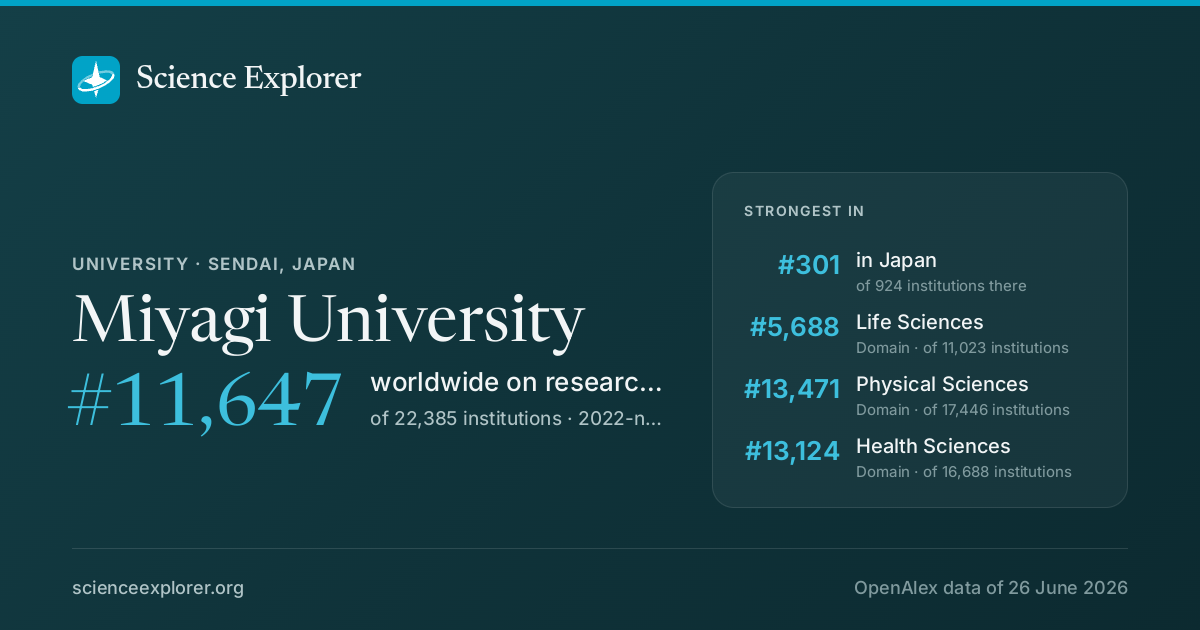
World rank, 2022-now #11,647
of 22,385 · #13,361 all time
Rank in Japan #301
of 924 Research works 653
▲ 28% vs 2018-21
Citations 7.6k 11.6 per fractional work
Top-10% rate 7.3%
all institutions 10.0%
vs its own fields 0.89×
1.00× is exactly expected
Open access 56%
world 40%
International 15%
world 18%
What is Miyagi University known for in research?
The fields where it stands highest, over all time, ranked among every institution above the floor in each field.
Which fields of science does Miyagi University work in?
In 2022-now, 27% of research at Miyagi University is in Physical Sciences , 26% in Health Sciences . Its largest fields are Medicine (20%), Agricultural and Biological Sciences (11%), Engineering (9%). It does 1.8× the world's share of Life Sciences .
Physical Sciences: 47 fractional works · 26.8% of its work Engineering: 16 fractional works · 9.2% of its work Electrical and Electronic Engineering: 4 fractional works · 2.1% of its work Biomedical Engineering: 3 fractional works · 2.0% of its work Civil and Structural Engineering: 2 fractional works · 0.9% of its work Mechanical Engineering: 2 fractional works · 0.9% of its work Ocean Engineering: 1 fractional works · 0.7% of its work Automotive Engineering: 1 fractional works · 0.7% of its work Building and Construction: 1 fractional works · 0.6% of its work Aerospace Engineering: 1 fractional works · 0.4% of its work Computational Mechanics: 1 fractional works · 0.3% of its work Mechanics of Materials: 0 fractional works · 0.2% of its work Smaller subfields together: 1 fractional works · 0.4% of its work Environmental Science: 7 fractional works · 4.2% of its work Ecology: 2 fractional works · 0.9% of its work Global and Planetary Change: 1 fractional works · 0.8% of its work Nature and Landscape Conservation: 1 fractional works · 0.7% of its work Management, Monitoring, Policy and Law: 1 fractional works · 0.4% of its work Health, Toxicology and Mutagenesis: 1 fractional works · 0.4% of its work Water Science and Technology: 1 fractional works · 0.3% of its work Pollution: 0 fractional works · 0.3% of its work Smaller subfields together: 1 fractional works · 0.5% of its work Computer Science: 5 fractional works · 3.0% of its work Information Systems: 1 fractional works · 0.8% of its work Human-Computer Interaction: 1 fractional works · 0.5% of its work Computer Vision and Pattern Recognition: 1 fractional works · 0.4% of its work Artificial Intelligence: 1 fractional works · 0.4% of its work Computer Networks and Communications: 1 fractional works · 0.3% of its work Signal Processing: 1 fractional works · 0.3% of its work Computer Science Applications: 0 fractional works · 0.2% of its work Smaller subfields together: 0 fractional works · 0.1% of its work Earth and Planetary Sciences: 5 fractional works · 3.0% of its work Oceanography: 2 fractional works · 1.4% of its work Geophysics: 1 fractional works · 0.7% of its work Atmospheric Science: 1 fractional works · 0.5% of its work Paleontology: 1 fractional works · 0.3% of its work Smaller subfields together: 0 fractional works · 0.1% of its work Materials Science: 5 fractional works · 2.7% of its work Materials Chemistry: 3 fractional works · 1.4% of its work Electronic, Optical and Magnetic Materials: 1 fractional works · 0.4% of its work Biomaterials: 1 fractional works · 0.3% of its work Smaller subfields together: 1 fractional works · 0.4% of its work Chemistry: 3 fractional works · 1.7% of its work Organic Chemistry: 1 fractional works · 0.8% of its work Analytical Chemistry: 1 fractional works · 0.5% of its work Inorganic Chemistry: 0 fractional works · 0.2% of its work Smaller subfields together: 0 fractional works · 0.2% of its work Energy: 2 fractional works · 1.1% of its work Renewable Energy, Sustainability and the Environment: 2 fractional works · 1.1% of its work Physics and Astronomy: 1 fractional works · 0.8% of its work Atomic and Molecular Physics, and Optics: 0 fractional works · 0.2% of its work Smaller subfields together: 1 fractional works · 0.6% of its work Mathematics: 1 fractional works · 0.7% of its work Chemical Engineering: 1 fractional works · 0.4% of its work Bioengineering: 0 fractional works · 0.2% of its work Smaller subfields together: 0 fractional works · 0.2% of its work Health Sciences: 45 fractional works · 25.8% of its work Medicine: 34 fractional works · 19.5% of its work Pulmonary and Respiratory Medicine: 4 fractional works · 2.0% of its work Public Health, Environmental and Occupational Health: 3 fractional works · 2.0% of its work Cardiology and Cardiovascular Medicine: 3 fractional works · 1.8% of its work Psychiatry and Mental health: 2 fractional works · 1.4% of its work Physiology: 2 fractional works · 1.2% of its work Infectious Diseases: 2 fractional works · 1.1% of its work Pediatrics, Perinatology and Child Health: 2 fractional works · 1.0% of its work Epidemiology: 2 fractional works · 1.0% of its work Pathology and Forensic Medicine: 1 fractional works · 0.7% of its work Radiology, Nuclear Medicine and Imaging: 1 fractional works · 0.7% of its work Immunology and Allergy: 1 fractional works · 0.7% of its work Oncology: 1 fractional works · 0.6% of its work Rheumatology: 1 fractional works · 0.5% of its work Neurology: 1 fractional works · 0.5% of its work Emergency Medicine: 1 fractional works · 0.4% of its work Surgery: 1 fractional works · 0.4% of its work Pharmacology: 1 fractional works · 0.4% of its work Endocrinology, Diabetes and Metabolism: 1 fractional works · 0.4% of its work Complementary and alternative medicine: 1 fractional works · 0.4% of its work Dermatology: 1 fractional works · 0.3% of its work Orthopedics and Sports Medicine: 1 fractional works · 0.3% of its work Biochemistry: 0 fractional works · 0.2% of its work Genetics: 0 fractional works · 0.2% of its work Smaller subfields together: 2 fractional works · 1.2% of its work Health Professions: 5 fractional works · 3.1% of its work General Health Professions: 3 fractional works · 1.7% of its work Radiological and Ultrasound Technology: 1 fractional works · 0.4% of its work Pharmacy: 0 fractional works · 0.2% of its work Emergency Medical Services: 0 fractional works · 0.2% of its work Smaller subfields together: 1 fractional works · 0.5% of its work Nursing: 5 fractional works · 2.7% of its work Nutrition and Dietetics: 4 fractional works · 2.1% of its work Leadership and Management: 1 fractional works · 0.7% of its work Dentistry: 0 fractional works · 0.2% of its work Veterinary: 0 fractional works · 0.2% of its work Small Animals: 0 fractional works · 0.2% of its work Life Sciences: 44 fractional works · 24.9% of its work Agricultural and Biological Sciences: 20 fractional works · 11.5% of its work Food Science: 9 fractional works · 5.0% of its work Plant Science: 5 fractional works · 2.8% of its work Ecology, Evolution, Behavior and Systematics: 2 fractional works · 1.1% of its work Animal Science and Zoology: 2 fractional works · 0.9% of its work Soil Science: 1 fractional works · 0.7% of its work Insect Science: 1 fractional works · 0.3% of its work Agronomy and Crop Science: 1 fractional works · 0.3% of its work General Agricultural and Biological Sciences: 0 fractional works · 0.2% of its work Aquatic Science: 0 fractional works · 0.2% of its work Biochemistry, Genetics and Molecular Biology: 15 fractional works · 8.5% of its work Molecular Biology: 10 fractional works · 5.4% of its work Genetics: 1 fractional works · 0.8% of its work Biotechnology: 1 fractional works · 0.6% of its work Biochemistry: 1 fractional works · 0.6% of its work Clinical Biochemistry: 1 fractional works · 0.4% of its work Cell Biology: 1 fractional works · 0.3% of its work Endocrinology: 0 fractional works · 0.3% of its work Smaller subfields together: 0 fractional works · 0.1% of its work Immunology and Microbiology: 4 fractional works · 2.3% of its work Immunology: 3 fractional works · 1.8% of its work Microbiology: 1 fractional works · 0.3% of its work Smaller subfields together: 1 fractional works · 0.3% of its work Neuroscience: 3 fractional works · 1.9% of its work Cognitive Neuroscience: 1 fractional works · 0.6% of its work Sensory Systems: 1 fractional works · 0.5% of its work Cellular and Molecular Neuroscience: 1 fractional works · 0.4% of its work Biological Psychiatry: 0 fractional works · 0.2% of its work Smaller subfields together: 0 fractional works · 0.2% of its work Pharmacology, Toxicology and Pharmaceutics: 1 fractional works · 0.6% of its work Pharmacology: 1 fractional works · 0.5% of its work Smaller subfields together: 0 fractional works · 0.0% of its work Social Sciences: 40 fractional works · 22.5% of its work Social Sciences: 15 fractional works · 8.4% of its work Sociology and Political Science: 6 fractional works · 3.6% of its work Transportation: 3 fractional works · 1.9% of its work Education: 2 fractional works · 1.1% of its work Communication: 1 fractional works · 0.6% of its work Linguistics and Language: 1 fractional works · 0.5% of its work Cultural Studies: 0 fractional works · 0.3% of its work Smaller subfields together: 1 fractional works · 0.4% of its work Psychology: 9 fractional works · 5.3% of its work Clinical Psychology: 3 fractional works · 1.7% of its work Social Psychology: 3 fractional works · 1.7% of its work Experimental and Cognitive Psychology: 3 fractional works · 1.4% of its work Developmental and Educational Psychology: 1 fractional works · 0.4% of its work Smaller subfields together: 0 fractional works · 0.1% of its work Business, Management and Accounting: 7 fractional works · 4.1% of its work Marketing: 3 fractional works · 1.4% of its work Strategy and Management: 2 fractional works · 1.2% of its work Management of Technology and Innovation: 2 fractional works · 1.2% of its work Organizational Behavior and Human Resource Management: 0 fractional works · 0.2% of its work Smaller subfields together: 0 fractional works · 0.1% of its work Arts and Humanities: 4 fractional works · 2.5% of its work Language and Linguistics: 2 fractional works · 1.1% of its work Literature and Literary Theory: 1 fractional works · 0.8% of its work Smaller subfields together: 1 fractional works · 0.6% of its work Decision Sciences: 2 fractional works · 1.2% of its work Management Science and Operations Research: 1 fractional works · 0.6% of its work Information Systems and Management: 1 fractional works · 0.6% of its work Economics, Econometrics and Finance: 2 fractional works · 1.0% of its work Economics and Econometrics: 2 fractional works · 0.9% of its work Smaller subfields together: 0 fractional works · 0.2% of its work Physical Sciences Engineering Environme… Computer… Earth and… Materials… Chemistry Health Sciences Medicine Health Pr… Nursing Life Sciences Agricultural and Biological Sciences Biochemistry Immunolog… Neuroscie… Social Sciences Social Sciences Psychology Business Arts and… ALL ITS WORK Miyagi University 176 fractional works, 2022-now 25% 27% 26% 22%
Each ring splits the one inside it: the four domains of science, their fields, their subfields. Size is fractional works in 2022-now. Every slice is a page; the interactive view zooms down to single topics and colours each by how much more of it this institution does than the world.
Its 4 domains and 26 fields, with their numbers 16 9.2% 7 4.2% 5 3.0% 5 3.0% 5 2.7% 3 1.7% 2 1.1% 1 0.8% 1 0.7% 1 0.4% 34 19.5% 5 3.1% 5 2.7% 0 0.2% 0 0.2% 20 11.5% 15 8.5% 4 2.3% 3 1.9% 1 0.6% 15 8.4% 9 5.3% 7 4.1% 4 2.5% 2 1.2% 2 1.0% All of science, and how each field's share has moved since 1950: the Science domain explorer
Field profile
Location quotient across every field it publishes in: outside the ring is more than an institution of this size would be expected to publish, inside it is less.
Agricultural and Biological Sciences: 2.42× its world share, 20 works Agricultural and Bio… Biochemistry, Genetics and Molecular Biology: 1.60× its world share, 15 works Biochemistry, Geneti… Immunology and Microbiology: 2.33× its world share, 4 works Immunology and Micro… Neuroscience: 1.20× its world share, 3 works Neuroscience Pharmacology, Toxicology and Pharmaceutics: 1.62× its world share, 1 works Pharmacology, Toxico… Chemical Engineering: 1.22× its world share, 1 works Chemical Engineering Chemistry: 1.11× its world share, 3 works Chemistry Computer Science: 0.39× its world share, 5 works Computer Science Earth and Planetary Sciences: 1.93× its world share, 5 works Earth and Planetary … Energy: 1.20× its world share, 2 works Energy Engineering: 0.61× its world share, 16 works Engineering Environmental Science: 0.84× its world share, 7 works Environmental Science Materials Science: 0.76× its world share, 5 works Materials Science Mathematics: 0.56× its world share, 1 works Mathematics Physics and Astronomy: 0.36× its world share, 1 works Physics and Astronomy Dentistry: 0.50× its world share, 0 works Dentistry Health Professions: 1.16× its world share, 5 works Health Professions Medicine: 1.02× its world share, 34 works Medicine Nursing: 5.59× its world share, 5 works Nursing Veterinary: 1.60× its world share, 0 works Veterinary Arts and Humanities: 0.86× its world share, 4 works Arts and Humanities Business, Management and Accounting: 1.27× its world share, 7 works Business, Management… Decision Sciences: 1.26× its world share, 2 works Decision Sciences Economics, Econometrics and Finance: 0.48× its world share, 2 works Economics, Econometr… Psychology: 1.73× its world share, 9 works Psychology Social Sciences: 0.66× its world share, 15 works Social Sciences 1× world share
Rings at 0.5×, 1× and 2×. Widest outward: Nursing , 5.6×. Every wedge is a field page.
All 26 fields, with their numbers Nursing 5.59× 5 works Agricultural and Biological Sciences 2.42× 20 works Immunology and Microbiology 2.33× 4 works Earth and Planetary Sciences 1.93× 5 works Psychology 1.73× 9 works Pharmacology, Toxicology and Pharmaceutics 1.62× 1 works Biochemistry, Genetics and Molecular Biology 1.60× 15 works Veterinary 1.60× 0 works Business, Management and Accounting 1.27× 7 works Decision Sciences 1.26× 2 works Chemical Engineering 1.22× 1 works Neuroscience 1.20× 3 works Energy 1.20× 2 works Health Professions 1.16× 5 works Chemistry 1.11× 3 works Medicine 1.02× 34 works Arts and Humanities 0.86× 4 works Environmental Science 0.84× 7 works Materials Science 0.76× 5 works Social Sciences 0.66× 15 works Engineering 0.61× 16 works Mathematics 0.56× 1 works Dentistry 0.50× 0 works Economics, Econometrics and Finance 0.48× 2 works Computer Science 0.39× 5 works Physics and Astronomy 0.36× 1 works
Who are the top researchers at Miyagi University?
Ranked on the quality score, Kosuke Motoki , Matthew Nall and Toshikazu Komoda lead among researchers whose main affiliation is Miyagi University.
1
Kosuke Motoki
Japan · #566,484 worldwide2.6k citations · 126 works
2
Matthew Nall
Japan · #1,835,251 worldwide119 citations · 24 works
3
Toshikazu Komoda
Japan · #2,806,101 worldwide661 citations · 23 works
4
Kei Kudo
Japan · #3,157,779 worldwide570 citations · 21 works
5
Yoshihito Suda
Japan · #3,383,904 worldwide2.2k citations · 109 works
6
Mariko Otsuka
Japan · #3,620,227 worldwide85 citations · 33 works
7
Yu Ishida
Japan · #3,760,109 worldwide276 citations · 34 works
8
Mitsunori Yanagisawa
Japan · #3,841,000 worldwide386 citations · 25 works
9
Keiko Tokunaga
Japan · #3,858,696 worldwide337 citations · 16 works
10
Kiyotaka Suda
Japan · #4,031,926 worldwide23 citations · 17 works
All ranked researchers at Miyagi University
What are the most cited papers from Miyagi University?
The most cited paper from Miyagi University is "Guidelines for the use and interpretation of assays for monitoring autophagy (3rd edition)" (Daniel J. Klionsky et al., 2016), with 6,023 citations. Next come "Prospects for observing and localizing gravitational-wave transients with Advanced LIGO, Advanced Virgo and KAGRA" (1,175) and "Touchdown of the Hayabusa Spacecraft at the Muses Sea on Itokawa" (429).
Most cited papers
# Paper Released Citations 1
Guidelines for the use and interpretation of assays for monitoring autophagy (3rd edition)
Daniel J. Klionsky et al. · Autophagy
Open access 2,467 authors 2 Jan 2016
6,023 2
Prospects for observing and localizing gravitational-wave transients with Advanced LIGO, Advanced Virgo and KAGRA
B. P. Abbott et al. · Living Reviews in Relativity
Open access 1,100 authors 26 Apr 2018
1,175 3
Touchdown of the Hayabusa Spacecraft at the Muses Sea on Itokawa
Hajime Yano, Takuji Kubota, Hideaki Miyamoto et al. · Science
Jun 2006
429 4
Dysfunction of fibroblasts of extrarenal origin underlies renal fibrosis and renal anemia in mice
Nariaki Asada, Masayuki Takase, Jin Nakamura et al. · Journal of Clinical Investigation
Open access 12 Sep 2011
347 5
Vitamin E: Regulatory Redox Interactions
Taiki Miyazawa, Gregor Carpentero Burdeos, Mayuko Itaya et al. · IUBMB Life
Open access 25 Jan 2019
315
All 60 most cited papers, with filters and sorting
Which keywords describe research at Miyagi University?
By fractional works in 2022-now, weighted toward what it does more of than the world: Inflammation, Probiotics, Community Resilience, Disaster Recovery, Urban Reconstruction, Immune Responses, Gut Microbiota and Consumer Perception.
Size is fractional works in 2022-now in the topics tagged with each word; colour is the word's share of this institution's work against its share of the world's. The 40 words are chosen for being large and distinctive. Each links to the topic it comes from most.
All 40 words, with their numbers Epidemiology 7 ◆ 1.05× 43 topics Inflammation 7 ▲ 1.94× 22 topics Sustainability 6 ▲ 1.38× 14 topics Climate Change 5 ◆ 1.03× 28 topics Quality of Life 4 ▲ 1.71× 18 topics Oxidative Stress 4 ▲ 1.41× 18 topics COVID-19 4 ▲ 1.66× 12 topics Antioxidant 3 ▲ 2.7× 11 topics Consumer Behavior 3 ▲ 3.0× 6 topics Heart Failure 3 ▲ 4.2× 9 topics Probiotics 3 ▲ 7.8× 5 topics Community Resilience 3 ▲ 10× 2 topics Gut Microbiota 3 ▲ 5.2× 7 topics Antioxidant Activity 3 ▲ 2.6× 11 topics Clinical Trials 3 ▲ 2.4× 9 topics Disaster Recovery 3 ▲ 198× 1 topic Social Capital 3 ▲ 3.1× 8 topics Urban Reconstruction 3 ▲ 198× 1 topic Metabolism 3 ▲ 3.0× 10 topics Consumer Perception 3 ▲ 6.7× 6 topics Immune Responses 3 ▲ 11× 2 topics Prevalence 3 ▲ 3.8× 7 topics Self-Efficacy 3 ▲ 5.9× 5 topics Microbiota 3 ▲ 6.7× 4 topics Immune Modulation 2 ▲ 13× 2 topics Ion Channels 2 ▲ 12× 4 topics Cancer Prevention 2 ▲ 4.8× 7 topics Prebiotics 2 ▲ 13× 2 topics Ecosystem Resilience 2 ▲ 7.6× 3 topics Lipid Oxidation 2 ▲ 12× 2 topics Ocean Acidification 2 ▲ 16× 3 topics Gut Health 2 ▲ 19× 1 topic Lactic Acid Bacteria 2 ▲ 19× 1 topic Benthic Communities 2 ▲ 18× 2 topics Marine Biodiversity 2 ▲ 18× 2 topics Polyphenols 2 ▲ 6.2× 4 topics Stress Management 2 ▲ 10× 3 topics Kelp Forests 2 ▲ 33× 1 topic Seagrasses 2 ▲ 33× 1 topic Neuronal Function 2 ▲ 26× 2 topics
How open and international is its research?
Against the world's own shares: the tick on each track. Both are shares of its output, so they
sit on one scale and can be read against each other as well as against the world.
56% 44%
56.4% 43.6%
World: 40% of research is openly available.
15% 85%
14.8% 85.2%
World: 18% is written across borders.
How has Miyagi University's research output changed?
Output in 2022-2025 was 28% higher than in 2018-2021.
still counting 1990 2000 2010 2020
The same series as a ribbon: one cell per year, darker for more. The line above answers how much ; this answers when .
Its share of all research
still counting 0.00050% 0.0010% 0.0015% Miyagi University 0.00067% in 2025 1980 1990 2000 2010 2020 Fractional works of Miyagi University over all fractional works that year. How the balance of science has shifted .
How much of it reaches the world top 10%
still counting 10% 20% all institutions 10.0% in 2025 Miyagi University 7.2% in 2025 2010 2020 Of each year's output, the share that reached the world's 10% most cited for its field and year. Peak 15.6% in 2013.
Share Miyagi University's ranking
A card with Miyagi University's standing and the fields it leads in, for a post or a slide. A link to this page previews as the same card.
Badges for a website 1 Each links back here and updates with every snapshot
 Japan · #566,484 worldwide
2.6k citations · 126 works