Science Explorer Back to mapMap
Discussion
Company · Purchase · United States

Pepsi (United States)

World rank, all time
#16,062
of 34,923
Rank in United States
#3,319
of 7,310
Research works
232
▼ 38% vs 2018-21
Citations
8.7k
37.5 per fractional work
Top-10% rate
10.6%
all institutions 10.0%
vs its own fields
1.12×
1.00× is exactly expected
Open access
34%
world 40%
International
36%
world 18%

Which fields of science does Pepsi (United States) work in?

In 2022-now, 38% of research at Pepsi (United States) is in Health Sciences, 31% in Life Sciences. Its largest fields are Medicine (31%), Agricultural and Biological Sciences (24%), Environmental Science (6%). It does 1.9× the world's share of Life Sciences.

Health Sciences: 15 fractional works · 38.2% of its workMedicine: 12 fractional works · 30.6% of its workPhysiology: 4 fractional works · 9.8% of its workPublic Health, Environmental and Occupational Health: 3 fractional works · 7.8% of its workRehabilitation: 1 fractional works · 2.3% of its workOrthopedics and Sports Medicine: 1 fractional works · 1.7% of its workGastroenterology: 0 fractional works · 1.3% of its workInfectious Diseases: 0 fractional works · 1.1% of its workPathology and Forensic Medicine: 0 fractional works · 1.1% of its workEndocrinology, Diabetes and Metabolism: 0 fractional works · 1.1% of its workRadiology, Nuclear Medicine and Imaging: 0 fractional works · 0.9% of its workPulmonary and Respiratory Medicine: 0 fractional works · 0.8% of its workBiochemistry: 0 fractional works · 0.7% of its workComplementary and alternative medicine: 0 fractional works · 0.7% of its workPharmacology: 0 fractional works · 0.5% of its workRheumatology: 0 fractional works · 0.4% of its workDermatology: 0 fractional works · 0.3% of its workNursing: 2 fractional works · 6.1% of its workNutrition and Dietetics: 2 fractional works · 6.1% of its workHealth Professions: 1 fractional works · 1.6% of its workGeneral Health Professions: 0 fractional works · 1.0% of its workPharmacy: 0 fractional works · 0.4% of its workSmaller subfields together: 0 fractional works · 0.2% of its workLife Sciences: 12 fractional works · 31.4% of its workAgricultural and Biological Sciences: 10 fractional works · 23.9% of its workFood Science: 6 fractional works · 13.9% of its workPlant Science: 3 fractional works · 8.1% of its workAnimal Science and Zoology: 0 fractional works · 1.0% of its workGeneral Agricultural and Biological Sciences: 0 fractional works · 0.5% of its workSoil Science: 0 fractional works · 0.3% of its workEcology, Evolution, Behavior and Systematics: 0 fractional works · 0.2% of its workBiochemistry, Genetics and Molecular Biology: 3 fractional works · 6.3% of its workMolecular Biology: 1 fractional works · 1.7% of its workGenetics: 1 fractional works · 1.7% of its workBiotechnology: 0 fractional works · 1.3% of its workCancer Research: 0 fractional works · 0.8% of its workCell Biology: 0 fractional works · 0.4% of its workMolecular Medicine: 0 fractional works · 0.3% of its workBiophysics: 0 fractional works · 0.2% of its workNeuroscience: 0 fractional works · 1.2% of its workBiological Psychiatry: 0 fractional works · 0.4% of its workCellular and Molecular Neuroscience: 0 fractional works · 0.3% of its workSmaller subfields together: 0 fractional works · 0.5% of its workPhysical Sciences: 9 fractional works · 22.3% of its workEnvironmental Science: 3 fractional works · 6.5% of its workHealth, Toxicology and Mutagenesis: 2 fractional works · 4.1% of its workIndustrial and Manufacturing Engineering: 0 fractional works · 0.9% of its workEcology: 0 fractional works · 0.5% of its workPollution: 0 fractional works · 0.5% of its workWater Science and Technology: 0 fractional works · 0.5% of its workSmaller subfields together: 0 fractional works · 0.1% of its workEngineering: 2 fractional works · 4.1% of its workBiomedical Engineering: 1 fractional works · 3.5% of its workMechanical Engineering: 0 fractional works · 0.3% of its workOcean Engineering: 0 fractional works · 0.3% of its workSmaller subfields together: 0 fractional works · 0.1% of its workChemistry: 2 fractional works · 4.1% of its workOrganic Chemistry: 1 fractional works · 2.0% of its workAnalytical Chemistry: 0 fractional works · 1.0% of its workSpectroscopy: 0 fractional works · 0.8% of its workSmaller subfields together: 0 fractional works · 0.2% of its workMaterials Science: 1 fractional works · 3.2% of its workPolymers and Plastics: 0 fractional works · 1.2% of its workMaterials Chemistry: 0 fractional works · 1.1% of its workBiomaterials: 0 fractional works · 0.8% of its workSmaller subfields together: 0 fractional works · 0.0% of its workComputer Science: 1 fractional works · 1.7% of its workArtificial Intelligence: 0 fractional works · 0.8% of its workInformation Systems: 0 fractional works · 0.4% of its workHuman-Computer Interaction: 0 fractional works · 0.3% of its workComputer Vision and Pattern Recognition: 0 fractional works · 0.2% of its workChemical Engineering: 0 fractional works · 1.2% of its workFluid Flow and Transfer Processes: 0 fractional works · 0.8% of its workFiltration and Separation: 0 fractional works · 0.3% of its workSmaller subfields together: 0 fractional works · 0.1% of its workPhysics and Astronomy: 0 fractional works · 0.8% of its workStatistical and Nonlinear Physics: 0 fractional works · 0.8% of its workEarth and Planetary Sciences: 0 fractional works · 0.4% of its workGeology: 0 fractional works · 0.4% of its workEnergy: 0 fractional works · 0.3% of its workRenewable Energy, Sustainability and the Environment: 0 fractional works · 0.3% of its workSocial Sciences: 3 fractional works · 8.1% of its workPsychology: 1 fractional works · 3.2% of its workExperimental and Cognitive Psychology: 0 fractional works · 0.9% of its workApplied Psychology: 0 fractional works · 0.8% of its workSocial Psychology: 0 fractional works · 0.8% of its workClinical Psychology: 0 fractional works · 0.4% of its workGeneral Psychology: 0 fractional works · 0.3% of its workSmaller subfields together: 0 fractional works · 0.0% of its workSocial Sciences: 1 fractional works · 2.1% of its workCommunication: 0 fractional works · 1.3% of its workCultural Studies: 0 fractional works · 0.7% of its workSmaller subfields together: 0 fractional works · 0.2% of its workArts and Humanities: 1 fractional works · 1.4% of its workLiterature and Literary Theory: 0 fractional works · 0.6% of its workArcheology: 0 fractional works · 0.4% of its workConservation: 0 fractional works · 0.4% of its workBusiness, Management and Accounting: 0 fractional works · 0.6% of its workOrganizational Behavior and Human Resource Management: 0 fractional works · 0.3% of its workSmaller subfields together: 0 fractional works · 0.3% of its workDecision Sciences: 0 fractional works · 0.6% of its workManagement Science and Operations Research: 0 fractional works · 0.3% of its workStatistics, Probability and Uncertainty: 0 fractional works · 0.3% of its workEconomics, Econometrics and Finance: 0 fractional works · 0.2% of its workEconomics and Econometrics: 0 fractional works · 0.2% of its workALL ITS WORKPepsi (UnitedStates)40fractional works, 2022-now
Life Sciences31%Physical Sciences22%Health Sciences38%Social Sciences8%

Each ring splits the one inside it: the four domains of science, their fields, their subfields. Size is fractional works in 2022-now. Every slice is a page; the interactive view zooms down to single topics and colours each by how much more of it this institution does than the world.

Its 4 domains and 21 fields, with their numbers
    1. Medicine1230.6%
    2. Nursing26.1%
    3. Health Professions11.6%
    1. Agricultural and Biological Sciences1023.9%
    2. Biochemistry, Genetics and Molecular Biology36.3%
    3. Neuroscience01.2%
    1. Environmental Science36.5%
    2. Engineering24.1%
    3. Chemistry24.1%
    4. Materials Science13.2%
    5. Computer Science11.7%
    6. Chemical Engineering01.2%
    7. Physics and Astronomy00.8%
    8. Earth and Planetary Sciences00.4%
    9. Energy00.3%
    1. Psychology13.2%
    2. Social Sciences12.1%
    3. Arts and Humanities11.4%
    4. Business, Management and Accounting00.6%
    5. Decision Sciences00.6%
    6. Economics, Econometrics and Finance00.2%
All of science, and how each field's share has moved since 1950: the Science domain explorer

Field profile

Location quotient across every field it publishes in: outside the ring is more than an institution of this size would be expected to publish, inside it is less.

Agricultural and Biological Sciences: 5.03× its world share, 10 worksAgricultural and Bio…Biochemistry, Genetics and Molecular Biology: 1.19× its world share, 2 worksBiochemistry, Geneti…Neuroscience: 0.70× its world share, 0 worksNeuroscienceChemical Engineering: 3.37× its world share, 0 worksChemical EngineeringChemistry: 2.59× its world share, 2 worksChemistryComputer Science: 0.22× its world share, 1 worksComputer ScienceEarth and Planetary Sciences: 0.27× its world share, 0 worksEarth and Planetary …Energy: 0.30× its world share, 0 worksEnergyEngineering: 0.27× its world share, 2 worksEngineeringEnvironmental Science: 1.30× its world share, 3 worksEnvironmental ScienceMaterials Science: 0.91× its world share, 1 worksMaterials SciencePhysics and Astronomy: 0.38× its world share, 0 worksPhysics and AstronomyHealth Professions: 0.61× its world share, 1 worksHealth ProfessionsMedicine: 1.59× its world share, 12 worksMedicineNursing: 12.40× its world share, 2 worksNursingArts and Humanities: 0.48× its world share, 1 worksArts and HumanitiesBusiness, Management and Accounting: 0.18× its world share, 0 worksBusiness, Management…Decision Sciences: 0.58× its world share, 0 worksDecision SciencesEconomics, Econometrics and Finance: 0.10× its world share, 0 worksEconomics, Econometr…Psychology: 1.06× its world share, 1 worksPsychologySocial Sciences: 0.17× its world share, 1 worksSocial Sciences1×world share
more than its size predictsabout as predictedless

Rings at 0.5×, 1× and 2×. Widest outward: Nursing, 12.4×. Every wedge is a field page.

All 21 fields, with their numbers
  1. Nursing12.40×2 works
  2. Agricultural and Biological Sciences5.03×10 works
  3. Chemical Engineering3.37×0 works
  4. Chemistry2.59×2 works
  5. Medicine1.59×12 works
  6. Environmental Science1.30×3 works
  7. Biochemistry, Genetics and Molecular Biology1.19×2 works
  8. Psychology1.06×1 works
  9. Materials Science0.91×1 works
  10. Neuroscience0.70×0 works
  11. Health Professions0.61×1 works
  12. Decision Sciences0.58×0 works
  13. Arts and Humanities0.48×1 works
  14. Physics and Astronomy0.38×0 works
  15. Energy0.30×0 works
  16. Earth and Planetary Sciences0.27×0 works
  17. Engineering0.27×2 works
  18. Computer Science0.22×1 works
  19. Business, Management and Accounting0.18×0 works
  20. Social Sciences0.17×1 works
  21. Economics, Econometrics and Finance0.10×0 works

Who are the top researchers at Pepsi (United States)?

Ranked on the quality score, Marianne O’Shea, YiFang Chu and Alison Kamil lead among researchers whose main affiliation is Pepsi (United States).

  1. 1 Marianne O’Shea United States · #638,941 worldwide 3k citations · 68 works
  2. 2 YiFang Chu United States · #907,902 worldwide 5.8k citations · 115 works
  3. 3 Alison Kamil United States · #1,091,590 worldwide 1.1k citations · 35 works
  4. 4 Maike Rahn United States · #1,609,676 worldwide 748 citations · 31 works
  5. 5 Allan H. Church United States · #1,653,142 worldwide 3.8k citations · 170 works
  6. 6 B. Jan‐Willem van Klinken United States · #1,705,629 worldwide 1.2k citations · 27 works
  7. 7 David P. Eickholt United States · #2,600,481 worldwide 323 citations · 20 works
  8. 8 Lisa E. Fleige United States · #2,660,013 worldwide 805 citations · 15 works
  9. 9 Jodee Johnson United States · #2,900,031 worldwide 502 citations · 26 works
  10. 10 Yumin Chen United States · #2,912,684 worldwide 2.6k citations · 102 works
All ranked researchers at Pepsi (United States)

What are the most cited papers from Pepsi (United States)?

The most cited paper from Pepsi (United States) is "Health Benefits of Fruits and Vegetables" (Joanne L. Slavin, Beate B Lloyd, 2012), with 2,138 citations. Next come "Marketing Analytics for Data-Rich Environments" (1,221) and "Grand challenges in chronic non-communicable diseases" (705).

Most cited papers
#PaperReleasedCitations
1 Health Benefits of Fruits and Vegetables Joanne L. Slavin, Beate B Lloyd · Advances in Nutrition Open access Jul 2012 2,138
2 Marketing Analytics for Data-Rich Environments Michel Wedel, P.K. Kannan · Journal of Marketing 23 May 2016 1,221
3 Grand challenges in chronic non-communicable diseases Abdallah S. Daar, PETER A. SINGER, Deepa L Persad et al. · Nature Open access Nov 2007 705
4 Oral processing, texture and mouthfeel: From rheology to tribology and beyond Jason Richard Stokes, Michael W. Boehm, Stefan K. Baier · Current Opinion in Colloid & Interface Science ReviewOpen access 30 Apr 2013 656
5 Nature and consequences of non-covalent interactions between flavonoids and macronutrients in foods Nicolas Bordenave, Bruce R. Hamaker, Mário G. Ferruzzi · Food & Function 31 Oct 2013 432
All 60 most cited papers, with filters and sorting

Which keywords describe research at Pepsi (United States)?

By fractional works in 2022-now, weighted toward what it does more of than the world: Obesity, Metabolic Syndrome, Fluid Replacement, Heat Stroke, Genetics, Rheological Properties, Consumer Perception and Metabolic Health.

▲ more of its work than of the world's◆ about the world's share▼ less than the world's

Size is fractional works in 2022-now in the topics tagged with each word; colour is the word's share of this institution's work against its share of the world's. The 40 words are chosen for being large and distinctive. Each links to the topic it comes from most.

All 40 words, with their numbers
  1. Obesity3▲ 10×8 topics
  2. Epidemiology3▲ 1.74×8 topics
  3. Inflammation3▲ 3.3×6 topics
  4. Metabolic Syndrome3▲ 8.3×5 topics
  5. Fluid Replacement2▲ 262×1 topic
  6. Heat Stroke2▲ 262×1 topic
  7. Cardiovascular Disease2▲ 5.2×6 topics
  8. Genetics2▲ 8.1×6 topics
  9. Public Health2▲ 3.7×5 topics
  10. Rheological Properties2▲ 30×2 topics
  11. Consumer Perception2▲ 23×4 topics
  12. Metabolic Health2▲ 25×2 topics
  13. Metabolism2▲ 9.5×6 topics
  14. Hydrocolloids2▲ 62×2 topics
  15. Health Effects2▲ 7.3×5 topics
  16. Nanoparticles2▲ 3.5×3 topics
  17. Cancer Prevention2▲ 16×3 topics
  18. Emulsions2▲ 60×2 topics
  19. Antioxidants2▲ 9.2×3 topics
  20. Environmental Exposure2▲ 36×2 topics
  21. Health2▲ 10×4 topics
  22. Health Benefits2▲ 12×3 topics
  23. Potato2▲ 106×2 topics
  24. Antioxidant Activity2▲ 6.2×4 topics
  25. Chronic Diseases2▲ 15×3 topics
  26. Dietary Fiber2▲ 35×2 topics
  27. Lipid Oxidation2▲ 37×2 topics
  28. Biomarkers1▲ 5.1×2 topics
  29. Food Safety1▲ 13×4 topics
  30. Glycemic Index1▲ 64×1 topic
  31. Gut Microbiota1▲ 9.9×4 topics
  32. Starch1▲ 64×1 topic
  33. Consumer Acceptance1▲ 50×1 topic
  34. Dietary Patterns1▲ 51×1 topic
  35. Exposome1▲ 91×1 topic
  36. Mediterranean Diet1▲ 51×1 topic
  37. Nanoemulsions1▲ 68×1 topic
  38. Omics1▲ 91×1 topic
  39. Proteins1▲ 34×1 topic
  40. Ultra-Processed Foods1▲ 122×1 topic

Which research topics does Pepsi (United States) publish most on?

By volume in 2022-now: Thermoregulation and physiological responses, Food composition and properties, Health, Environment, Cognitive Aging and Nutritional Studies and Diet.

  1. 1 Thermoregulation and physiological responses Physiology 2 works
  2. 2 Food composition and properties Nutrition and Dietetics 1 works
  3. 3 Health, Environment, Cognitive Aging Health, Toxicology and Mutagenesis 1 works
  4. 4 Nutritional Studies and Diet Public Health, Environmental and Occupational Health 1 works
  5. 5 Proteins in Food Systems Food Science 1 works
  6. 6 Consumer Attitudes and Food Labeling Public Health, Environmental and Occupational Health 1 works
  7. 7 Potato Plant Research Food Science 1 works
  8. 8 Diet and metabolism studies Physiology 1 works
  9. 9 Exercise and Physiological Responses Rehabilitation 1 works
  10. 10 Polysaccharides Composition and Applications Food Science 1 works

How open and international is its research?

Against the world's own shares: the tick on each track. Both are shares of its output, so they sit on one scale and can be read against each other as well as against the world.

openly available34.5%not open65.5%

World: 40% of research is openly available.

with international co-authors36.1%domestic only63.9%

World: 18% is written across borders.

How has Pepsi (United States)'s research output changed?

Output in 2022-2025 was 38% lower than in 2018-2021.

still counting1990200020102020
grewheldshrank

The same series as a ribbon: one cell per year, darker for more. The line above answers how much; this answers when.

Its share of all research

Growing output can still be a shrinking share: all of science grows. This is Pepsi (United States) as a percentage of every work published that year, 0.00016% in 2024.

still counting0.00020%0.00040%0.00060%Pepsi (United States)0.000070% in 202519801990200020102020

Fractional works of Pepsi (United States) over all fractional works that year. How the balance of science has shifted.

Other research institutions in Purchase

All research institutions in Purchase

Share Pepsi (United States)'s ranking
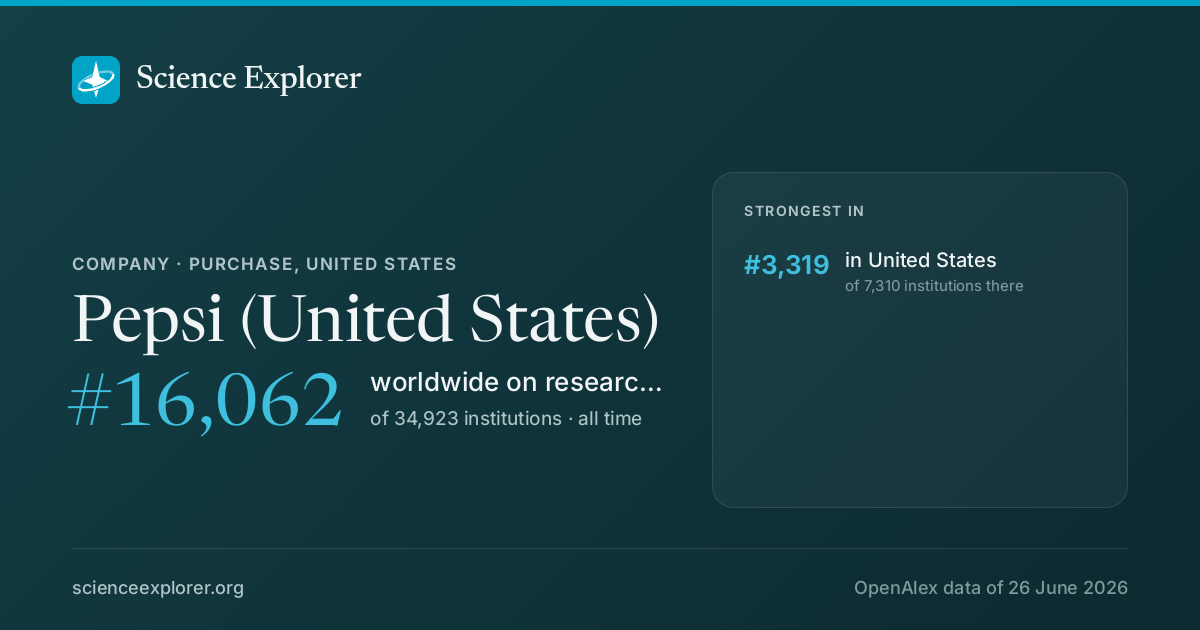
Pepsi (United States) on Science Explorer

A card with Pepsi (United States)'s standing and the fields it leads in, for a post or a slide. A link to this page previews as the same card.

Download the card

1200 × 630 PNG, sized for social posts, drawn from the latest snapshot.

Badges for a website1Each links back here and updates with every snapshot

Research measures only: rankings here say nothing about teaching, admissions or student experience. Comparable institutions and collaboration partners have tabs of their own, above.

Discussion

Ask a question or share a note about Pepsi (United States). Keep it to the research: no personal attacks, advertising or links. Any reader can report a post, which collapses it for everyone until it is opened.