Science Explorer Back to mapMap
Discussion
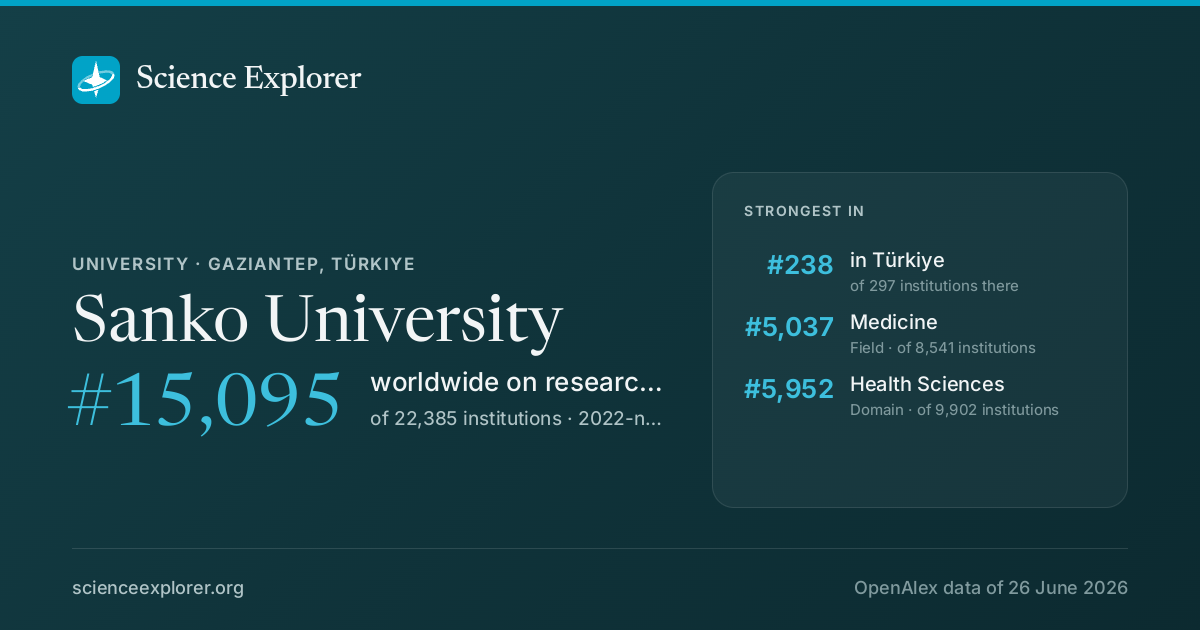
University · Gaziantep · Türkiye

Sanko University

In research, Sanko University stands highest in Medicine (#5,037 of 8,541 worldwide) and Health Sciences (#5,952 of 9,902 worldwide), 2022-now.

World rank, 2022-now
#15,095
of 22,385 · #25,739 all time
Rank in Türkiye
#238
of 297
Research works
507
▲ 22% vs 2018-21
Citations
2.4k
4.6 per fractional work
Top-10% rate
5.2%
all institutions 10.0%
vs its own fields
0.86×
1.00× is exactly expected
Open access
66%
world 40%
International
11%
world 18%

What is Sanko University known for in research?

The fields where it stands highest, 2022-now, ranked among every institution above the floor in each field.

FieldWorld rankWhere that sitsTop-10% rateWorksAll time
MedicineField #5,037 of 8,541 3.6%115 #9577
Health SciencesDomain #5,952 of 9,902 3.7%130 #11653

Each strip is that field's whole ranked pool, with the notch where Sanko University sits in it, in the colour of the band that rank falls in. The track under the rate is the rate itself: it carries no average mark, because the average differs by field (from about 6% in Dentistry to 21% in Economics).

Which fields of science does Sanko University work in?

In 2022-now, 69% of research at Sanko University is in Health Sciences, 14% in Life Sciences. Its largest fields are Medicine (60%), Biochemistry, Genetics and Molecular Biology (8%), Health Professions (6%). It does 2.9× the world's share of Health Sciences.

Health Sciences: 153 fractional works · 68.8% of its workMedicine: 134 fractional works · 60.4% of its workSurgery: 19 fractional works · 8.5% of its workPulmonary and Respiratory Medicine: 10 fractional works · 4.5% of its workEpidemiology: 8 fractional works · 3.6% of its workOncology: 8 fractional works · 3.6% of its workNeurology: 7 fractional works · 3.3% of its workPsychiatry and Mental health: 7 fractional works · 3.0% of its workPathology and Forensic Medicine: 6 fractional works · 2.8% of its workPublic Health, Environmental and Occupational Health: 6 fractional works · 2.6% of its workPhysiology: 6 fractional works · 2.6% of its workEndocrinology, Diabetes and Metabolism: 5 fractional works · 2.5% of its workRheumatology: 5 fractional works · 2.2% of its workOrthopedics and Sports Medicine: 4 fractional works · 1.7% of its workDermatology: 4 fractional works · 1.6% of its workPharmacology: 4 fractional works · 1.6% of its workCardiology and Cardiovascular Medicine: 3 fractional works · 1.6% of its workPediatrics, Perinatology and Child Health: 3 fractional works · 1.5% of its workHematology: 3 fractional works · 1.5% of its workInfectious Diseases: 3 fractional works · 1.4% of its workOphthalmology: 3 fractional works · 1.4% of its workGenetics: 3 fractional works · 1.1% of its workRadiology, Nuclear Medicine and Imaging: 3 fractional works · 1.1% of its workRehabilitation: 2 fractional works · 1.0% of its workReproductive Medicine: 2 fractional works · 0.7% of its workObstetrics and Gynecology: 2 fractional works · 0.7% of its workCritical Care and Intensive Care Medicine: 1 fractional works · 0.7% of its workTransplantation: 1 fractional works · 0.6% of its workInternal Medicine: 1 fractional works · 0.6% of its workEmergency Medicine: 1 fractional works · 0.4% of its workComplementary and alternative medicine: 1 fractional works · 0.3% of its workGastroenterology: 1 fractional works · 0.3% of its workNephrology: 1 fractional works · 0.3% of its workHealth Informatics: 1 fractional works · 0.3% of its workGeriatrics and Gerontology: 1 fractional works · 0.2% of its workSmaller subfields together: 2 fractional works · 0.7% of its workHealth Professions: 14 fractional works · 6.3% of its workGeneral Health Professions: 6 fractional works · 2.7% of its workPhysical Therapy, Sports Therapy and Rehabilitation: 2 fractional works · 1.1% of its workEmergency Medical Services: 2 fractional works · 0.8% of its workPharmacy: 1 fractional works · 0.4% of its workOccupational Therapy: 1 fractional works · 0.4% of its workRadiological and Ultrasound Technology: 1 fractional works · 0.4% of its workSpeech and Hearing: 1 fractional works · 0.3% of its workSmaller subfields together: 1 fractional works · 0.3% of its workDentistry: 3 fractional works · 1.2% of its workPeriodontics: 1 fractional works · 0.6% of its workOral Surgery: 1 fractional works · 0.3% of its workOrthodontics: 0 fractional works · 0.2% of its workSmaller subfields together: 0 fractional works · 0.1% of its workNursing: 1 fractional works · 0.6% of its workNutrition and Dietetics: 1 fractional works · 0.4% of its workSmaller subfields together: 0 fractional works · 0.1% of its workVeterinary: 1 fractional works · 0.3% of its workLife Sciences: 32 fractional works · 14.5% of its workBiochemistry, Genetics and Molecular Biology: 18 fractional works · 8.1% of its workMolecular Biology: 7 fractional works · 3.0% of its workCancer Research: 3 fractional works · 1.5% of its workGenetics: 2 fractional works · 1.1% of its workMolecular Medicine: 2 fractional works · 0.9% of its workClinical Biochemistry: 1 fractional works · 0.5% of its workCell Biology: 1 fractional works · 0.5% of its workEndocrinology: 1 fractional works · 0.4% of its workSmaller subfields together: 0 fractional works · 0.2% of its workNeuroscience: 7 fractional works · 2.9% of its workCognitive Neuroscience: 2 fractional works · 1.1% of its workEndocrine and Autonomic Systems: 2 fractional works · 0.7% of its workNeurology: 1 fractional works · 0.5% of its workCellular and Molecular Neuroscience: 1 fractional works · 0.3% of its workSmaller subfields together: 1 fractional works · 0.3% of its workImmunology and Microbiology: 4 fractional works · 1.6% of its workImmunology: 3 fractional works · 1.2% of its workApplied Microbiology and Biotechnology: 1 fractional works · 0.3% of its workSmaller subfields together: 0 fractional works · 0.1% of its workAgricultural and Biological Sciences: 3 fractional works · 1.5% of its workPlant Science: 1 fractional works · 0.5% of its workFood Science: 1 fractional works · 0.3% of its workInsect Science: 0 fractional works · 0.2% of its workSmaller subfields together: 1 fractional works · 0.5% of its workPharmacology, Toxicology and Pharmaceutics: 1 fractional works · 0.3% of its workSocial Sciences: 27 fractional works · 12.0% of its workPsychology: 14 fractional works · 6.2% of its workClinical Psychology: 9 fractional works · 4.0% of its workExperimental and Cognitive Psychology: 2 fractional works · 1.1% of its workSocial Psychology: 1 fractional works · 0.5% of its workApplied Psychology: 1 fractional works · 0.4% of its workSmaller subfields together: 0 fractional works · 0.1% of its workSocial Sciences: 7 fractional works · 3.3% of its workSociology and Political Science: 3 fractional works · 1.3% of its workLife-span and Life-course Studies: 1 fractional works · 0.4% of its workEducation: 1 fractional works · 0.4% of its workPolitical Science and International Relations: 1 fractional works · 0.4% of its workHealth: 1 fractional works · 0.4% of its workSmaller subfields together: 1 fractional works · 0.4% of its workArts and Humanities: 3 fractional works · 1.6% of its workHistory: 2 fractional works · 0.9% of its workMuseology: 1 fractional works · 0.4% of its workPhilosophy: 0 fractional works · 0.2% of its workSmaller subfields together: 0 fractional works · 0.1% of its workEconomics, Econometrics and Finance: 2 fractional works · 0.8% of its workEconomics and Econometrics: 1 fractional works · 0.6% of its workSmaller subfields together: 0 fractional works · 0.1% of its workBusiness, Management and Accounting: 0 fractional works · 0.1% of its workDecision Sciences: 0 fractional works · 0.1% of its workPhysical Sciences: 11 fractional works · 4.8% of its workEngineering: 5 fractional works · 2.0% of its workBiomedical Engineering: 3 fractional works · 1.6% of its workSmaller subfields together: 1 fractional works · 0.5% of its workEnvironmental Science: 2 fractional works · 1.1% of its workManagement, Monitoring, Policy and Law: 1 fractional works · 0.6% of its workSmaller subfields together: 1 fractional works · 0.5% of its workComputer Science: 2 fractional works · 0.9% of its workComputer Vision and Pattern Recognition: 1 fractional works · 0.4% of its workArtificial Intelligence: 1 fractional works · 0.3% of its workSmaller subfields together: 0 fractional works · 0.2% of its workMaterials Science: 1 fractional works · 0.4% of its workBiomaterials: 1 fractional works · 0.4% of its workEarth and Planetary Sciences: 0 fractional works · 0.2% of its workChemistry: 0 fractional works · 0.1% of its workEnergy: 0 fractional works · 0.1% of its workALL ITS WORKSanko University222fractional works, 2022-now
Life Sciences14%Physical Sciences5%Health Sciences69%Social Sciences12%

Each ring splits the one inside it: the four domains of science, their fields, their subfields. Size is fractional works in 2022-now. Every slice is a page; the interactive view zooms down to single topics and colours each by how much more of it this institution does than the world.

Its 4 domains and 23 fields, with their numbers
    1. Medicine13460.4%
    2. Health Professions146.3%
    3. Dentistry31.2%
    4. Nursing10.6%
    5. Veterinary10.3%
    1. Biochemistry, Genetics and Molecular Biology188.1%
    2. Neuroscience72.9%
    3. Immunology and Microbiology41.6%
    4. Agricultural and Biological Sciences31.5%
    5. Pharmacology, Toxicology and Pharmaceutics10.3%
    1. Psychology146.2%
    2. Social Sciences73.3%
    3. Arts and Humanities31.6%
    4. Economics, Econometrics and Finance20.8%
    5. Business, Management and Accounting00.1%
    6. Decision Sciences00.1%
    1. Engineering52.0%
    2. Environmental Science21.1%
    3. Computer Science20.9%
    4. Materials Science10.4%
    5. Earth and Planetary Sciences00.2%
    6. Chemistry00.1%
    7. Energy00.1%
All of science, and how each field's share has moved since 1950: the Science domain explorer

Field profile

Location quotient across every field it publishes in: outside the ring is more than an institution of this size would be expected to publish, inside it is less.

Agricultural and Biological Sciences: 0.32× its world share, 3 worksAgricultural and Bio…Biochemistry, Genetics and Molecular Biology: 1.52× its world share, 18 worksBiochemistry, Geneti…Immunology and Microbiology: 1.61× its world share, 4 worksImmunology and Micro…Neuroscience: 1.82× its world share, 7 worksNeurosciencePharmacology, Toxicology and Pharmaceutics: 0.74× its world share, 1 worksPharmacology, Toxico…Chemistry: 0.08× its world share, 0 worksChemistryComputer Science: 0.11× its world share, 2 worksComputer ScienceEarth and Planetary Sciences: 0.11× its world share, 0 worksEarth and Planetary …Energy: 0.09× its world share, 0 worksEnergyEngineering: 0.14× its world share, 4 worksEngineeringEnvironmental Science: 0.22× its world share, 2 worksEnvironmental ScienceMaterials Science: 0.11× its world share, 1 worksMaterials ScienceDentistry: 2.47× its world share, 3 worksDentistryHealth Professions: 2.38× its world share, 14 worksHealth ProfessionsMedicine: 3.14× its world share, 134 worksMedicineNursing: 1.22× its world share, 1 worksNursingVeterinary: 2.21× its world share, 1 worksVeterinaryArts and Humanities: 0.54× its world share, 4 worksArts and HumanitiesBusiness, Management and Accounting: 0.02× its world share, 0 worksBusiness, Management…Decision Sciences: 0.07× its world share, 0 worksDecision SciencesEconomics, Econometrics and Finance: 0.36× its world share, 2 worksEconomics, Econometr…Psychology: 2.03× its world share, 14 worksPsychologySocial Sciences: 0.26× its world share, 7 worksSocial Sciences1×world share
more than its size predictsabout as predictedless

Rings at 0.5×, 1× and 2×. Widest outward: Medicine, 3.1×. Every wedge is a field page.

All 23 fields, with their numbers
  1. Medicine3.14×134 works
  2. Dentistry2.47×3 works
  3. Health Professions2.38×14 works
  4. Veterinary2.21×1 works
  5. Psychology2.03×14 works
  6. Neuroscience1.82×7 works
  7. Immunology and Microbiology1.61×4 works
  8. Biochemistry, Genetics and Molecular Biology1.52×18 works
  9. Nursing1.22×1 works
  10. Pharmacology, Toxicology and Pharmaceutics0.74×1 works
  11. Arts and Humanities0.54×4 works
  12. Economics, Econometrics and Finance0.36×2 works
  13. Agricultural and Biological Sciences0.32×3 works
  14. Social Sciences0.26×7 works
  15. Environmental Science0.22×2 works
  16. Engineering0.14×4 works
  17. Computer Science0.11×2 works
  18. Earth and Planetary Sciences0.11×0 works
  19. Materials Science0.11×1 works
  20. Energy0.09×0 works
  21. Chemistry0.08×0 works
  22. Decision Sciences0.07×0 works
  23. Business, Management and Accounting0.02×0 works

Who are the top researchers at Sanko University?

Ranked on the quality score, Meryem Kılıç, Hadiye Demirbakan and Mehmet Sökücü lead among researchers whose main affiliation is Sanko University.

  1. 1 Meryem Kılıç Türkiye · #2,951,941 worldwide 171 citations · 31 works
  2. 2 Hadiye Demirbakan Türkiye · #3,615,950 worldwide 241 citations · 36 works
  3. 3 Mehmet Sökücü Türkiye · #4,258,148 worldwide 76 citations · 20 works
  4. 4 Barış Yılbaş Türkiye · #4,409,107 worldwide 71 citations · 15 works
  5. 5 Eyüp İlker Saygılı Türkiye · #4,731,242 worldwide 615 citations · 47 works
  6. 6 Arzu Demi̇rgüç Türkiye · #4,895,884 worldwide 121 citations · 19 works
  7. 7 Hakan Polat Türkiye · #4,938,915 worldwide 18 citations · 18 works
  8. 8 Seyit Mehmet Ceylan Türkiye · #4,939,195 worldwide 388 citations · 22 works
  9. 9 Pınar Günel Karadeniz Türkiye · #4,967,252 worldwide 389 citations · 57 works
  10. 10 Fatma Elif Yıldırım Türkiye · #5,030,101 worldwide 181 citations · 18 works
All ranked researchers at Sanko University

What are the most cited papers from Sanko University?

The most cited paper from Sanko University is "Factors related to recurrence of idiopathic granulomatous mastitis: what do we learn from a multicentre study?" (Erdal Uysal, Atilla Soran, Efe Sezgın et al., 2017), with 125 citations. Next come "Radiation triggering immune response and inflammation" (125) and "Origin and distribution anomalies of the left anterior descending artery in 70,850 adult patients: Multicenter data collection" (119).

Most cited papers
#PaperReleasedCitations
1 Factors related to recurrence of idiopathic granulomatous mastitis: what do we learn from a multicentre study? Erdal Uysal, Atilla Soran, Efe Sezgın et al. · ANZ Journal of Surgery Open access 27 Jul 2017 125
2 Radiation triggering immune response and inflammation Nezih Hekim, Zafer Çetin, Zacharenia Nikitaki et al. · Cancer Letters 21 Apr 2015 125
3 Origin and distribution anomalies of the left anterior descending artery in 70,850 adult patients: Multicenter data collection Cemal Tuncer, Batyraliev Ta, Remzi Yılmaz et al. · Catheterization and Cardiovascular Interventions 2006 119
4 Quantitation of antibodies against SARS‐CoV‐2 spike protein after two doses of CoronaVac in healthcare workers Ayşen Bayram, Hadiye Demirbakan, Pınar Günel Karadeniz et al. · Journal of Medical Virology Open access 21 May 2021 99
5 Ginger for Healthy Ageing: A Systematic Review on Current Evidence of Its Antioxidant, Anti‐Inflammatory, and Anticancer Properties Mehtap Özkur, Necla Benlier, Işıl Takan et al. · Oxidative Medicine and Cellular Longevity ReviewOpen access 2022 96
All 60 most cited papers, with filters and sorting

Which keywords describe research at Sanko University?

By fractional works in 2022-now, weighted toward what it does more of than the world: Epidemiology, Inflammation, Treatment, Quality of Life, Prognostic Factors, Depression, Rehabilitation and Diagnostic Criteria.

▲ more of its work than of the world's◆ about the world's share▼ less than the world's

Size is fractional works in 2022-now in the topics tagged with each word; colour is the word's share of this institution's work against its share of the world's. The 40 words are chosen for being large and distinctive. Each links to the topic it comes from most.

All 40 words, with their numbers
  1. Epidemiology28▲ 3.2×57 topics
  2. Inflammation15▲ 3.1×52 topics
  3. Quality of Life12▲ 3.6×28 topics
  4. Treatment11▲ 4.1×26 topics
  5. Mental Health8▲ 2.6×14 topics
  6. Depression8▲ 4.2×17 topics
  7. Oxidative Stress8▲ 2.2×33 topics
  8. Cardiovascular Disease8▲ 3.1×22 topics
  9. Risk Factors7▲ 2.9×20 topics
  10. Cancer7▲ 2.3×22 topics
  11. Metabolic Syndrome7▲ 3.8×16 topics
  12. Prognostic Factors7▲ 7.0×12 topics
  13. Neurological Disorders7▲ 5.3×13 topics
  14. Obesity6▲ 3.7×16 topics
  15. Rehabilitation6▲ 7.2×10 topics
  16. Diagnostic Criteria6▲ 11×7 topics
  17. Elderly5▲ 9.7×4 topics
  18. Chemotherapy5▲ 3.2×17 topics
  19. Parkinson's Disease5▲ 9.2×6 topics
  20. Diabetes5▲ 4.4×17 topics
  21. Insulin Resistance5▲ 5.0×9 topics
  22. Antibiotic Resistance5▲ 5.6×8 topics
  23. Anxiety5▲ 4.6×8 topics
  24. Social Support5▲ 3.9×8 topics
  25. Pain Management5▲ 8.9×7 topics
  26. Metastasis4▲ 5.8×7 topics
  27. Prevention4▲ 4.3×9 topics
  28. Quarantine4▲ 12×2 topics
  29. Self-Efficacy4▲ 6.5×5 topics
  30. Interventions4▲ 13×3 topics
  31. Nursing4▲ 8.6×4 topics
  32. Psychological Factors4▲ 7.8×6 topics
  33. Thrombosis4▲ 5.8×6 topics
  34. Muscle Strength4▲ 14×4 topics
  35. Psychometric Evaluation3▲ 15×2 topics
  36. Rituximab3▲ 10×4 topics
  37. Healthcare Workers3▲ 6.4×4 topics
  38. Cerebral Palsy3▲ 19×2 topics
  39. Circadian Rhythms3▲ 12×2 topics
  40. Stroke3▲ 7.8×5 topics

Which research topics does Sanko University publish most on?

By volume in 2022-now: Cerebral Palsy and Movement Disorders, Balance, Gait, and Falls Prevention, Sleep and related disorders and COVID-19 and Mental Health.

  1. 1 Cerebral Palsy and Movement Disorders Psychiatry and Mental health 3 works
  2. 2 Balance, Gait, and Falls Prevention Physical Therapy, Sports Therapy and Rehabilitation 2 works
  3. 3 Sleep and related disorders Experimental and Cognitive Psychology 2 works
  4. 4 COVID-19 and Mental Health Clinical Psychology 2 works
  5. 5 Health and Well-being Studies Clinical Psychology 2 works
  6. 6 Multiple Sclerosis Research Studies Pathology and Forensic Medicine 2 works
  7. 7 Ottoman and Turkish Studies History 2 works
  8. 8 Stoma care and complications Surgery 2 works
  9. 9 Antibiotic Resistance in Bacteria Molecular Medicine 2 works
  10. 10 Chronic Lymphocytic Leukemia Research Genetics 2 works

How open and international is its research?

Against the world's own shares: the tick on each track. Both are shares of its output, so they sit on one scale and can be read against each other as well as against the world.

openly available66.3%not open33.7%

World: 40% of research is openly available.

with international co-authors11.3%domestic only88.7%

World: 18% is written across borders.

How has Sanko University's research output changed?

Output in 2022-2025 was 22% higher than in 2018-2021.

still counting1990200020102020
grewheldshrank

The same series as a ribbon: one cell per year, darker for more. The line above answers how much; this answers when.

Its share of all research

Growing output can still be a shrinking share: all of science grows. This is Sanko University as a percentage of every work published that year, 0.00081% in 2024.

still counting0.00050%0.0010%0.0015%Sanko University0.00083% in 20251990200020102020

Fractional works of Sanko University over all fractional works that year. How the balance of science has shifted.

How much of it reaches the world top 10%

Year by year, against all institutions in the same year.

still counting5%10%15%all institutions10.0% in 2025Sanko University5.0% in 20252020

Of each year's output, the share that reached the world's 10% most cited for its field and year. Peak 5.6% in 2021.

Other research institutions in Gaziantep

All research institutions in Gaziantep

Share Sanko University's ranking

Sanko University on Science Explorer

A card with Sanko University's standing and the fields it leads in, for a post or a slide. A link to this page previews as the same card.

Download the card

1200 × 630 PNG, sized for social posts, drawn from the latest snapshot.

Badges for a website1Each links back here and updates with every snapshot

Research measures only: rankings here say nothing about teaching, admissions or student experience. Comparable institutions and collaboration partners have tabs of their own, above.

Discussion

Ask a question or share a note about Sanko University. Posts are plain text and can be reported.