Science Explorer Back to mapMap
Discussion
University · Hermosillo · Mexico

Universidad de Hermosillo

World rank, 2022-now
#17,308
of 22,385 · #17,486 all time
Rank in Mexico
#196
of 232
Research works
311
▼ 16% vs 2018-21
Citations
2.4k
7.7 per fractional work
Top-10% rate
6.9%
all institutions 10.0%
vs its own fields
0.95×
1.00× is exactly expected
Open access
61%
world 40%
International
27%
world 18%

Which fields of science does Universidad de Hermosillo work in?

In 2022-now, 33% of research at Universidad de Hermosillo is in Health Sciences, 24% in Physical Sciences. Its largest fields are Medicine (29%), Social Sciences (14%), Agricultural and Biological Sciences (9%). It does 1.4× the world's share of Life Sciences.

Health Sciences: 33 fractional works · 32.8% of its workMedicine: 30 fractional works · 29.5% of its workSurgery: 5 fractional works · 4.5% of its workPublic Health, Environmental and Occupational Health: 4 fractional works · 3.7% of its workEpidemiology: 3 fractional works · 3.1% of its workPulmonary and Respiratory Medicine: 3 fractional works · 2.5% of its workPhysiology: 2 fractional works · 2.2% of its workCardiology and Cardiovascular Medicine: 2 fractional works · 1.9% of its workOncology: 1 fractional works · 1.4% of its workInfectious Diseases: 1 fractional works · 1.2% of its workDermatology: 1 fractional works · 0.8% of its workObstetrics and Gynecology: 1 fractional works · 0.7% of its workRadiology, Nuclear Medicine and Imaging: 1 fractional works · 0.6% of its workComplementary and alternative medicine: 1 fractional works · 0.6% of its workPathology and Forensic Medicine: 1 fractional works · 0.6% of its workEndocrinology, Diabetes and Metabolism: 1 fractional works · 0.5% of its workBiochemistry: 0 fractional works · 0.5% of its workUrology: 0 fractional works · 0.5% of its workHealth Informatics: 0 fractional works · 0.5% of its workTransplantation: 0 fractional works · 0.4% of its workFamily Practice: 0 fractional works · 0.3% of its workPediatrics, Perinatology and Child Health: 0 fractional works · 0.3% of its workRehabilitation: 0 fractional works · 0.3% of its workReproductive Medicine: 0 fractional works · 0.3% of its workRheumatology: 0 fractional works · 0.3% of its workEmergency Medicine: 0 fractional works · 0.3% of its workHepatology: 0 fractional works · 0.2% of its workImmunology and Allergy: 0 fractional works · 0.2% of its workPsychiatry and Mental health: 0 fractional works · 0.2% of its workSmaller subfields together: 1 fractional works · 0.6% of its workHealth Professions: 2 fractional works · 2.3% of its workGeneral Health Professions: 1 fractional works · 1.3% of its workEmergency Medical Services: 1 fractional works · 0.5% of its workPharmacy: 0 fractional works · 0.2% of its workSmaller subfields together: 0 fractional works · 0.2% of its workDentistry: 1 fractional works · 0.5% of its workPeriodontics: 0 fractional works · 0.4% of its workSmaller subfields together: 0 fractional works · 0.1% of its workNursing: 0 fractional works · 0.4% of its workNutrition and Dietetics: 0 fractional works · 0.3% of its workSmaller subfields together: 0 fractional works · 0.0% of its workVeterinary: 0 fractional works · 0.1% of its workPhysical Sciences: 24 fractional works · 23.6% of its workEnvironmental Science: 7 fractional works · 6.7% of its workEcology: 2 fractional works · 2.4% of its workGlobal and Planetary Change: 1 fractional works · 1.1% of its workHealth, Toxicology and Mutagenesis: 1 fractional works · 0.7% of its workManagement, Monitoring, Policy and Law: 1 fractional works · 0.7% of its workWater Science and Technology: 1 fractional works · 0.6% of its workNature and Landscape Conservation: 0 fractional works · 0.3% of its workPollution: 0 fractional works · 0.3% of its workEnvironmental Engineering: 0 fractional works · 0.2% of its workSmaller subfields together: 0 fractional works · 0.3% of its workComputer Science: 5 fractional works · 4.6% of its workArtificial Intelligence: 2 fractional works · 1.5% of its workComputer Networks and Communications: 1 fractional works · 1.4% of its workInformation Systems: 1 fractional works · 0.8% of its workComputer Science Applications: 0 fractional works · 0.4% of its workSmaller subfields together: 0 fractional works · 0.4% of its workEngineering: 4 fractional works · 4.0% of its workBiomedical Engineering: 1 fractional works · 1.0% of its workControl and Systems Engineering: 1 fractional works · 1.0% of its workElectrical and Electronic Engineering: 1 fractional works · 0.6% of its workBuilding and Construction: 0 fractional works · 0.3% of its workMechanical Engineering: 0 fractional works · 0.3% of its workSmaller subfields together: 1 fractional works · 0.8% of its workMaterials Science: 2 fractional works · 2.3% of its workMaterials Chemistry: 1 fractional works · 1.2% of its workBiomaterials: 1 fractional works · 0.7% of its workSmaller subfields together: 0 fractional works · 0.4% of its workChemistry: 2 fractional works · 2.1% of its workOrganic Chemistry: 2 fractional works · 1.6% of its workSmaller subfields together: 0 fractional works · 0.5% of its workEarth and Planetary Sciences: 2 fractional works · 1.8% of its workPaleontology: 1 fractional works · 0.6% of its workGeochemistry and Petrology: 0 fractional works · 0.3% of its workGeophysics: 0 fractional works · 0.3% of its workAtmospheric Science: 0 fractional works · 0.3% of its workSmaller subfields together: 0 fractional works · 0.3% of its workMathematics: 1 fractional works · 1.4% of its workApplied Mathematics: 1 fractional works · 0.6% of its workStatistics and Probability: 0 fractional works · 0.4% of its workModeling and Simulation: 0 fractional works · 0.3% of its workSmaller subfields together: 0 fractional works · 0.2% of its workPhysics and Astronomy: 1 fractional works · 0.6% of its workStatistical and Nonlinear Physics: 0 fractional works · 0.2% of its workSmaller subfields together: 0 fractional works · 0.3% of its workEnergy: 0 fractional works · 0.2% of its workRenewable Energy, Sustainability and the Environment: 0 fractional works · 0.2% of its workSocial Sciences: 23 fractional works · 23.3% of its workSocial Sciences: 14 fractional works · 14.4% of its workEducation: 4 fractional works · 4.4% of its workSociology and Political Science: 2 fractional works · 2.2% of its workPolitical Science and International Relations: 2 fractional works · 2.1% of its workDemography: 2 fractional works · 2.0% of its workLaw: 1 fractional works · 0.8% of its workSafety Research: 1 fractional works · 0.8% of its workCultural Studies: 0 fractional works · 0.5% of its workUrban Studies: 0 fractional works · 0.5% of its workGender Studies: 0 fractional works · 0.3% of its workGeneral Social Sciences: 0 fractional works · 0.3% of its workSmaller subfields together: 0 fractional works · 0.5% of its workPsychology: 5 fractional works · 4.6% of its workClinical Psychology: 3 fractional works · 2.8% of its workSocial Psychology: 1 fractional works · 1.1% of its workExperimental and Cognitive Psychology: 1 fractional works · 0.6% of its workSmaller subfields together: 0 fractional works · 0.2% of its workEconomics, Econometrics and Finance: 2 fractional works · 2.0% of its workEconomics and Econometrics: 2 fractional works · 1.9% of its workSmaller subfields together: 0 fractional works · 0.1% of its workArts and Humanities: 1 fractional works · 1.2% of its workLanguage and Linguistics: 1 fractional works · 0.7% of its workLiterature and Literary Theory: 0 fractional works · 0.2% of its workSmaller subfields together: 0 fractional works · 0.3% of its workBusiness, Management and Accounting: 1 fractional works · 0.7% of its workManagement Information Systems: 0 fractional works · 0.3% of its workSmaller subfields together: 0 fractional works · 0.4% of its workDecision Sciences: 0 fractional works · 0.4% of its workManagement Science and Operations Research: 0 fractional works · 0.2% of its workSmaller subfields together: 0 fractional works · 0.1% of its workLife Sciences: 20 fractional works · 20.2% of its workAgricultural and Biological Sciences: 9 fractional works · 9.1% of its workPlant Science: 3 fractional works · 3.2% of its workFood Science: 2 fractional works · 2.4% of its workEcology, Evolution, Behavior and Systematics: 1 fractional works · 1.1% of its workGeneral Agricultural and Biological Sciences: 1 fractional works · 0.7% of its workSoil Science: 0 fractional works · 0.5% of its workAgronomy and Crop Science: 0 fractional works · 0.4% of its workInsect Science: 0 fractional works · 0.3% of its workAquatic Science: 0 fractional works · 0.3% of its workSmaller subfields together: 0 fractional works · 0.2% of its workBiochemistry, Genetics and Molecular Biology: 8 fractional works · 7.9% of its workMolecular Biology: 5 fractional works · 4.8% of its workCancer Research: 1 fractional works · 1.1% of its workGenetics: 1 fractional works · 0.9% of its workMolecular Medicine: 0 fractional works · 0.4% of its workBiotechnology: 0 fractional works · 0.2% of its workSmaller subfields together: 1 fractional works · 0.6% of its workImmunology and Microbiology: 2 fractional works · 2.3% of its workImmunology: 1 fractional works · 1.1% of its workParasitology: 1 fractional works · 0.7% of its workSmaller subfields together: 0 fractional works · 0.5% of its workNeuroscience: 1 fractional works · 0.8% of its workCellular and Molecular Neuroscience: 0 fractional works · 0.3% of its workSmaller subfields together: 0 fractional works · 0.4% of its workPharmacology, Toxicology and Pharmaceutics: 0 fractional works · 0.1% of its workALL ITS WORKUniversidad deHermosillo100fractional works, 2022-now
Life Sciences20%Physical Sciences24%Health Sciences33%Social Sciences23%

Each ring splits the one inside it: the four domains of science, their fields, their subfields. Size is fractional works in 2022-now. Every slice is a page; the interactive view zooms down to single topics and colours each by how much more of it this institution does than the world.

Its 4 domains and 25 fields, with their numbers
    1. Medicine3029.5%
    2. Health Professions22.3%
    3. Dentistry10.5%
    4. Nursing00.4%
    5. Veterinary00.1%
    1. Environmental Science76.7%
    2. Computer Science54.6%
    3. Engineering44.0%
    4. Materials Science22.3%
    5. Chemistry22.1%
    6. Earth and Planetary Sciences21.8%
    7. Mathematics11.4%
    8. Physics and Astronomy10.6%
    9. Energy00.2%
    1. Social Sciences1414.4%
    2. Psychology54.6%
    3. Economics, Econometrics and Finance22.0%
    4. Arts and Humanities11.2%
    5. Business, Management and Accounting10.7%
    6. Decision Sciences00.4%
    1. Agricultural and Biological Sciences99.1%
    2. Biochemistry, Genetics and Molecular Biology87.9%
    3. Immunology and Microbiology22.3%
    4. Neuroscience10.8%
    5. Pharmacology, Toxicology and Pharmaceutics00.1%
All of science, and how each field's share has moved since 1950: the Science domain explorer

Field profile

Location quotient across every field it publishes in: outside the ring is more than an institution of this size would be expected to publish, inside it is less.

Agricultural and Biological Sciences: 1.92× its world share, 9 worksAgricultural and Bio…Biochemistry, Genetics and Molecular Biology: 1.48× its world share, 8 worksBiochemistry, Geneti…Immunology and Microbiology: 2.33× its world share, 2 worksImmunology and Micro…Neuroscience: 0.47× its world share, 1 worksNeurosciencePharmacology, Toxicology and Pharmaceutics: 0.24× its world share, 0 worksPharmacology, Toxico…Chemistry: 1.34× its world share, 2 worksChemistryComputer Science: 0.59× its world share, 5 worksComputer ScienceEarth and Planetary Sciences: 1.14× its world share, 2 worksEarth and Planetary …Energy: 0.24× its world share, 0 worksEnergyEngineering: 0.27× its world share, 4 worksEngineeringEnvironmental Science: 1.34× its world share, 7 worksEnvironmental ScienceMaterials Science: 0.66× its world share, 2 worksMaterials ScienceMathematics: 1.23× its world share, 1 worksMathematicsPhysics and Astronomy: 0.26× its world share, 1 worksPhysics and AstronomyDentistry: 1.10× its world share, 0 worksDentistryHealth Professions: 0.87× its world share, 2 worksHealth ProfessionsMedicine: 1.53× its world share, 30 worksMedicineNursing: 0.82× its world share, 0 worksNursingVeterinary: 0.82× its world share, 0 worksVeterinaryArts and Humanities: 0.42× its world share, 1 worksArts and HumanitiesBusiness, Management and Accounting: 0.22× its world share, 1 worksBusiness, Management…Decision Sciences: 0.37× its world share, 0 worksDecision SciencesEconomics, Econometrics and Finance: 0.92× its world share, 2 worksEconomics, Econometr…Psychology: 1.52× its world share, 5 worksPsychologySocial Sciences: 1.14× its world share, 14 worksSocial Sciences1×world share
more than its size predictsabout as predictedless

Rings at 0.5×, 1× and 2×. Widest outward: Immunology and Microbiology, 2.3×. Every wedge is a field page.

All 25 fields, with their numbers
  1. Immunology and Microbiology2.33×2 works
  2. Agricultural and Biological Sciences1.92×9 works
  3. Medicine1.53×30 works
  4. Psychology1.52×5 works
  5. Biochemistry, Genetics and Molecular Biology1.48×8 works
  6. Chemistry1.34×2 works
  7. Environmental Science1.34×7 works
  8. Mathematics1.23×1 works
  9. Earth and Planetary Sciences1.14×2 works
  10. Social Sciences1.14×14 works
  11. Dentistry1.10×0 works
  12. Economics, Econometrics and Finance0.92×2 works
  13. Health Professions0.87×2 works
  14. Nursing0.82×0 works
  15. Veterinary0.82×0 works
  16. Materials Science0.66×2 works
  17. Computer Science0.59×5 works
  18. Neuroscience0.47×1 works
  19. Arts and Humanities0.42×1 works
  20. Decision Sciences0.37×0 works
  21. Engineering0.27×4 works
  22. Physics and Astronomy0.26×1 works
  23. Pharmacology, Toxicology and Pharmaceutics0.24×0 works
  24. Energy0.24×0 works
  25. Business, Management and Accounting0.22×1 works

What are the most cited papers from Universidad de Hermosillo?

The most cited paper from Universidad de Hermosillo is "A Global Look at Time" (Anna Sircova et al., 2014), with 548 citations. Next come "Extraction and validation of a new set of CMS pythia8 tunes from underlying-event measurements" (433) and "High proportion of cactus species threatened with extinction" (375).

Most cited papers
#PaperReleasedCitations
1 A Global Look at Time Anna Sircova et al. · SAGE Open Open access 2014 548
2 Extraction and validation of a new set of CMS pythia8 tunes from underlying-event measurements A. M. Sirunyan et al. · The European Physical Journal C Open access2,284 authors 2020 433
3 High proportion of cactus species threatened with extinction Bárbara Goettsch et al. · Nature Plants Open access 5 Oct 2015 375
4 White spot syndrome virus: an overview on an emergent concern Arturo Sánchez‐Paz · Veterinary Research Open access 25 Feb 2010 359
5 PLGA nanoparticle preparations by emulsification and nanoprecipitation techniques: effects of formulation parameters Karol Yesenia Hernández-Giottonini, Rosalva Josefina Rodríguez-Córdova, Cindy Alejandra Gutiérrez-Valenzuela et al. · RSC Advances Open access 2020 318
All 60 most cited papers, with filters and sorting

Which keywords describe research at Universidad de Hermosillo?

By fractional works in 2022-now, weighted toward what it does more of than the world: Latin America, Climate Change, Innovation Ecosystems, Coping Strategies, Quality of Life, Education, Kidney Transplantation and Social Responsibility.

▲ more of its work than of the world's◆ about the world's share▼ less than the world's

Size is fractional works in 2022-now in the topics tagged with each word; colour is the word's share of this institution's work against its share of the world's. The 40 words are chosen for being large and distinctive. Each links to the topic it comes from most.

All 40 words, with their numbers
  1. Epidemiology5▲ 1.21×35 topics
  2. Climate Change5▲ 1.69×25 topics
  3. Education4▲ 2.1×12 topics
  4. Quality of Life3▲ 2.4×17 topics
  5. Inflammation3▲ 1.49×17 topics
  6. Cancer3▲ 2.0×18 topics
  7. Oxidative Stress3▲ 1.59×18 topics
  8. Human Rights2▲ 2.4×6 topics
  9. Mental Health2▲ 1.74×10 topics
  10. Latin America2▲ 11×5 topics
  11. Social Impact2▲ 5.3×5 topics
  12. Antioxidant2▲ 2.9×12 topics
  13. Coping Strategies2▲ 7.9×4 topics
  14. Innovation Ecosystems2▲ 20×2 topics
  15. Metabolic Syndrome2▲ 2.5×10 topics
  16. Biodiversity2▲ 2.5×12 topics
  17. Ethical Considerations2▲ 5.5×6 topics
  18. Teacher Training2▲ 3.0×3 topics
  19. Kidney Transplantation2▲ 28×2 topics
  20. Social Responsibility2▲ 7.7×3 topics
  21. Urban Development2▲ 5.0×3 topics
  22. Digital Marketing2▲ 4.3×2 topics
  23. Economic Impact2▲ 3.2×3 topics
  24. Psychopharmacology Education2▲ 25×1 topic
  25. Small and Medium Enterprises2▲ 8.8×1 topic
  26. Transplantation2▲ 15×2 topics
  27. Constitutionalism2▲ 17×3 topics
  28. Distance Learning2▲ 4.2×5 topics
  29. Graft Survival2▲ 18×3 topics
  30. Communication1▲ 4.4×5 topics
  31. Criminal Justice1▲ 6.5×3 topics
  32. Living Kidney Donors1▲ 57×1 topic
  33. Organ Donation1▲ 57×1 topic
  34. Population Dynamics1▲ 5.5×6 topics
  35. Mortality Risk1▲ 5.6×2 topics
  36. Shoulder Function1▲ 15×2 topics
  37. Weight Loss1▲ 8.0×3 topics
  38. Ischemia-Reperfusion Injury1▲ 16×1 topic
  39. Liver Transplantation1▲ 8.9×1 topic
  40. Schizophrenia1▲ 9.5×2 topics

Which research topics does Universidad de Hermosillo publish most on?

By volume in 2022-now: Business, Innovation, and Economy, Organ Donation and Transplantation, Organ Transplantation Techniques and Outcomes and Family Caregiving in Mental Illness.

  1. 1 Business, Innovation, and Economy Economics and Econometrics 2 works
  2. 2 Organ Donation and Transplantation Public Health, Environmental and Occupational Health 1 works
  3. 3 Organ Transplantation Techniques and Outcomes Surgery 1 works
  4. 4 Family Caregiving in Mental Illness Clinical Psychology 1 works
  5. 5 Social Skills and Education Education 1 works
  6. 6 Ethics and bioethics in healthcare Public Health, Environmental and Occupational Health 1 works
  7. 7 Knowledge Societies in the 21st Century Demography 1 works
  8. 8 Shoulder Injury and Treatment Surgery 1 works
  9. 9 Disability Rights and Representation Safety Research 1 works
  10. 10 Elder Abuse and Neglect Demography 1 works

How open and international is its research?

Against the world's own shares: the tick on each track. Both are shares of its output, so they sit on one scale and can be read against each other as well as against the world.

openly available61.4%not open38.6%

World: 40% of research is openly available.

with international co-authors26.9%domestic only73.1%

World: 18% is written across borders.

How has Universidad de Hermosillo's research output changed?

Output in 2022-2025 was 16% lower than in 2018-2021.

still counting1990200020102020
grewheldshrank

The same series as a ribbon: one cell per year, darker for more. The line above answers how much; this answers when.

Its share of all research

Growing output can still be a shrinking share: all of science grows. This is Universidad de Hermosillo as a percentage of every work published that year, 0.00038% in 2024.

still counting0.00050%0.0010%Universidad de Hermosillo0.00050% in 202519801990200020102020

Fractional works of Universidad de Hermosillo over all fractional works that year. How the balance of science has shifted.

Other research institutions in Hermosillo

All research institutions in Hermosillo

Share Universidad de Hermosillo's ranking
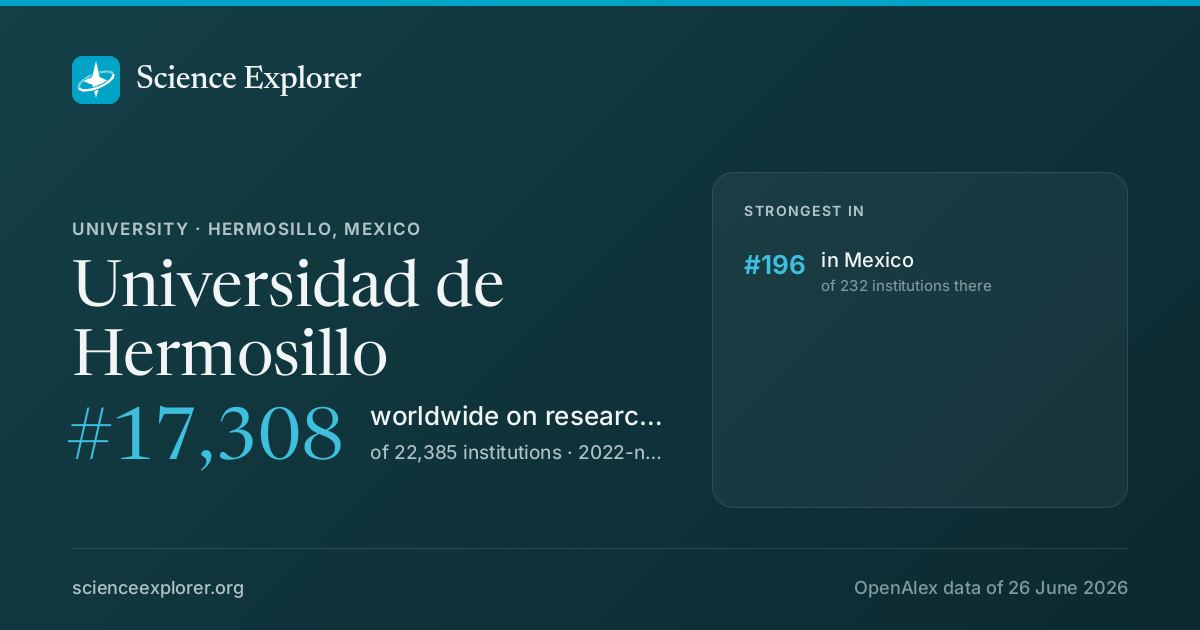
Universidad de Hermosillo on Science Explorer

A card with Universidad de Hermosillo's standing and the fields it leads in, for a post or a slide. A link to this page previews as the same card.

Download the card

1200 × 630 PNG, sized for social posts, drawn from the latest snapshot.

Badges for a website1Each links back here and updates with every snapshot

Research measures only: rankings here say nothing about teaching, admissions or student experience. Comparable institutions and collaboration partners have tabs of their own, above.

Discussion

Ask a question or share a note about Universidad de Hermosillo. Posts are plain text and can be reported.