Warde Medical Laboratory
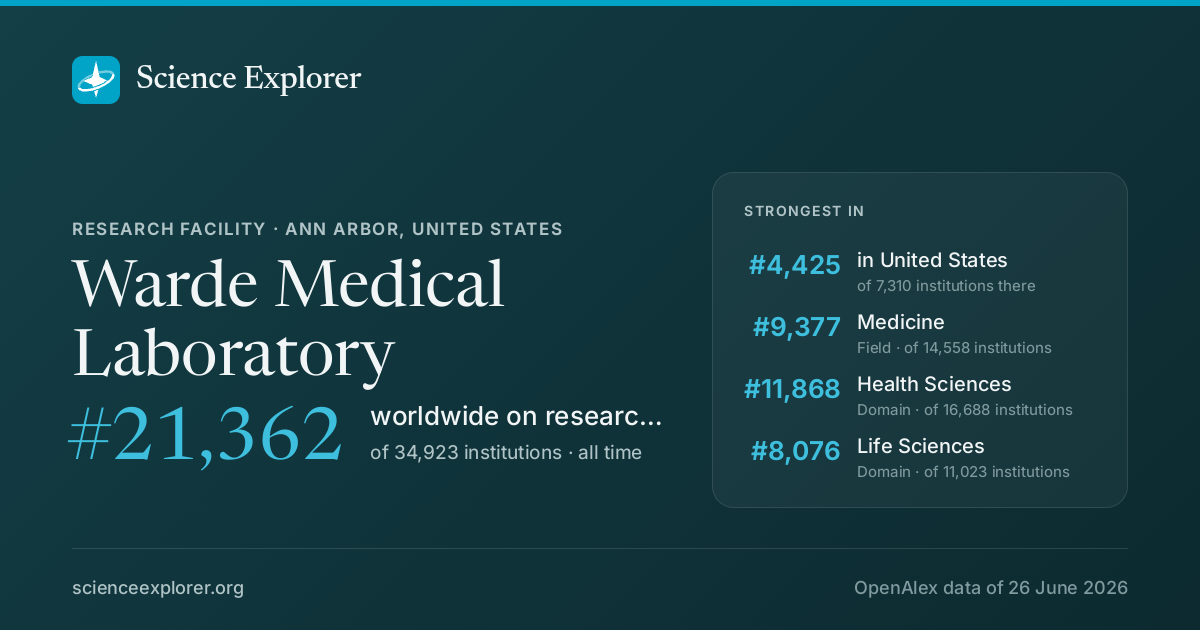
In research, Warde Medical Laboratory stands highest in Medicine (#9,377 of 14,558 worldwide), Health Sciences (#11,868 of 16,688 worldwide) and Life Sciences (#8,076 of 11,023 worldwide), over all time.
- World rank, all time
- #21,362 of 34,923
- Rank in United States
- #4,425 of 7,310
- Research works
- 408 ▲ 53% vs 2018-21
- Citations
- 15k 36.9 per fractional work
- Top-10% rate
- 7.2% all institutions 10.0%
- vs its own fields
- 1.41× 1.00× is exactly expected
- Open access
- 26% world 40%
- International
- 6% world 18%
What is Warde Medical Laboratory known for in research?
The fields where it stands highest, over all time, ranked among every institution above the floor in each field.
| Field | World rank | Where that sits | Top-10% rate | Works |
|---|---|---|---|---|
| MedicineField | #9,377 of 14,558 | 8.0% | 174 | |
| Health SciencesDomain | #11,868 of 16,688 | 7.9% | 180 | |
| Life SciencesDomain | #8,076 of 11,023 | 7.7% | 149 |
Each strip is that field's whole ranked pool, with the notch where Warde Medical Laboratory sits in it, in the colour of the band that rank falls in. The track under the rate is the rate itself: it carries no average mark, because the average differs by field (from about 6% in Dentistry to 21% in Economics).
Which fields of science does Warde Medical Laboratory work in?
In all years, 44% of research at Warde Medical Laboratory is in Health Sciences, 36% in Life Sciences. Its largest fields are Medicine (43%), Biochemistry, Genetics and Molecular Biology (25%), Chemistry (15%). It does 2.4× the world's share of Life Sciences.
Each ring splits the one inside it: the four domains of science, their fields, their subfields. Size is fractional works in all years. Every slice is a page; the interactive view zooms down to single topics and colours each by how much more of it this institution does than the world.
Its 4 domains and 22 fields, with their numbers
- Health Sciences18044.0%
- Medicine17442.6%
- Health Professions30.7%
- Nursing20.4%
- Veterinary10.3%
- Life Sciences14936.5%
- Physical Sciences7618.6%
- Chemistry6014.8%
- Engineering61.6%
- Computer Science30.6%
- Chemical Engineering20.6%
- Environmental Science20.4%
- Materials Science20.4%
- Mathematics10.2%
- Social Sciences41.0%
Field profile
Location quotient across every field it publishes in: outside the ring is more than an institution of this size would be expected to publish, inside it is less.
Rings at 0.5×, 1× and 2×. Widest outward: Veterinary, 12.1×. Every wedge is a field page.
All 10 fields, with their numbers
- Veterinary12.11×0 works
- Medicine3.44×7 works
- Engineering1.21×2 works
- Neuroscience1.01×0 works
- Psychology0.97×0 works
- Biochemistry, Genetics and Molecular Biology0.92×0 works
- Arts and Humanities0.61×0 works
- Health Professions0.35×0 works
- Social Sciences0.14×0 works
- Economics, Econometrics and Finance0.08×0 works
Who are the top researchers at Warde Medical Laboratory?
Ranked on the quality score, Carl L. Heifetz, Leslie M. Werbel and Mi K. Dong lead among researchers whose main affiliation is Warde Medical Laboratory.
- 1
Carl L. Heifetz
 United States · #4,820,427 worldwide
1k citations · 41 works
- 2
Leslie M. Werbel
United States · #5,319,082 worldwide
2.3k citations · 180 works
- 3
Mi K. Dong
United States · #5,736,551 worldwide
236 citations · 17 works
- 4
Edward F. Elslager
United States · #5,806,531 worldwide
2.2k citations · 179 works
- 5
Josephine C. Sesnie
United States · #6,077,747 worldwide
174 citations · 19 works
- 6
Richard L. Stanfield
United States · #6,715,186 worldwide
781 citations · 47 works
Which keywords describe research at Warde Medical Laboratory?
By fractional works in all years, weighted toward what it does more of than the world: Inflammation, Synthesis, Drug Discovery, Medicinal Chemistry, Anticancer Agents, Cell Signaling, Biological Evaluation and Oxidative Stress.
- Cardiovascular Diseases
- Chemoselective
- Derivatives
- Pharmacokinetics
- Oxidation
- Therapeutic Targets
- Anticancer
- G-Protein-Coupled Receptors
- Neuroprotection
- Signal Transduction
- Catalyst
- Genetic Variants
- Molecular Mechanisms
- Atherosclerosis
- Cancer
- Heterocycles
- Biological Evaluation
- Anticancer Agents
- Oxidative Stress
- Synthesis
- Inflammation
- Drug Discovery
- Medicinal Chemistry
- Cell Signaling
- Heterocyclic Compounds
- Pharmacology
- Reactive Oxygen Species
- Chemotherapy
- Metabolism
- Antimicrobial Activity
- Clinical Trials
- Crystal Structure
- Arrestin
- Hypertension
- Antimicrobial
- Endothelial Dysfunction
- Tumor Microenvironment
- Genomic Stability
- Quinoxaline
- Microwave-Assisted Synthesis
Size is fractional works in all years in the topics tagged with each word; colour is the word's share of this institution's work against its share of the world's. The 40 words are chosen for being large and distinctive. Each links to the topic it comes from most.
All 40 words, with their numbers
- Inflammation48▲ 5.0×42 topics
- Synthesis35▲ 15×15 topics
- Drug Discovery28▲ 17×9 topics
- Oxidative Stress25▲ 3.3×28 topics
- Medicinal Chemistry24▲ 15×10 topics
- Anticancer Agents22▲ 21×9 topics
- Cell Signaling18▲ 13×7 topics
- Biological Evaluation17▲ 34×6 topics
- Heterocyclic Compounds16▲ 25×5 topics
- Heterocycles16▲ 21×7 topics
- Pharmacology15▲ 11×4 topics
- Cancer15▲ 2.6×27 topics
- Reactive Oxygen Species14▲ 6.9×8 topics
- Atherosclerosis14▲ 9.3×8 topics
- Chemotherapy14▲ 4.7×13 topics
- Molecular Mechanisms14▲ 18×4 topics
- Metabolism13▲ 5.1×12 topics
- Genetic Variants13▲ 15×6 topics
- Antimicrobial Activity13▲ 17×6 topics
- Catalyst12▲ 28×2 topics
- Clinical Trials11▲ 4.4×10 topics
- Signal Transduction11▲ 11×3 topics
- Crystal Structure11▲ 11×2 topics
- Neuroprotection10▲ 6.8×9 topics
- Arrestin10▲ 31×1 topic
- G-Protein-Coupled Receptors10▲ 31×1 topic
- Hypertension10▲ 6.9×7 topics
- Anticancer10▲ 12×5 topics
- Antimicrobial10▲ 9.1×4 topics
- Therapeutic Targets10▲ 10×7 topics
- Endothelial Dysfunction10▲ 8.0×7 topics
- Oxidation9▲ 11×2 topics
- Tumor Microenvironment9▲ 6.0×7 topics
- Pharmacokinetics8▲ 7.3×6 topics
- Genomic Stability8▲ 21×2 topics
- Derivatives8▲ 32×1 topic
- Quinoxaline8▲ 43×1 topic
- Chemoselective8▲ 14×3 topics
- Microwave-Assisted Synthesis8▲ 23×3 topics
- Cardiovascular Diseases8▲ 16×2 topics
Which research topics does Warde Medical Laboratory publish most on?
By volume in 2022-now: Microfluidic and Bio-sensing Technologies, Endometriosis Research and Treatment, Liver Disease Diagnosis and Treatment and 3D Printing in Biomedical Research.
Area is fractional works; colour is the subfield each topic belongs to.
- 1 Microfluidic and Bio-sensing Technologies Biomedical Engineering 1 works
- 2 Endometriosis Research and Treatment Reproductive Medicine 0 works
- 3 Liver Disease Diagnosis and Treatment Epidemiology 0 works
- 4 3D Printing in Biomedical Research Biomedical Engineering 0 works
- 5 Cancer Cells and Metastasis Oncology 0 works
- 6 Renal Diseases and Glomerulopathies Nephrology 0 works
- 7 Cardiac Valve Diseases and Treatments Cardiology and Cardiovascular Medicine 0 works
- 8 Botulinum Toxin and Related Neurological Disorders Neurology 0 works
- 9 Nerve Injury and Rehabilitation Surgery 0 works
- 10 Muscle activation and electromyography studies Biomedical Engineering 0 works
How open and international is its research?
Against the world's own shares: the tick on each track. Both are shares of its output, so they sit on one scale and can be read against each other as well as against the world.
World: 40% of research is openly available.
World: 18% is written across borders.
How has Warde Medical Laboratory's research output changed?
Output in 2022-2025 was 53% higher than in 2018-2021.
The same series as a ribbon: one cell per year, darker for more. The line above answers how much; this answers when.
Its share of all research
Growing output can still be a shrinking share: all of science grows. This is Warde Medical Laboratory as a percentage of every work published that year, 0.000046% in 2024.
Fractional works of Warde Medical Laboratory over all fractional works that year. How the balance of science has shifted.
How much of it reaches the world top 10%
Year by year, against all institutions in the same year.
Of each year's output, the share that reached the world's 10% most cited for its field and year. Peak 14.9% in 1992.
Other research institutions in Ann Arbor
- University of Michigan
- Ann Arbor Center for Independent Living
- C. S. Mott Children's Hospital
- Environmental Research Institute of Michigan
- Women's Hospital
- A. Alfred Taubman Health Care Center
- Michigan Center for Translational Pathology
- U-M Rogel Cancer Center

Share Warde Medical Laboratory's ranking
Badges for a website1Each links back here and updates with every snapshot

Research measures only: rankings here say nothing about teaching, admissions or student experience. Comparable institutions and collaboration partners have tabs of their own, above.
Discussion
Ask a question or share a note about Warde Medical Laboratory. Posts are plain text and can be reported.