 Science in Bulgaria
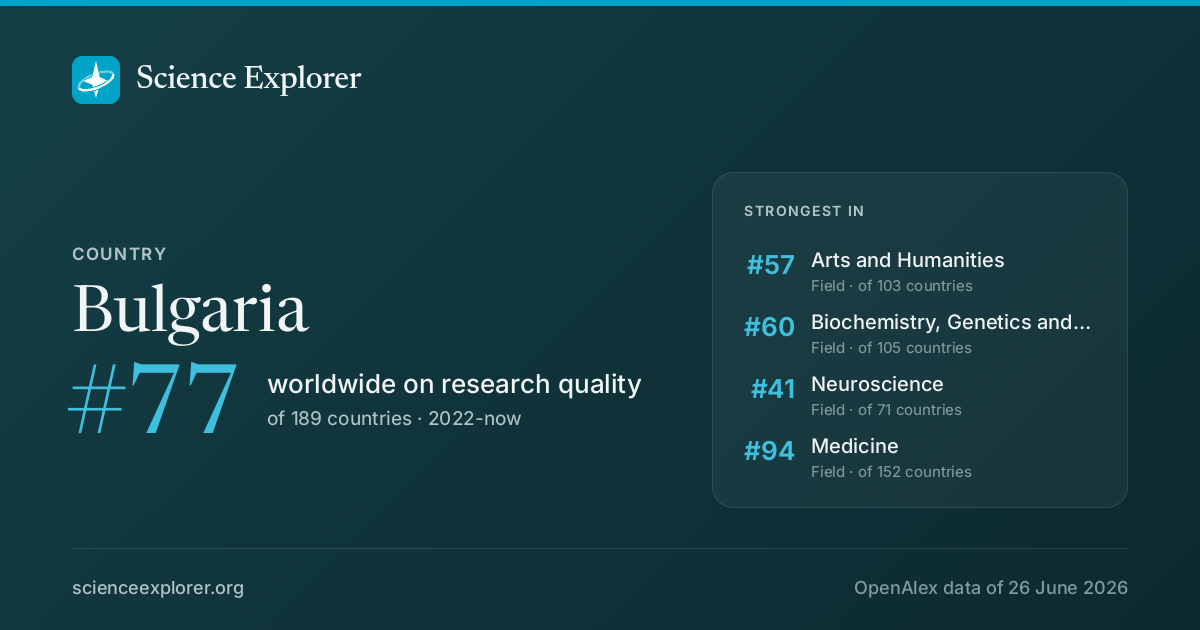
Bulgaria ranks #77 of 189 countries on research quality in 2022-now (#78 all time), with 36k research works and 4.8% of them in the world's top 10%.
- World rank, 2022-now
- #77 of 189 · #78 all time
- Works, 2022-now
- 36k ▲ 22% vs 2018-21
- Citations
- 1.6M 9.6 per fractional work, all time
- Top-10% rate
- 4.8% all institutions 10.0%
- vs its own fields
- 0.52× 1.00× is exactly expected
- In the world top 100
- 0 0 in the top 1,000
- Open access
- 44% world 40%
- International
- 24% world 18%
BulgariaWhat is Bulgaria strongest at in science?
On research quality in 2022-now, Bulgaria ranks highest in Arts and Humanities (#57 of 103), Biochemistry, Genetics and Molecular Biology (#60 of 105) and Neuroscience (#41 of 71). Relative to its size it is most specialised in General Energy, Tourism, Leisure and Hospitality Management and Numerical Analysis.
| Field | World rank | Where that sits | Top-10% rate | Works | All time | Institutions |
|---|---|---|---|---|---|---|
| Arts and HumanitiesField | #57 of 103 | 6.0% | 1,039 | #68 | Institutions | |
| Biochemistry, Genetics and Molecular BiologyField | #60 of 105 | 5.2% | 1,617 | #65 | Institutions | |
| NeuroscienceField | #41 of 71 | 5.2% | 435 | #38 | Institutions | |
| MedicineField | #94 of 152 | 4.8% | 5,889 | #96 | Institutions | |
| EngineeringField | #83 of 131 | 3.4% | 6,202 | #68 | Institutions | |
| Agricultural and Biological SciencesField | #79 of 124 | 5.9% | 2,543 | #88 | Institutions | |
| Computer ScienceField | #83 of 128 | 4.3% | 3,146 | #70 | Institutions | |
| Materials ScienceField | #58 of 87 | 3.7% | 1,140 | #55 | Institutions | |
| MathematicsField | #54 of 80 | 7.4% | 722 | #50 | Institutions | |
| Molecular BiologySubfield | #57 of 84 | 5.0% | 884 | #59 | Institutions | |
| SurgerySubfield | #59 of 86 | 4.9% | 703 | #71 | Institutions | |
| Economics, Econometrics and FinanceField | #75 of 107 | 6.1% | 926 | #77 | Institutions |
Where its research is concentrated
Location quotient: how much more (or less) of each node it does than its size predicts. Drawn around 1×, where "twice the world share" and "half of it" are the same distance apart in opposite directions. A volume reading, which on a country axis is largely population and industrial structure.
- General EnergySubfield · 51.2 works · #31 of 167 active here4.6×
- Tourism, Leisure and Hospitality ManagementSubfield · 38.5 works · #35 of 165 active here4.1×
- Numerical AnalysisSubfield · 121.1 works · #36 of 173 active here3.5×
- AnatomySubfield · 30.5 works · #27 of 159 active here3.1×
- ClassicsSubfield · 73.4 works · #29 of 153 active here3.0×
- Nuclear Energy and EngineeringSubfield · 8.2 works · #30 of 121 active here3.0×
- General DentistrySubfield · 50.2 works · #36 of 177 active here2.8×
- General Materials ScienceSubfield · 48.2 works · #31 of 155 active here2.7×
The whole field profile
All 26 fields at once. A specialist and a generalist produce the same ranked list and a completely different shape.
Rings at 0.5×, 1× and 2×. Widest outward: Dentistry, 2.3×. Every wedge is a field page.
All 26 fields, with their numbers
- Dentistry2.32×464 works
- Mathematics1.70×824 works
- Agricultural and Biological Sciences1.54×3,002 works
- Veterinary1.47×82 works
- Earth and Planetary Sciences1.44×927 works
- Pharmacology, Toxicology and Pharmaceutics1.26×182 works
- Energy1.24×470 works
- Decision Sciences1.19×473 works
- Economics, Econometrics and Finance1.19×1,043 works
- Engineering1.12×6,919 works
- Chemistry1.10×710 works
- Computer Science1.10×3,529 works
- Environmental Science1.10×2,238 works
- Arts and Humanities1.05×1,242 works
- Business, Management and Accounting1.05×1,391 works
- Physics and Astronomy1.01×927 works
- Nursing1.00×201 works
- Immunology and Microbiology0.94×389 works
- Chemical Engineering0.93×134 works
- Materials Science0.92×1,325 works
- Biochemistry, Genetics and Molecular Biology0.86×1,883 works
- Medicine0.85×6,747 works
- Neuroscience0.78×522 works
- Social Sciences0.74×3,866 works
- Health Professions0.69×752 works
- Psychology0.69×865 works
Which fields of science does Bulgaria work in?
In 2022-now, 44% of research in Bulgaria is in Physical Sciences, 22% in Social Sciences. Its largest fields are Engineering (17%), Medicine (16%), Social Sciences (9%).
Each ring splits the one inside it: the four domains of science, their fields, their subfields. Size is fractional works in 2022-now. Every slice is a page; the interactive view zooms down to single topics and colours each by how much more of it this country does than the world.
Its 4 domains and 26 fields, with their numbers
- Physical Sciences18k43.8%
- Engineering6,91916.8%
- Computer Science3,5298.6%
- Environmental Science2,2385.4%
- Materials Science1,3253.2%
- Physics and Astronomy9272.3%
- Earth and Planetary Sciences9272.3%
- Mathematics8242.0%
- Chemistry7101.7%
- Energy4701.1%
- Chemical Engineering1340.3%
- Social Sciences8,88021.6%
- Social Sciences3,8679.4%
- Business, Management and Accounting1,3913.4%
- Arts and Humanities1,2413.0%
- Economics, Econometrics and Finance1,0432.5%
- Psychology8652.1%
- Decision Sciences4731.2%
- Health Sciences8,24620.1%
- Medicine6,74716.4%
- Health Professions7521.8%
- Dentistry4631.1%
- Nursing2010.5%
- Veterinary820.2%
- Life Sciences5,97814.5%
Which keywords describe research in Bulgaria?
By fractional works in 2022-now, weighted toward what it does more of than the world: Climate Change, Renewable Energy, Sustainable Development, Sustainability, Machine Learning, Artificial Intelligence, Epidemiology and Energy Efficiency.
- paleoceanography
- Black Sea
- Taxonomy
- Power Electronics
- Optimization
- Environmental Management
- Antioxidant Activity
- Invasive Species
- E-Learning
- Antioxidant
- Internet of Things
- Remote Sensing
- Educational Technology
- Inflammation
- Globalization
- Oxidative Stress
- Artificial Intelligence
- Renewable Energy
- Sustainability
- Machine Learning
- Climate Change
- Epidemiology
- Sustainable Development
- Deep Learning
- Environmental Impact
- Energy Efficiency
- Big Data
- Neural Networks
- Innovation
- Economic Growth
- Biodiversity
- Supply Chain Management
- Cyber-Physical Systems
- Security
- Digital Transformation
- Smart Grid
- Biogeography
- Phylogeny
- Mediterranean
- Caspian Sea
Size is fractional works in 2022-now in the topics tagged with each word; colour is the word's share of this country's work against its share of the world's. The 40 words are chosen for being large and distinctive. Each links to the topic it comes from most.
All 40 words, with their numbers
- Climate Change1,519▲ 1.36×126 topics
- Machine Learning1,477◆ 1.08×97 topics
- Epidemiology1,397▼ 0.85×138 topics
- Sustainability1,336▲ 1.33×130 topics
- Sustainable Development1,218▲ 1.89×10⁹ topics
- Renewable Energy1,186▲ 1.99×60 topics
- Deep Learning1,146▼ 0.81×85 topics
- Artificial Intelligence951▲ 1.62×65 topics
- Environmental Impact804◆ 1.15×74 topics
- Oxidative Stress777◆ 1.15×62 topics
- Energy Efficiency769▲ 2.0×46 topics
- Globalization741◆ 0.92×164 topics
- Big Data727▲ 1.85×35 topics
- Inflammation726▼ 0.83×83 topics
- Neural Networks716◆ 1.13×42 topics
- Educational Technology621▲ 1.28×46 topics
- Innovation595▲ 1.40×85 topics
- Remote Sensing569◆ 1.13×41 topics
- Economic Growth567▲ 1.69×36 topics
- Internet of Things566▲ 1.61×31 topics
- Biodiversity544▲ 1.74×38 topics
- Antioxidant505▲ 1.79×51 topics
- Supply Chain Management470▲ 1.27×27 topics
- E-Learning449◆ 1.13×25 topics
- Cyber-Physical Systems444▲ 4.1×9 topics
- Invasive Species444▲ 2.5×21 topics
- Security411▲ 1.50×31 topics
- Antioxidant Activity407▲ 1.59×32 topics
- Digital Transformation402▲ 1.81×32 topics
- Environmental Management393▲ 2.4×22 topics
- Smart Grid350▲ 2.4×10 topics
- Optimization331▲ 1.79×26 topics
- Biogeography319▲ 2.8×20 topics
- Power Electronics304▲ 2.3×8 topics
- Phylogeny238▲ 3.5×17 topics
- Taxonomy224▲ 3.8×15 topics
- Mediterranean219▲ 6.0×6 topics
- Black Sea165▲ 11×2 topics
- Caspian Sea160▲ 14×1 topic
- paleoceanography160▲ 14×1 topic
Which research topics does Bulgaria publish the most in?
Its largest topics in 2022-now are Marine and environmental studies, Diverse Aspects of Tourism Research, Intuitionistic Fuzzy Systems Applications.
Area is fractional works in 2022-now; colour is the subfield each topic belongs to. Every tile is a topic page.
- 1 Marine and environmental studies Oceanography 160 works
- 2 Diverse Aspects of Tourism Research Sociology and Political Science 121 works
- 3 Intuitionistic Fuzzy Systems Applications Artificial Intelligence 108 works
- 4 Business and Economic Development Management, Monitoring, Policy and Law 106 works
- 5 Digital Transformation in Industry Industrial and Manufacturing Engineering 101 works
- 6 Phytochemicals and Antioxidant Activities Biochemistry 99 works
- 7 Economic and Business Development Strategies Economics and Econometrics 99 works
- 8 Big Data and Business Intelligence Management Information Systems 96 works
- 9 Essential Oils and Antimicrobial Activity Food Science 95 works
- 10 Educational Innovations and Challenges Information Systems 88 works
- 11 Military Technology and Strategies Aerospace Engineering 88 works
- 12 Smart Grid Energy Management Electrical and Electronic Engineering 88 works
Which universities in Bulgaria lead research?
Bulgarian Academy of Sciences, College of Tourism and Angel Kanchev University of Ruse rank highest in Bulgaria on research quality in 2022-now.
One dot per institution in the list below. The upper left is the interesting corner.
- 1Bulgarian Academy of SciencesGovernment institution · Sofia · #1,689 worldwide5.0% top 10% · 8.8k works
- 2College of TourismUniversity · Blagoevgrad · #2,901 worldwide8.7% top 10% · 779 works
- 3Angel Kanchev University of RuseUniversity · Rousse · #4,756 worldwide4.0% top 10% · 1.1k works
- 4Sofia University "St. Kliment Ohridski"University · Sofia · #4,889 worldwide5.3% top 10% · 2.3k works
- 5New Bulgarian UniversityUniversity · Sofia · #5,210 worldwide3.6% top 10% · 500 works
- 6South-West University "Neofit Rilski"University · Blagoevgrad · #5,589 worldwide4.9% top 10% · 486 works
- 7University of National and World EconomyUniversity · Sofia · #6,253 worldwide4.2% top 10% · 609 works
- 8Medical University PlovdivUniversity · Plovdiv · #6,829 worldwide8.3% top 10% · 1.2k works
- 9University of Food TechnologiesUniversity · Plovdiv · #7,166 worldwide4.5% top 10% · 468 works
- 10University of Economics VarnaUniversity · Varna · #7,638 worldwide4.5% top 10% · 329 works
- 11Shumen UniversityUniversity · Shumen · #7,843 worldwide3.0% top 10% · 412 works
- 12D. A. Tsenov Academy of EconomicsUniversity · Sistov · #8,319 worldwide7.6% top 10% · 219 works
- 13Prof. Assen Zlatarov UniversityUniversity · Burgas · #8,436 worldwide3.0% top 10% · 328 works
- 14St. Cyril and St. Methodius University of Veliko TarnovoUniversity · Veliko Tarnovo · #8,519 worldwide4.8% top 10% · 344 works
- 15Nikola Vaptsarov Naval AcademyUniversity · Varna · #8,547 worldwide3.5% top 10% · 240 works


The track on each row is its top-10% rate; the tick is the average of all institutions, 10.0% (how it is set): teal above it, red below.
All ranked institutions in BulgariaWho are the top researchers in Bulgaria?
A. Cimmino, A. Cabrera and L. Litov rank highest among researchers based in Bulgaria.
- 1 A. Cimmino #8,111 worldwide 84k citations · 1,049 works
- 2 A. Cabrera #11,365 worldwide 33k citations · 472 works
- 3 L. Litov #17,576 worldwide 113k citations · 2,193 works
- 4 S. Stoykova #20,679 worldwide 47k citations · 461 works
- 5 V. Genchev #32,911 worldwide 54k citations · 539 works
- 6 George Christoff #46,579 worldwide 2.8k citations · 87 works
- 7 N. Zaganidis #46,879 worldwide 14k citations · 201 works
- 8 Vesselka L. Duleva #68,655 worldwide 15k citations · 68 works
- 9 D. Lomidze #68,921 worldwide 36k citations · 354 works
- 10 Tzvetana Katova #75,523 worldwide 17k citations · 49 works
Which cities in Bulgaria are research hubs?
How open and international is Bulgaria's research?
44% of its research is openly available (world: 40%), and 24% is written with international co-authors (world: 18%).
World: 40% of research is openly available.
World: 18% is written across borders.
In 2022-now, 70% of its research is openly available (world 63%) and 22% is written with co-authors abroad (world 22%). Against what its own mix of topics predicts, that is 1.14× the expected open access and 1.00× the expected international share, which puts it #93 of 173 countries on openness.
How has Bulgaria's research grown?
Output in 2022-2025 was 22% higher than in 2018-2021.
The same series as a ribbon: one cell per year, darker for more. The line above answers how much; this answers when.
Its share of all research
Growing output can still be a shrinking share: all of science grows. This is Bulgaria as a percentage of every work published that year, 0.16% in 2024.
Fractional works of Bulgaria over all fractional works that year. How the balance of science has shifted.
How much of it reaches the world top 10%
Over the whole record, 4.9% of its 165k works since 1950 reached the world top 10% for their field and year.
Of each year's output, the share that reached the world's 10% most cited for its field and year. Peak 6.4% in 2007.
Which countries have research most like Bulgaria's?
Libya is Bulgaria's closest research twin: of all countries, its research is spread across the fields most like Bulgaria's, with both strong in Dentistry.
- 1
 LibyaBoth strong in Dentistry, Veterinary, Agricultural and Biological Sciences
0.68 Compare
- 2
 RomaniaBoth strong in Dentistry, Mathematics, Decision Sciences
0.62 Compare
- 3
 IraqBoth strong in Dentistry, Mathematics, Agricultural and Biological Sciences
0.62 Compare
- 4
 YemenBoth strong in Dentistry, Mathematics, Pharmacology, Toxicology and Pharmaceutics
0.55 Compare
- 5
 SerbiaBoth strong in Mathematics, Agricultural and Biological Sciences, Dentistry
0.54 Compare
Similarity is the correlation of each side's location quotients across every field it publishes in, on a log scale: 1 is the same shape of research, 0 is unrelated. It ignores size. How it is measured.
Compare Bulgaria with
 Lebanon
 Mozambique
 Zimbabwe
 Laos
 Uruguay
Share Bulgaria's ranking
Badges for a website1Each links back here and updates with every snapshot

Research fields in Bulgaria
- Physical Sciences
- Life Sciences
- Social Sciences
- Arts and Humanities
- Biochemistry, Genetics and Molecular Biology
- Neuroscience
- Medicine
- Engineering
- Agricultural and Biological Sciences
- Health Sciences
- Computer Science
- Materials Science
- Mathematics
- Molecular Biology
- Surgery
- Economics, Econometrics and Finance
- Social Sciences
- Chemistry
- Environmental Science
- Plant Science
- Business, Management and Accounting
- Organic Chemistry
- Political Science and International Relations
- Physics and Astronomy
- Sociology and Political Science
- Economics and Econometrics
- Information Systems
- Genetics
- Psychology
- Dentistry
- Atomic and Molecular Physics, and Optics
- Electrical and Electronic Engineering
- Food Science
- Pulmonary and Respiratory Medicine
- Ecology, Evolution, Behavior and Systematics
- Aerospace Engineering
- Materials Chemistry
- Artificial Intelligence
- Mechanics of Materials
- Biomedical Engineering
- Computational Theory and Mathematics
- Computer Vision and Pattern Recognition
- Epidemiology
- Industrial and Manufacturing Engineering
- Health Professions
- Management Science and Operations Research
- Language and Linguistics
- Decision Sciences
- Control and Systems Engineering
- Earth and Planetary Sciences
- Astronomy and Astrophysics
- Education
- Mechanical Engineering
- Automotive Engineering
- Computer Networks and Communications
- Ecology
- Environmental Engineering
- Global and Planetary Change
- Civil and Structural Engineering
- Renewable Energy, Sustainability and the Environment
Discussion
Ask a question or share a note about Bulgaria. Posts are plain text and can be reported.