 Science in Estonia
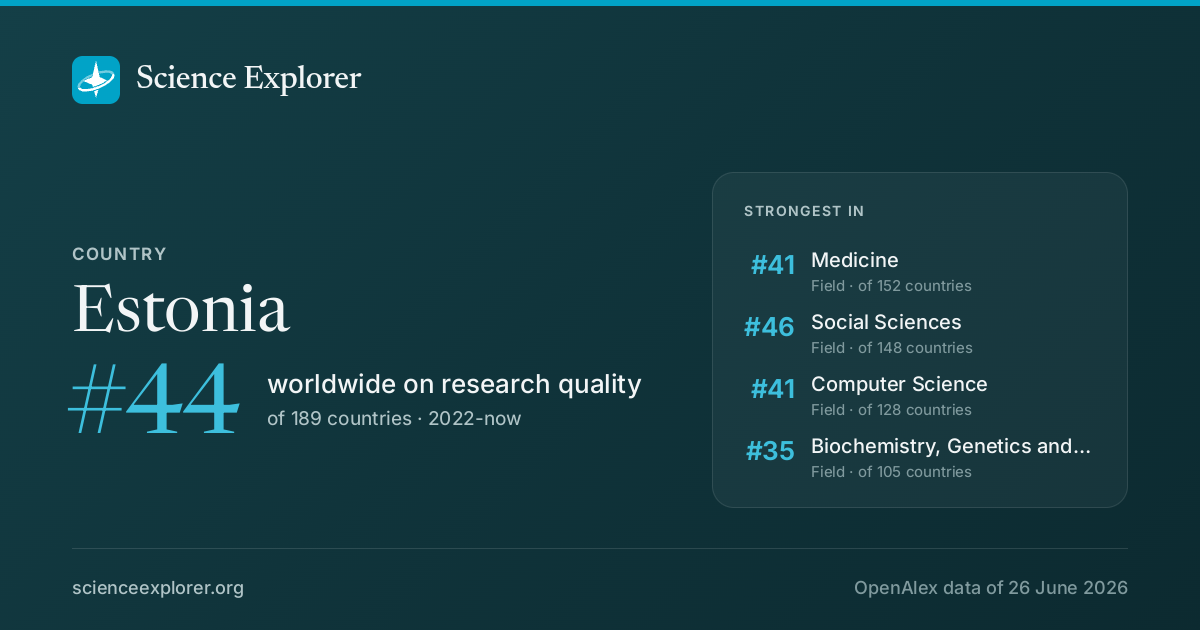
Estonia ranks #44 of 189 countries on research quality in 2022-now (#52 all time), with 11k research works and 10.9% of them in the world's top 10%.
- World rank, 2022-now
- #44 of 189 · #52 all time
- Works, 2022-now
- 11k ▲ 7% vs 2018-21
- Citations
- 909k 15.8 per fractional work, all time
- Top-10% rate
- 10.9% all institutions 10.0%
- vs its own fields
- 1.00× 1.00× is exactly expected
- In the world top 100
- 0 1 in the top 1,000
- Open access
- 47% world 40%
- International
- 31% world 18%
EstoniaWhat is Estonia strongest at in science?
On research quality in 2022-now, Estonia ranks highest in Medicine (#41 of 152), Social Sciences (#46 of 148) and Computer Science (#41 of 128). Relative to its size it is most specialised in Paleontology, Nature and Landscape Conservation and Oceanography.
| Field | World rank | Where that sits | Top-10% rate | Works | All time | Institutions |
|---|---|---|---|---|---|---|
| MedicineField | #41 of 152 | 10.4% | 1,083 | #45 | Institutions | |
| Social SciencesField | #46 of 148 | 13.4% | 1,946 | #47 | Institutions | |
| Computer ScienceField | #41 of 128 | 10.5% | 1,008 | #50 | Institutions | |
| Biochemistry, Genetics and Molecular BiologyField | #35 of 105 | 10.6% | 542 | #39 | Institutions | |
| Agricultural and Biological SciencesField | #42 of 124 | 12.5% | 664 | #49 | Institutions | |
| PsychologyField | #37 of 106 | 8.5% | 564 | #42 | Institutions | |
| Arts and HumanitiesField | #36 of 103 | 12.8% | 697 | #39 | Institutions | |
| EngineeringField | #47 of 131 | 9.5% | 1,573 | #55 | Institutions | |
| Sociology and Political ScienceSubfield | #46 of 119 | 12.5% | 567 | #49 | Institutions | |
| Political Science and International RelationsSubfield | #37 of 95 | 16.2% | 415 | #39 | Institutions | |
| Molecular BiologySubfield | #35 of 84 | 9.6% | 306 | #39 | Institutions | |
| Environmental ScienceField | #51 of 122 | 10.1% | 751 | #63 | Institutions |
Where its research is concentrated
Location quotient: how much more (or less) of each node it does than its size predicts. Drawn around 1×, where "twice the world share" and "half of it" are the same distance apart in opposite directions. A volume reading, which on a country axis is largely population and industrial structure.
- PaleontologySubfield · 54.3 works · #62 of 212 active here3.4×
- Nature and Landscape ConservationSubfield · 96.7 works · #61 of 222 active here3.1×
- OceanographySubfield · 106.9 works · #61 of 215 active here2.9×
- CommunicationSubfield · 101.8 works · #71 of 204 active here2.8×
- Language and LinguisticsSubfield · 162.8 works · #73 of 213 active here2.8×
- Linguistics and LanguageSubfield · 41.0 works · #77 of 194 active here2.7×
- Literature and Literary TheorySubfield · 176.9 works · #73 of 208 active here2.5×
- General PsychologySubfield · 3.3 works · #49 of 123 active here2.4×
The whole field profile
All 26 fields at once. A specialist and a generalist produce the same ranked list and a completely different shape.
Rings at 0.5×, 1× and 2×. Widest outward: Arts and Humanities, 2.0×. Every wedge is a field page.
All 26 fields, with their numbers
- Arts and Humanities2.05×780 works
- Psychology1.63×653 works
- Earth and Planetary Sciences1.60×330 works
- Environmental Science1.39×909 works
- Agricultural and Biological Sciences1.35×845 works
- Social Sciences1.32×2,207 works
- Veterinary1.26×23 works
- Physics and Astronomy1.17×342 works
- Computer Science1.12×1,150 works
- Decision Sciences1.11×142 works
- Business, Management and Accounting1.03×436 works
- Energy0.99×120 works
- Mathematics0.94×145 works
- Biochemistry, Genetics and Molecular Biology0.93×656 works
- Health Professions0.92×321 works
- Engineering0.88×1,739 works
- Economics, Econometrics and Finance0.87×246 works
- Chemical Engineering0.83×38 works
- Neuroscience0.77×164 works
- Chemistry0.76×158 works
- Nursing0.76×49 works
- Materials Science0.70×320 works
- Immunology and Microbiology0.58×78 works
- Pharmacology, Toxicology and Pharmaceutics0.56×26 works
- Medicine0.51×1,293 works
- Dentistry0.25×16 works
Which fields of science does Estonia work in?
In 2022-now, 40% of research in Estonia is in Physical Sciences, 34% in Social Sciences. Its largest fields are Social Sciences (17%), Engineering (13%), Medicine (10%). It does 1.4× the world's share of Social Sciences.
Each ring splits the one inside it: the four domains of science, their fields, their subfields. Size is fractional works in 2022-now. Every slice is a page; the interactive view zooms down to single topics and colours each by how much more of it this country does than the world.
Its 4 domains and 26 fields, with their numbers
- Physical Sciences5,25239.8%
- Engineering1,73913.2%
- Computer Science1,1508.7%
- Environmental Science9096.9%
- Physics and Astronomy3422.6%
- Earth and Planetary Sciences3302.5%
- Materials Science3212.4%
- Chemistry1581.2%
- Mathematics1451.1%
- Energy1200.9%
- Chemical Engineering380.3%
- Social Sciences4,46433.9%
- Social Sciences2,20716.7%
- Arts and Humanities7805.9%
- Psychology6535.0%
- Business, Management and Accounting4363.3%
- Economics, Econometrics and Finance2461.9%
- Decision Sciences1421.1%
- Life Sciences1,76813.4%
- Health Sciences1,70212.9%
- Medicine1,2939.8%
- Health Professions3212.4%
- Nursing490.4%
- Veterinary230.2%
- Dentistry160.1%
Which keywords describe research in Estonia?
By fractional works in 2022-now, weighted toward what it does more of than the world: Climate Change, Globalization, Machine Learning, Sustainability, Ecosystem Functioning, Biodiversity, Invasive Species and Big Data.
- Eastern Europe
- Literary Analysis
- Accountability
- Ecosystem Resilience
- Habitat Fragmentation
- Trust
- Global Change
- Governance
- European Union
- Religion
- Ecosystem Functioning
- Security
- Invasive Species
- Identity
- Biodiversity
- Social Media
- Renewable Energy
- Artificial Intelligence
- Globalization
- Machine Learning
- Climate Change
- Sustainability
- Deep Learning
- Environmental Impact
- Big Data
- Education
- Public Health
- Ethics
- Internet of Things
- Power Electronics
- Renewable Energy Integration
- Conservation
- International Relations
- Migration
- Corpus Linguistics
- Model Predictive Control
- European Integration
- Soviet Union
- Folklore
- Diplomacy
Size is fractional works in 2022-now in the topics tagged with each word; colour is the word's share of this country's work against its share of the world's. The 40 words are chosen for being large and distinctive. Each links to the topic it comes from most.
All 40 words, with their numbers
- Climate Change634▲ 1.77×116 topics
- Machine Learning470◆ 1.07×89 topics
- Sustainability396▲ 1.23×118 topics
- Globalization383▲ 1.48×145 topics
- Deep Learning323▼ 0.71×81 topics
- Artificial Intelligence237▲ 1.26×59 topics
- Environmental Impact236◆ 1.05×68 topics
- Renewable Energy227▲ 1.19×53 topics
- Big Data222▲ 1.76×31 topics
- Social Media219▲ 1.20×36 topics
- Education216◆ 0.96×120 topics
- Biodiversity210▲ 2.1×35 topics
- Public Health193◆ 1.00×63 topics
- Identity188▲ 1.97×67 topics
- Ethics174▲ 2.6×53 topics
- Invasive Species168▲ 3.0×21 topics
- Internet of Things149▲ 1.32×24 topics
- Security146▲ 1.65×27 topics
- Power Electronics145▲ 3.4×8 topics
- Ecosystem Functioning138▲ 5.1×7 topics
- Renewable Energy Integration135▲ 3.1×6 topics
- Religion129▲ 2.1×41 topics
- Conservation128▲ 2.3×24 topics
- European Union124▲ 4.2×26 topics
- International Relations123▲ 3.9×26 topics
- Governance114▲ 2.6×19 topics
- Migration113▲ 2.5×28 topics
- Global Change104▲ 3.0×7 topics
- Corpus Linguistics98▲ 3.5×5 topics
- Trust97▲ 2.7×11 topics
- Model Predictive Control96▲ 2.9×6 topics
- Habitat Fragmentation90▲ 3.1×5 topics
- European Integration87▲ 12×6 topics
- Ecosystem Resilience79▲ 3.9×5 topics
- Soviet Union77▲ 11×3 topics
- Accountability76▲ 4.6×4 topics
- Folklore74▲ 11×3 topics
- Literary Analysis73▲ 28×2 topics
- Diplomacy70▲ 5.7×8 topics
- Eastern Europe62▲ 9.0×3 topics
Which research topics does Estonia publish the most in?
Its largest topics in 2022-now are Historical Geopolitical and Social Dynamics, Ethics and Social Impacts of AI, Advanced DC-DC Converters.
Area is fractional works in 2022-now; colour is the subfield each topic belongs to. Every tile is a topic page.
- 1 Historical Geopolitical and Social Dynamics Political Science and International Relations 48 works
- 2 Ethics and Social Impacts of AI Safety Research 46 works
- 3 Advanced DC-DC Converters Electrical and Electronic Engineering 45 works
- 4 Building Energy and Comfort Optimization Building and Construction 44 works
- 5 Ecology and Vegetation Dynamics Studies Nature and Landscape Conservation 44 works
- 6 Natural Language Processing Techniques Artificial Intelligence 43 works
- 7 Soil Carbon and Nitrogen Dynamics Soil Science 43 works
- 8 Psychology, Coaching, and Therapy Social Psychology 42 works
- 9 Microgrid Control and Optimization Control and Systems Engineering 41 works
- 10 Folklore, Mythology, and Literature Studies Literature and Literary Theory 39 works
- 11 Cosmology and Gravitation Theories Astronomy and Astrophysics 38 works
- 12 Social Media and Politics Communication 38 works
How many world-class institutions does Estonia hold?
Average quality and elite capacity disagree by construction, and both are worth knowing: the first is decided by a country's whole institution population, the second counts the institutions it holds at the top. One square per institution.
| Standing among countries | 2022-now | Where that sits | All time |
|---|---|---|---|
| Average qualityits whole institution population | #44 of 189 | #52 of 203 | |
| Elite capacitythe institutions it holds at the top | #41 of 204 | #49 of 216 |
Elite capacity counts a country's institutions by their worldwide rank, weighted so a place at #1 counts for more than one at #480. Countries under 100 fractional works are left out.
Bands are exclusive, so the squares add up to 1 (the institutions it holds in the world top 1,000), not to four times it.
Which universities in Estonia lead research?
University of Tartu, Tallinn University of Technology and Praxis rank highest in Estonia on research quality in 2022-now.
One dot per institution in the list below. The upper left is the interesting corner.
- 1University of TartuUniversity · Tartu · #727 worldwide11.4% top 10% · 4.2k works
- 2Tallinn University of TechnologyUniversity · Tallinn · #1,548 worldwide10.7% top 10% · 2.6k works
- 3PraxisNonprofit · Tallinn · #2,357 worldwide6.3% top 10% · 986 works
- 4Tallinn UniversityUniversity · Tallinn · #2,766 worldwide12.0% top 10% · 1.1k works
- 5Estonian University of Life SciencesUniversity · Tartu · #4,643 worldwide11.5% top 10% · 562 works
- 6National Institute of Chemical Physics and BiophysicsResearch facility · Tallinn · #8,614 worldwide16.0% top 10% · 170 works
- 7Ministry of AgricultureGovernment institution · Tallinn · #9,670 worldwide15.0% top 10% · 413 works
- 8Estonian Business SchoolUniversity · Tallinn · #16,562 worldwide8.5% top 10% · 110 works
- 9Tallinn University of Applied SciencesUniversity · Tallinn · #17,352 worldwide8.4% top 10% · 68 works
- 10Estonian Academy of ArtsUniversity · Tallinn · #19,220 worldwide7.8% top 10% · 67 works
- 11Estonian Literary MuseumArchive · Tartu · #19,598 worldwide7.4% top 10% · 106 works
- 12Institute of the Estonian LanguageResearch facility · Tallinn · #20,308 worldwide10.2% top 10% · 81 works
- 13North Estonia Medical CentreHospital / health system · Tallinn · #21,078 worldwide11.2% top 10% · 65 works
- 14Estonian Academy of SciencesGovernment institution · Tallinn · #21,439 worldwide9.6% top 10% · 65 works


The track on each row is its top-10% rate; the tick is the average of all institutions, 10.0% (how it is set): teal above it, red below.
All ranked institutions in EstoniaWho are the top researchers in Estonia?
Tõnu Esko, Leho Tedersoo and Lili A. Milani rank highest among researchers based in Estonia.
- 1 Tõnu Esko #672 worldwide 156k citations · 825 works
- 2 Leho Tedersoo #1,145 worldwide 66k citations · 375 works
- 3 Lili A. Milani #1,515 worldwide 75k citations · 479 works
- 4 Reedik Mägi #1,607 worldwide 91k citations · 582 works
- 5 Andres Metspalu #2,577 worldwide 134k citations · 841 works
- 6 Mohammad Bahram #3,139 worldwide 29k citations · 219 works
- 7 Linda D. Hollebeek #3,288 worldwide 26k citations · 193 works
- 8 Mari Nelis #6,993 worldwide 47k citations · 173 works
- 9 Toomas Kivisild #7,820 worldwide 30k citations · 327 works
- 10 Evelin Mihailov #8,648 worldwide 49k citations · 196 works
Which cities in Estonia are research hubs?
How open and international is Estonia's research?
47% of its research is openly available (world: 40%), and 31% is written with international co-authors (world: 18%).
World: 40% of research is openly available.
World: 18% is written across borders.
In 2022-now, 61% of its research is openly available (world 63%) and 40% is written with co-authors abroad (world 22%). Against what its own mix of topics predicts, that is 1.02× the expected open access and 1.77× the expected international share, which puts it #112 of 173 countries on openness.
How has Estonia's research grown?
Output in 2022-2025 was 7% higher than in 2018-2021.
The same series as a ribbon: one cell per year, darker for more. The line above answers how much; this answers when.
Its share of all research
Growing output can still be a shrinking share: all of science grows. This is Estonia as a percentage of every work published that year, 0.050% in 2024.
Fractional works of Estonia over all fractional works that year. How the balance of science has shifted.
How much of it reaches the world top 10%
Over the whole record, 8.9% of its 57k works since 1950 reached the world top 10% for their field and year.
Of each year's output, the share that reached the world's 10% most cited for its field and year. Peak 11.1% in 2023.
Which countries have research most like Estonia's?
Slovakia is Estonia's closest research twin: of all countries, its research is spread across the fields most like Estonia's, with both strong in Environmental Science.
- 1
 SlovakiaBoth strong in Environmental Science, Earth and Planetary Sciences, Agricultural and Biological Sciences
0.73 Compare
- 2
 BurundiBoth strong in Arts and Humanities, Agricultural and Biological Sciences, Social Sciences
0.72 Compare
- 3
 MongoliaBoth strong in Arts and Humanities, Earth and Planetary Sciences, Environmental Science
0.61 Compare
- 4
 BahamasBoth strong in Earth and Planetary Sciences, Environmental Science, Arts and Humanities
0.60 Compare
- 5
 Faroe IslandsBoth strong in Earth and Planetary Sciences, Psychology, Arts and Humanities
0.59 Compare
Similarity is the correlation of each side's location quotients across every field it publishes in, on a log scale: 1 is the same shape of research, 0 is unrelated. It ignores size. How it is measured.
Compare Estonia with
 Türkiye
 Iran
 Mexico
 Qatar
 Romania
 Uganda
Share Estonia's ranking
Badges for a website1Each links back here and updates with every snapshot

Research fields in Estonia
- Life Sciences
- Medicine
- Health Sciences
- Social Sciences
- Social Sciences
- Computer Science
- Biochemistry, Genetics and Molecular Biology
- Agricultural and Biological Sciences
- Psychology
- Arts and Humanities
- Physical Sciences
- Engineering
- Sociology and Political Science
- Political Science and International Relations
- Molecular Biology
- Environmental Science
- Plant Science
- Artificial Intelligence
- Electrical and Electronic Engineering
- Education
- Economics, Econometrics and Finance
- Health Professions
- Business, Management and Accounting
- Information Systems
- Social Psychology
- Earth and Planetary Sciences
- Materials Science
- Physics and Astronomy
Discussion
Ask a question or share a note about Estonia. Posts are plain text and can be reported.