 Science in Thailand
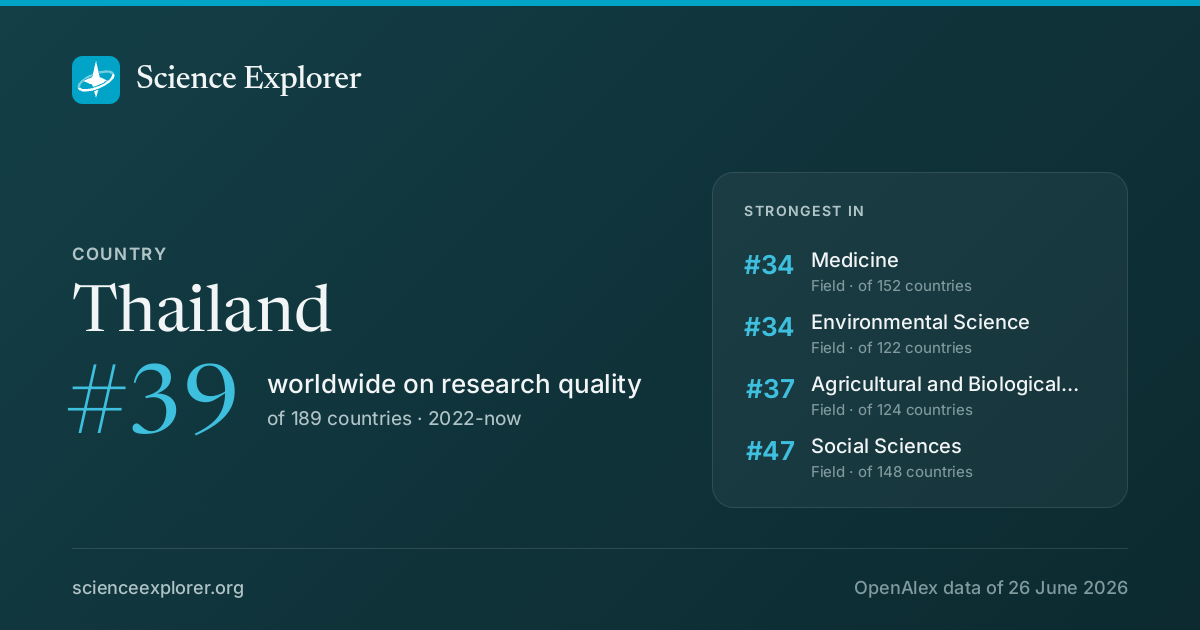
Thailand ranks #39 of 189 countries on research quality in 2022-now (#41 all time), with 94k research works and 8.8% of them in the world's top 10%.
- World rank, 2022-now
- #39 of 189 · #41 all time
- Works, 2022-now
- 94k ▲ 34% vs 2018-21
- Citations
- 4.5M 13.7 per fractional work, all time
- Top-10% rate
- 8.8% all institutions 10.0%
- vs its own fields
- 0.80× 1.00× is exactly expected
- In the world top 100
- 0 0 in the top 1,000
- Open access
- 49% world 40%
- International
- 22% world 18%
ThailandWhat is Thailand strongest at in science?
On research quality in 2022-now, Thailand ranks highest in Medicine (#34 of 152), Environmental Science (#34 of 122) and Agricultural and Biological Sciences (#37 of 124). Relative to its size it is most specialised in Parasitology, Biochemistry and Tourism, Leisure and Hospitality Management.
| Field | World rank | Where that sits | Top-10% rate | Works | All time | Institutions |
|---|---|---|---|---|---|---|
| MedicineField | #34 of 152 | 8.7% | 19,713 | #35 | Institutions | |
| Environmental ScienceField | #34 of 122 | 7.9% | 4,874 | #44 | Institutions | |
| Agricultural and Biological SciencesField | #37 of 124 | 10.7% | 6,777 | #39 | Institutions | |
| Social SciencesField | #47 of 148 | 10.6% | 9,167 | #51 | Institutions | |
| EngineeringField | #44 of 131 | 8.0% | 12,945 | #44 | Institutions | |
| Computer ScienceField | #45 of 128 | 8.2% | 6,299 | #47 | Institutions | |
| Biochemistry, Genetics and Molecular BiologyField | #38 of 105 | 7.6% | 5,478 | #41 | Institutions | |
| EducationSubfield | #41 of 112 | 11.4% | 2,724 | #46 | Institutions | |
| Sociology and Political ScienceSubfield | #45 of 119 | 10.1% | 2,733 | #50 | Institutions | |
| Arts and HumanitiesField | #39 of 103 | 12.1% | 1,729 | #48 | Institutions | |
| Business, Management and AccountingField | #44 of 110 | 9.0% | 3,974 | #48 | Institutions | |
| SurgerySubfield | #35 of 86 | 9.3% | 2,259 | #36 | Institutions |
Where its research is concentrated
Location quotient: how much more (or less) of each node it does than its size predicts. Drawn around 1×, where "twice the world share" and "half of it" are the same distance apart in opposite directions. A volume reading, which on a country axis is largely population and industrial structure.
- ParasitologySubfield · 348.0 works · #21 of 211 active here3.0×
- BiochemistrySubfield · 392.7 works · #21 of 198 active here3.0×
- Tourism, Leisure and Hospitality ManagementSubfield · 68.6 works · #20 of 165 active here2.8×
- BiomaterialsSubfield · 1,277.7 works · #20 of 199 active here2.8×
- OrthodonticsSubfield · 330.3 works · #19 of 173 active here2.7×
- Molecular MedicineSubfield · 303.1 works · #23 of 200 active here2.6×
- PharmacologySubfield · 516.1 works · #20 of 204 active here2.6×
- MusicSubfield · 219.3 works · #20 of 174 active here2.5×
The whole field profile
All 26 fields at once. A specialist and a generalist produce the same ranked list and a completely different shape.
Rings at 0.5×, 1× and 2×. Widest outward: Pharmacology, Toxicology and Pharmaceutics, 2.3×. Every wedge is a field page.
All 26 fields, with their numbers
- Pharmacology, Toxicology and Pharmaceutics2.34×892 works
- Veterinary2.13×314 works
- Dentistry2.05×1,077 works
- Nursing1.78×943 works
- Agricultural and Biological Sciences1.54×7,920 works
- Immunology and Microbiology1.45×1,577 works
- Decision Sciences1.45×1,514 works
- Business, Management and Accounting1.29×4,500 works
- Materials Science1.25×4,723 works
- Chemical Engineering1.19×451 works
- Biochemistry, Genetics and Molecular Biology1.11×6,387 works
- Medicine1.10×23k works
- Energy1.09×1,080 works
- Environmental Science1.05×5,640 works
- Mathematics1.04×1,326 works
- Psychology0.98×3,241 works
- Chemistry0.97×1,647 works
- Engineering0.90×15k works
- Computer Science0.85×7,114 works
- Health Professions0.83×2,354 works
- Economics, Econometrics and Finance0.79×1,833 works
- Social Sciences0.79×11k works
- Arts and Humanities0.67×2,090 works
- Neuroscience0.63×1,099 works
- Earth and Planetary Sciences0.52×890 works
- Physics and Astronomy0.46×1,110 works
Which fields of science does Thailand work in?
In 2022-now, 36% of research in Thailand is in Physical Sciences, 25% in Health Sciences. Its largest fields are Medicine (21%), Engineering (14%), Social Sciences (10%). It does 1.3× the world's share of Life Sciences.
Each ring splits the one inside it: the four domains of science, their fields, their subfields. Size is fractional works in 2022-now. Every slice is a page; the interactive view zooms down to single topics and colours each by how much more of it this country does than the world.
Its 4 domains and 26 fields, with their numbers
- Physical Sciences39k35.7%
- Engineering15k13.5%
- Computer Science7,1146.6%
- Environmental Science5,6405.2%
- Materials Science4,7234.4%
- Chemistry1,6471.5%
- Mathematics1,3261.2%
- Physics and Astronomy1,1101.0%
- Energy1,0801.0%
- Earth and Planetary Sciences8900.8%
- Chemical Engineering4510.4%
- Health Sciences28k25.5%
- Medicine23k21.2%
- Health Professions2,3552.2%
- Dentistry1,0771.0%
- Nursing9430.9%
- Veterinary3130.3%
- Social Sciences24k22.3%
- Social Sciences11k10.1%
- Business, Management and Accounting4,5004.2%
- Psychology3,2413.0%
- Arts and Humanities2,0901.9%
- Economics, Econometrics and Finance1,8331.7%
- Decision Sciences1,5141.4%
- Life Sciences18k16.5%
- Agricultural and Biological Sciences7,9207.3%
- Biochemistry, Genetics and Molecular Biology6,3875.9%
- Immunology and Microbiology1,5771.5%
- Neuroscience1,0991.0%
- Pharmacology, Toxicology and Pharmaceutics8920.8%
Which keywords describe research in Thailand?
By fractional works in 2022-now, weighted toward what it does more of than the world: Epidemiology, Antioxidant, Biomedical Applications, Machine Learning, Sustainability, Deep Learning, Environmental Impact and Inflammation.
- Biodegradable Polymers
- Vaccine Development
- Flavonoids
- Gut Microbiota
- Anti-inflammatory
- Global Burden
- Supply Chain Management
- Mechanical Properties
- COVID-19
- Neural Networks
- Educational Technology
- Antioxidant Activity
- Nanocomposites
- Cardiovascular Disease
- Renewable Energy
- Antioxidant
- Biomedical Applications
- Environmental Impact
- Sustainability
- Deep Learning
- Epidemiology
- Machine Learning
- Inflammation
- Climate Change
- Oxidative Stress
- Nanoparticles
- Globalization
- Quality of Life
- Artificial Intelligence
- Cancer
- Treatment
- Nanomaterials
- Tissue Engineering
- Diagnosis
- Antioxidants
- Health Benefits
- Pathogenesis
- Technology Integration
- Antimicrobial
- Biomaterials
Size is fractional works in 2022-now in the topics tagged with each word; colour is the word's share of this country's work against its share of the world's. The 40 words are chosen for being large and distinctive. Each links to the topic it comes from most.
All 40 words, with their numbers
- Epidemiology5,771▲ 1.34×139 topics
- Deep Learning3,350◆ 0.90×85 topics
- Machine Learning3,342◆ 0.93×97 topics
- Sustainability2,916◆ 1.10×132 topics
- Inflammation2,649◆ 1.15×83 topics
- Environmental Impact2,480▲ 1.35×72 topics
- Climate Change2,247▼ 0.76×125 topics
- Biomedical Applications2,236▲ 1.75×36 topics
- Oxidative Stress2,210▲ 1.24×63 topics
- Antioxidant1,937▲ 2.6×51 topics
- Nanoparticles1,735▲ 1.27×44 topics
- Renewable Energy1,714◆ 1.10×59 topics
- Globalization1,659▼ 0.78×156 topics
- Cardiovascular Disease1,633▲ 1.32×39 topics
- Quality of Life1,613◆ 1.03×59 topics
- Nanocomposites1,602▲ 1.88×22 topics
- Artificial Intelligence1,586◆ 1.03×64 topics
- Antioxidant Activity1,547▲ 2.3×32 topics
- Cancer1,532◆ 1.05×59 topics
- Educational Technology1,512▲ 1.18×46 topics
- Treatment1,505◆ 1.15×52 topics
- Neural Networks1,478◆ 0.89×42 topics
- Nanomaterials1,452▲ 1.28×21 topics
- COVID-191,411◆ 1.00×34 topics
- Tissue Engineering1,224▲ 1.87×13 topics
- Mechanical Properties1,219◆ 1.15×39 topics
- Diagnosis1,163◆ 1.15×41 topics
- Supply Chain Management1,150▲ 1.19×27 topics
- Antioxidants1,081▲ 2.3×17 topics
- Global Burden966▲ 1.64×12 topics
- Health Benefits946▲ 2.6×16 topics
- Anti-inflammatory932▲ 3.0×29 topics
- Pathogenesis929▲ 1.68×24 topics
- Gut Microbiota812▲ 2.2×7 topics
- Technology Integration789▲ 2.3×12 topics
- Flavonoids781▲ 2.8×12 topics
- Antimicrobial778▲ 2.5×14 topics
- Vaccine Development766▲ 2.8×11 topics
- Biomaterials706▲ 2.7×7 topics
- Biodegradable Polymers702▲ 3.8×4 topics
Which research topics does Thailand publish the most in?
Its largest topics in 2022-now are Linguistic, Cultural, and Literary Studies, Legal and Regulatory Analysis, Military Technology and Strategies.
Area is fractional works in 2022-now; colour is the subfield each topic belongs to. Every tile is a topic page.
- 1 Linguistic, Cultural, and Literary Studies Sociology and Political Science 514 works
- 2 Legal and Regulatory Analysis Transportation 448 works
- 3 Military Technology and Strategies Aerospace Engineering 444 works
- 4 Technology-Enhanced Education Studies Education 420 works
- 5 Digital Marketing and Social Media Sociology and Political Science 405 works
- 6 Southeast Asian Sociopolitical Studies Political Science and International Relations 351 works
- 7 Technology Adoption and User Behaviour Information Systems and Management 340 works
- 8 EFL/ESL Teaching and Learning Language and Linguistics 335 works
- 9 biodegradable polymer synthesis and properties Biomaterials 322 works
- 10 Diverse Aspects of Tourism Research Sociology and Political Science 313 works
- 11 Phytochemicals and Antioxidant Activities Biochemistry 305 works
- 12 Nanocomposite Films for Food Packaging Biomaterials 281 works
Which universities in Thailand lead research?
Chulalongkorn University, Mahidol University and Chiang Mai University rank highest in Thailand on research quality in 2022-now.
One dot per institution in the list below. The upper left is the interesting corner.
- 1Chulalongkorn UniversityUniversity · Bangkok · #1,149 worldwide9.7% top 10% · 9k works
- 2Mahidol UniversityUniversity · Bangkok · #1,359 worldwide9.9% top 10% · 10k works
- 3Chiang Mai UniversityUniversity · Chiang Mai · #1,691 worldwide10.3% top 10% · 6.5k works
- 4Ministry of EducationGovernment institution · Bangkok · #1,712 worldwide17.7% top 10% · 535 works
- 5King Mongkut's University of Technology ThonburiUniversity · Bangkok · #2,345 worldwide9.9% top 10% · 2k works
- 6Khon Kaen UniversityUniversity · Khon Kaen · #2,353 worldwide9.5% top 10% · 4.5k works
- 7National Institute of Development AdministrationUniversity · Bangkok · #2,804 worldwide12.2% top 10% · 508 works
- 8Thammasat UniversityUniversity · Bangkok · #2,938 worldwide8.5% top 10% · 3.7k works
- 9Vidyasirimedhi Institute of Science and TechnologyUniversity · Rayong · #2,954 worldwide9.0% top 10% · 505 works
- 10Kasetsart UniversityUniversity · Bangkok · #2,978 worldwide7.4% top 10% · 4.2k works
- 11Walailak UniversityUniversity · Nakhon Si Thammarat · #3,035 worldwide13.4% top 10% · 1.4k works
- 12Asian Institute of TechnologyUniversity · Pathum Thani · #3,139 worldwide11.1% top 10% · 844 works
- 13Mae Fah Luang UniversityUniversity · Chiang Rai · #3,256 worldwide10.4% top 10% · 957 works
- 14Krirk UniversityUniversity · Bangkok · #3,259 worldwide9.2% top 10% · 941 works
- 15King Mongkut's University of Technology North BangkokUniversity · Bangkok · #3,362 worldwide9.0% top 10% · 2.7k works


The track on each row is its top-10% rate; the tick is the average of all institutions, 10.0% (how it is set): teal above it, red below.
All ranked institutions in ThailandWho are the top researchers in Thailand?
Omid Mahian, Nicholas Day and Jin Cao rank highest among researchers based in Thailand.
- 1 Omid Mahian #6,124 worldwide 24k citations · 323 works
- 2 Nicholas Day #9,058 worldwide 83k citations · 4,663 works
- 3 Jin Cao #9,597 worldwide 8.7k citations · 140 works
- 4 W. Mitthumsiri #10,824 worldwide 39k citations · 252 works
- 5 Philip Hallinger #12,771 worldwide 31k citations · 388 works
- 6 Jiaqian Qin #13,100 worldwide 21k citations · 378 works
- 7 Nicholas John White #15,852 worldwide 138k citations · 2,002 works
- 8 Veeramuthu Ashokkumar #17,759 worldwide 8.5k citations · 133 works
- 9 Arjen M. Dondorp #22,052 worldwide 46k citations · 863 works
- 10 François Henry Nosten #23,514 worldwide 68k citations · 1,051 works
Which cities in Thailand are research hubs?
- 1
BangkokThailand
180k works
- 2
Chiang MaiThailand
27k works
- 3
Pathum ThaniThailand
19k works
- 4
SongkhlaThailand
19k works
- 5
Khon KaenThailand
17k works
How much of it is in the largest
The same cities as shares of everything these twelve account for.
Shares of the rows listed above, not of the whole node.
How open and international is Thailand's research?
49% of its research is openly available (world: 40%), and 22% is written with international co-authors (world: 18%).
World: 40% of research is openly available.
World: 18% is written across borders.
In 2022-now, 68% of its research is openly available (world 63%) and 25% is written with co-authors abroad (world 22%). Against what its own mix of topics predicts, that is 1.08× the expected open access and 1.10× the expected international share, which puts it #126 of 173 countries on openness.
How has Thailand's research grown?
Output in 2022-2025 was 34% higher than in 2018-2021.
The same series as a ribbon: one cell per year, darker for more. The line above answers how much; this answers when.
Its share of all research
Growing output can still be a shrinking share: all of science grows. This is Thailand as a percentage of every work published that year, 0.43% in 2024.
Fractional works of Thailand over all fractional works that year. How the balance of science has shifted.
How much of it reaches the world top 10%
Over the whole record, 7.5% of its 329k works since 1950 reached the world top 10% for their field and year.
Of each year's output, the share that reached the world's 10% most cited for its field and year. Peak 9.2% in 2025.
Which countries have research most like Thailand's?
Sudan is Thailand's closest research twin: of all countries, its research is spread across the fields most like Thailand's, with both strong in Veterinary.
- 1
 SudanBoth strong in Veterinary, Pharmacology, Toxicology and Pharmaceutics, Nursing
0.76 Compare
- 2
 IraqBoth strong in Pharmacology, Toxicology and Pharmaceutics, Dentistry, Agricultural and Biological Sciences
0.75 Compare
- 3
 LibyaBoth strong in Pharmacology, Toxicology and Pharmaceutics, Dentistry, Veterinary
0.73 Compare
- 4
 PakistanBoth strong in Dentistry, Pharmacology, Toxicology and Pharmaceutics, Nursing
0.71 Compare
- 5
 EgyptBoth strong in Pharmacology, Toxicology and Pharmaceutics, Dentistry, Nursing
0.71 Compare
Similarity is the correlation of each side's location quotients across every field it publishes in, on a log scale: 1 is the same shape of research, 0 is unrelated. It ignores size. How it is measured.
Compare Thailand with
 Argentina
 Bangladesh
 United Arab Emirates
 Romania
 Slovenia
 Mexico
Share Thailand's ranking
Badges for a website1Each links back here and updates with every snapshot

Research fields in Thailand
- Health Sciences
- Medicine
- Life Sciences
- Physical Sciences
- Environmental Science
- Agricultural and Biological Sciences
- Social Sciences
- Social Sciences
- Engineering
- Computer Science
- Biochemistry, Genetics and Molecular Biology
- Education
- Sociology and Political Science
- Arts and Humanities
- Business, Management and Accounting
- Surgery
- Plant Science
- Health Professions
- Public Health, Environmental and Occupational Health
- Civil and Structural Engineering
- Molecular Biology
- Psychology
- Biomedical Engineering
- Immunology and Microbiology
- Epidemiology
- Information Systems
- Materials Science
- Infectious Diseases
- Pulmonary and Respiratory Medicine
- Economics, Econometrics and Finance
- Food Science
- Decision Sciences
- Artificial Intelligence
- Chemistry
- Building and Construction
- Dentistry
- Health, Toxicology and Mutagenesis
- Pharmacology, Toxicology and Pharmaceutics
- Pharmacology
- Animal Science and Zoology
- Electrical and Electronic Engineering
- Political Science and International Relations
- Oncology
- Economics and Econometrics
- Cardiology and Cardiovascular Medicine
- Strategy and Management
- Physiology
- Mathematics
- Mechanical Engineering
- General Health Professions
- Materials Chemistry
- Endocrinology, Diabetes and Metabolism
- Ecology, Evolution, Behavior and Systematics
- Polymers and Plastics
- Genetics
- Neurology
- Nutrition and Dietetics
- Pediatrics, Perinatology and Child Health
- Ecology
- Social Psychology
Questions people ask
What is Thailand strongest at in science?
On research quality in 2022-now, Thailand ranks highest in Medicine (#34 of 152), Environmental Science (#34 of 122) and Agricultural and Biological Sciences (#37 of 124). Relative to its size it is most specialised in Parasitology, Biochemistry and Tourism, Leisure and Hospitality Management.
See the full answerDiscussion
Ask a question or share a note about Thailand. Keep it to the research: no personal attacks, advertising or links. Any reader can report a post, which collapses it for everyone until it is opened.