Science Explorer Back to mapMap
Discussion
Nonprofit · Cambridge · United States

Angiogenesis Foundation

World rank, all time
#29,103
of 34,923
Rank in United States
#6,127
of 7,310
Research works
202
▼ 11% vs 2018-21
Citations
14k
68.9 per fractional work
Top-10% rate
7.5%
all institutions 10.0%
vs its own fields
1.18×
1.00× is exactly expected
Open access
41%
world 40%
International
37%
world 18%

Which fields of science does Angiogenesis Foundation work in?

In all years, 51% of research at Angiogenesis Foundation is in Health Sciences, 43% in Life Sciences. Its largest fields are Medicine (48%), Biochemistry, Genetics and Molecular Biology (35%), Neuroscience (3%). It does 2.7× the world's share of Life Sciences.

Health Sciences: 102 fractional works · 50.5% of its workMedicine: 97 fractional works · 48.3% of its workRadiology, Nuclear Medicine and Imaging: 16 fractional works · 8.0% of its workOncology: 13 fractional works · 6.3% of its workSurgery: 9 fractional works · 4.3% of its workPulmonary and Respiratory Medicine: 8 fractional works · 3.8% of its workRehabilitation: 7 fractional works · 3.5% of its workOphthalmology: 4 fractional works · 1.9% of its workImmunology and Allergy: 4 fractional works · 1.9% of its workPhysiology: 3 fractional works · 1.6% of its workCardiology and Cardiovascular Medicine: 3 fractional works · 1.6% of its workRheumatology: 3 fractional works · 1.4% of its workGenetics: 3 fractional works · 1.3% of its workEpidemiology: 3 fractional works · 1.3% of its workPathology and Forensic Medicine: 3 fractional works · 1.3% of its workHematology: 2 fractional works · 1.2% of its workEndocrinology, Diabetes and Metabolism: 2 fractional works · 1.2% of its workNeurology: 2 fractional works · 1.1% of its workHepatology: 2 fractional works · 1.0% of its workUrology: 2 fractional works · 0.8% of its workPharmacology: 1 fractional works · 0.7% of its workTransplantation: 1 fractional works · 0.5% of its workReproductive Medicine: 1 fractional works · 0.5% of its workPublic Health, Environmental and Occupational Health: 1 fractional works · 0.5% of its workPsychiatry and Mental health: 1 fractional works · 0.5% of its workOrthopedics and Sports Medicine: 1 fractional works · 0.3% of its workDermatology: 1 fractional works · 0.3% of its workInternal Medicine: 1 fractional works · 0.3% of its workAnesthesiology and Pain Medicine: 0 fractional works · 0.2% of its workObstetrics and Gynecology: 0 fractional works · 0.2% of its workComplementary and alternative medicine: 0 fractional works · 0.2% of its workSmaller subfields together: 1 fractional works · 0.7% of its workDentistry: 2 fractional works · 1.1% of its workOral Surgery: 1 fractional works · 0.6% of its workOrthodontics: 1 fractional works · 0.4% of its workSmaller subfields together: 0 fractional works · 0.1% of its workHealth Professions: 2 fractional works · 0.8% of its workOccupational Therapy: 1 fractional works · 0.4% of its workSmaller subfields together: 1 fractional works · 0.3% of its workNursing: 1 fractional works · 0.3% of its workNutrition and Dietetics: 1 fractional works · 0.3% of its workVeterinary: 0 fractional works · 0.1% of its workLife Sciences: 86 fractional works · 42.7% of its workBiochemistry, Genetics and Molecular Biology: 71 fractional works · 35.4% of its workMolecular Biology: 47 fractional works · 23.4% of its workCancer Research: 10 fractional works · 5.1% of its workCell Biology: 6 fractional works · 3.0% of its workGenetics: 4 fractional works · 2.0% of its workBiochemistry: 2 fractional works · 0.9% of its workBiotechnology: 1 fractional works · 0.3% of its workBiophysics: 1 fractional works · 0.3% of its workSmaller subfields together: 1 fractional works · 0.3% of its workNeuroscience: 7 fractional works · 3.4% of its workCellular and Molecular Neuroscience: 5 fractional works · 2.3% of its workNeurology: 1 fractional works · 0.6% of its workDevelopmental Neuroscience: 1 fractional works · 0.3% of its workEndocrine and Autonomic Systems: 0 fractional works · 0.2% of its workSmaller subfields together: 0 fractional works · 0.1% of its workImmunology and Microbiology: 7 fractional works · 3.2% of its workImmunology: 6 fractional works · 3.2% of its workSmaller subfields together: 0 fractional works · 0.0% of its workAgricultural and Biological Sciences: 1 fractional works · 0.4% of its workPlant Science: 1 fractional works · 0.3% of its workSmaller subfields together: 0 fractional works · 0.1% of its workPharmacology, Toxicology and Pharmaceutics: 1 fractional works · 0.3% of its workPharmacology: 1 fractional works · 0.3% of its workPhysical Sciences: 11 fractional works · 5.7% of its workChemistry: 3 fractional works · 1.4% of its workOrganic Chemistry: 2 fractional works · 1.0% of its workSmaller subfields together: 1 fractional works · 0.4% of its workEngineering: 3 fractional works · 1.3% of its workBiomedical Engineering: 2 fractional works · 0.9% of its workAutomotive Engineering: 0 fractional works · 0.2% of its workSmaller subfields together: 0 fractional works · 0.2% of its workMaterials Science: 2 fractional works · 0.8% of its workBiomaterials: 1 fractional works · 0.6% of its workMaterials Chemistry: 0 fractional works · 0.2% of its workComputer Science: 1 fractional works · 0.7% of its workComputational Theory and Mathematics: 1 fractional works · 0.6% of its workSmaller subfields together: 0 fractional works · 0.1% of its workEnvironmental Science: 1 fractional works · 0.5% of its workHealth, Toxicology and Mutagenesis: 0 fractional works · 0.2% of its workSmaller subfields together: 0 fractional works · 0.2% of its workPhysics and Astronomy: 1 fractional works · 0.4% of its workRadiation: 1 fractional works · 0.4% of its workMathematics: 1 fractional works · 0.4% of its workModeling and Simulation: 1 fractional works · 0.3% of its workSmaller subfields together: 0 fractional works · 0.1% of its workEnergy: 0 fractional works · 0.1% of its workSocial Sciences: 2 fractional works · 1.1% of its workArts and Humanities: 1 fractional works · 0.4% of its workHistory and Philosophy of Science: 1 fractional works · 0.4% of its workSmaller subfields together: 0 fractional works · 0.0% of its workSocial Sciences: 1 fractional works · 0.3% of its workEconomics, Econometrics and Finance: 0 fractional works · 0.2% of its workDecision Sciences: 0 fractional works · 0.2% of its workALL ITS WORKAngiogenesisFoundation202fractional works, all years
Life Sciences43%Physical Sciences6%Health Sciences51%Social Sciences1%

Each ring splits the one inside it: the four domains of science, their fields, their subfields. Size is fractional works in all years. Every slice is a page; the interactive view zooms down to single topics and colours each by how much more of it this institution does than the world.

Its 4 domains and 23 fields, with their numbers
    1. Medicine9748.3%
    2. Dentistry21.1%
    3. Health Professions20.8%
    4. Nursing10.3%
    5. Veterinary00.1%
    1. Biochemistry, Genetics and Molecular Biology7135.4%
    2. Neuroscience73.4%
    3. Immunology and Microbiology73.2%
    4. Agricultural and Biological Sciences10.4%
    5. Pharmacology, Toxicology and Pharmaceutics10.3%
    1. Chemistry31.4%
    2. Engineering31.3%
    3. Materials Science20.8%
    4. Computer Science10.7%
    5. Environmental Science10.5%
    6. Physics and Astronomy10.4%
    7. Mathematics10.4%
    8. Energy00.1%
    1. Arts and Humanities10.4%
    2. Social Sciences10.3%
    3. Economics, Econometrics and Finance00.2%
    4. Decision Sciences00.2%
    5. Business, Management and Accounting00.0%
All of science, and how each field's share has moved since 1950: the Science domain explorer

Field profile

Location quotient across every field it publishes in: outside the ring is more than an institution of this size would be expected to publish, inside it is less.

Agricultural and Biological Sciences: 0.52× its world share, 0 worksAgricultural and Bio…Biochemistry, Genetics and Molecular Biology: 5.39× its world share, 4 worksBiochemistry, Geneti…Immunology and Microbiology: 4.83× its world share, 1 worksImmunology and Micro…Neuroscience: 0.72× its world share, 0 worksNeuroscienceComputer Science: 0.23× its world share, 0 worksComputer ScienceEnergy: 1.74× its world share, 0 worksEnergyEngineering: 0.06× its world share, 0 worksEngineeringEnvironmental Science: 0.39× its world share, 0 worksEnvironmental SciencePhysics and Astronomy: 0.93× its world share, 0 worksPhysics and AstronomyDentistry: 10.33× its world share, 1 worksDentistryHealth Professions: 0.63× its world share, 0 worksHealth ProfessionsMedicine: 2.45× its world share, 7 worksMedicineNursing: 1.45× its world share, 0 worksNursing1×world share
more than its size predictsabout as predictedless

Rings at 0.5×, 1× and 2×. Widest outward: Dentistry, 10.3×. Every wedge is a field page.

All 13 fields, with their numbers
  1. Dentistry10.33×1 works
  2. Biochemistry, Genetics and Molecular Biology5.39×4 works
  3. Immunology and Microbiology4.83×1 works
  4. Medicine2.45×7 works
  5. Energy1.74×0 works
  6. Nursing1.45×0 works
  7. Physics and Astronomy0.93×0 works
  8. Neuroscience0.72×0 works
  9. Health Professions0.63×0 works
  10. Agricultural and Biological Sciences0.52×0 works
  11. Environmental Science0.39×0 works
  12. Computer Science0.23×0 works
  13. Engineering0.06×0 works

Who are the top researchers at Angiogenesis Foundation?

Ranked on the quality score, Richard A.D. Carano, Scott S. Stawicki and William W. Li lead among researchers whose main affiliation is Angiogenesis Foundation.

  1. 1 Richard A.D. Carano United States · #50,117 worldwide 21k citations · 185 works
  2. 2 Scott S. Stawicki United States · #146,419 worldwide 5.7k citations · 27 works
  3. 3 William W. Li United States · #201,728 worldwide 10k citations · 83 works
  4. 4 Kai H. Barck United States · #423,735 worldwide 3k citations · 81 works
  5. 5 John Brady Ridgway United States · #518,597 worldwide 6.2k citations · 25 works
  6. 6 Jed Ross United States · #1,009,931 worldwide 3.1k citations · 46 works
  7. 7 Peter Gribling United States · #1,146,806 worldwide 2k citations · 36 works
  8. 8 Vincent W. Li United States · #1,394,029 worldwide 7k citations · 50 works
All ranked researchers at Angiogenesis Foundation

What are the most cited papers from Angiogenesis Foundation?

The most cited paper from Angiogenesis Foundation is "Molecular subclasses of high-grade glioma predict prognosis, delineate a pattern of disease progression, and resemble stages in neurogenesis" (HEIDI S. PHILLIPS, Samir Kharbanda, Ruihuan Chen et al., 2006), with 3,223 citations. Next come "Identification of a CpG Island Methylator Phenotype that Defines a Distinct Subgroup of Glioma" (2,394) and "Mesenchymal Differentiation Mediated by NF-κB Promotes Radiation Resistance in Glioblastoma" (1,165).

Most cited papers
#PaperReleasedCitations
1 Molecular subclasses of high-grade glioma predict prognosis, delineate a pattern of disease progression, and resemble stages in neurogenesis HEIDI S. PHILLIPS, Samir Kharbanda, Ruihuan Chen et al. · Cancer Cell Open access Mar 2006 3,223
2 Identification of a CpG Island Methylator Phenotype that Defines a Distinct Subgroup of Glioma Houtan Noushmehr et al. · Cancer Cell Open access 16 Apr 2010 2,394
3 Mesenchymal Differentiation Mediated by NF-κB Promotes Radiation Resistance in Glioblastoma Krishna Bhat et al. · Cancer Cell Open access 29 Aug 2013 1,165
4 Inhibition of Dll4 signalling inhibits tumour growth by deregulating angiogenesis John Brady Ridgway, Gu Zhang, Yan Wu et al. · Nature Dec 2006 993
5 Age-Related Macular Degeneration: Etiology, Pathogenesis, and Therapeutic Strategies Jayakrishna Ambati, Balamurali Krishna Ambati, Sonia H. Yoo et al. · Survey of Ophthalmology May 2003 968
All 59 most cited papers, with filters and sorting

Which keywords describe research at Angiogenesis Foundation?

By fractional works in all years, weighted toward what it does more of than the world: Inflammation, Angiogenesis, Vascular Endothelial Growth Factor, Pericytes, Cancer, endothelial progenitor cells, VEGF and Wound Healing.

▲ more of its work than of the world's◆ about the world's share▼ less than the world's

Size is fractional works in all years in the topics tagged with each word; colour is the word's share of this institution's work against its share of the world's. The 40 words are chosen for being large and distinctive. Each links to the topic it comes from most.

All 40 words, with their numbers
  1. Inflammation29▲ 6.0×46 topics
  2. Angiogenesis22▲ 26×15 topics
  3. Vascular Endothelial Growth Factor21▲ 105×3 topics
  4. Cancer20▲ 7.0×33 topics
  5. Pericytes19▲ 192×2 topics
  6. VEGF18▲ 263×1 topic
  7. endothelial progenitor cells18▲ 263×1 topic
  8. Wound Healing13▲ 29×8 topics
  9. Macrophages12▲ 37×7 topics
  10. Oxidative Stress12▲ 3.3×33 topics
  11. Diabetes11▲ 11×7 topics
  12. Cell Signaling9▲ 13×8 topics
  13. Metastasis9▲ 13×10 topics
  14. Growth Factors8▲ 40×3 topics
  15. Extracellular Matrix8▲ 17×6 topics
  16. Regeneration8▲ 23×3 topics
  17. Immunotherapy7▲ 5.5×15 topics
  18. Tumor Microenvironment7▲ 10×7 topics
  19. Chronic Wounds7▲ 84×1 topic
  20. Fibroblasts7▲ 84×1 topic
  21. Cancer Therapy7▲ 5.3×16 topics
  22. Cancer Progression6▲ 13×7 topics
  23. Stem Cells6▲ 9.9×10 topics
  24. Tumor Hypoxia5▲ 29×2 topics
  25. HIF-15▲ 34×1 topic
  26. Warburg Effect5▲ 34×1 topic
  27. Cell Adhesion5▲ 28×3 topics
  28. Transcriptional Regulation5▲ 9.7×9 topics
  29. Magnetic Resonance Imaging5▲ 6.4×4 topics
  30. Prostate Cancer4▲ 15×4 topics
  31. Apoptosis4▲ 5.3×10 topics
  32. Atherosclerosis4▲ 5.3×9 topics
  33. Perfusion Imaging4▲ 19×2 topics
  34. Focal Adhesion Kinase4▲ 32×1 topic
  35. Integrins4▲ 32×1 topic
  36. Screening4▲ 20×2 topics
  37. Fibrosis3▲ 8.6×7 topics
  38. Stem Cell Therapy3▲ 17×2 topics
  39. Glycosylation3▲ 7.4×3 topics
  40. Radiation Therapy3▲ 11×2 topics

Which research topics does Angiogenesis Foundation publish most on?

By volume in 2022-now: Wound Healing and Treatments, Prostate Cancer Diagnosis and Treatment, Biomedical Research and Pathophysiology and Ovarian function and disorders.

  1. 1 Wound Healing and Treatments Rehabilitation 1 works
  2. 2 Prostate Cancer Diagnosis and Treatment Pulmonary and Respiratory Medicine 1 works
  3. 3 Biomedical Research and Pathophysiology Pathology and Forensic Medicine 0 works
  4. 4 Ovarian function and disorders Reproductive Medicine 0 works
  5. 5 Angiogenesis and VEGF in Cancer Molecular Biology 0 works
  6. 6 Plant Gene Expression Analysis Molecular Biology 0 works
  7. 7 Peripheral Artery Disease Management Surgery 0 works
  8. 8 Chromatin Remodeling and Cancer Molecular Biology 0 works
  9. 9 Cerebrovascular and Carotid Artery Diseases Pulmonary and Respiratory Medicine 0 works
  10. 10 Phytochemicals and Antioxidant Activities Biochemistry 0 works

How open and international is its research?

Against the world's own shares: the tick on each track. Both are shares of its output, so they sit on one scale and can be read against each other as well as against the world.

openly available41.0%not open59.0%

World: 40% of research is openly available.

with international co-authors37.0%domestic only63.0%

World: 18% is written across borders.

How has Angiogenesis Foundation's research output changed?

Output in 2022-2025 was 11% lower than in 2018-2021.

still counting1990200020102020
grewheldshrank

The same series as a ribbon: one cell per year, darker for more. The line above answers how much; this answers when.

Its share of all research

Growing output can still be a shrinking share: all of science grows. This is Angiogenesis Foundation as a percentage of every work published that year, 0.000052% in 2024.

still counting0.00050%0.0010%Angiogenesis Foundation0.000070% in 202519801990200020102020

Fractional works of Angiogenesis Foundation over all fractional works that year. How the balance of science has shifted.

Other research institutions in Cambridge

All research institutions in Cambridge

Share Angiogenesis Foundation's ranking
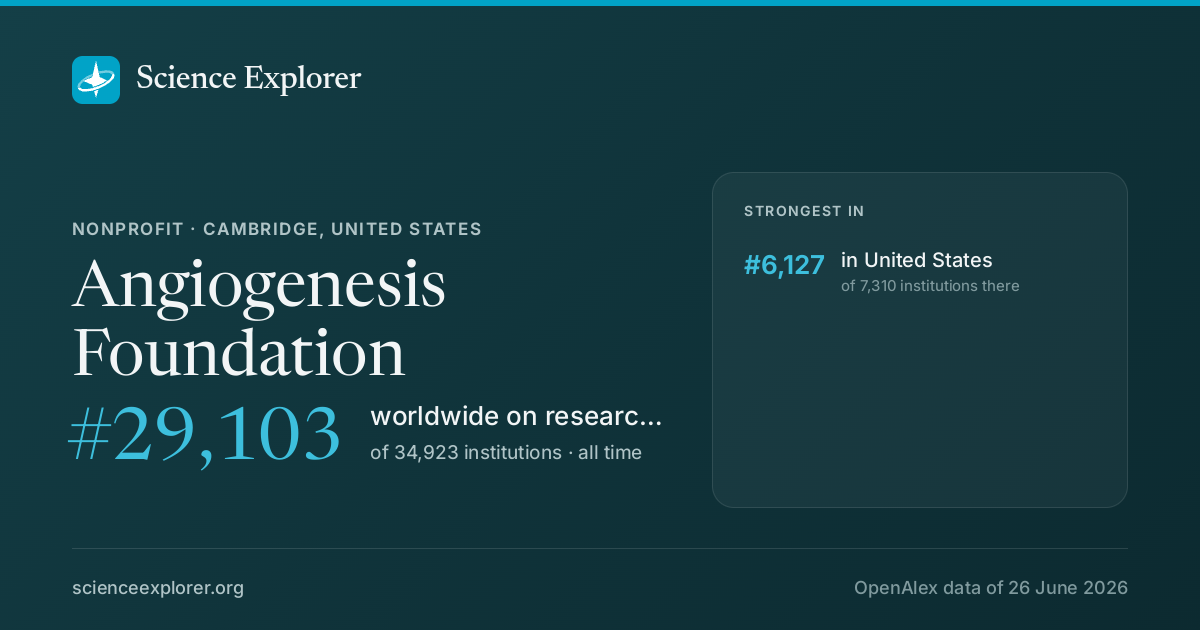
Angiogenesis Foundation on Science Explorer

A card with Angiogenesis Foundation's standing and the fields it leads in, for a post or a slide. A link to this page previews as the same card.

Download the card

1200 × 630 PNG, sized for social posts, drawn from the latest snapshot.

Badges for a website1Each links back here and updates with every snapshot

Research measures only: rankings here say nothing about teaching, admissions or student experience. Comparable institutions and collaboration partners have tabs of their own, above.

Discussion

Ask a question or share a note about Angiogenesis Foundation. Posts are plain text and can be reported.