Science Explorer Back to mapMap
Discussion
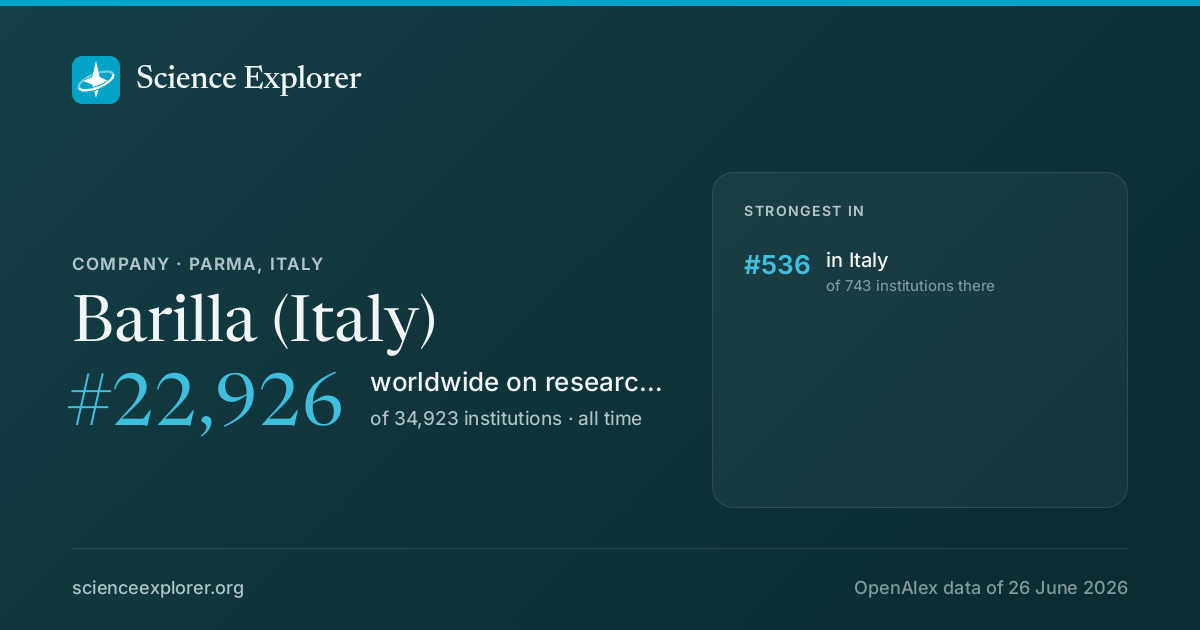
Company · Parma · Italy

Barilla (Italy)

World rank, all time
#22,926
of 34,923
Rank in Italy
#536
of 743
Research works
167
▼ 31% vs 2018-21
Citations
5.4k
32.3 per fractional work
Top-10% rate
22.8%
all institutions 10.0%
vs its own fields
1.22×
1.00× is exactly expected
Open access
60%
world 40%
International
20%
world 18%

Which fields of science does Barilla (Italy) work in?

In 2022-now, 49% of research at Barilla (Italy) is in Health Sciences, 30% in Life Sciences. Its largest fields are Medicine (41%), Agricultural and Biological Sciences (19%), Environmental Science (7%). It does 1.9× the world's share of Health Sciences.

Health Sciences: 23 fractional works · 48.8% of its workMedicine: 20 fractional works · 41.0% of its workEpidemiology: 2 fractional works · 5.1% of its workInfectious Diseases: 2 fractional works · 5.1% of its workPediatrics, Perinatology and Child Health: 2 fractional works · 5.1% of its workPublic Health, Environmental and Occupational Health: 2 fractional works · 3.5% of its workPulmonary and Respiratory Medicine: 2 fractional works · 3.2% of its workObstetrics and Gynecology: 1 fractional works · 2.6% of its workSurgery: 1 fractional works · 2.4% of its workNeurology: 1 fractional works · 1.7% of its workPhysiology: 1 fractional works · 1.7% of its workEmergency Medicine: 1 fractional works · 1.6% of its workEndocrinology, Diabetes and Metabolism: 1 fractional works · 1.5% of its workImmunology and Allergy: 1 fractional works · 1.2% of its workOrthopedics and Sports Medicine: 1 fractional works · 1.1% of its workBiochemistry: 0 fractional works · 0.6% of its workRadiology, Nuclear Medicine and Imaging: 0 fractional works · 0.6% of its workAnesthesiology and Pain Medicine: 0 fractional works · 0.5% of its workReproductive Medicine: 0 fractional works · 0.5% of its workCardiology and Cardiovascular Medicine: 0 fractional works · 0.5% of its workPathology and Forensic Medicine: 0 fractional works · 0.5% of its workCritical Care and Intensive Care Medicine: 0 fractional works · 0.4% of its workHematology: 0 fractional works · 0.3% of its workPsychiatry and Mental health: 0 fractional works · 0.3% of its workRheumatology: 0 fractional works · 0.3% of its workDermatology: 0 fractional works · 0.2% of its workPharmacology: 0 fractional works · 0.2% of its workSmaller subfields together: 0 fractional works · 0.4% of its workNursing: 3 fractional works · 6.1% of its workNutrition and Dietetics: 3 fractional works · 6.1% of its workHealth Professions: 1 fractional works · 1.5% of its workGeneral Health Professions: 0 fractional works · 1.0% of its workSmaller subfields together: 0 fractional works · 0.5% of its workDentistry: 0 fractional works · 0.2% of its workPeriodontics: 0 fractional works · 0.2% of its workLife Sciences: 14 fractional works · 29.7% of its workAgricultural and Biological Sciences: 9 fractional works · 19.4% of its workFood Science: 4 fractional works · 8.3% of its workPlant Science: 3 fractional works · 7.1% of its workSoil Science: 1 fractional works · 1.4% of its workEcology, Evolution, Behavior and Systematics: 1 fractional works · 1.1% of its workAgronomy and Crop Science: 0 fractional works · 0.7% of its workAnimal Science and Zoology: 0 fractional works · 0.6% of its workSmaller subfields together: 0 fractional works · 0.3% of its workBiochemistry, Genetics and Molecular Biology: 3 fractional works · 6.4% of its workMolecular Biology: 2 fractional works · 3.9% of its workGenetics: 1 fractional works · 1.1% of its workBiophysics: 0 fractional works · 0.8% of its workCancer Research: 0 fractional works · 0.4% of its workSmaller subfields together: 0 fractional works · 0.3% of its workImmunology and Microbiology: 1 fractional works · 2.2% of its workImmunology: 1 fractional works · 1.2% of its workVirology: 0 fractional works · 0.7% of its workApplied Microbiology and Biotechnology: 0 fractional works · 0.2% of its workSmaller subfields together: 0 fractional works · 0.0% of its workNeuroscience: 1 fractional works · 1.5% of its workDevelopmental Neuroscience: 0 fractional works · 0.6% of its workEndocrine and Autonomic Systems: 0 fractional works · 0.4% of its workSensory Systems: 0 fractional works · 0.3% of its workSmaller subfields together: 0 fractional works · 0.3% of its workPharmacology, Toxicology and Pharmaceutics: 0 fractional works · 0.3% of its workPharmacology: 0 fractional works · 0.3% of its workPhysical Sciences: 8 fractional works · 16.4% of its workEnvironmental Science: 3 fractional works · 6.7% of its workEcology: 1 fractional works · 3.0% of its workHealth, Toxicology and Mutagenesis: 0 fractional works · 0.8% of its workGlobal and Planetary Change: 0 fractional works · 0.7% of its workEnvironmental Engineering: 0 fractional works · 0.6% of its workEnvironmental Chemistry: 0 fractional works · 0.6% of its workPollution: 0 fractional works · 0.5% of its workIndustrial and Manufacturing Engineering: 0 fractional works · 0.3% of its workManagement, Monitoring, Policy and Law: 0 fractional works · 0.2% of its workChemistry: 2 fractional works · 3.8% of its workAnalytical Chemistry: 1 fractional works · 2.9% of its workSpectroscopy: 0 fractional works · 0.9% of its workEngineering: 2 fractional works · 3.6% of its workBiomedical Engineering: 1 fractional works · 2.5% of its workComputational Mechanics: 0 fractional works · 0.2% of its workMechanical Engineering: 0 fractional works · 0.2% of its workMechanics of Materials: 0 fractional works · 0.2% of its workSmaller subfields together: 0 fractional works · 0.4% of its workMaterials Science: 1 fractional works · 1.3% of its workBiomaterials: 0 fractional works · 0.9% of its workPolymers and Plastics: 0 fractional works · 0.2% of its workSmaller subfields together: 0 fractional works · 0.2% of its workEarth and Planetary Sciences: 0 fractional works · 0.6% of its workAtmospheric Science: 0 fractional works · 0.4% of its workPaleontology: 0 fractional works · 0.3% of its workMathematics: 0 fractional works · 0.3% of its workModeling and Simulation: 0 fractional works · 0.3% of its workSocial Sciences: 2 fractional works · 5.0% of its workSocial Sciences: 1 fractional works · 2.5% of its workEducation: 1 fractional works · 1.5% of its workHealth: 0 fractional works · 0.8% of its workSmaller subfields together: 0 fractional works · 0.2% of its workBusiness, Management and Accounting: 1 fractional works · 1.3% of its workMarketing: 0 fractional works · 0.8% of its workStrategy and Management: 0 fractional works · 0.5% of its workPsychology: 1 fractional works · 1.1% of its workSocial Psychology: 0 fractional works · 0.5% of its workClinical Psychology: 0 fractional works · 0.3% of its workExperimental and Cognitive Psychology: 0 fractional works · 0.2% of its workArts and Humanities: 0 fractional works · 0.1% of its workEconomics, Econometrics and Finance: 0 fractional works · 0.0% of its workALL ITS WORKBarilla (Italy)48fractional works, 2022-now
Life Sciences30%Physical Sciences16%Health Sciences49%Social Sciences5%

Each ring splits the one inside it: the four domains of science, their fields, their subfields. Size is fractional works in 2022-now. Every slice is a page; the interactive view zooms down to single topics and colours each by how much more of it this institution does than the world.

Its 4 domains and 20 fields, with their numbers
    1. Medicine2041.0%
    2. Nursing36.1%
    3. Health Professions11.5%
    4. Dentistry00.2%
    1. Agricultural and Biological Sciences919.4%
    2. Biochemistry, Genetics and Molecular Biology36.4%
    3. Immunology and Microbiology12.2%
    4. Neuroscience11.5%
    5. Pharmacology, Toxicology and Pharmaceutics00.3%
    1. Environmental Science36.7%
    2. Chemistry23.8%
    3. Engineering23.6%
    4. Materials Science11.3%
    5. Earth and Planetary Sciences00.6%
    6. Mathematics00.3%
    1. Social Sciences12.5%
    2. Business, Management and Accounting11.3%
    3. Psychology11.1%
    4. Arts and Humanities00.1%
    5. Economics, Econometrics and Finance00.0%
All of science, and how each field's share has moved since 1950: the Science domain explorer

Field profile

Location quotient across every field it publishes in: outside the ring is more than an institution of this size would be expected to publish, inside it is less.

Agricultural and Biological Sciences: 4.08× its world share, 9 worksAgricultural and Bio…Biochemistry, Genetics and Molecular Biology: 1.19× its world share, 3 worksBiochemistry, Geneti…Immunology and Microbiology: 2.15× its world share, 1 worksImmunology and Micro…Neuroscience: 0.95× its world share, 1 worksNeurosciencePharmacology, Toxicology and Pharmaceutics: 0.89× its world share, 0 worksPharmacology, Toxico…Chemistry: 2.45× its world share, 2 worksChemistryEarth and Planetary Sciences: 0.41× its world share, 0 worksEarth and Planetary …Engineering: 0.24× its world share, 2 worksEngineeringEnvironmental Science: 1.35× its world share, 3 worksEnvironmental ScienceMaterials Science: 0.37× its world share, 1 worksMaterials ScienceMathematics: 0.22× its world share, 0 worksMathematicsDentistry: 0.48× its world share, 0 worksDentistryHealth Professions: 0.59× its world share, 1 worksHealth ProfessionsMedicine: 2.13× its world share, 20 worksMedicineNursing: 12.38× its world share, 3 worksNursingArts and Humanities: 0.05× its world share, 0 worksArts and HumanitiesBusiness, Management and Accounting: 0.40× its world share, 1 worksBusiness, Management…Economics, Econometrics and Finance: 0.02× its world share, 0 worksEconomics, Econometr…Psychology: 0.36× its world share, 0 worksPsychologySocial Sciences: 0.20× its world share, 1 worksSocial Sciences1×world share
more than its size predictsabout as predictedless

Rings at 0.5×, 1× and 2×. Widest outward: Nursing, 12.4×. Every wedge is a field page.

All 20 fields, with their numbers
  1. Nursing12.38×3 works
  2. Agricultural and Biological Sciences4.08×9 works
  3. Chemistry2.45×2 works
  4. Immunology and Microbiology2.15×1 works
  5. Medicine2.13×20 works
  6. Environmental Science1.35×3 works
  7. Biochemistry, Genetics and Molecular Biology1.19×3 works
  8. Neuroscience0.95×1 works
  9. Pharmacology, Toxicology and Pharmaceutics0.89×0 works
  10. Health Professions0.59×1 works
  11. Dentistry0.48×0 works
  12. Earth and Planetary Sciences0.41×0 works
  13. Business, Management and Accounting0.40×1 works
  14. Materials Science0.37×1 works
  15. Psychology0.36×0 works
  16. Engineering0.24×2 works
  17. Mathematics0.22×0 works
  18. Social Sciences0.20×1 works
  19. Arts and Humanities0.05×0 works
  20. Economics, Econometrics and Finance0.02×0 works

Who are the top researchers at Barilla (Italy)?

Ranked on the quality score, Luca Fernando Ruini, Paola Carnevali and Roberto Ciati lead among researchers whose main affiliation is Barilla (Italy).

  1. 1 Luca Fernando Ruini Italy · #888,459 worldwide 1k citations · 37 works
  2. 2 Paola Carnevali Italy · #892,375 worldwide 2k citations · 39 works
  3. 3 Roberto Ciati Italy · #1,036,412 worldwide 1.3k citations · 16 works
  4. 4 Katarzyna Dembska Italy · #2,342,190 worldwide 455 citations · 27 works
  5. 5 Pierpacifico Gismondi Italy · #2,490,936 worldwide 407 citations · 19 works
  6. 6 Camilla Melegari Italy · #2,507,231 worldwide 803 citations · 28 works
  7. 7 Roberta Ghizzoni Italy · #2,869,934 worldwide 803 citations · 42 works
  8. 8 Michele Suman Italy · #4,232,326 worldwide 4.5k citations · 193 works
  9. 9 Dante Catellani Italy · #4,995,762 worldwide 488 citations · 21 works
  10. 10 Daniele Cavanna Italy · #5,637,771 worldwide 546 citations · 67 works
All ranked researchers at Barilla (Italy)

What are the most cited papers from Barilla (Italy)?

The most cited paper from Barilla (Italy) is "Impact of food processing and detoxification treatments on mycotoxin contamination" (Petr Karlovský, Michele Suman, Franz Berthiller et al., 2016), with 684 citations. Next come "Conceptual Models of Food Choice: Influential Factors Related to Foods, Individual Differences, and Society" (588) and "Interaction of probiotic Lactobacillus and Bifidobacterium strains with human intestinal epithelial cells: Adhesion properties, competition against enteropathogens and modulation of IL-8 production" (399).

Most cited papers
#PaperReleasedCitations
1 Impact of food processing and detoxification treatments on mycotoxin contamination Petr Karlovský, Michele Suman, Franz Berthiller et al. · Mycotoxin Research Open access 23 Aug 2016 684
2 Conceptual Models of Food Choice: Influential Factors Related to Foods, Individual Differences, and Society Pin-Jane Chen, Marta Antonelli · Foods Open access 18 Dec 2020 588
3 Interaction of probiotic Lactobacillus and Bifidobacterium strains with human intestinal epithelial cells: Adhesion properties, competition against enteropathogens and modulation of IL-8 production Marco Candela, Federico Perna, Paola Carnevali et al. · International Journal of Food Microbiology May 2008 399
4 Antioxidant activity and dietary fibre in durum wheat bran by-products Fabrizio Esposito, Guido Arlotti, Angela Bonifati et al. · Food Research International Open access 6 Jul 2005 300
5 Effects of higher- versus lower-protein diets on health outcomes: a systematic review and meta-analysis Nancy A. Santesso, Elie A. Akl, Marta Angela Bianchi et al. · European Journal of Clinical Nutrition ReviewOpen access 18 Apr 2012 294
All 60 most cited papers, with filters and sorting

Which keywords describe research at Barilla (Italy)?

By fractional works in 2022-now, weighted toward what it does more of than the world: Epidemiology, Metabolic Syndrome, Preterm Infants, Inflammation, Health Benefits, Food Authentication, Dietary Fiber and Health Effects.

▲ more of its work than of the world's◆ about the world's share▼ less than the world's

Size is fractional works in 2022-now in the topics tagged with each word; colour is the word's share of this institution's work against its share of the world's. The 40 words are chosen for being large and distinctive. Each links to the topic it comes from most.

All 40 words, with their numbers
  1. Epidemiology6▲ 3.2×36 topics
  2. Inflammation3▲ 3.3×17 topics
  3. Climate Change3▲ 2.0×11 topics
  4. Metabolic Syndrome2▲ 6.4×10 topics
  5. Health Benefits2▲ 14×4 topics
  6. Preterm Infants2▲ 38×4 topics
  7. Food Authentication2▲ 39×2 topics
  8. Health Effects2▲ 7.0×6 topics
  9. Dietary Fiber2▲ 37×2 topics
  10. Environmental Impact2▲ 2.3×8 topics
  11. Neurodevelopmental Outcomes2▲ 18×5 topics
  12. Rheological Properties2▲ 20×2 topics
  13. Vaccine2▲ 8.6×8 topics
  14. Antiretroviral Therapy2▲ 20×6 topics
  15. Public Health2▲ 2.1×8 topics
  16. Diagnosis1▲ 3.2×9 topics
  17. Metabolic Health1▲ 14×2 topics
  18. Cardiovascular Disease1▲ 2.4×9 topics
  19. Food Safety1▲ 9.5×8 topics
  20. Glycemic Index1▲ 48×1 topic
  21. Multivariate Calibration1▲ 42×1 topic
  22. Near-Infrared Spectroscopy1▲ 31×1 topic
  23. Pathogenesis1▲ 5.2×9 topics
  24. Starch1▲ 48×1 topic
  25. Sustainability1◆ 1.15×7 topics
  26. Treatment1▲ 2.2×11 topics
  27. Antioxidants1▲ 5.5×6 topics
  28. Oxidative Stress1▲ 1.53×7 topics
  29. Antimicrobial Resistance1▲ 11×6 topics
  30. Antioxidant Activity1▲ 3.7×7 topics
  31. Bronchopulmonary Dysplasia1▲ 34×2 topics
  32. Clinical Practice Guidelines1▲ 4.3×3 topics
  33. Genetics1▲ 3.1×6 topics
  34. Immune Response1▲ 4.1×8 topics
  35. Obesity1▲ 3.0×7 topics
  36. Risk Factors1▲ 2.0×5 topics
  37. Chronic Diseases1▲ 8.2×4 topics
  38. Infection1▲ 8.8×4 topics
  39. Lung Stem Cells1▲ 37×1 topic
  40. Respiratory Distress Syndrome1▲ 26×1 topic

Which research topics does Barilla (Italy) publish most on?

By volume in 2022-now: Spectroscopy and Chemometric Analyses, Food composition and properties, Neonatal Respiratory Health Research and Advanced Chemical Sensor Technologies.

  1. 1 Spectroscopy and Chemometric Analyses Analytical Chemistry 1 works
  2. 2 Food composition and properties Nutrition and Dietetics 1 works
  3. 3 Neonatal Respiratory Health Research Pulmonary and Respiratory Medicine 1 works
  4. 4 Advanced Chemical Sensor Technologies Biomedical Engineering 1 works
  5. 5 Neonatal and fetal brain pathology Pediatrics, Perinatology and Child Health 1 works
  6. 6 Agriculture Sustainability and Environmental Impact Ecology 1 works
  7. 7 Respiratory viral infections research Epidemiology 1 works
  8. 8 Identification and Quantification in Food Molecular Biology 1 works
  9. 9 Microbial Metabolites in Food Biotechnology Nutrition and Dietetics 1 works
  10. 10 Pneumonia and Respiratory Infections Epidemiology 1 works

How open and international is its research?

Against the world's own shares: the tick on each track. Both are shares of its output, so they sit on one scale and can be read against each other as well as against the world.

openly available59.8%not open40.2%

World: 40% of research is openly available.

with international co-authors19.7%domestic only80.3%

World: 18% is written across borders.

How has Barilla (Italy)'s research output changed?

Output in 2022-2025 was 31% lower than in 2018-2021.

still counting1990200020102020
grewheldshrank

The same series as a ribbon: one cell per year, darker for more. The line above answers how much; this answers when.

Its share of all research

Growing output can still be a shrinking share: all of science grows. This is Barilla (Italy) as a percentage of every work published that year, 0.00019% in 2024.

still counting0.00020%0.00040%0.00060%Barilla (Italy)0.00017% in 20251990200020102020

Fractional works of Barilla (Italy) over all fractional works that year. How the balance of science has shifted.

Other research institutions in Parma

All research institutions in Parma

Share Barilla (Italy)'s ranking

Barilla (Italy) on Science Explorer

A card with Barilla (Italy)'s standing and the fields it leads in, for a post or a slide. A link to this page previews as the same card.

Download the card

1200 × 630 PNG, sized for social posts, drawn from the latest snapshot.

Badges for a website1Each links back here and updates with every snapshot

Research measures only: rankings here say nothing about teaching, admissions or student experience. Comparable institutions and collaboration partners have tabs of their own, above.

Discussion

Ask a question or share a note about Barilla (Italy). Keep it to the research: no personal attacks, advertising or links. Any reader can report a post, which collapses it for everyone until it is opened.