- World rank, all time
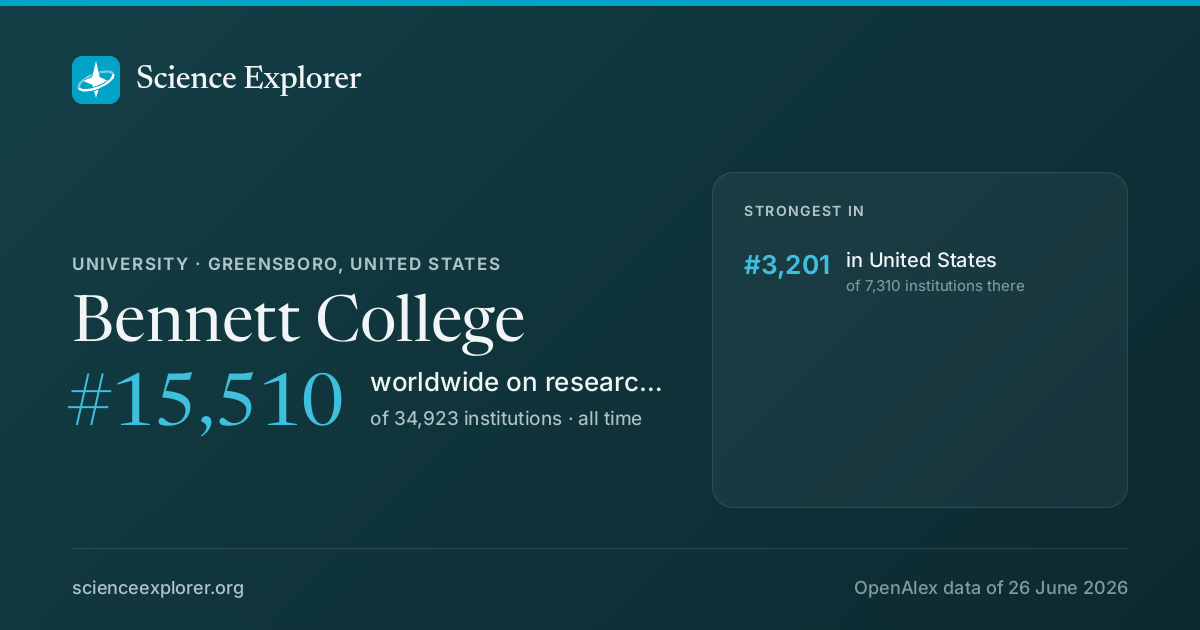
- #15,510 of 34,923
- Rank in United States
- #3,201 of 7,310
- Research works
- 130 ▼ 8% vs 2018-21
- Citations
- 2.6k 20.0 per fractional work
- Top-10% rate
- 6.6% all institutions 10.0%
- vs its own fields
- 0.99× 1.00× is exactly expected
- Open access
- 22% world 40%
- International
- 10% world 18%
Which fields of science does Bennett College work in?
In all years, 45% of research at Bennett College is in Social Sciences, 29% in Physical Sciences. Its largest fields are Social Sciences (27%), Medicine (10%), Computer Science (8%). It does 2.0× the world's share of Social Sciences.
Each ring splits the one inside it: the four domains of science, their fields, their subfields. Size is fractional works in all years. Every slice is a page; the interactive view zooms down to single topics and colours each by how much more of it this institution does than the world.
Its 4 domains and 25 fields, with their numbers
- Social Sciences5945.4%
- Physical Sciences3829.4%
- Computer Science107.7%
- Chemistry96.7%
- Mathematics64.6%
- Engineering54.0%
- Environmental Science21.7%
- Materials Science21.6%
- Physics and Astronomy21.4%
- Energy10.9%
- Earth and Planetary Sciences10.6%
- Chemical Engineering00.1%
- Health Sciences2317.8%
- Medicine1310.3%
- Health Professions96.8%
- Nursing10.5%
- Veterinary00.2%
- Life Sciences107.5%
Field profile
Location quotient across every field it publishes in: outside the ring is more than an institution of this size would be expected to publish, inside it is less.
Rings at 0.5×, 1× and 2×. Widest outward: Chemistry, 9.1×. Every wedge is a field page.
All 16 fields, with their numbers
- Chemistry9.10×2 works
- Energy8.60×1 works
- Decision Sciences3.12×0 works
- Arts and Humanities1.83×1 works
- Computer Science1.78×2 works
- Earth and Planetary Sciences1.40×0 works
- Engineering1.11×2 works
- Social Sciences1.09×2 works
- Materials Science0.69×0 works
- Medicine0.67×2 works
- Health Professions0.64×0 works
- Biochemistry, Genetics and Molecular Biology0.52×0 works
- Environmental Science0.27×0 works
- Agricultural and Biological Sciences0.26×0 works
- Physics and Astronomy0.13×0 works
- Psychology0.12×0 works
- Chemistry 9.1×
- Energy 8.6×
- Decision Sciences 3.1×
- Arts and Humanities 1.8×
- Computer Science 1.8×
- Earth and Planetary Sciences 1.4×
- Engineering 1.1×
- Social Sciences 1.1×
- Materials Science 0.7×
- Medicine 0.7×
- Health Professions 0.6×
- Biochemistry, Genetics and Molecular Biology 0.5×
- Environmental Science 0.3×
- Agricultural and Biological Sciences 0.3×
- Physics and Astronomy 0.1×
- Psychology 0.1×
Who are the top researchers at Bennett College?
Ranked on the quality score, George Breathett, Santiba D. Campbell and Lynn Veach Sadler lead among researchers whose main affiliation is Bennett College.
- 1
George Breathett
 United States · #2,311,635 worldwide
222 citations · 17 works
- 2
Santiba D. Campbell
United States · #2,729,754 worldwide
140 citations · 18 works
- 3
Lynn Veach Sadler
United States · #4,728,144 worldwide
30 citations · 25 works
Which keywords describe research at Bennett College?
By fractional works in all years, weighted toward what it does more of than the world: Mental Health, Race, Colonialism, Identity, Globalization, Gender, Feminism and Social Movements.
- Burnout
- Capacity Building
- Slavery
- Metal-Catalyzed Reactions
- Black Studies
- Politics
- Implicit Bias
- Intrusion Detection
- Developmental Trajectories
- Student Engagement
- Adolescents
- Resilience
- Nationalism
- Social Movements
- Feminism
- Gender
- Education
- Identity
- Machine Learning
- Globalization
- Mental Health
- Epidemiology
- Colonialism
- Race
- Deep Learning
- Educational Technology
- Literature
- Culture
- Postcolonialism
- Social Mobility
- Clinical Guidelines
- Transition Metal Catalysis
- Educational Inequality
- Defensive Medicine
- Malpractice Risk
- Archaeology
- Civil Rights Movement
- Number Theory
- Teaching Methods
- Parenting
Size is fractional works in all years in the topics tagged with each word; colour is the word's share of this institution's work against its share of the world's. The 40 words are chosen for being large and distinctive. Each links to the topic it comes from most.
All 40 words, with their numbers
- Mental Health6▲ 4.2×10 topics
- Globalization6▲ 2.4×16 topics
- Epidemiology6◆ 1.06×24 topics
- Machine Learning5▲ 1.70×8 topics
- Colonialism4▲ 7.0×8 topics
- Identity4▲ 4.5×10 topics
- Race4▲ 26×9 topics
- Education4▲ 2.5×10 topics
- Deep Learning4▲ 1.44×4 topics
- Gender4▲ 4.8×8 topics
- Educational Technology3▲ 3.5×7 topics
- Feminism3▲ 8.2×5 topics
- Literature3▲ 4.4×7 topics
- Social Movements3▲ 6.9×4 topics
- Culture3▲ 4.2×6 topics
- Nationalism3▲ 3.7×6 topics
- Postcolonialism2▲ 17×4 topics
- Resilience2▲ 5.0×4 topics
- Social Mobility2▲ 47×2 topics
- Adolescents2▲ 4.6×3 topics
- Clinical Guidelines2▲ 5.1×3 topics
- Student Engagement2▲ 6.0×6 topics
- Transition Metal Catalysis2▲ 11×4 topics
- Developmental Trajectories2▲ 11×3 topics
- Educational Inequality2▲ 24×2 topics
- Intrusion Detection2▲ 16×2 topics
- Defensive Medicine2▲ 42×1 topic
- Implicit Bias2▲ 31×2 topics
- Malpractice Risk2▲ 42×1 topic
- Politics2▲ 5.2×5 topics
- Archaeology2▲ 8.5×2 topics
- Black Studies2▲ 42×1 topic
- Civil Rights Movement2▲ 42×1 topic
- Metal-Catalyzed Reactions2▲ 15×2 topics
- Number Theory2▲ 42×3 topics
- Slavery2▲ 48×2 topics
- Teaching Methods2▲ 10×4 topics
- Capacity Building2▲ 18×2 topics
- Parenting2▲ 9.1×2 topics
- Burnout2▲ 12×3 topics
Which research topics does Bennett College publish most on?
By volume in 2022-now: Energy, Environment, and Transportation Policies, BIM and Construction Integration, Digital Media and Philosophy and Pragmatism in Philosophy and Education.
Area is fractional works; colour is the subfield each topic belongs to.
- 1 Energy, Environment, and Transportation Policies Renewable Energy, Sustainability and the Environment 1 works
- 2 BIM and Construction Integration Building and Construction 1 works
- 3 Digital Media and Philosophy Computer Science Applications 0 works
- 4 Pragmatism in Philosophy and Education Philosophy 0 works
- 5 Skin Protection and Aging Dermatology 0 works
- 6 Innovative Human-Technology Interaction Human-Computer Interaction 0 works
- 7 Interactive and Immersive Displays Human-Computer Interaction 0 works
- 8 Workplace Spirituality and Leadership Demography 0 works
- 9 Hair Growth and Disorders Urology 0 works
- 10 Digital Economy and Work Transformation Sociology and Political Science 0 works
How open and international is its research?
Against the world's own shares: the tick on each track. Both are shares of its output, so they sit on one scale and can be read against each other as well as against the world.
World: 40% of research is openly available.
World: 18% is written across borders.
How has Bennett College's research output changed?
Output in 2022-2025 was 8% lower than in 2018-2021.
The same series as a ribbon: one cell per year, darker for more. The line above answers how much; this answers when.
Its share of all research
Growing output can still be a shrinking share: all of science grows. This is Bennett College as a percentage of every work published that year, 0.000059% in 2024.
Fractional works of Bennett College over all fractional works that year. How the balance of science has shifted.
Other research institutions in Greensboro
- University of North Carolina at Greensboro
- North Carolina Agricultural and Technical State University
- Guilford College
- Cone Health
- Greensboro College
- Syngenta (United States)
- Center for Creative Leadership
- Medication Management (United States)

Share Bennett College's ranking
Badges for a website1Each links back here and updates with every snapshot

Research measures only: rankings here say nothing about teaching, admissions or student experience. Comparable institutions and collaboration partners have tabs of their own, above.
Discussion
Ask a question or share a note about Bennett College. Posts are plain text and can be reported.