Science Explorer Back to mapMap
Discussion
Research facility · Helsinki · Finland

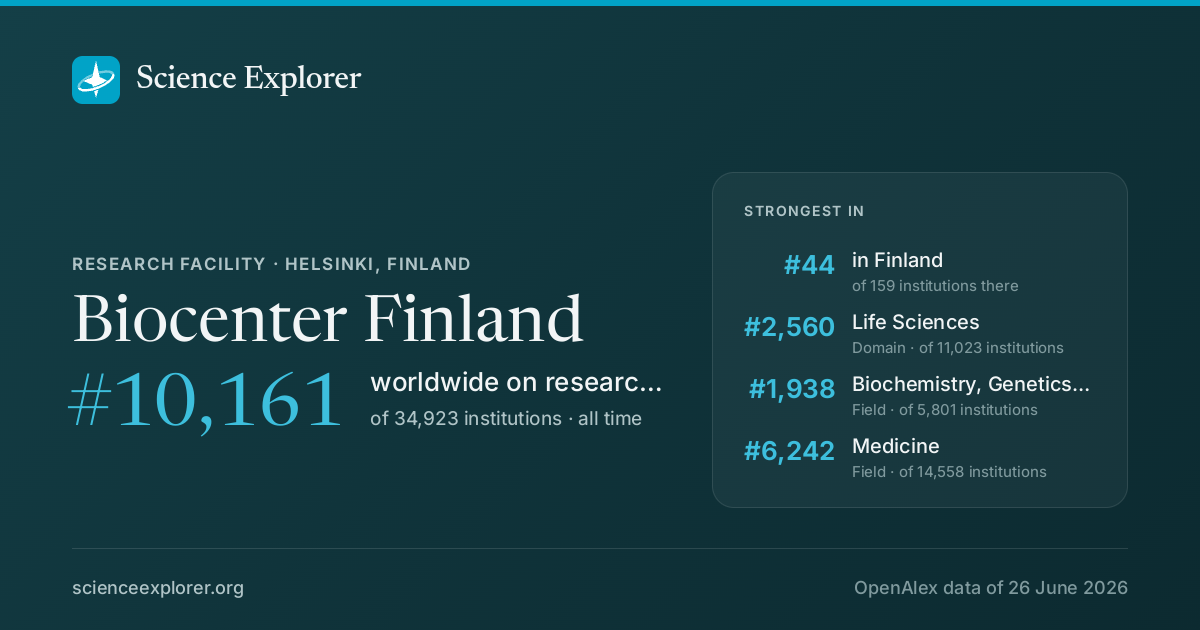
Biocenter Finland

In research, Biocenter Finland stands highest in Life Sciences (#2,560 of 11,023 worldwide), Biochemistry, Genetics and Molecular Biology (#1,938 of 5,801 worldwide) and Medicine (#6,242 of 14,558 worldwide), over all time. Relative to its size it is most specialised in Life Sciences (Life Sciences is 3.5× its share of world research).

World rank, all time
#10,161
of 34,923
Rank in Finland
#44
of 159
Research works
709
▲ 11% vs 2018-21
Citations
48k
68.4 per fractional work
Top-10% rate
15.1%
all institutions 10.0%
vs its own fields
1.28×
1.00× is exactly expected
Open access
46%
world 40%
International
34%
world 18%

What is Biocenter Finland known for in research?

The fields where it stands highest, over all time, ranked among every institution above the floor in each field.

FieldWorld rankWhere that sitsTop-10% rateWorks
Life SciencesDomain #2,560 of 11,023 14.9%406
Biochemistry, Genetics and Molecular BiologyField #1,938 of 5,801 15.0%239
MedicineField #6,242 of 14,558 17.8%161
Health SciencesDomain #7,617 of 16,688 18.5%170
Molecular BiologySubfield #1,723 of 3,729 14.1%141

Each strip is that field's whole ranked pool, with the notch where Biocenter Finland sits in it, in the colour of the band that rank falls in. The track under the rate is the rate itself: it carries no average mark, because the average differs by field (from about 6% in Dentistry to 21% in Economics).

Which fields of science does Biocenter Finland work in?

In 2022-now, 46% of research at Biocenter Finland is in Life Sciences, 31% in Health Sciences. Its largest fields are Biochemistry, Genetics and Molecular Biology (30%), Medicine (27%), Agricultural and Biological Sciences (13%). It does 2.8× the world's share of Life Sciences.

Life Sciences: 25 fractional works · 46.3% of its workBiochemistry, Genetics and Molecular Biology: 16 fractional works · 29.8% of its workMolecular Biology: 7 fractional works · 12.8% of its workGenetics: 4 fractional works · 6.7% of its workBiotechnology: 2 fractional works · 3.8% of its workCell Biology: 1 fractional works · 2.4% of its workCancer Research: 1 fractional works · 2.2% of its workClinical Biochemistry: 0 fractional works · 0.7% of its workEndocrinology: 0 fractional works · 0.3% of its workPhysiology: 0 fractional works · 0.3% of its workBiochemistry: 0 fractional works · 0.3% of its workAging: 0 fractional works · 0.2% of its workSmaller subfields together: 0 fractional works · 0.3% of its workAgricultural and Biological Sciences: 7 fractional works · 12.6% of its workPlant Science: 3 fractional works · 5.9% of its workInsect Science: 1 fractional works · 1.3% of its workFood Science: 1 fractional works · 1.3% of its workEcology, Evolution, Behavior and Systematics: 1 fractional works · 1.2% of its workGeneral Agricultural and Biological Sciences: 1 fractional works · 1.0% of its workAquatic Science: 0 fractional works · 0.6% of its workSoil Science: 0 fractional works · 0.5% of its workAnimal Science and Zoology: 0 fractional works · 0.3% of its workAgronomy and Crop Science: 0 fractional works · 0.3% of its workSmaller subfields together: 0 fractional works · 0.2% of its workImmunology and Microbiology: 1 fractional works · 2.5% of its workImmunology: 1 fractional works · 2.3% of its workSmaller subfields together: 0 fractional works · 0.2% of its workNeuroscience: 1 fractional works · 1.1% of its workCellular and Molecular Neuroscience: 0 fractional works · 0.9% of its workSmaller subfields together: 0 fractional works · 0.2% of its workPharmacology, Toxicology and Pharmaceutics: 0 fractional works · 0.3% of its workHealth Sciences: 17 fractional works · 30.9% of its workMedicine: 15 fractional works · 27.4% of its workOncology: 5 fractional works · 8.8% of its workSurgery: 1 fractional works · 2.1% of its workEpidemiology: 1 fractional works · 2.0% of its workPhysiology: 1 fractional works · 2.0% of its workEndocrinology, Diabetes and Metabolism: 1 fractional works · 1.3% of its workPulmonary and Respiratory Medicine: 1 fractional works · 1.0% of its workInfectious Diseases: 1 fractional works · 1.0% of its workDermatology: 1 fractional works · 1.0% of its workNeurology: 0 fractional works · 0.9% of its workPublic Health, Environmental and Occupational Health: 0 fractional works · 0.8% of its workRadiology, Nuclear Medicine and Imaging: 0 fractional works · 0.8% of its workRheumatology: 0 fractional works · 0.8% of its workPharmacology: 0 fractional works · 0.7% of its workPathology and Forensic Medicine: 0 fractional works · 0.7% of its workBiochemistry: 0 fractional works · 0.6% of its workGenetics: 0 fractional works · 0.4% of its workCardiology and Cardiovascular Medicine: 0 fractional works · 0.4% of its workComplementary and alternative medicine: 0 fractional works · 0.3% of its workHematology: 0 fractional works · 0.3% of its workOtorhinolaryngology: 0 fractional works · 0.3% of its workFamily Practice: 0 fractional works · 0.2% of its workSmaller subfields together: 1 fractional works · 1.1% of its workHealth Professions: 1 fractional works · 1.4% of its workEmergency Medical Services: 0 fractional works · 0.6% of its workSpeech and Hearing: 0 fractional works · 0.6% of its workGeneral Health Professions: 0 fractional works · 0.2% of its workNursing: 1 fractional works · 1.2% of its workNutrition and Dietetics: 1 fractional works · 1.2% of its workVeterinary: 0 fractional works · 0.8% of its workEquine: 0 fractional works · 0.7% of its workSmaller subfields together: 0 fractional works · 0.1% of its workPhysical Sciences: 10 fractional works · 18.3% of its workEnvironmental Science: 4 fractional works · 7.1% of its workGlobal and Planetary Change: 1 fractional works · 1.9% of its workEcology: 1 fractional works · 1.9% of its workHealth, Toxicology and Mutagenesis: 0 fractional works · 0.7% of its workNature and Landscape Conservation: 0 fractional works · 0.6% of its workEnvironmental Chemistry: 0 fractional works · 0.5% of its workEnvironmental Engineering: 0 fractional works · 0.4% of its workEcological Modeling: 0 fractional works · 0.3% of its workManagement, Monitoring, Policy and Law: 0 fractional works · 0.3% of its workPollution: 0 fractional works · 0.3% of its workSmaller subfields together: 0 fractional works · 0.1% of its workEngineering: 4 fractional works · 6.7% of its workBiomedical Engineering: 2 fractional works · 3.6% of its workMechanical Engineering: 0 fractional works · 0.9% of its workBuilding and Construction: 0 fractional works · 0.7% of its workComputational Mechanics: 0 fractional works · 0.6% of its workAutomotive Engineering: 0 fractional works · 0.5% of its workCivil and Structural Engineering: 0 fractional works · 0.2% of its workElectrical and Electronic Engineering: 0 fractional works · 0.2% of its workSmaller subfields together: 0 fractional works · 0.0% of its workMaterials Science: 1 fractional works · 1.6% of its workBiomaterials: 0 fractional works · 0.5% of its workMaterials Chemistry: 0 fractional works · 0.4% of its workPolymers and Plastics: 0 fractional works · 0.3% of its workSurfaces, Coatings and Films: 0 fractional works · 0.3% of its workChemistry: 1 fractional works · 1.0% of its workOrganic Chemistry: 0 fractional works · 0.6% of its workSpectroscopy: 0 fractional works · 0.2% of its workElectrochemistry: 0 fractional works · 0.2% of its workEarth and Planetary Sciences: 0 fractional works · 0.8% of its workOceanography: 0 fractional works · 0.4% of its workAtmospheric Science: 0 fractional works · 0.2% of its workSmaller subfields together: 0 fractional works · 0.1% of its workComputer Science: 0 fractional works · 0.5% of its workComputational Theory and Mathematics: 0 fractional works · 0.5% of its workSmaller subfields together: 0 fractional works · 0.1% of its workEnergy: 0 fractional works · 0.4% of its workRenewable Energy, Sustainability and the Environment: 0 fractional works · 0.4% of its workPhysics and Astronomy: 0 fractional works · 0.2% of its workRadiation: 0 fractional works · 0.2% of its workMathematics: 0 fractional works · 0.1% of its workSocial Sciences: 2 fractional works · 4.5% of its workSocial Sciences: 1 fractional works · 2.4% of its workSociology and Political Science: 0 fractional works · 0.8% of its workCultural Studies: 0 fractional works · 0.7% of its workGender Studies: 0 fractional works · 0.3% of its workPolitical Science and International Relations: 0 fractional works · 0.3% of its workAnthropology: 0 fractional works · 0.3% of its workPsychology: 1 fractional works · 1.0% of its workApplied Psychology: 0 fractional works · 0.3% of its workExperimental and Cognitive Psychology: 0 fractional works · 0.3% of its workSmaller subfields together: 0 fractional works · 0.3% of its workEconomics, Econometrics and Finance: 0 fractional works · 0.6% of its workEconomics and Econometrics: 0 fractional works · 0.6% of its workArts and Humanities: 0 fractional works · 0.3% of its workArcheology: 0 fractional works · 0.3% of its workBusiness, Management and Accounting: 0 fractional works · 0.1% of its workDecision Sciences: 0 fractional works · 0.0% of its workALL ITS WORKBiocenter Finland55fractional works, 2022-now
Life Sciences46%Physical Sciences18%Health Sciences31%Social Sciences4%

Each ring splits the one inside it: the four domains of science, their fields, their subfields. Size is fractional works in 2022-now. Every slice is a page; the interactive view zooms down to single topics and colours each by how much more of it this institution does than the world.

Its 4 domains and 24 fields, with their numbers
    1. Biochemistry, Genetics and Molecular Biology1629.8%
    2. Agricultural and Biological Sciences712.6%
    3. Immunology and Microbiology12.5%
    4. Neuroscience11.1%
    5. Pharmacology, Toxicology and Pharmaceutics00.3%
    1. Medicine1527.4%
    2. Health Professions11.4%
    3. Nursing11.2%
    4. Veterinary00.8%
    1. Environmental Science47.1%
    2. Engineering46.7%
    3. Materials Science11.6%
    4. Chemistry11.0%
    5. Earth and Planetary Sciences00.8%
    6. Computer Science00.5%
    7. Energy00.4%
    8. Physics and Astronomy00.2%
    9. Mathematics00.1%
    1. Social Sciences12.4%
    2. Psychology11.0%
    3. Economics, Econometrics and Finance00.6%
    4. Arts and Humanities00.3%
    5. Business, Management and Accounting00.1%
    6. Decision Sciences00.0%
All of science, and how each field's share has moved since 1950: the Science domain explorer

What does Biocenter Finland specialise in?

Where its research is concentrated relative to its size: Life Sciences takes 3.5× the share of its output that it takes of world research.

  1. Life SciencesDomain · 25.3 works3.5×
← less than its size predicts1×more →

Location quotient, a volume reading rather than an impact one. It surfaces small, lopsided specialities.

Field profile

Location quotient across every field it publishes in: outside the ring is more than an institution of this size would be expected to publish, inside it is less.

Agricultural and Biological Sciences: 2.66× its world share, 7 worksAgricultural and Bio…Biochemistry, Genetics and Molecular Biology: 5.59× its world share, 16 worksBiochemistry, Geneti…Immunology and Microbiology: 2.49× its world share, 1 worksImmunology and Micro…Neuroscience: 0.69× its world share, 1 worksNeurosciencePharmacology, Toxicology and Pharmaceutics: 0.78× its world share, 0 worksPharmacology, Toxico…Chemistry: 0.65× its world share, 1 worksChemistryComputer Science: 0.07× its world share, 0 worksComputer ScienceEarth and Planetary Sciences: 0.48× its world share, 0 worksEarth and Planetary …Energy: 0.40× its world share, 0 worksEnergyEngineering: 0.44× its world share, 4 worksEngineeringEnvironmental Science: 1.42× its world share, 4 worksEnvironmental ScienceMaterials Science: 0.45× its world share, 1 worksMaterials ScienceMathematics: 0.09× its world share, 0 worksMathematicsPhysics and Astronomy: 0.09× its world share, 0 worksPhysics and AstronomyHealth Professions: 0.54× its world share, 1 worksHealth ProfessionsMedicine: 1.43× its world share, 15 worksMedicineNursing: 2.55× its world share, 1 worksNursingVeterinary: 5.96× its world share, 0 worksVeterinaryArts and Humanities: 0.11× its world share, 0 worksArts and HumanitiesBusiness, Management and Accounting: 0.05× its world share, 0 worksBusiness, Management…Decision Sciences: 0.03× its world share, 0 worksDecision SciencesEconomics, Econometrics and Finance: 0.29× its world share, 0 worksEconomics, Econometr…Psychology: 0.31× its world share, 0 worksPsychologySocial Sciences: 0.19× its world share, 1 worksSocial Sciences1×world share
more than its size predictsabout as predictedless

Rings at 0.5×, 1× and 2×. Widest outward: Veterinary, 6.0×. Every wedge is a field page.

All 24 fields, with their numbers
  1. Veterinary5.96×0 works
  2. Biochemistry, Genetics and Molecular Biology5.59×16 works
  3. Agricultural and Biological Sciences2.66×7 works
  4. Nursing2.55×1 works
  5. Immunology and Microbiology2.49×1 works
  6. Medicine1.43×15 works
  7. Environmental Science1.42×4 works
  8. Pharmacology, Toxicology and Pharmaceutics0.78×0 works
  9. Neuroscience0.69×1 works
  10. Chemistry0.65×1 works
  11. Health Professions0.54×1 works
  12. Earth and Planetary Sciences0.48×0 works
  13. Materials Science0.45×1 works
  14. Engineering0.44×4 works
  15. Energy0.40×0 works
  16. Psychology0.31×0 works
  17. Economics, Econometrics and Finance0.29×0 works
  18. Social Sciences0.19×1 works
  19. Arts and Humanities0.11×0 works
  20. Mathematics0.09×0 works
  21. Physics and Astronomy0.09×0 works
  22. Computer Science0.07×0 works
  23. Business, Management and Accounting0.05×0 works
  24. Decision Sciences0.03×0 works

Who are the top researchers at Biocenter Finland?

Ranked on the quality score, Panu Hendolin, E. J. Matikkala and Osmo Suovaniemi lead among researchers whose main affiliation is Biocenter Finland.

  1. 1 Panu Hendolin Finland · #2,963,041 worldwide 1.9k citations · 30 works
  2. 2 E. J. Matikkala Finland · #3,942,054 worldwide 692 citations · 32 works
  3. 3 Osmo Suovaniemi Finland · #4,765,581 worldwide 453 citations · 26 works
  4. 4 Hilkka Tähtinen Finland · #5,477,182 worldwide 21 citations · 23 works
  5. 5 Terttu Ettala Finland · #5,553,983 worldwide 111 citations · 17 works
  6. 6 Lea I. Paloheimo Finland · #5,896,690 worldwide 478 citations · 32 works
  7. 7 Matti Kreula Finland · #6,338,965 worldwide 279 citations · 56 works
All ranked researchers at Biocenter Finland

What are the most cited papers from Biocenter Finland?

The most cited paper from Biocenter Finland is "Antioxidants, Oxidative Damage and Oxygen Deprivation Stress: a Review" (Olga B. Blokhina, 2002), with 4,033 citations. Next come "New genetic loci implicated in fasting glucose homeostasis and their impact on type 2 diabetes risk" (2,239) and "The K+/Cl− co-transporter KCC2 renders GABA hyperpolarizing during neuronal maturation" (2,163).

Most cited papers
#PaperReleasedCitations
1 Antioxidants, Oxidative Damage and Oxygen Deprivation Stress: a Review Olga B. Blokhina · Annals of Botany Open access 31 Dec 2002 4,033
2 New genetic loci implicated in fasting glucose homeostasis and their impact on type 2 diabetes risk Josée Dupuis et al. · Nature Genetics Open access263 authors 17 Jan 2010 2,239
3 The K+/Cl− co-transporter KCC2 renders GABA hyperpolarizing during neuronal maturation Claudio Rivera, Juha Voipio, John A. Payne et al. · Nature 1999 2,163
4 The GDNF family: Signalling, biological functions and therapeutic value Matti S. Airaksinen, Märt Saarma · Nature reviews. Neuroscience Review May 2002 1,860
5 The Paleozoic Origin of Enzymatic Lignin Decomposition Reconstructed from 31 Fungal Genomes Dimitrios Floudas et al. · Science Open access 28 Jun 2012 1,840
All 60 most cited papers, with filters and sorting

Which keywords describe research at Biocenter Finland?

By fractional works in 2022-now, weighted toward what it does more of than the world: Immunotherapy, Gene Therapy, Tumor Regression, Cancer Immunotherapy, Genomic Integration, AAV, Viral Vectors and Leukemia.

▲ more of its work than of the world's◆ about the world's share▼ less than the world's

Size is fractional works in 2022-now in the topics tagged with each word; colour is the word's share of this institution's work against its share of the world's. The 29 words are chosen for being large and distinctive. Each links to the topic it comes from most.

All 29 words, with their numbers
  1. Immunotherapy4▲ 11×9 topics
  2. Gene Therapy4▲ 40×2 topics
  3. Tumor Regression4▲ 64×2 topics
  4. Inflammation3▲ 2.9×28 topics
  5. Cancer Immunotherapy3▲ 36×2 topics
  6. Genomic Integration3▲ 92×2 topics
  7. AAV3▲ 129×1 topic
  8. Viral Vectors3▲ 129×1 topic
  9. Leukemia3▲ 57×2 topics
  10. Lymphoma3▲ 30×2 topics
  11. CAR T Cells2▲ 64×1 topic
  12. Chimeric Antigen Receptor2▲ 64×1 topic
  13. Climate Change2▲ 1.40×18 topics
  14. Oxidative Stress2▲ 2.3×19 topics
  15. Cancer2▲ 2.8×14 topics
  16. Cardiovascular Disease2▲ 2.9×12 topics
  17. Epidemiology2▼ 0.73×18 topics
  18. Biomarkers2▲ 4.0×6 topics
  19. Tumor Targeting2▲ 14×3 topics
  20. Arginine Deprivation1▲ 64×1 topic
  21. Bacterial Therapy1▲ 64×1 topic
  22. Gene Expression1▲ 4.0×11 topics
  23. Cancer Therapy1▲ 4.2×10 topics
  24. Insulin Resistance1▲ 4.8×7 topics
  25. Metabolic Syndrome1▲ 2.6×10 topics
  26. Obesity1▲ 2.8×9 topics
  27. Cell Death1▲ 8.4×6 topics
  28. Cholesterol1▲ 14×4 topics
  29. Genomics1▲ 7.2×6 topics

Which research topics does Biocenter Finland publish most on?

By volume in 2022-now: Virus-based gene therapy research, CAR-T cell therapy research, Cancer Research and Treatments and Extracellular vesicles in disease.

  1. 1 Virus-based gene therapy research Genetics 3 works
  2. 2 CAR-T cell therapy research Oncology 2 works
  3. 3 Cancer Research and Treatments Biotechnology 1 works
  4. 4 Extracellular vesicles in disease Molecular Biology 1 works
  5. 5 Enzyme-mediated dye degradation Plant Science 1 works
  6. 6 Fatty Acid Research and Health Nutrition and Dietetics 1 works
  7. 7 Viral Infectious Diseases and Gene Expression in Insects Molecular Biology 0 works
  8. 8 Fermentation and Sensory Analysis Food Science 0 works
  9. 9 Immunotherapy and Immune Responses Immunology 0 works
  10. 10 Carbon Dioxide Capture Technologies Mechanical Engineering 0 works

How open and international is its research?

Against the world's own shares: the tick on each track. Both are shares of its output, so they sit on one scale and can be read against each other as well as against the world.

openly available46.5%not open53.5%

World: 40% of research is openly available.

with international co-authors34.5%domestic only65.5%

World: 18% is written across borders.

How has Biocenter Finland's research output changed?

Output in 2022-2025 was 11% higher than in 2018-2021.

still counting1990200020102020
grewheldshrank

The same series as a ribbon: one cell per year, darker for more. The line above answers how much; this answers when.

Its share of all research

Growing output can still be a shrinking share: all of science grows. This is Biocenter Finland as a percentage of every work published that year, 0.00012% in 2024.

still counting0.0010%0.0020%0.0030%Biocenter Finland0.00024% in 202519801990200020102020

Fractional works of Biocenter Finland over all fractional works that year. How the balance of science has shifted.

How much of it reaches the world top 10%

Year by year, against all institutions in the same year.

10%20%30%Biocenter Finland21.1% in 2010all institutions10.0% in 201020002010

Of each year's output, the share that reached the world's 10% most cited for its field and year. Peak 27.0% in 2002.

Other research institutions in Helsinki

All research institutions in Helsinki

Share Biocenter Finland's ranking

Biocenter Finland on Science Explorer

A card with Biocenter Finland's standing and the fields it leads in, for a post or a slide. A link to this page previews as the same card.

Download the card

1200 × 630 PNG, sized for social posts, drawn from the latest snapshot.

Badges for a website1Each links back here and updates with every snapshot

Research measures only: rankings here say nothing about teaching, admissions or student experience. Comparable institutions and collaboration partners have tabs of their own, above.

Discussion

Ask a question or share a note about Biocenter Finland. Posts are plain text and can be reported.