Science Explorer Back to mapMap
Discussion
Research facility · Detroit · United States

DMC University Laboratories

World rank, all time
#33,913
of 34,923
Rank in United States
#7,129
of 7,310
Research works
123
▲ 16% vs 2018-21
Citations
2.7k
22.0 per fractional work
Top-10% rate
5.2%
all institutions 10.0%
vs its own fields
0.95×
1.00× is exactly expected
Open access
31%
world 40%
International
5%
world 18%

Which fields of science does DMC University Laboratories work in?

In all years, 46% of research at DMC University Laboratories is in Health Sciences, 36% in Life Sciences. Its largest fields are Medicine (44%), Biochemistry, Genetics and Molecular Biology (20%), Immunology and Microbiology (8%). It does 2.2× the world's share of Life Sciences.

Health Sciences: 57 fractional works · 46.1% of its workMedicine: 54 fractional works · 43.5% of its workEpidemiology: 9 fractional works · 7.3% of its workInfectious Diseases: 8 fractional works · 6.2% of its workSurgery: 5 fractional works · 4.2% of its workCardiology and Cardiovascular Medicine: 3 fractional works · 2.3% of its workPharmacology: 3 fractional works · 2.3% of its workRadiology, Nuclear Medicine and Imaging: 3 fractional works · 2.2% of its workPublic Health, Environmental and Occupational Health: 3 fractional works · 2.2% of its workOncology: 2 fractional works · 2.0% of its workPhysiology: 2 fractional works · 1.7% of its workPediatrics, Perinatology and Child Health: 2 fractional works · 1.5% of its workPulmonary and Respiratory Medicine: 2 fractional works · 1.5% of its workGenetics: 1 fractional works · 0.9% of its workHematology: 1 fractional works · 0.9% of its workComplementary and alternative medicine: 1 fractional works · 0.8% of its workRheumatology: 1 fractional works · 0.7% of its workPathology and Forensic Medicine: 1 fractional works · 0.7% of its workPsychiatry and Mental health: 1 fractional works · 0.7% of its workEndocrinology, Diabetes and Metabolism: 1 fractional works · 0.6% of its workHepatology: 1 fractional works · 0.6% of its workEmergency Medicine: 1 fractional works · 0.6% of its workNeurology: 1 fractional works · 0.5% of its workCritical Care and Intensive Care Medicine: 1 fractional works · 0.5% of its workGastroenterology: 0 fractional works · 0.4% of its workImmunology and Allergy: 0 fractional works · 0.4% of its workMicrobiology: 0 fractional works · 0.4% of its workAnesthesiology and Pain Medicine: 0 fractional works · 0.3% of its workOphthalmology: 0 fractional works · 0.3% of its workNephrology: 0 fractional works · 0.3% of its workRehabilitation: 0 fractional works · 0.2% of its workSmaller subfields together: 1 fractional works · 0.4% of its workHealth Professions: 2 fractional works · 1.5% of its workRadiological and Ultrasound Technology: 1 fractional works · 0.5% of its workGeneral Health Professions: 1 fractional works · 0.4% of its workOccupational Therapy: 0 fractional works · 0.4% of its workSmaller subfields together: 0 fractional works · 0.1% of its workVeterinary: 1 fractional works · 0.5% of its workSmall Animals: 1 fractional works · 0.5% of its workNursing: 1 fractional works · 0.4% of its workNutrition and Dietetics: 1 fractional works · 0.4% of its workDentistry: 0 fractional works · 0.1% of its workLife Sciences: 45 fractional works · 36.3% of its workBiochemistry, Genetics and Molecular Biology: 25 fractional works · 20.1% of its workMolecular Biology: 10 fractional works · 7.8% of its workClinical Biochemistry: 4 fractional works · 3.1% of its workGenetics: 4 fractional works · 3.0% of its workEndocrinology: 2 fractional works · 1.8% of its workMolecular Medicine: 1 fractional works · 1.0% of its workCell Biology: 1 fractional works · 0.9% of its workCancer Research: 1 fractional works · 0.8% of its workBiotechnology: 1 fractional works · 0.5% of its workBiophysics: 1 fractional works · 0.5% of its workBiochemistry: 0 fractional works · 0.3% of its workPhysiology: 0 fractional works · 0.3% of its workImmunology and Microbiology: 10 fractional works · 8.2% of its workImmunology: 6 fractional works · 4.8% of its workMicrobiology: 2 fractional works · 1.8% of its workParasitology: 1 fractional works · 1.0% of its workVirology: 0 fractional works · 0.3% of its workApplied Microbiology and Biotechnology: 0 fractional works · 0.3% of its workAgricultural and Biological Sciences: 5 fractional works · 3.9% of its workAnimal Science and Zoology: 2 fractional works · 1.7% of its workPlant Science: 1 fractional works · 0.7% of its workFood Science: 1 fractional works · 0.6% of its workAgronomy and Crop Science: 0 fractional works · 0.4% of its workInsect Science: 0 fractional works · 0.3% of its workSmaller subfields together: 0 fractional works · 0.2% of its workPharmacology, Toxicology and Pharmaceutics: 3 fractional works · 2.2% of its workPharmacology: 3 fractional works · 2.1% of its workSmaller subfields together: 0 fractional works · 0.1% of its workNeuroscience: 2 fractional works · 1.9% of its workNeurology: 1 fractional works · 0.8% of its workCellular and Molecular Neuroscience: 1 fractional works · 0.7% of its workSmaller subfields together: 0 fractional works · 0.3% of its workPhysical Sciences: 19 fractional works · 15.5% of its workChemistry: 8 fractional works · 6.6% of its workSpectroscopy: 3 fractional works · 2.3% of its workAnalytical Chemistry: 2 fractional works · 1.8% of its workOrganic Chemistry: 1 fractional works · 1.1% of its workPhysical and Theoretical Chemistry: 1 fractional works · 0.9% of its workElectrochemistry: 0 fractional works · 0.4% of its workEngineering: 5 fractional works · 4.4% of its workMechanics of Materials: 2 fractional works · 1.4% of its workBiomedical Engineering: 1 fractional works · 0.9% of its workMechanical Engineering: 1 fractional works · 0.8% of its workAutomotive Engineering: 1 fractional works · 0.5% of its workElectrical and Electronic Engineering: 1 fractional works · 0.5% of its workComputational Mechanics: 0 fractional works · 0.3% of its workSmaller subfields together: 0 fractional works · 0.1% of its workEnvironmental Science: 2 fractional works · 1.9% of its workEcology: 1 fractional works · 0.8% of its workIndustrial and Manufacturing Engineering: 1 fractional works · 0.5% of its workHealth, Toxicology and Mutagenesis: 0 fractional works · 0.4% of its workSmaller subfields together: 0 fractional works · 0.2% of its workMaterials Science: 1 fractional works · 1.0% of its workMaterials Chemistry: 1 fractional works · 0.8% of its workSmaller subfields together: 0 fractional works · 0.2% of its workChemical Engineering: 1 fractional works · 0.8% of its workBioengineering: 1 fractional works · 0.5% of its workFluid Flow and Transfer Processes: 0 fractional works · 0.3% of its workPhysics and Astronomy: 1 fractional works · 0.4% of its workAtomic and Molecular Physics, and Optics: 0 fractional works · 0.3% of its workSmaller subfields together: 0 fractional works · 0.2% of its workComputer Science: 0 fractional works · 0.4% of its workArtificial Intelligence: 0 fractional works · 0.3% of its workSmaller subfields together: 0 fractional works · 0.1% of its workSocial Sciences: 3 fractional works · 2.1% of its workPsychology: 1 fractional works · 0.7% of its workClinical Psychology: 1 fractional works · 0.6% of its workSmaller subfields together: 0 fractional works · 0.1% of its workEconomics, Econometrics and Finance: 1 fractional works · 0.6% of its workEconomics and Econometrics: 1 fractional works · 0.6% of its workSocial Sciences: 1 fractional works · 0.6% of its workSociology and Political Science: 1 fractional works · 0.5% of its workSmaller subfields together: 0 fractional works · 0.0% of its workDecision Sciences: 0 fractional works · 0.3% of its workStatistics, Probability and Uncertainty: 0 fractional works · 0.3% of its workALL ITS WORKDMC UniversityLaboratories123fractional works, all years
Life Sciences36%Physical Sciences15%Health Sciences46%Social Sciences2%

Each ring splits the one inside it: the four domains of science, their fields, their subfields. Size is fractional works in all years. Every slice is a page; the interactive view zooms down to single topics and colours each by how much more of it this institution does than the world.

Its 4 domains and 21 fields, with their numbers
    1. Medicine5443.5%
    2. Health Professions21.5%
    3. Veterinary10.5%
    4. Nursing10.4%
    5. Dentistry00.1%
    1. Biochemistry, Genetics and Molecular Biology2520.1%
    2. Immunology and Microbiology108.2%
    3. Agricultural and Biological Sciences53.9%
    4. Pharmacology, Toxicology and Pharmaceutics32.2%
    5. Neuroscience21.9%
    1. Chemistry86.6%
    2. Engineering54.4%
    3. Environmental Science21.9%
    4. Materials Science11.0%
    5. Chemical Engineering10.8%
    6. Physics and Astronomy10.4%
    7. Computer Science00.4%
    1. Psychology10.7%
    2. Economics, Econometrics and Finance10.6%
    3. Social Sciences10.6%
    4. Decision Sciences00.3%
All of science, and how each field's share has moved since 1950: the Science domain explorer

Field profile

Location quotient across every field it publishes in: outside the ring is more than an institution of this size would be expected to publish, inside it is less.

Agricultural and Biological Sciences: 0.28× its world share, 0 worksAgricultural and Bio…Biochemistry, Genetics and Molecular Biology: 2.93× its world share, 1 worksBiochemistry, Geneti…Immunology and Microbiology: 2.18× its world share, 0 worksImmunology and Micro…Neuroscience: 1.62× its world share, 0 worksNeuroscienceEnvironmental Science: 0.21× its world share, 0 worksEnvironmental ScienceHealth Professions: 0.40× its world share, 0 worksHealth ProfessionsMedicine: 3.58× its world share, 4 worksMedicineNursing: 2.68× its world share, 0 worksNursingEconomics, Econometrics and Finance: 2.76× its world share, 0 worksEconomics, Econometr…1×world share
more than its size predictsabout as predictedless

Rings at 0.5×, 1× and 2×. Widest outward: Medicine, 3.6×. Every wedge is a field page.

All 9 fields, with their numbers
  1. Medicine3.58×4 works
  2. Biochemistry, Genetics and Molecular Biology2.93×1 works
  3. Economics, Econometrics and Finance2.76×0 works
  4. Nursing2.68×0 works
  5. Immunology and Microbiology2.18×0 works
  6. Neuroscience1.62×0 works
  7. Health Professions0.40×0 works
  8. Agricultural and Biological Sciences0.28×0 works
  9. Environmental Science0.21×0 works

Who are the top researchers at DMC University Laboratories?

Ranked on the quality score, Anthony J. Glazko, Wesley A. Dill and Graham Chen lead among researchers whose main affiliation is DMC University Laboratories.

  1. 1 Anthony J. Glazko United States · #843,146 worldwide 2.9k citations · 93 works
  2. 2 Wesley A. Dill United States · #2,296,214 worldwide 1.1k citations · 34 works
  3. 3 Graham Chen United States · #2,306,483 worldwide 955 citations · 40 works
  4. 4 ORSON D. BIRD United States · #2,399,593 worldwide 1.5k citations · 53 works
  5. 5 N. S. Ferry United States · #2,797,208 worldwide 293 citations · 31 works
  6. 6 A.D. Emmett United States · #2,957,892 worldwide 754 citations · 50 works
  7. 7 O. M. Gruhzit United States · #3,151,876 worldwide 371 citations · 29 works
  8. 8 W. Glen Bywater United States · #3,195,524 worldwide 161 citations · 15 works
  9. 9 Gertrude Rodney United States · #3,370,121 worldwide 280 citations · 16 works
  10. 10 L.W. Rowe United States · #3,478,841 worldwide 394 citations · 41 works
All ranked researchers at DMC University Laboratories

What are the most cited papers from DMC University Laboratories?

The most cited paper from DMC University Laboratories is "Amniotic Infection Syndrome: Nosology and Reproducibility of Placental Reaction Patterns" (Raymond W. Redline, Ona Marie Faye-Petersen, Debra S. Heller et al., 2003), with 683 citations. Next come "36th International Symposium on Intensive Care and Emergency Medicine" (531) and "Incidence of and Risk Factors for Colistin-Associated Nephrotoxicity in a Large Academic Health System" (333).

Most cited papers
#PaperReleasedCitations
1 Amniotic Infection Syndrome: Nosology and Reproducibility of Placental Reaction Patterns Raymond W. Redline, Ona Marie Faye-Petersen, Debra S. Heller et al. · Pediatric and Developmental Pathology Sep 2003 683
2 36th International Symposium on Intensive Care and Emergency Medicine R. M. Bateman et al. · Critical Care Open access2,440 authors Apr 2016 531
3 Incidence of and Risk Factors for Colistin-Associated Nephrotoxicity in a Large Academic Health System Jason M. Pogue, Jaewon Lee, Dror Marchaim et al. · Clinical Infectious Diseases Open access 7 Sep 2011 333
4 The Application of the Fluorescent Antibody Technic to the Investigation of Lupus Erythematosus and Various Dermatoses Thomas K. Burnham, Thomas R. Neblett, Gerald Fine · Journal of Investigative Dermatology Open access Dec 1963 279
5 Evaluation of the FilmArray Blood Culture Identification Panel: Results of a Multicenter Controlled Trial Hossein Salimnia, Marilynn Ransom Fairfax, Paul Lephart et al. · Journal of Clinical Microbiology Open access 6 Jan 2016 244
All 60 most cited papers, with filters and sorting

Which keywords describe research at DMC University Laboratories?

By fractional works in all years, weighted toward what it does more of than the world: Epidemiology, Pathogenesis, Inflammation, Antimicrobial Resistance, Diagnosis, Virulence Factors, Antibiotic Resistance and Vaccine.

▲ more of its work than of the world's◆ about the world's share▼ less than the world's

Size is fractional works in all years in the topics tagged with each word; colour is the word's share of this institution's work against its share of the world's. The 40 words are chosen for being large and distinctive. Each links to the topic it comes from most.

All 40 words, with their numbers
  1. Epidemiology24▲ 4.8×54 topics
  2. Inflammation10▲ 3.4×27 topics
  3. Pathogenesis8▲ 11×14 topics
  4. Antimicrobial Resistance6▲ 20×8 topics
  5. Diagnosis6▲ 5.0×19 topics
  6. Treatment6▲ 3.5×19 topics
  7. Virulence Factors5▲ 20×7 topics
  8. Antibiotic Resistance4▲ 8.9×10 topics
  9. Cancer4▲ 2.5×13 topics
  10. Vaccine4▲ 8.2×9 topics
  11. Clinical Management4▲ 16×4 topics
  12. Healthcare-Associated Infections4▲ 26×5 topics
  13. Bacteremia4▲ 40×3 topics
  14. Genetic Mutations4▲ 5.7×6 topics
  15. Pharmacology4▲ 8.5×6 topics
  16. Virus3▲ 21×3 topics
  17. Genomics3▲ 7.0×4 topics
  18. Immunity3▲ 7.2×7 topics
  19. Vaccine Development3▲ 8.0×7 topics
  20. Genomic Analysis3▲ 8.2×7 topics
  21. Genetic Analysis3▲ 43×2 topics
  22. Molecular Diagnosis3▲ 58×2 topics
  23. MRSA2▲ 59×1 topic
  24. Matrix-Assisted Laser Desorption Ionization-Time of Flight Mass Spectrometry2▲ 70×1 topic
  25. Microorganism Identification2▲ 70×1 topic
  26. Staphylococcus aureus2▲ 27×1 topic
  27. Chiral Separation2▲ 16×1 topic
  28. Gene Therapy2▲ 7.5×3 topics
  29. Infection2▲ 6.9×7 topics
  30. Liquid Chromatography2▲ 13×1 topic
  31. Molecular Mechanisms2▲ 11×2 topics
  32. Virulence2▲ 25×5 topics
  33. AAV2▲ 27×1 topic
  34. Glycosylation2▲ 8.2×2 topics
  35. Influenza2▲ 37×2 topics
  36. Microbiome2▲ 12×2 topics
  37. Pathogen Recognition2▲ 20×2 topics
  38. Toll-like Receptors2▲ 10×2 topics
  39. Viral Vectors2▲ 27×1 topic
  40. Genomic Sequencing2▲ 12×4 topics

Which research topics does DMC University Laboratories publish most on?

By volume in 2022-now: COVID-19 Pandemic Impacts, Pituitary Gland Disorders and Treatments, Bladder and Urothelial Cancer Treatments and Cancer Immunotherapy and Biomarkers.

  1. 1 COVID-19 Pandemic Impacts Economics and Econometrics 0 works
  2. 2 Pituitary Gland Disorders and Treatments Endocrinology, Diabetes and Metabolism 0 works
  3. 3 Bladder and Urothelial Cancer Treatments Surgery 0 works
  4. 4 Cancer Immunotherapy and Biomarkers Oncology 0 works
  5. 5 Cancer Diagnosis and Treatment Oncology 0 works
  6. 6 Moyamoya disease diagnosis and treatment Rheumatology 0 works
  7. 7 Prenatal Screening and Diagnostics Pediatrics, Perinatology and Child Health 0 works
  8. 8 Pharmacological Effects and Toxicity Studies Pediatrics, Perinatology and Child Health 0 works
  9. 9 Endoplasmic Reticulum Stress and Disease Cell Biology 0 works
  10. 10 Antifungal resistance and susceptibility Infectious Diseases 0 works

How open and international is its research?

Against the world's own shares: the tick on each track. Both are shares of its output, so they sit on one scale and can be read against each other as well as against the world.

openly available31.2%not open68.8%

World: 40% of research is openly available.

with international co-authors5.3%domestic only94.7%

World: 18% is written across borders.

How has DMC University Laboratories's research output changed?

Output in 2022-2025 was 16% higher than in 2018-2021.

still counting1990200020102020
grewheldshrank

The same series as a ribbon: one cell per year, darker for more. The line above answers how much; this answers when.

Its share of all research

Growing output can still be a shrinking share: all of science grows. This is DMC University Laboratories as a percentage of every work published that year, 0.000019% in 2024.

still counting0.00025%0.00050%0.00075%DMC University Laboratories0.000027% in 202519801990200020102020

Fractional works of DMC University Laboratories over all fractional works that year. How the balance of science has shifted.

Other research institutions in Detroit

All research institutions in Detroit

Share DMC University Laboratories's ranking
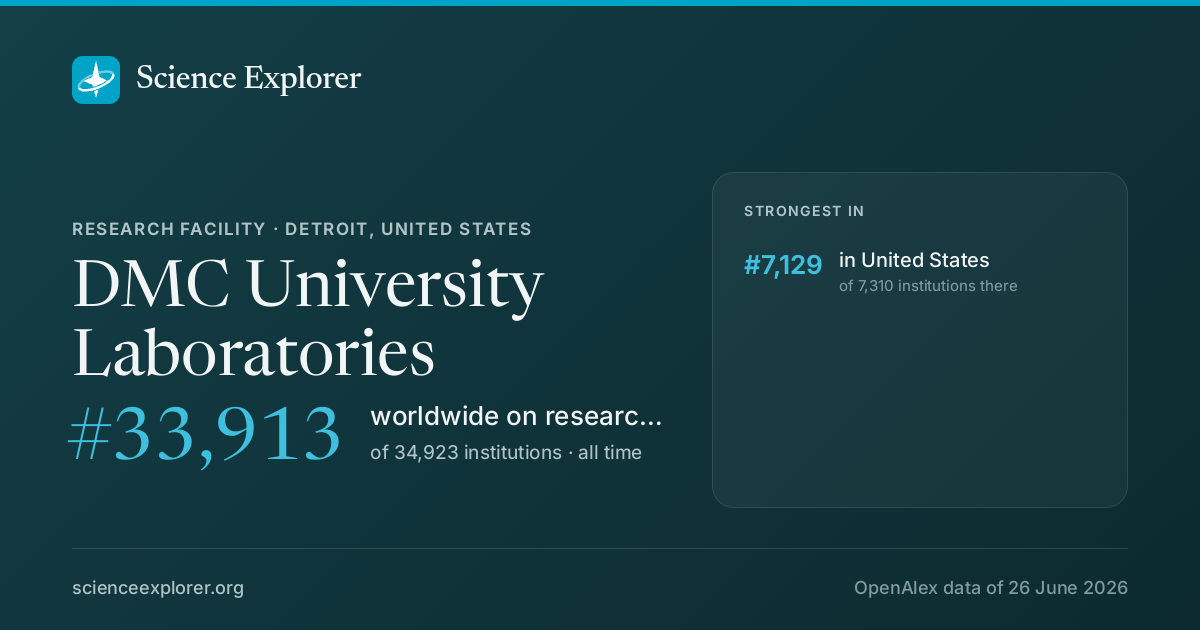
DMC University Laboratories on Science Explorer

A card with DMC University Laboratories's standing and the fields it leads in, for a post or a slide. A link to this page previews as the same card.

Download the card

1200 × 630 PNG, sized for social posts, drawn from the latest snapshot.

Badges for a website1Each links back here and updates with every snapshot

Research measures only: rankings here say nothing about teaching, admissions or student experience. Comparable institutions and collaboration partners have tabs of their own, above.

Discussion

Ask a question or share a note about DMC University Laboratories. Posts are plain text and can be reported.