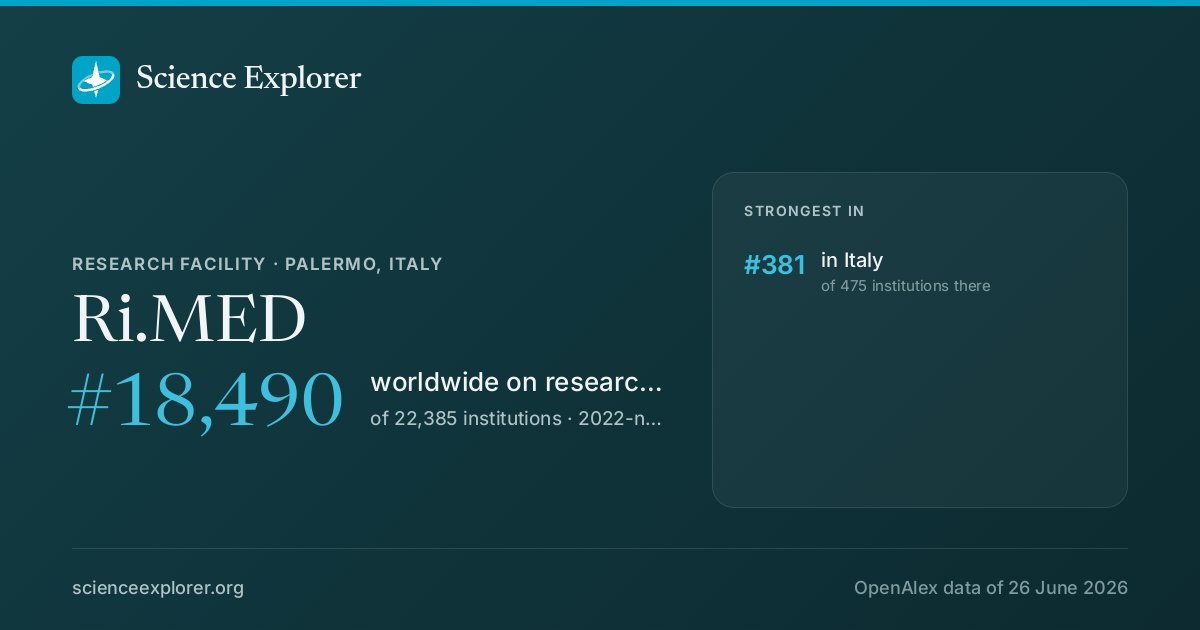
- World rank, 2022-now
- #18,490 of 22,385 · #15,708 all time
- Rank in Italy
- #381 of 475
- Research works
- 222 ▲ 27% vs 2018-21
- Citations
- 5.4k 24.2 per fractional work
- Top-10% rate
- 18.6% all institutions 10.0%
- vs its own fields
- 1.15× 1.00× is exactly expected
- Open access
- 63% world 40%
- International
- 54% world 18%
Which fields of science does Ri.MED work in?
In 2022-now, 46% of research at Ri.MED is in Health Sciences, 28% in Life Sciences. Its largest fields are Medicine (44%), Biochemistry, Genetics and Molecular Biology (20%), Engineering (10%). It does 1.9× the world's share of Life Sciences.
Each ring splits the one inside it: the four domains of science, their fields, their subfields. Size is fractional works in 2022-now. Every slice is a page; the interactive view zooms down to single topics and colours each by how much more of it this institution does than the world.
Its 4 domains and 22 fields, with their numbers
- Health Sciences4245.5%
- Medicine4044.0%
- Health Professions10.7%
- Dentistry10.7%
- Veterinary00.1%
- Nursing00.0%
- Life Sciences2628.1%
- Physical Sciences2425.9%
- Engineering99.6%
- Computer Science44.4%
- Materials Science44.0%
- Chemistry33.2%
- Physics and Astronomy11.6%
- Environmental Science11.5%
- Earth and Planetary Sciences10.7%
- Chemical Engineering00.5%
- Mathematics00.3%
- Energy00.1%
- Social Sciences00.5%
- Social Sciences00.3%
- Psychology00.2%
Field profile
Location quotient across every field it publishes in: outside the ring is more than an institution of this size would be expected to publish, inside it is less.
Rings at 0.5×, 1× and 2×. Widest outward: Immunology and Microbiology, 5.6×. Every wedge is a field page.
All 22 fields, with their numbers
- Immunology and Microbiology5.63×5 works
- Biochemistry, Genetics and Molecular Biology3.68×18 works
- Medicine2.29×40 works
- Chemistry2.06×3 works
- Chemical Engineering1.54×0 works
- Dentistry1.38×1 works
- Neuroscience1.28×2 works
- Materials Science1.16×4 works
- Veterinary1.01×0 works
- Physics and Astronomy0.70×1 works
- Engineering0.64×9 works
- Computer Science0.56×4 works
- Earth and Planetary Sciences0.43×1 works
- Environmental Science0.29×1 works
- Mathematics0.29×0 works
- Health Professions0.28×1 works
- Pharmacology, Toxicology and Pharmaceutics0.21×0 works
- Agricultural and Biological Sciences0.13×1 works
- Nursing0.09×0 works
- Energy0.08×0 works
- Psychology0.07×0 works
- Social Sciences0.02×0 works
- Immunology and Microbiology 5.6×
- Biochemistry, Genetics and Molecular Biology 3.7×
- Medicine 2.3×
- Chemistry 2.1×
- Chemical Engineering 1.5×
- Dentistry 1.4×
- Neuroscience 1.3×
- Materials Science 1.2×
- Veterinary 1.0×
- Physics and Astronomy 0.7×
- Engineering 0.6×
- Computer Science 0.6×
- Earth and Planetary Sciences 0.4×
- Environmental Science 0.3×
- Mathematics 0.3×
- Health Professions 0.3×
- Pharmacology, Toxicology and Pharmaceutics 0.2×
- Agricultural and Biological Sciences 0.1×
- Nursing 0.1×
- Energy 0.1×
- Psychology 0.1×
- Social Sciences 0.0×
Who are the top researchers at Ri.MED?
Ranked on the quality score, Viviana Benfante, Albert Comelli and Riccardo Gottardi lead among researchers whose main affiliation is Ri.MED.
- 1
Viviana Benfante
 Italy · #211,180 worldwide
840 citations · 50 works
- 2
Albert Comelli
Italy · #334,736 worldwide
2.3k citations · 130 works
- 3
Riccardo Gottardi
Italy · #343,295 worldwide
2.9k citations · 115 works
- 4
Caterina Alfano
Italy · #878,460 worldwide
1.3k citations · 45 works
- 5
Danila Vella
Italy · #902,806 worldwide
495 citations · 27 works
- 6
Bruno G. Douradinha
Italy · #1,307,829 worldwide
1.8k citations · 63 works
- 7
Anna Paola Carreca
Italy · #1,326,312 worldwide
897 citations · 52 works
- 8
Eleonora de Sabata
Italy · #1,344,381 worldwide
760 citations · 28 works
- 9
María Agnese Morando
Italy · #1,793,085 worldwide
658 citations · 25 works
- 10
Chiara Cipollina
Italy · #1,941,247 worldwide
1.9k citations · 91 works
Which keywords describe research at Ri.MED?
By fractional works in 2022-now, weighted toward what it does more of than the world: Inflammation, Cancer, Machine Learning, Regenerative Medicine, Tissue Engineering, Texture Analysis, Precision Medicine and Angiogenesis.
- Macrophages
- Therapeutic
- Drug Discovery
- SARS-CoV-2
- Medical Image Analysis
- Ischemia-Reperfusion Injury
- Metastasis
- Transplantation
- Surgical Aortic-Valve Replacement
- Immunity
- Quantitative Analysis
- Biogenesis
- Extracellular Matrix
- Feature Extraction
- Medicinal Chemistry
- Texture Analysis
- Angiogenesis
- Precision Medicine
- Tissue Engineering
- Machine Learning
- Inflammation
- Cancer
- Biomarkers
- Regenerative Medicine
- Drug Delivery
- Medical Imaging
- Regeneration
- Biomedical Applications
- Immune Response
- Gene Expression
- Radiomics
- Mesenchymal Stem Cells
- Transcatheter Aortic-Valve Replacement
- Innate Immunity
- ACE2 Receptor
- Liver Transplantation
- Pharmacokinetics
- Stromal Cells
- Graft Survival
- Anticancer Agents
Size is fractional works in 2022-now in the topics tagged with each word; colour is the word's share of this institution's work against its share of the world's. The 40 words are chosen for being large and distinctive. Each links to the topic it comes from most.
All 40 words, with their numbers
- Inflammation7▲ 3.8×30 topics
- Machine Learning7▲ 2.3×10 topics
- Cancer6▲ 4.9×21 topics
- Tissue Engineering4▲ 6.6×9 topics
- Biomarkers3▲ 5.3×8 topics
- Precision Medicine3▲ 7.4×4 topics
- Regenerative Medicine3▲ 15×5 topics
- Angiogenesis3▲ 11×12 topics
- Drug Delivery3▲ 6.6×7 topics
- Texture Analysis3▲ 16×3 topics
- Medical Imaging3▲ 6.7×4 topics
- Medicinal Chemistry3▲ 13×6 topics
- Regeneration3▲ 17×4 topics
- Feature Extraction3▲ 7.5×3 topics
- Biomedical Applications3▲ 2.6×11 topics
- Extracellular Matrix3▲ 16×6 topics
- Immune Response3▲ 5.2×7 topics
- Biogenesis3▲ 17×3 topics
- Gene Expression3▲ 4.5×6 topics
- Quantitative Analysis3▲ 13×1 topic
- Radiomics3▲ 25×1 topic
- Immunity2▲ 6.5×5 topics
- Mesenchymal Stem Cells2▲ 22×2 topics
- Surgical Aortic-Valve Replacement2▲ 34×1 topic
- Transcatheter Aortic-Valve Replacement2▲ 34×1 topic
- Transplantation2▲ 23×2 topics
- Innate Immunity2▲ 6.6×9 topics
- Metastasis2▲ 6.4×6 topics
- ACE2 Receptor2▲ 8.3×2 topics
- Ischemia-Reperfusion Injury2▲ 28×2 topics
- Liver Transplantation2▲ 16×4 topics
- Medical Image Analysis2▲ 10×4 topics
- Pharmacokinetics2▲ 7.1×3 topics
- SARS-CoV-22▲ 6.1×2 topics
- Stromal Cells2▲ 24×2 topics
- Drug Discovery2▲ 7.8×4 topics
- Graft Survival2▲ 21×2 topics
- Therapeutic2▲ 18×2 topics
- Anticancer Agents2▲ 11×3 topics
- Macrophages2▲ 9.0×5 topics
Which research topics does Ri.MED publish most on?
By volume in 2022-now: Radiomics and Machine Learning in Medical Imaging, Cardiac Valve Diseases and Treatments, Organ Transplantation Techniques and Outcomes and Computational Drug Discovery Methods.
Area is fractional works; colour is the subfield each topic belongs to.
- 1 Radiomics and Machine Learning in Medical Imaging Radiology, Nuclear Medicine and Imaging 3 works
- 2 Cardiac Valve Diseases and Treatments Cardiology and Cardiovascular Medicine 2 works
- 3 Organ Transplantation Techniques and Outcomes Surgery 2 works
- 4 Computational Drug Discovery Methods Computational Theory and Mathematics 2 works
- 5 Electrospun Nanofibers in Biomedical Applications Biomaterials 2 works
- 6 MicroRNA in disease regulation Cancer Research 1 works
- 7 Mesenchymal stem cell research Genetics 1 works
- 8 Tissue Engineering and Regenerative Medicine Surgery 1 works
- 9 Extracellular vesicles in disease Molecular Biology 1 works
- 10 Prostate Cancer Diagnosis and Treatment Pulmonary and Respiratory Medicine 1 works
How open and international is its research?
Against the world's own shares: the tick on each track. Both are shares of its output, so they sit on one scale and can be read against each other as well as against the world.
World: 40% of research is openly available.
World: 18% is written across borders.
How has Ri.MED's research output changed?
Output in 2022-2025 was 27% higher than in 2018-2021.
The same series as a ribbon: one cell per year, darker for more. The line above answers how much; this answers when.
Its share of all research
Growing output can still be a shrinking share: all of science grows. This is Ri.MED as a percentage of every work published that year, 0.00035% in 2024.
Fractional works of Ri.MED over all fractional works that year. How the balance of science has shifted.
Other research institutions in Palermo
- University of Palermo
- Istituto Mediterraneo per i Trapianti e Terapie ad Alta Specializzazione
- Azienda di Rilievo Nazionale ed Alta Specializzazione
- Ospedale Vincenzo Cervello
- Istituto Zooprofilattico Sperimentale Della Sicilia
- Regione Siciliana
- La Maddalena
- Institute for Biomedical Research and Innovation
Share Ri.MED's ranking
Badges for a website1Each links back here and updates with every snapshot

Research measures only: rankings here say nothing about teaching, admissions or student experience. Comparable institutions and collaboration partners have tabs of their own, above.
Discussion
Ask a question or share a note about Ri.MED. Posts are plain text and can be reported.