Science Explorer Back to mapMap
Discussion

Sugen Life Sciences (India)

World rank, 2022-now
#21,294
of 22,385
Rank in India
#1,496
of 1,562
Research works
114
▲ 735% vs 2018-21
Citations
892
7.8 per fractional work
Top-10% rate
8.3%
all institutions 10.0%
vs its own fields
0.97×
1.00× is exactly expected
Open access
49%
world 40%
International
27%
world 18%

Which fields of science does Sugen Life Sciences (India) work in?

In 2022-now, 51% of research at Sugen Life Sciences (India) is in Physical Sciences, 25% in Life Sciences. Its largest fields are Chemistry (25%), Medicine (16%), Biochemistry, Genetics and Molecular Biology (14%). It does 1.7× the world's share of Life Sciences.

Physical Sciences: 40 fractional works · 51.2% of its workChemistry: 19 fractional works · 24.8% of its workOrganic Chemistry: 17 fractional works · 21.8% of its workAnalytical Chemistry: 1 fractional works · 1.5% of its workSpectroscopy: 1 fractional works · 1.1% of its workInorganic Chemistry: 0 fractional works · 0.4% of its workComputer Science: 9 fractional works · 12.1% of its workArtificial Intelligence: 3 fractional works · 3.7% of its workComputer Vision and Pattern Recognition: 2 fractional works · 2.4% of its workComputer Networks and Communications: 2 fractional works · 2.4% of its workInformation Systems: 2 fractional works · 2.1% of its workComputational Theory and Mathematics: 1 fractional works · 1.3% of its workSoftware: 0 fractional works · 0.2% of its workEngineering: 7 fractional works · 9.1% of its workBiomedical Engineering: 2 fractional works · 3.1% of its workElectrical and Electronic Engineering: 2 fractional works · 2.9% of its workMechanical Engineering: 1 fractional works · 0.8% of its workAerospace Engineering: 0 fractional works · 0.4% of its workAutomotive Engineering: 0 fractional works · 0.4% of its workMechanics of Materials: 0 fractional works · 0.4% of its workMedia Technology: 0 fractional works · 0.4% of its workBuilding and Construction: 0 fractional works · 0.2% of its workControl and Systems Engineering: 0 fractional works · 0.2% of its workIndustrial and Manufacturing Engineering: 0 fractional works · 0.2% of its workEnvironmental Science: 2 fractional works · 2.3% of its workWater Science and Technology: 1 fractional works · 1.3% of its workHealth, Toxicology and Mutagenesis: 0 fractional works · 0.6% of its workEcological Modeling: 0 fractional works · 0.2% of its workSmaller subfields together: 0 fractional works · 0.2% of its workMaterials Science: 1 fractional works · 1.7% of its workMaterials Chemistry: 1 fractional works · 0.9% of its workBiomaterials: 0 fractional works · 0.6% of its workSmaller subfields together: 0 fractional works · 0.2% of its workChemical Engineering: 0 fractional works · 0.4% of its workCatalysis: 0 fractional works · 0.2% of its workSmaller subfields together: 0 fractional works · 0.1% of its workPhysics and Astronomy: 0 fractional works · 0.3% of its workAtomic and Molecular Physics, and Optics: 0 fractional works · 0.2% of its workSmaller subfields together: 0 fractional works · 0.1% of its workEnergy: 0 fractional works · 0.3% of its workRenewable Energy, Sustainability and the Environment: 0 fractional works · 0.3% of its workEarth and Planetary Sciences: 0 fractional works · 0.1% of its workLife Sciences: 19 fractional works · 24.7% of its workBiochemistry, Genetics and Molecular Biology: 11 fractional works · 14.2% of its workMolecular Biology: 7 fractional works · 9.5% of its workGenetics: 2 fractional works · 2.3% of its workMolecular Medicine: 1 fractional works · 1.1% of its workBiochemistry: 0 fractional works · 0.5% of its workBiophysics: 0 fractional works · 0.3% of its workCancer Research: 0 fractional works · 0.2% of its workDevelopmental Biology: 0 fractional works · 0.2% of its workAgricultural and Biological Sciences: 5 fractional works · 6.2% of its workPlant Science: 2 fractional works · 2.2% of its workFood Science: 1 fractional works · 1.1% of its workEcology, Evolution, Behavior and Systematics: 1 fractional works · 0.9% of its workSoil Science: 1 fractional works · 0.9% of its workAnimal Science and Zoology: 0 fractional works · 0.5% of its workInsect Science: 0 fractional works · 0.3% of its workGeneral Agricultural and Biological Sciences: 0 fractional works · 0.2% of its workSmaller subfields together: 0 fractional works · 0.1% of its workImmunology and Microbiology: 2 fractional works · 2.2% of its workImmunology: 1 fractional works · 0.8% of its workMicrobiology: 1 fractional works · 0.7% of its workApplied Microbiology and Biotechnology: 0 fractional works · 0.4% of its workSmaller subfields together: 0 fractional works · 0.2% of its workNeuroscience: 1 fractional works · 1.1% of its workNeurology: 0 fractional works · 0.6% of its workCognitive Neuroscience: 0 fractional works · 0.5% of its workSmaller subfields together: 0 fractional works · 0.1% of its workPharmacology, Toxicology and Pharmaceutics: 1 fractional works · 0.9% of its workPharmaceutical Science: 0 fractional works · 0.6% of its workPharmacology: 0 fractional works · 0.3% of its workSmaller subfields together: 0 fractional works · 0.1% of its workHealth Sciences: 14 fractional works · 18.0% of its workMedicine: 12 fractional works · 16.0% of its workPharmacology: 2 fractional works · 2.6% of its workInfectious Diseases: 2 fractional works · 2.5% of its workOncology: 1 fractional works · 1.4% of its workEpidemiology: 1 fractional works · 1.2% of its workPhysiology: 1 fractional works · 1.2% of its workPulmonary and Respiratory Medicine: 1 fractional works · 1.1% of its workDermatology: 1 fractional works · 0.9% of its workPublic Health, Environmental and Occupational Health: 1 fractional works · 0.9% of its workComplementary and alternative medicine: 1 fractional works · 0.7% of its workSurgery: 0 fractional works · 0.6% of its workRehabilitation: 0 fractional works · 0.4% of its workEndocrinology, Diabetes and Metabolism: 0 fractional works · 0.4% of its workGenetics: 0 fractional works · 0.4% of its workRheumatology: 0 fractional works · 0.3% of its workBiochemistry: 0 fractional works · 0.2% of its workCardiology and Cardiovascular Medicine: 0 fractional works · 0.2% of its workHematology: 0 fractional works · 0.2% of its workPathology and Forensic Medicine: 0 fractional works · 0.2% of its workPediatrics, Perinatology and Child Health: 0 fractional works · 0.2% of its workSmaller subfields together: 0 fractional works · 0.3% of its workDentistry: 1 fractional works · 0.9% of its workPeriodontics: 0 fractional works · 0.6% of its workSmaller subfields together: 0 fractional works · 0.2% of its workHealth Professions: 1 fractional works · 0.8% of its workGeneral Health Professions: 0 fractional works · 0.6% of its workHealth Information Management: 0 fractional works · 0.2% of its workSmaller subfields together: 0 fractional works · 0.0% of its workNursing: 0 fractional works · 0.3% of its workNutrition and Dietetics: 0 fractional works · 0.3% of its workSocial Sciences: 5 fractional works · 6.1% of its workBusiness, Management and Accounting: 1 fractional works · 1.8% of its workMarketing: 1 fractional works · 0.8% of its workBusiness and International Management: 0 fractional works · 0.6% of its workAccounting: 0 fractional works · 0.2% of its workSmaller subfields together: 0 fractional works · 0.1% of its workSocial Sciences: 1 fractional works · 1.4% of its workSociology and Political Science: 0 fractional works · 0.6% of its workEducation: 0 fractional works · 0.3% of its workTransportation: 0 fractional works · 0.2% of its workSmaller subfields together: 0 fractional works · 0.3% of its workPsychology: 1 fractional works · 1.3% of its workExperimental and Cognitive Psychology: 1 fractional works · 0.9% of its workSocial Psychology: 0 fractional works · 0.4% of its workArts and Humanities: 1 fractional works · 0.8% of its workLiterature and Literary Theory: 0 fractional works · 0.4% of its workPhilosophy: 0 fractional works · 0.2% of its workSmaller subfields together: 0 fractional works · 0.2% of its workDecision Sciences: 1 fractional works · 0.7% of its workManagement Science and Operations Research: 0 fractional works · 0.6% of its workSmaller subfields together: 0 fractional works · 0.2% of its workEconomics, Econometrics and Finance: 0 fractional works · 0.1% of its workALL ITS WORKSugen LifeSciences (India)78fractional works, 2022-now
Life Sciences25%Physical Sciences51%Health Sciences18%Social Sciences6%

Each ring splits the one inside it: the four domains of science, their fields, their subfields. Size is fractional works in 2022-now. Every slice is a page; the interactive view zooms down to single topics and colours each by how much more of it this institution does than the world.

Its 4 domains and 24 fields, with their numbers
    1. Chemistry1924.8%
    2. Computer Science912.1%
    3. Engineering79.1%
    4. Environmental Science22.3%
    5. Materials Science11.7%
    6. Chemical Engineering00.4%
    7. Physics and Astronomy00.3%
    8. Energy00.3%
    9. Earth and Planetary Sciences00.1%
    1. Biochemistry, Genetics and Molecular Biology1114.2%
    2. Agricultural and Biological Sciences56.2%
    3. Immunology and Microbiology22.2%
    4. Neuroscience11.1%
    5. Pharmacology, Toxicology and Pharmaceutics10.9%
    1. Medicine1216.0%
    2. Dentistry10.9%
    3. Health Professions10.8%
    4. Nursing00.3%
    1. Business, Management and Accounting11.8%
    2. Social Sciences11.4%
    3. Psychology11.3%
    4. Arts and Humanities10.8%
    5. Decision Sciences10.7%
    6. Economics, Econometrics and Finance00.1%
All of science, and how each field's share has moved since 1950: the Science domain explorer

Field profile

Location quotient across every field it publishes in: outside the ring is more than an institution of this size would be expected to publish, inside it is less.

Agricultural and Biological Sciences: 1.31× its world share, 5 worksAgricultural and Bio…Biochemistry, Genetics and Molecular Biology: 2.67× its world share, 11 worksBiochemistry, Geneti…Immunology and Microbiology: 2.16× its world share, 2 worksImmunology and Micro…Neuroscience: 0.70× its world share, 1 worksNeurosciencePharmacology, Toxicology and Pharmaceutics: 2.67× its world share, 1 worksPharmacology, Toxico…Chemical Engineering: 1.02× its world share, 0 worksChemical EngineeringChemistry: 15.83× its world share, 19 worksChemistryComputer Science: 1.56× its world share, 10 worksComputer ScienceEarth and Planetary Sciences: 0.05× its world share, 0 worksEarth and Planetary …Energy: 0.29× its world share, 0 worksEnergyEngineering: 0.61× its world share, 7 worksEngineeringEnvironmental Science: 0.47× its world share, 2 worksEnvironmental ScienceMaterials Science: 0.50× its world share, 1 worksMaterials SciencePhysics and Astronomy: 0.14× its world share, 0 worksPhysics and AstronomyDentistry: 1.76× its world share, 1 worksDentistryHealth Professions: 0.31× its world share, 1 worksHealth ProfessionsMedicine: 0.83× its world share, 12 worksMedicineNursing: 0.58× its world share, 0 worksNursingArts and Humanities: 0.28× its world share, 1 worksArts and HumanitiesBusiness, Management and Accounting: 0.56× its world share, 1 worksBusiness, Management…Decision Sciences: 0.74× its world share, 1 worksDecision SciencesEconomics, Econometrics and Finance: 0.04× its world share, 0 worksEconomics, Econometr…Psychology: 0.42× its world share, 1 worksPsychologySocial Sciences: 0.11× its world share, 1 worksSocial Sciences1×world share
more than its size predictsabout as predictedless

Rings at 0.5×, 1× and 2×. Widest outward: Chemistry, 15.8×. Every wedge is a field page.

All 24 fields, with their numbers
  1. Chemistry15.83×19 works
  2. Biochemistry, Genetics and Molecular Biology2.67×11 works
  3. Pharmacology, Toxicology and Pharmaceutics2.67×1 works
  4. Immunology and Microbiology2.16×2 works
  5. Dentistry1.76×1 works
  6. Computer Science1.56×10 works
  7. Agricultural and Biological Sciences1.31×5 works
  8. Chemical Engineering1.02×0 works
  9. Medicine0.83×12 works
  10. Decision Sciences0.74×1 works
  11. Neuroscience0.70×1 works
  12. Engineering0.61×7 works
  13. Nursing0.58×0 works
  14. Business, Management and Accounting0.56×1 works
  15. Materials Science0.50×1 works
  16. Environmental Science0.47×2 works
  17. Psychology0.42×1 works
  18. Health Professions0.31×1 works
  19. Energy0.29×0 works
  20. Arts and Humanities0.28×1 works
  21. Physics and Astronomy0.14×0 works
  22. Social Sciences0.11×1 works
  23. Earth and Planetary Sciences0.05×0 works
  24. Economics, Econometrics and Finance0.04×0 works

What are the most cited papers from Sugen Life Sciences (India)?

The most cited paper from Sugen Life Sciences (India) is "Wnt-1 Regulates Free Pools of Catenins and Stabilizes APC-Catenin Complexes" (Jackie Papkoff, Bonnee Rubinfeld, Brian B. Schryver et al., 1996), with 330 citations. Next come "Identification of a New Pyk2 Target Protein with Arf-GAP Activity" (175) and "A Function for Phosphatidylinositol 3-Kinase β (p85α-p110β) in Fibroblasts during Mitogenesis: Requirement for Insulin- and Lysophosphatidic Acid-Mediated Signal Transduction" (129).

Most cited papers
#PaperReleasedCitations
1 Wnt-1 Regulates Free Pools of Catenins and Stabilizes APC-Catenin Complexes Jackie Papkoff, Bonnee Rubinfeld, Brian B. Schryver et al. · Molecular and Cellular Biology Open access May 1996 330
2 Identification of a New Pyk2 Target Protein with Arf-GAP Activity Julian Andreev, J.‐P. Simon, D D Sabatini et al. · Molecular and Cellular Biology Open access Mar 1999 175
3 A Function for Phosphatidylinositol 3-Kinase β (p85α-p110β) in Fibroblasts during Mitogenesis: Requirement for Insulin- and Lysophosphatidic Acid-Mediated Signal Transduction Serge Roche, Julian Downward, Patrick Raynal et al. · Molecular and Cellular Biology Open access Dec 1998 129
4 Emerging Role of Injectable Dipeptide Hydrogels in Biomedical Applications Neeraj Kulkarni, Prajakta Rao, Govinda Shivaji Jadhav et al. · ACS Omega Open access 20 Jan 2023 48
5 Tinospora cordifolia, a safety evaluation C.V. Chandrasekaran, L.N. Mathuram, Prabhu Daivasigamani et al. · Toxicology in Vitro 4 Aug 2009 43
All 69 most cited papers, with filters and sorting

Which keywords describe research at Sugen Life Sciences (India)?

By fractional works in 2022-now, weighted toward what it does more of than the world: Medicinal Chemistry, Heterocyclic Compounds, Anticancer Agents, Synthesis, Drug Discovery, Tubulin Inhibitors, Vascular Targeting Agents and Biological Evaluation.

▲ more of its work than of the world's◆ about the world's share▼ less than the world's

Size is fractional works in 2022-now in the topics tagged with each word; colour is the word's share of this institution's work against its share of the world's. The 40 words are chosen for being large and distinctive. Each links to the topic it comes from most.

All 40 words, with their numbers
  1. Medicinal Chemistry8▲ 37×6 topics
  2. Heterocyclic Compounds7▲ 105×5 topics
  3. Anticancer Agents7▲ 59×6 topics
  4. Synthesis7▲ 22×15 topics
  5. Machine Learning6▲ 2.4×20 topics
  6. Deep Learning5▲ 1.83×19 topics
  7. Drug Discovery5▲ 28×9 topics
  8. Biological Evaluation4▲ 102×5 topics
  9. Tubulin Inhibitors4▲ 126×1 topic
  10. Vascular Targeting Agents4▲ 126×1 topic
  11. Anti-inflammatory3▲ 14×9 topics
  12. Anticancer3▲ 22×6 topics
  13. Heterocycles3▲ 37×7 topics
  14. Antimicrobial2▲ 11×4 topics
  15. Organic Synthesis2▲ 26×6 topics
  16. Antimicrobial Activity2▲ 18×4 topics
  17. Antioxidant2▲ 3.9×11 topics
  18. Asymmetric Synthesis2▲ 50×5 topics
  19. Catalysis2▲ 4.0×6 topics
  20. Click Chemistry2▲ 49×1 topic
  21. Copper-Catalyzed Cycloaddition2▲ 95×1 topic
  22. Molecular Docking2▲ 22×3 topics
  23. Biosensors2▲ 5.2×4 topics
  24. Genetic Variation2▲ 11×4 topics
  25. Cancer Therapy2▲ 4.2×9 topics
  26. Catalyst2▲ 39×2 topics
  27. Green Chemistry2▲ 14×6 topics
  28. Feature Extraction2▲ 5.0×4 topics
  29. Oxidation2▲ 15×2 topics
  30. Derivatives2▲ 61×1 topic
  31. Multicomponent Reactions2▲ 82×3 topics
  32. Quinoxaline2▲ 108×1 topic
  33. Transition Metal Catalysis2▲ 25×4 topics
  34. Flavonoids2▲ 7.7×5 topics
  35. Alkaloids1▲ 37×3 topics
  36. Biological Activities1▲ 12×6 topics
  37. Enantioselective Synthesis1▲ 29×5 topics
  38. SARS-CoV-21▲ 6.1×2 topics
  39. Microwave-Assisted Synthesis1▲ 57×3 topics
  40. Nanocatalysts1▲ 27×2 topics

Which research topics does Sugen Life Sciences (India) publish most on?

By volume in 2022-now: Synthesis and biological activity, Click Chemistry and Applications, Synthesis and Biological Evaluation and Quinazolinone synthesis and applications.

  1. 1 Synthesis and biological activity Organic Chemistry 4 works
  2. 2 Click Chemistry and Applications Organic Chemistry 2 works
  3. 3 Synthesis and Biological Evaluation Organic Chemistry 2 works
  4. 4 Quinazolinone synthesis and applications Organic Chemistry 1 works
  5. 5 Multicomponent Synthesis of Heterocycles Organic Chemistry 1 works
  6. 6 Analytical Methods in Pharmaceuticals Analytical Chemistry 1 works
  7. 7 Computational Drug Discovery Methods Computational Theory and Mathematics 1 works
  8. 8 Genetics and Physical Performance Genetics 1 works
  9. 9 Protein Degradation and Inhibitors Molecular Biology 1 works
  10. 10 SARS-CoV-2 and COVID-19 Research Infectious Diseases 1 works

How open and international is its research?

Against the world's own shares: the tick on each track. Both are shares of its output, so they sit on one scale and can be read against each other as well as against the world.

openly available48.7%not open51.3%

World: 40% of research is openly available.

with international co-authors26.8%domestic only73.2%

World: 18% is written across borders.

How has Sugen Life Sciences (India)'s research output changed?

Output in 2022-2025 was 735% higher than in 2018-2021.

still counting1990200020102020
grewheldshrank

The same series as a ribbon: one cell per year, darker for more. The line above answers how much; this answers when.

Its share of all research

Growing output can still be a shrinking share: all of science grows. This is Sugen Life Sciences (India) as a percentage of every work published that year, 0.00031% in 2024.

still counting0.00020%0.00040%0.00060%Sugen Life Sciences (India)0.00050% in 202519801990200020102020

Fractional works of Sugen Life Sciences (India) over all fractional works that year. How the balance of science has shifted.

Other research institutions in Tirumala - Tirupati

All research institutions in Tirumala - Tirupati

Share Sugen Life Sciences (India)'s ranking
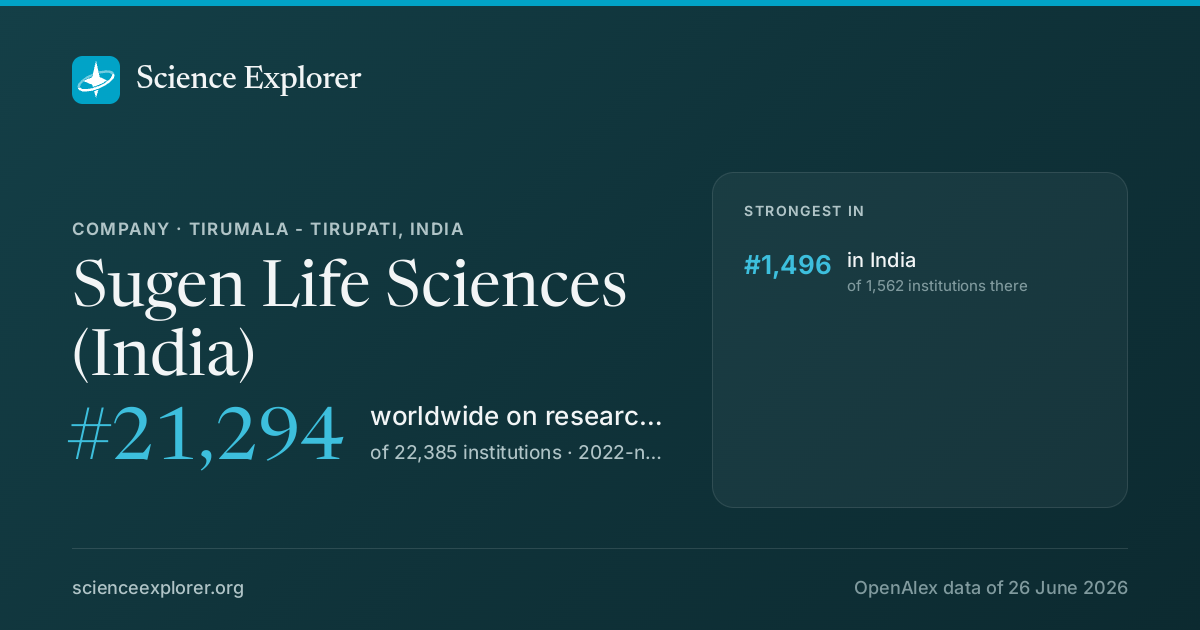
Sugen Life Sciences (India) on Science Explorer

A card with Sugen Life Sciences (India)'s standing and the fields it leads in, for a post or a slide. A link to this page previews as the same card.

Download the card

1200 × 630 PNG, sized for social posts, drawn from the latest snapshot.

Badges for a website1Each links back here and updates with every snapshot

Research measures only: rankings here say nothing about teaching, admissions or student experience. Comparable institutions and collaboration partners have tabs of their own, above.

Discussion

Ask a question or share a note about Sugen Life Sciences (India). Keep it to the research: no personal attacks, advertising or links. Any reader can report a post, which collapses it for everyone until it is opened.