Science Explorer Back to mapMap
Discussion
Country

Science in Eritrea

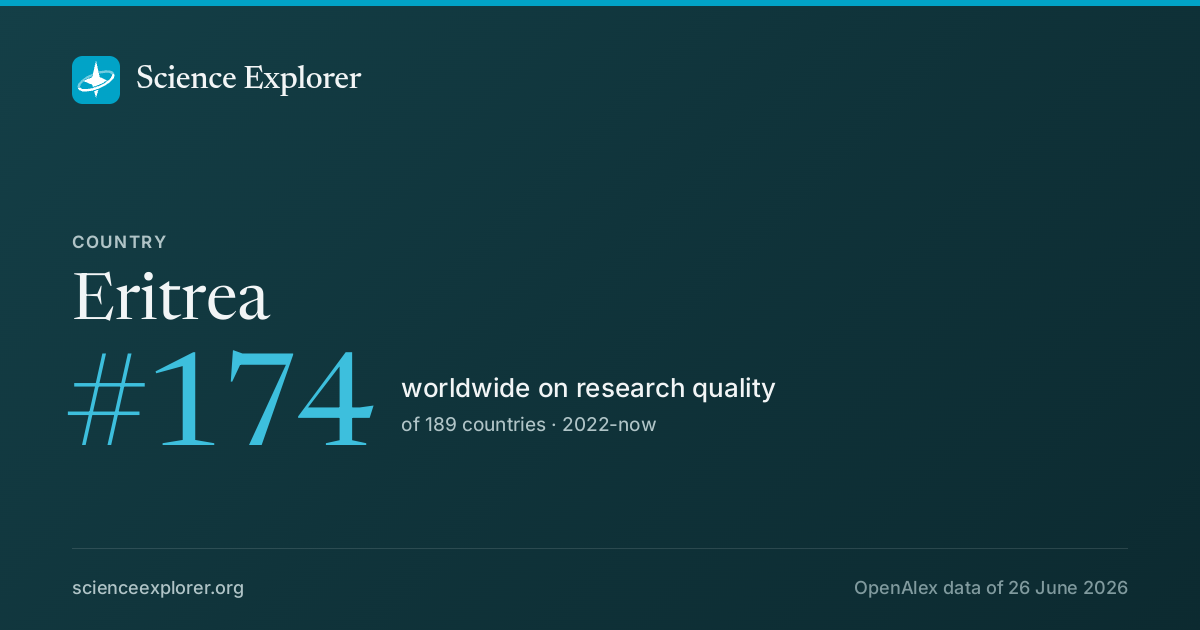
Eritrea ranks #174 of 189 countries on research quality in 2022-now (#175 all time), with 213 research works and 8.2% of them in the world's top 10%.

World rank, 2022-now
#174
of 189 · #175 all time
Works, 2022-now
213
▼ 22% vs 2018-21
Citations
14k
13.0 per fractional work, all time
Top-10% rate
8.2%
all institutions 10.0%
vs its own fields
1.01×
1.00× is exactly expected
In the world top 100
0
0 in the top 1,000
Open access
73%
world 40%
International
34%
world 18%

Which fields of science does Eritrea work in?

In 2022-now, 39% of research in Eritrea is in Health Sciences, 25% in Social Sciences. Its largest fields are Medicine (33%), Social Sciences (16%), Environmental Science (7%). It does 1.6× the world's share of Health Sciences.

Health Sciences: 92 fractional works · 38.8% of its workMedicine: 78 fractional works · 32.9% of its workSurgery: 11 fractional works · 4.9% of its workEpidemiology: 9 fractional works · 4.0% of its workPublic Health, Environmental and Occupational Health: 8 fractional works · 3.4% of its workPediatrics, Perinatology and Child Health: 8 fractional works · 3.2% of its workInfectious Diseases: 6 fractional works · 2.4% of its workObstetrics and Gynecology: 5 fractional works · 2.0% of its workEmergency Medicine: 4 fractional works · 1.6% of its workEndocrinology, Diabetes and Metabolism: 3 fractional works · 1.2% of its workOncology: 2 fractional works · 0.8% of its workGeriatrics and Gerontology: 2 fractional works · 0.8% of its workReproductive Medicine: 2 fractional works · 0.7% of its workCardiology and Cardiovascular Medicine: 2 fractional works · 0.7% of its workComplementary and alternative medicine: 2 fractional works · 0.7% of its workPulmonary and Respiratory Medicine: 2 fractional works · 0.7% of its workRheumatology: 1 fractional works · 0.5% of its workPhysiology: 1 fractional works · 0.5% of its workHematology: 1 fractional works · 0.5% of its workFamily Practice: 1 fractional works · 0.4% of its workGenetics: 1 fractional works · 0.4% of its workHepatology: 1 fractional works · 0.4% of its workRadiology, Nuclear Medicine and Imaging: 1 fractional works · 0.4% of its workOphthalmology: 1 fractional works · 0.4% of its workDermatology: 1 fractional works · 0.4% of its workPharmacology: 1 fractional works · 0.3% of its workAnesthesiology and Pain Medicine: 1 fractional works · 0.3% of its workPsychiatry and Mental health: 1 fractional works · 0.2% of its workBiochemistry: 0 fractional works · 0.2% of its workSmaller subfields together: 2 fractional works · 0.9% of its workHealth Professions: 8 fractional works · 3.5% of its workGeneral Health Professions: 5 fractional works · 2.1% of its workEmergency Medical Services: 1 fractional works · 0.4% of its workSpeech and Hearing: 1 fractional works · 0.4% of its workComplementary and Manual Therapy: 1 fractional works · 0.3% of its workSmaller subfields together: 1 fractional works · 0.4% of its workNursing: 4 fractional works · 1.8% of its workNutrition and Dietetics: 4 fractional works · 1.8% of its workVeterinary: 1 fractional works · 0.4% of its workSmall Animals: 1 fractional works · 0.4% of its workDentistry: 0 fractional works · 0.1% of its workSocial Sciences: 59 fractional works · 25.0% of its workSocial Sciences: 38 fractional works · 15.9% of its workPolitical Science and International Relations: 10 fractional works · 4.3% of its workEducation: 9 fractional works · 3.6% of its workSociology and Political Science: 7 fractional works · 3.1% of its workSafety Research: 2 fractional works · 0.9% of its workTransportation: 1 fractional works · 0.6% of its workAnthropology: 1 fractional works · 0.5% of its workGender Studies: 1 fractional works · 0.4% of its workCultural Studies: 1 fractional works · 0.4% of its workLaw: 1 fractional works · 0.4% of its workPublic Administration: 1 fractional works · 0.4% of its workDevelopment: 1 fractional works · 0.3% of its workLinguistics and Language: 1 fractional works · 0.3% of its workCommunication: 1 fractional works · 0.2% of its workDemography: 0 fractional works · 0.2% of its workSmaller subfields together: 1 fractional works · 0.5% of its workEconomics, Econometrics and Finance: 7 fractional works · 2.8% of its workEconomics and Econometrics: 5 fractional works · 2.2% of its workFinance: 1 fractional works · 0.3% of its workGeneral Economics, Econometrics and Finance: 1 fractional works · 0.3% of its workPsychology: 6 fractional works · 2.5% of its workClinical Psychology: 3 fractional works · 1.1% of its workSocial Psychology: 2 fractional works · 0.8% of its workDevelopmental and Educational Psychology: 1 fractional works · 0.5% of its workSmaller subfields together: 0 fractional works · 0.1% of its workBusiness, Management and Accounting: 6 fractional works · 2.4% of its workStrategy and Management: 2 fractional works · 0.8% of its workAccounting: 2 fractional works · 0.8% of its workOrganizational Behavior and Human Resource Management: 1 fractional works · 0.4% of its workManagement of Technology and Innovation: 1 fractional works · 0.3% of its workSmaller subfields together: 0 fractional works · 0.1% of its workArts and Humanities: 3 fractional works · 1.2% of its workHistory: 1 fractional works · 0.4% of its workLanguage and Linguistics: 1 fractional works · 0.4% of its workLiterature and Literary Theory: 1 fractional works · 0.3% of its workSmaller subfields together: 0 fractional works · 0.1% of its workDecision Sciences: 0 fractional works · 0.1% of its workPhysical Sciences: 54 fractional works · 23.1% of its workEnvironmental Science: 18 fractional works · 7.5% of its workManagement, Monitoring, Policy and Law: 3 fractional works · 1.4% of its workWater Science and Technology: 3 fractional works · 1.4% of its workIndustrial and Manufacturing Engineering: 3 fractional works · 1.2% of its workGlobal and Planetary Change: 2 fractional works · 0.9% of its workHealth, Toxicology and Mutagenesis: 1 fractional works · 0.6% of its workPollution: 1 fractional works · 0.6% of its workEnvironmental Engineering: 1 fractional works · 0.5% of its workEcology: 1 fractional works · 0.5% of its workEcological Modeling: 1 fractional works · 0.4% of its workSmaller subfields together: 0 fractional works · 0.2% of its workEngineering: 14 fractional works · 5.9% of its workElectrical and Electronic Engineering: 4 fractional works · 1.8% of its workMechanical Engineering: 2 fractional works · 0.9% of its workBiomedical Engineering: 2 fractional works · 0.8% of its workAerospace Engineering: 1 fractional works · 0.5% of its workBuilding and Construction: 1 fractional works · 0.5% of its workControl and Systems Engineering: 1 fractional works · 0.3% of its workAutomotive Engineering: 1 fractional works · 0.3% of its workComputational Mechanics: 0 fractional works · 0.2% of its workSmaller subfields together: 1 fractional works · 0.5% of its workComputer Science: 7 fractional works · 3.2% of its workArtificial Intelligence: 4 fractional works · 1.6% of its workComputer Vision and Pattern Recognition: 1 fractional works · 0.4% of its workSignal Processing: 1 fractional works · 0.3% of its workInformation Systems: 1 fractional works · 0.3% of its workComputational Theory and Mathematics: 1 fractional works · 0.3% of its workSmaller subfields together: 0 fractional works · 0.2% of its workMaterials Science: 6 fractional works · 2.5% of its workPolymers and Plastics: 2 fractional works · 0.7% of its workMaterials Chemistry: 2 fractional works · 0.7% of its workBiomaterials: 2 fractional works · 0.7% of its workSmaller subfields together: 1 fractional works · 0.4% of its workEnergy: 3 fractional works · 1.3% of its workRenewable Energy, Sustainability and the Environment: 2 fractional works · 1.0% of its workEnergy Engineering and Power Technology: 1 fractional works · 0.3% of its workMathematics: 3 fractional works · 1.1% of its workStatistics and Probability: 1 fractional works · 0.4% of its workModeling and Simulation: 1 fractional works · 0.2% of its workSmaller subfields together: 1 fractional works · 0.4% of its workChemistry: 2 fractional works · 0.7% of its workOrganic Chemistry: 1 fractional works · 0.5% of its workSmaller subfields together: 1 fractional works · 0.3% of its workEarth and Planetary Sciences: 2 fractional works · 0.7% of its workGeophysics: 1 fractional works · 0.3% of its workSmaller subfields together: 1 fractional works · 0.5% of its workPhysics and Astronomy: 0 fractional works · 0.1% of its workLife Sciences: 31 fractional works · 13.1% of its workAgricultural and Biological Sciences: 13 fractional works · 5.6% of its workPlant Science: 4 fractional works · 1.6% of its workEcology, Evolution, Behavior and Systematics: 3 fractional works · 1.1% of its workFood Science: 2 fractional works · 0.8% of its workAgronomy and Crop Science: 2 fractional works · 0.7% of its workGeneral Agricultural and Biological Sciences: 1 fractional works · 0.3% of its workSoil Science: 1 fractional works · 0.3% of its workAnimal Science and Zoology: 1 fractional works · 0.2% of its workSmaller subfields together: 1 fractional works · 0.5% of its workBiochemistry, Genetics and Molecular Biology: 7 fractional works · 2.8% of its workMolecular Biology: 2 fractional works · 1.0% of its workGenetics: 1 fractional works · 0.5% of its workCell Biology: 1 fractional works · 0.4% of its workClinical Biochemistry: 1 fractional works · 0.3% of its workCancer Research: 1 fractional works · 0.2% of its workSmaller subfields together: 1 fractional works · 0.3% of its workImmunology and Microbiology: 6 fractional works · 2.7% of its workImmunology: 2 fractional works · 0.8% of its workApplied Microbiology and Biotechnology: 2 fractional works · 0.8% of its workMicrobiology: 1 fractional works · 0.4% of its workVirology: 1 fractional works · 0.4% of its workParasitology: 1 fractional works · 0.3% of its workNeuroscience: 3 fractional works · 1.4% of its workCognitive Neuroscience: 2 fractional works · 0.8% of its workSensory Systems: 1 fractional works · 0.4% of its workSmaller subfields together: 0 fractional works · 0.2% of its workPharmacology, Toxicology and Pharmaceutics: 2 fractional works · 0.7% of its workToxicology: 1 fractional works · 0.4% of its workSmaller subfields together: 1 fractional works · 0.3% of its workALL ITS WORKEritrea236fractional works, 2022-now
Life Sciences13%Physical Sciences23%Health Sciences39%Social Sciences25%

Each ring splits the one inside it: the four domains of science, their fields, their subfields. Size is fractional works in 2022-now. Every slice is a page; the interactive view zooms down to single topics and colours each by how much more of it this country does than the world.

Its 4 domains and 25 fields, with their numbers
    1. Medicine7832.9%
    2. Health Professions83.5%
    3. Nursing41.8%
    4. Veterinary10.4%
    5. Dentistry00.1%
    1. Social Sciences3815.9%
    2. Economics, Econometrics and Finance72.8%
    3. Psychology62.5%
    4. Business, Management and Accounting62.4%
    5. Arts and Humanities31.2%
    6. Decision Sciences00.1%
    1. Environmental Science187.5%
    2. Engineering145.9%
    3. Computer Science73.2%
    4. Materials Science62.5%
    5. Energy31.3%
    6. Mathematics31.1%
    7. Chemistry20.7%
    8. Earth and Planetary Sciences20.7%
    9. Physics and Astronomy00.1%
    1. Agricultural and Biological Sciences135.6%
    2. Biochemistry, Genetics and Molecular Biology72.8%
    3. Immunology and Microbiology62.7%
    4. Neuroscience31.4%
    5. Pharmacology, Toxicology and Pharmaceutics20.7%
All of science, and how each field's share has moved since 1950: the Science domain explorer

Which keywords describe research in Eritrea?

By fractional works in 2022-now, weighted toward what it does more of than the world: Epidemiology, Conflict, Maternal Mortality, Religion, Child Development, Politics, Society and Drug Resistance.

▲ more of its work than of the world's◆ about the world's share▼ less than the world's

Size is fractional works in 2022-now in the topics tagged with each word; colour is the word's share of this country's work against its share of the world's. The 40 words are chosen for being large and distinctive. Each links to the topic it comes from most.

All 40 words, with their numbers
  1. Epidemiology19▲ 2.0×58 topics
  2. Climate Change9▲ 1.34×25 topics
  3. Public Health7▲ 2.1×18 topics
  4. Diagnosis7▲ 3.3×16 topics
  5. Conflict7▲ 19×5 topics
  6. Environmental Impact7▲ 1.75×20 topics
  7. Maternal Mortality6▲ 12×5 topics
  8. Religion6▲ 5.9×5 topics
  9. History6▲ 3.8×5 topics
  10. Child Development6▲ 6.2×4 topics
  11. Treatment6▲ 2.1×17 topics
  12. Immune Response6▲ 4.3×11 topics
  13. Culture6▲ 4.7×4 topics
  14. COVID-195▲ 1.74×15 topics
  15. Drug Resistance5▲ 7.8×6 topics
  16. Politics5▲ 8.6×2 topics
  17. Society5▲ 12×2 topics
  18. Human Rights5▲ 2.2×11 topics
  19. Eritrea5▲ 159×1 topic
  20. Ethiopia5▲ 159×1 topic
  21. Migration5▲ 6.3×2 topics
  22. Antiretroviral Therapy5▲ 12×6 topics
  23. Global Governance4▲ 7.9×8 topics
  24. Vaccine4▲ 4.7×10 topics
  25. Health Inequalities4▲ 15×2 topics
  26. Poverty Reduction4▲ 13×3 topics
  27. Child Mortality4▲ 23×1 topic
  28. Community Health Workers4▲ 19×2 topics
  29. Health Systems4▲ 23×1 topic
  30. Maternal and Child Undernutrition4▲ 20×1 topic
  31. Water Sanitation Hygiene4▲ 20×1 topic
  32. Insulin Resistance4▲ 3.5×8 topics
  33. Infectious Diseases4▲ 4.5×7 topics
  34. Sustainability Assessment3▲ 9.4×2 topics
  35. HIV Infection3▲ 12×3 topics
  36. Infertility3▲ 8.0×3 topics
  37. Gender Inequality3▲ 8.1×4 topics
  38. Global Health3▲ 7.2×2 topics
  39. Security Council2▲ 21×2 topics
  40. Water Scarcity2▲ 13×2 topics

Which research topics does Eritrea publish the most in?

Its largest topics in 2022-now are African history and culture analysis, Global Maternal and Child Health, Child Nutrition and Water Access.

  1. 1 African history and culture analysis Political Science and International Relations 5 works
  2. 2 Global Maternal and Child Health Pediatrics, Perinatology and Child Health 4 works
  3. 3 Child Nutrition and Water Access Nutrition and Dietetics 4 works
  4. 4 Wastewater Treatment and Reuse Industrial and Manufacturing Engineering 2 works
  5. 5 Diagnosis and treatment of tuberculosis Surgery 2 works
  6. 6 Poverty, Education, and Child Welfare Safety Research 2 works
  7. 7 Antibiotic Use and Resistance Applied Microbiology and Biotechnology 2 works
  8. 8 Tuberculosis Research and Epidemiology Infectious Diseases 2 works
  9. 9 Pharmaceutical Practices and Patient Outcomes Geriatrics and Gerontology 2 works
  10. 10 International Law and Human Rights Political Science and International Relations 2 works
  11. 11 Climate change impacts on agriculture Ecology, Evolution, Behavior and Systematics 2 works
  12. 12 Microfinance and Financial Inclusion Economics and Econometrics 1 works

Which universities in Eritrea lead research?

University of Asmara rank highest in Eritrea on research quality in 2022-now.

  1. 1University of AsmaraUniversity · Asmara · #8,158 worldwide8.2% top 10% · 213 works

The track on each row is its top-10% rate; the tick is the average of all institutions, 10.0% (how it is set): teal above it, red below.

All ranked institutions in Eritrea

Who are the top researchers in Eritrea?

Selam Mihreteab, Ghebrebrhan Ogubazghi and Eyasu Habte Tesfamariam rank highest among researchers based in Eritrea.

  1. 1 Selam Mihreteab #1,183,860 worldwide 1.1k citations · 28 works
  2. 2 Ghebrebrhan Ogubazghi #1,338,523 worldwide 1.3k citations · 65 works
  3. 3 Eyasu Habte Tesfamariam #1,384,050 worldwide 286 citations · 20 works
  4. 4 Araia Berhane #1,422,903 worldwide 896 citations · 32 works
  5. 5 Meron Mehari Kifle #1,474,057 worldwide 804 citations · 23 works
  6. 6 Woldai Ghebreab #1,721,341 worldwide 2.5k citations · 29 works
  7. 7 Woldeselassie Ogbazghi #1,856,878 worldwide 504 citations · 28 works
  8. 8 Abdulmumini Usman #1,871,814 worldwide 746 citations · 20 works
  9. 9 Ismail Pasha #1,887,625 worldwide 584 citations · 29 works
  10. 10 Kamal C. Semwal #2,120,950 worldwide 1k citations · 22 works
Top researchers in Eritrea

How open and international is Eritrea's research?

73% of its research is openly available (world: 40%), and 34% is written with international co-authors (world: 18%).

openly available73.0%not open27.0%

World: 40% of research is openly available.

with international co-authors33.5%domestic only66.5%

World: 18% is written across borders.

How has Eritrea's research grown?

Output in 2022-2025 was 22% lower than in 2018-2021.

still counting1990200020102020
grewheldshrank

The same series as a ribbon: one cell per year, darker for more. The line above answers how much; this answers when.

Its share of all research

Growing output can still be a shrinking share: all of science grows. This is Eritrea as a percentage of every work published that year, 0.00097% in 2024.

still counting0.0010%0.0020%0.0030%Eritrea0.00077% in 202519801990200020102020

Fractional works of Eritrea over all fractional works that year. How the balance of science has shifted.

How much of it reaches the world top 10%

Over the whole record, 8.7% of its 1.1k works since 1955 reached the world top 10% for their field and year.

still counting10%20%30%Eritrea12.3% in 2025all institutions10.0% in 202520102020

Of each year's output, the share that reached the world's 10% most cited for its field and year. Peak 20.8% in 2015.

Which countries have research most like Eritrea's?

Ethiopia is Eritrea's closest research twin: of all countries, its research is spread across the fields most like Eritrea's, with both strong in Nursing.

  1. 1 EthiopiaBoth strong in Nursing, Veterinary, Immunology and Microbiology 0.76 Compare
  2. 2 LaosBoth strong in Veterinary, Immunology and Microbiology, Nursing 0.73 Compare
  3. 3 SudanBoth strong in Veterinary, Nursing, Pharmacology, Toxicology and Pharmaceutics 0.72 Compare
  4. 4 Côte d'IvoireBoth strong in Nursing, Pharmacology, Toxicology and Pharmaceutics, Environmental Science 0.71 Compare
  5. 5 GuineaBoth strong in Immunology and Microbiology, Nursing, Medicine 0.70 Compare

Similarity is the correlation of each side's location quotients across every field it publishes in, on a log scale: 1 is the same shape of research, 0 is unrelated. It ignores size. How it is measured.

Compare Eritrea with
Compare any two

Share Eritrea's ranking

Eritrea on Science Explorer

A card with Eritrea's standing and the fields it leads in, for a post or a slide. A link to this page previews as the same card.

Download the card

1200 × 630 PNG, sized for social posts, drawn from the latest snapshot.

Badges for a website1Each links back here and updates with every snapshot

Discussion

Ask a question or share a note about Eritrea. Posts are plain text and can be reported.