
Science Explorer Back to mapMap
University · Jacksonville · United States

Illinois College

In research, Illinois College stands highest in Health Sciences (#701 of 9,902 worldwide), Medicine (#664 of 8,541 worldwide) and Life Sciences (#959 of 6,403 worldwide), 2022-now.

World rank, 2022-now
#1,383
of 22,385 · #1,151 all time
Rank in United States
#296
of 3,332
Research works
9.8k
▲ 32% vs 2018-21
Citations
263k
26.9 per fractional work
Top-10% rate
11.5%
all institutions 10.0%
vs its own fields
0.97×
1.00× is exactly expected
Open access
32%
world 40%
International
11%
world 18%

What is Illinois College known for in research?

The fields where it stands highest, 2022-now, ranked among every institution above the floor in each field.

FieldWorld rankWhere that sitsTop-10% rateWorksAll time
Health SciencesDomain #701 of 9,902 10.8%801 #708
MedicineField #664 of 8,541 10.6%707 #640
Life SciencesDomain #959 of 6,403 10.2%222 #952
Physical SciencesDomain #2,287 of 10,670 12.1%133 #1789
Biochemistry, Genetics and Molecular BiologyField #669 of 2,964 9.9%121 #764
Social SciencesDomain #2,377 of 9,585 14.6%177 #1277
SurgerySubfield #504 of 1,532 11.9%101 #511
Molecular BiologySubfield #668 of 1,880 10.6%65 #810
Health ProfessionsField #778 of 1,895 13.1%63 #620
Social SciencesField #2,611 of 5,988 15.5%86 #1559

Each strip is that field's whole ranked pool, with the notch where Illinois College sits in it, in the colour of the band that rank falls in. The track under the rate is the rate itself: it carries no average mark, because the average differs by field (from about 6% in Dentistry to 21% in Economics).

Which of those standings moved

The same fields on both windows: where it stood over the whole record, and where it stands in 2022-now. The distance is the story, and it is the one thing the two rank columns above cannot show.

  1. Health Sciences#708 #701
  2. Medicine#640 #664
  3. Life Sciences#952 #959
  4. Physical Sciences#1,789 #2,287
  5. Biochemistry, Genetics and Molecular Biology#764 #669
  6. Social Sciences#1,277 #2,377
  7. Surgery#511 #504
  8. Molecular Biology#810 #668
  9. Health Professions#620 #778
  10. Social Sciences#1,559 #2,611
all time2022-now, better2022-now, worse

A dot further right is a better standing. Fields it was not ranked in over the whole record are left out.

Which fields of science does Illinois College work in?

In 2022-now, 60% of research at Illinois College is in Health Sciences, 17% in Life Sciences. Its largest fields are Medicine (53%), Biochemistry, Genetics and Molecular Biology (9%), Social Sciences (6%). It does 2.6× the world's share of Health Sciences.

Health Sciences: 954 fractional works · 60.1% of its workMedicine: 843 fractional works · 53.1% of its workSurgery: 124 fractional works · 7.8% of its workEpidemiology: 75 fractional works · 4.7% of its workPulmonary and Respiratory Medicine: 68 fractional works · 4.3% of its workPublic Health, Environmental and Occupational Health: 62 fractional works · 3.9% of its workCardiology and Cardiovascular Medicine: 53 fractional works · 3.3% of its workOncology: 38 fractional works · 2.4% of its workRadiology, Nuclear Medicine and Imaging: 34 fractional works · 2.1% of its workPhysiology: 34 fractional works · 2.1% of its workNeurology: 34 fractional works · 2.1% of its workInfectious Diseases: 25 fractional works · 1.6% of its workPsychiatry and Mental health: 24 fractional works · 1.5% of its workPathology and Forensic Medicine: 24 fractional works · 1.5% of its workPediatrics, Perinatology and Child Health: 21 fractional works · 1.3% of its workEndocrinology, Diabetes and Metabolism: 19 fractional works · 1.2% of its workHematology: 17 fractional works · 1.1% of its workGenetics: 17 fractional works · 1.1% of its workDermatology: 16 fractional works · 1.0% of its workRheumatology: 16 fractional works · 1.0% of its workEmergency Medicine: 14 fractional works · 0.9% of its workOphthalmology: 12 fractional works · 0.8% of its workObstetrics and Gynecology: 10 fractional works · 0.6% of its workPharmacology: 9 fractional works · 0.6% of its workHealth Informatics: 9 fractional works · 0.5% of its workRehabilitation: 8 fractional works · 0.5% of its workGastroenterology: 7 fractional works · 0.5% of its workReproductive Medicine: 7 fractional works · 0.4% of its workNephrology: 7 fractional works · 0.4% of its workHepatology: 7 fractional works · 0.4% of its workCritical Care and Intensive Care Medicine: 6 fractional works · 0.4% of its workOrthopedics and Sports Medicine: 6 fractional works · 0.4% of its workAnesthesiology and Pain Medicine: 6 fractional works · 0.4% of its workOtorhinolaryngology: 5 fractional works · 0.3% of its workInternal Medicine: 5 fractional works · 0.3% of its workImmunology and Allergy: 4 fractional works · 0.3% of its workGeriatrics and Gerontology: 4 fractional works · 0.3% of its workComplementary and alternative medicine: 4 fractional works · 0.3% of its workFamily Practice: 4 fractional works · 0.2% of its workSmaller subfields together: 8 fractional works · 0.5% of its workHealth Professions: 74 fractional works · 4.7% of its workGeneral Health Professions: 40 fractional works · 2.5% of its workEmergency Medical Services: 13 fractional works · 0.8% of its workSpeech and Hearing: 5 fractional works · 0.3% of its workPhysical Therapy, Sports Therapy and Rehabilitation: 4 fractional works · 0.2% of its workSmaller subfields together: 12 fractional works · 0.8% of its workDentistry: 23 fractional works · 1.4% of its workOrthodontics: 7 fractional works · 0.5% of its workOral Surgery: 7 fractional works · 0.4% of its workPeriodontics: 6 fractional works · 0.4% of its workSmaller subfields together: 3 fractional works · 0.2% of its workNursing: 8 fractional works · 0.5% of its workNutrition and Dietetics: 6 fractional works · 0.4% of its workSmaller subfields together: 2 fractional works · 0.2% of its workVeterinary: 6 fractional works · 0.4% of its workSmall Animals: 6 fractional works · 0.4% of its workSmaller subfields together: 1 fractional works · 0.0% of its workLife Sciences: 269 fractional works · 16.9% of its workBiochemistry, Genetics and Molecular Biology: 146 fractional works · 9.2% of its workMolecular Biology: 78 fractional works · 4.9% of its workGenetics: 25 fractional works · 1.6% of its workCancer Research: 17 fractional works · 1.1% of its workCell Biology: 7 fractional works · 0.4% of its workBiophysics: 5 fractional works · 0.3% of its workBiotechnology: 4 fractional works · 0.2% of its workSmaller subfields together: 11 fractional works · 0.7% of its workNeuroscience: 55 fractional works · 3.5% of its workCognitive Neuroscience: 18 fractional works · 1.1% of its workNeurology: 13 fractional works · 0.8% of its workCellular and Molecular Neuroscience: 10 fractional works · 0.6% of its workSensory Systems: 5 fractional works · 0.3% of its workEndocrine and Autonomic Systems: 4 fractional works · 0.2% of its workSmaller subfields together: 6 fractional works · 0.4% of its workImmunology and Microbiology: 42 fractional works · 2.7% of its workImmunology: 31 fractional works · 2.0% of its workMicrobiology: 4 fractional works · 0.3% of its workParasitology: 4 fractional works · 0.3% of its workSmaller subfields together: 3 fractional works · 0.2% of its workAgricultural and Biological Sciences: 18 fractional works · 1.1% of its workEcology, Evolution, Behavior and Systematics: 4 fractional works · 0.3% of its workPlant Science: 4 fractional works · 0.2% of its workSmaller subfields together: 10 fractional works · 0.6% of its workPharmacology, Toxicology and Pharmaceutics: 8 fractional works · 0.5% of its workPharmacology: 5 fractional works · 0.3% of its workSmaller subfields together: 3 fractional works · 0.2% of its workSocial Sciences: 205 fractional works · 12.9% of its workSocial Sciences: 100 fractional works · 6.3% of its workSociology and Political Science: 29 fractional works · 1.8% of its workEducation: 16 fractional works · 1.0% of its workPolitical Science and International Relations: 12 fractional works · 0.8% of its workGender Studies: 12 fractional works · 0.8% of its workHealth: 8 fractional works · 0.5% of its workLaw: 6 fractional works · 0.4% of its workSafety Research: 4 fractional works · 0.3% of its workDemography: 4 fractional works · 0.2% of its workSmaller subfields together: 7 fractional works · 0.4% of its workPsychology: 53 fractional works · 3.3% of its workClinical Psychology: 22 fractional works · 1.4% of its workSocial Psychology: 12 fractional works · 0.8% of its workExperimental and Cognitive Psychology: 10 fractional works · 0.6% of its workApplied Psychology: 4 fractional works · 0.3% of its workSmaller subfields together: 3 fractional works · 0.2% of its workArts and Humanities: 15 fractional works · 1.0% of its workLiterature and Literary Theory: 4 fractional works · 0.3% of its workSmaller subfields together: 11 fractional works · 0.7% of its workEconomics, Econometrics and Finance: 15 fractional works · 1.0% of its workEconomics and Econometrics: 13 fractional works · 0.8% of its workSmaller subfields together: 2 fractional works · 0.1% of its workBusiness, Management and Accounting: 15 fractional works · 1.0% of its workAccounting: 3 fractional works · 0.2% of its workSmaller subfields together: 12 fractional works · 0.7% of its workDecision Sciences: 7 fractional works · 0.4% of its workPhysical Sciences: 159 fractional works · 10.0% of its workEngineering: 61 fractional works · 3.8% of its workBiomedical Engineering: 37 fractional works · 2.3% of its workMechanical Engineering: 5 fractional works · 0.3% of its workElectrical and Electronic Engineering: 4 fractional works · 0.3% of its workSmaller subfields together: 15 fractional works · 0.9% of its workComputer Science: 39 fractional works · 2.5% of its workArtificial Intelligence: 14 fractional works · 0.9% of its workComputational Theory and Mathematics: 6 fractional works · 0.3% of its workInformation Systems: 4 fractional works · 0.3% of its workComputer Networks and Communications: 4 fractional works · 0.3% of its workHardware and Architecture: 3 fractional works · 0.2% of its workSmaller subfields together: 8 fractional works · 0.5% of its workEnvironmental Science: 22 fractional works · 1.4% of its workHealth, Toxicology and Mutagenesis: 8 fractional works · 0.5% of its workEcology: 4 fractional works · 0.2% of its workSmaller subfields together: 10 fractional works · 0.7% of its workMaterials Science: 14 fractional works · 0.9% of its workMaterials Chemistry: 9 fractional works · 0.6% of its workSmaller subfields together: 5 fractional works · 0.3% of its workChemistry: 8 fractional works · 0.5% of its workOrganic Chemistry: 4 fractional works · 0.2% of its workSmaller subfields together: 4 fractional works · 0.3% of its workPhysics and Astronomy: 7 fractional works · 0.5% of its workAtomic and Molecular Physics, and Optics: 4 fractional works · 0.2% of its workSmaller subfields together: 4 fractional works · 0.2% of its workMathematics: 4 fractional works · 0.3% of its workEarth and Planetary Sciences: 2 fractional works · 0.1% of its workEnergy: 1 fractional works · 0.0% of its workChemical Engineering: 0 fractional works · 0.0% of its workALL ITS WORKIllinois College1,587fractional works, 2022-now
Life Sciences17%Physical Sciences10%Health Sciences60%Social Sciences13%

Each ring splits the one inside it: the four domains of science, their fields, their subfields. Size is fractional works in 2022-now. Every slice is a page; the interactive view zooms down to single topics and colours each by how much more of it this institution does than the world.

Its 4 domains and 26 fields, with their numbers
    1. Medicine84353.1%
    2. Health Professions744.7%
    3. Dentistry231.4%
    4. Nursing80.5%
    5. Veterinary60.4%
    1. Biochemistry, Genetics and Molecular Biology1469.2%
    2. Neuroscience553.5%
    3. Immunology and Microbiology422.7%
    4. Agricultural and Biological Sciences181.1%
    5. Pharmacology, Toxicology and Pharmaceutics80.5%
    1. Social Sciences1006.3%
    2. Psychology533.3%
    3. Arts and Humanities151.0%
    4. Economics, Econometrics and Finance151.0%
    5. Business, Management and Accounting151.0%
    6. Decision Sciences70.4%
    1. Engineering613.8%
    2. Computer Science392.5%
    3. Environmental Science221.4%
    4. Materials Science140.9%
    5. Chemistry80.5%
    6. Physics and Astronomy70.5%
    7. Mathematics40.3%
    8. Earth and Planetary Sciences20.1%
    9. Energy10.0%
    10. Chemical Engineering00.0%
All of science, and how each field's share has moved since 1950: the Science domain explorer

Field profile

Location quotient across every field it publishes in: outside the ring is more than an institution of this size would be expected to publish, inside it is less.

Agricultural and Biological Sciences: 0.23× its world share, 18 worksAgricultural and Bio…Biochemistry, Genetics and Molecular Biology: 1.73× its world share, 146 worksBiochemistry, Geneti…Immunology and Microbiology: 2.65× its world share, 42 worksImmunology and Micro…Neuroscience: 2.13× its world share, 55 worksNeurosciencePharmacology, Toxicology and Pharmaceutics: 1.34× its world share, 8 worksPharmacology, Toxico…Chemical Engineering: 0.08× its world share, 0 worksChemical EngineeringChemistry: 0.33× its world share, 8 worksChemistryComputer Science: 0.32× its world share, 39 worksComputer ScienceEarth and Planetary Sciences: 0.07× its world share, 2 worksEarth and Planetary …Energy: 0.05× its world share, 1 worksEnergyEngineering: 0.25× its world share, 61 worksEngineeringEnvironmental Science: 0.28× its world share, 22 worksEnvironmental ScienceMaterials Science: 0.26× its world share, 14 worksMaterials ScienceMathematics: 0.21× its world share, 4 worksMathematicsPhysics and Astronomy: 0.20× its world share, 7 worksPhysics and AstronomyDentistry: 2.98× its world share, 23 worksDentistryHealth Professions: 1.77× its world share, 74 worksHealth ProfessionsMedicine: 2.76× its world share, 843 worksMedicineNursing: 1.08× its world share, 8 worksNursingVeterinary: 2.89× its world share, 6 worksVeterinaryArts and Humanities: 0.34× its world share, 16 worksArts and HumanitiesBusiness, Management and Accounting: 0.30× its world share, 15 worksBusiness, Management…Decision Sciences: 0.45× its world share, 7 worksDecision SciencesEconomics, Econometrics and Finance: 0.45× its world share, 15 worksEconomics, Econometr…Psychology: 1.09× its world share, 53 worksPsychologySocial Sciences: 0.50× its world share, 100 worksSocial Sciences1×world share
more than its size predictsabout as predictedless

Rings at 0.5×, 1× and 2×. Widest outward: Dentistry, 3.0×. Every wedge is a field page.

All 26 fields, with their numbers
  1. Dentistry2.98×23 works
  2. Veterinary2.89×6 works
  3. Medicine2.76×843 works
  4. Immunology and Microbiology2.65×42 works
  5. Neuroscience2.13×55 works
  6. Health Professions1.77×74 works
  7. Biochemistry, Genetics and Molecular Biology1.73×146 works
  8. Pharmacology, Toxicology and Pharmaceutics1.34×8 works
  9. Psychology1.09×53 works
  10. Nursing1.08×8 works
  11. Social Sciences0.50×100 works
  12. Decision Sciences0.45×7 works
  13. Economics, Econometrics and Finance0.45×15 works
  14. Arts and Humanities0.34×16 works
  15. Chemistry0.33×8 works
  16. Computer Science0.32×39 works
  17. Business, Management and Accounting0.30×15 works
  18. Environmental Science0.28×22 works
  19. Materials Science0.26×14 works
  20. Engineering0.25×61 works
  21. Agricultural and Biological Sciences0.23×18 works
  22. Mathematics0.21×4 works
  23. Physics and Astronomy0.20×7 works
  24. Chemical Engineering0.08×0 works
  25. Earth and Planetary Sciences0.07×2 works
  26. Energy0.05×1 works

Who are the top researchers at Illinois College?

Ranked on the quality score, Tapan K. Misra, Alfonse T. Masi and Muhammad B. Yunus lead among researchers whose main affiliation is Illinois College.

  1. 1 Tapan K. Misra United States · #189,309 worldwide 4.3k citations · 49 works
  2. 2 Alfonse T. Masi United States · #206,839 worldwide 58k citations · 295 works
  3. 3 Muhammad B. Yunus United States · #209,937 worldwide 20k citations · 80 works
  4. 4 Adam Cross United States · #445,849 worldwide 1.5k citations · 24 works
  5. 5 Lưu Phương Chu United States · #583,755 worldwide 3.1k citations · 21 works
  6. 6 Norman C. Estes United States · #642,282 worldwide 9.7k citations · 86 works
  7. 7 Sai Murali Krishna Pulukuri United States · #645,604 worldwide 1.8k citations · 58 works
  8. 8 Ian J. Purvis United States · #666,704 worldwide 3k citations · 50 works
  9. 9 Israel Bronstein United States · #675,213 worldwide 2.7k citations · 74 works
  10. 10 Bernard R. Cahill United States · #687,619 worldwide 2.6k citations · 45 works
All ranked researchers at Illinois College

What are the most cited papers from Illinois College?

The most cited paper from Illinois College is "The 1982 revised criteria for the classification of systemic lupus erythematosus" (Eng M. Tan, Alan S. Cohen, James F. Fries et al., 1982), with 14,664 citations. Next come "Guidelines for the use and interpretation of assays for monitoring autophagy (3rd edition)" (6,023) and "A new method for off-line removal of ocular artifact" (5,130).

Most cited papers
#PaperReleasedCitations
1 The 1982 revised criteria for the classification of systemic lupus erythematosus Eng M. Tan, Alan S. Cohen, James F. Fries et al. · Arthritis & Rheumatism Nov 1982 14,664
2 Guidelines for the use and interpretation of assays for monitoring autophagy (3rd edition) Daniel J. Klionsky et al. · Autophagy Open access2,467 authors 2 Jan 2016 6,023
3 A new method for off-line removal of ocular artifact Gabriele Gratton, MICHAEL G. H. COLES, Emanuel Donchin · Electroencephalography and Clinical Neurophysiology Apr 1983 5,130
4 Cancer Chemopreventive Activity of Resveratrol, a Natural Product Derived from Grapes Meishiang Jang, Lining Cai, George Udeani et al. · Science 10 Jan 1997 4,949
5 Reactive Oxygen Species in Inflammation and Tissue Injury Manish Mittal, Mohammad R. Siddiqui, Khiem A. Tran et al. · Antioxidants and Redox Signaling Open access 2 Sep 2013 4,933
All 60 most cited papers, with filters and sorting

Which keywords describe research at Illinois College?

By fractional works in 2022-now, weighted toward what it does more of than the world: Epidemiology, Inflammation, Risk Factors, Diagnosis, Treatment, Quality of Life, Immunotherapy and Complications.

▲ more of its work than of the world's◆ about the world's share▼ less than the world's

Size is fractional works in 2022-now in the topics tagged with each word; colour is the word's share of this institution's work against its share of the world's. The 40 words are chosen for being large and distinctive. Each links to the topic it comes from most.

All 40 words, with their numbers
  1. Epidemiology173▲ 2.7×125 topics
  2. Inflammation78▲ 2.3×82 topics
  3. Treatment50▲ 2.6×48 topics
  4. Risk Factors50▲ 2.8×36 topics
  5. Quality of Life49▲ 2.1×46 topics
  6. Diagnosis46▲ 3.1×41 topics
  7. Oxidative Stress41▲ 1.58×54 topics
  8. Public Health41▲ 1.78×45 topics
  9. Cancer40▲ 1.88×49 topics
  10. Cardiovascular Disease35▲ 1.94×36 topics
  11. Management34▲ 2.7×31 topics
  12. Immunotherapy33▲ 2.9×19 topics
  13. Mental Health30▲ 1.32×33 topics
  14. Complications29▲ 3.7×17 topics
  15. Clinical Trials27▲ 2.6×19 topics
  16. Depression27▲ 1.96×21 topics
  17. Healthcare27▲ 1.48×21 topics
  18. Chemotherapy26▲ 2.3×24 topics
  19. Surgical Management25▲ 3.8×20 topics
  20. Biomarkers24▲ 2.2×17 topics
  21. Metabolic Syndrome23▲ 1.82×23 topics
  22. Medical Education23▲ 5.4×11 topics
  23. Neurological Disorders23▲ 2.5×20 topics
  24. Pathogenesis23▲ 2.8×23 topics
  25. Mortality21▲ 2.4×13 topics
  26. Clinical Practice Guidelines21▲ 2.4×13 topics
  27. Genetic Mutations19▲ 2.8×23 topics
  28. Guidelines19▲ 2.5×13 topics
  29. Rehabilitation19▲ 3.0×13 topics
  30. Reflective Practice18▲ 6.2×5 topics
  31. Radiotherapy18▲ 2.9×13 topics
  32. Neuroprotection18▲ 3.1×14 topics
  33. Neuroinflammation16▲ 3.5×6 topics
  34. Assessment Methods16▲ 9.2×3 topics
  35. Competency-Based Education15▲ 11×2 topics
  36. Faculty Development14▲ 12×2 topics
  37. Continuing Medical Education14▲ 14×1 topic
  38. Professional Identity Formation14▲ 14×1 topic
  39. Academic Medicine13▲ 10×3 topics
  40. Prophylaxis13▲ 6.3×4 topics

Which research topics does Illinois College publish most on?

By volume in 2022-now: Innovations in Medical Education, Diversity and Career in Medicine, Artificial Intelligence in Healthcare and Education and Traumatic Brain Injury Research.

  1. 1 Innovations in Medical Education Public Health, Environmental and Occupational Health 14 works
  2. 2 Diversity and Career in Medicine Gender Studies 10 works
  3. 3 Artificial Intelligence in Healthcare and Education Health Informatics 8 works
  4. 4 Traumatic Brain Injury Research Epidemiology 6 works
  5. 5 Hemoglobinopathies and Related Disorders Genetics 6 works
  6. 6 Simulation-Based Education in Healthcare Physiology 6 works
  7. 7 Cardiac Valve Diseases and Treatments Cardiology and Cardiovascular Medicine 5 works
  8. 8 Infective Endocarditis Diagnosis and Management Epidemiology 5 works
  9. 9 Surgical Simulation and Training Surgery 5 works
  10. 10 Cardiovascular Health and Risk Factors Cardiology and Cardiovascular Medicine 5 works

How open and international is its research?

Against the world's own shares: the tick on each track. Both are shares of its output, so they sit on one scale and can be read against each other as well as against the world.

openly available32.0%not open68.0%

World: 40% of research is openly available.

with international co-authors10.7%domestic only89.3%

World: 18% is written across borders.

How has Illinois College's research output changed?

Output in 2022-2025 was 32% higher than in 2018-2021.

still counting1990200020102020
grewheldshrank

The same series as a ribbon: one cell per year, darker for more. The line above answers how much; this answers when.

Its share of all research

Growing output can still be a shrinking share: all of science grows. This is Illinois College as a percentage of every work published that year, 0.0063% in 2024.

still counting0.010%0.020%0.030%Illinois College0.0066% in 202519801990200020102020

Fractional works of Illinois College over all fractional works that year. How the balance of science has shifted.

How much of it reaches the world top 10%

Year by year, against all institutions in the same year.

still counting10%20%Illinois College11.4% in 2025all institutions10.0% in 2025200020102020

Of each year's output, the share that reached the world's 10% most cited for its field and year. Peak 15.1% in 1992.

Other research institutions in Jacksonville

All research institutions in Jacksonville

Share Illinois College's ranking
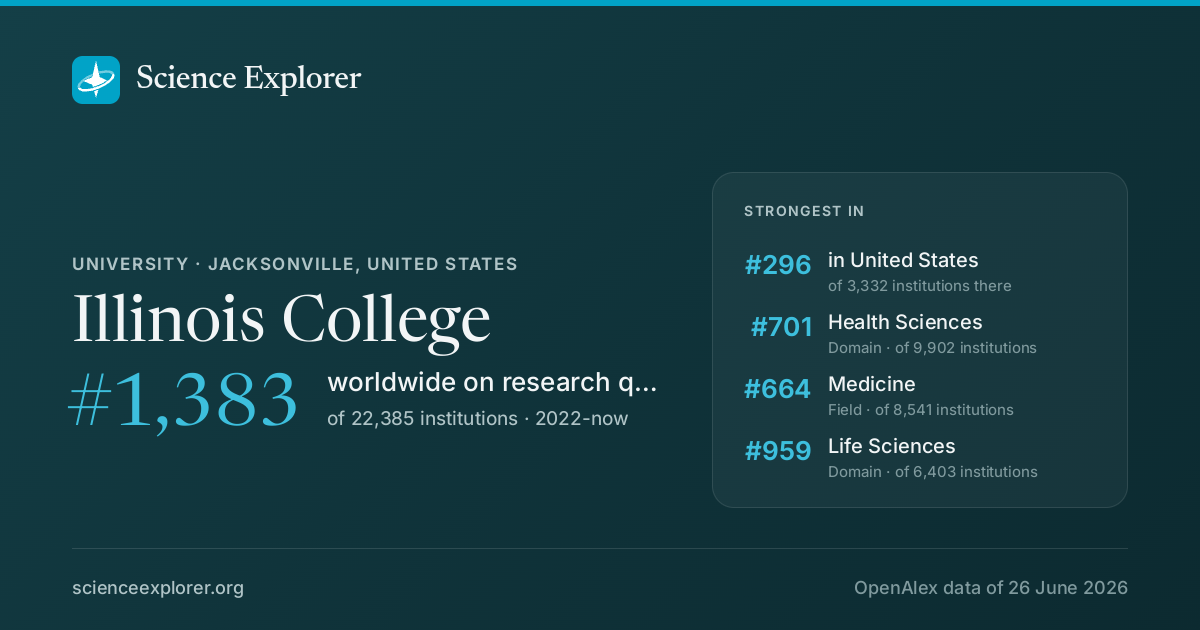
Illinois College on Science Explorer

A card with Illinois College's standing and the fields it leads in, for a post or a slide. A link to this page previews as the same card.

Download the card

1200 × 630 PNG, sized for social posts, drawn from the latest snapshot.

Badges for a website2Each links back here and updates with every snapshot

Its overall standing, then the domains, fields and subfields where Illinois College is in the world's top ten or its top 1%. Each has an image of its own.

Overall

Domains

Research measures only: rankings here say nothing about teaching, admissions or student experience. Comparable institutions and collaboration partners have tabs of their own, above.

Discussion

Ask a question or share a note about Illinois College. Posts are plain text and can be reported.

