Pharmerit (United States)
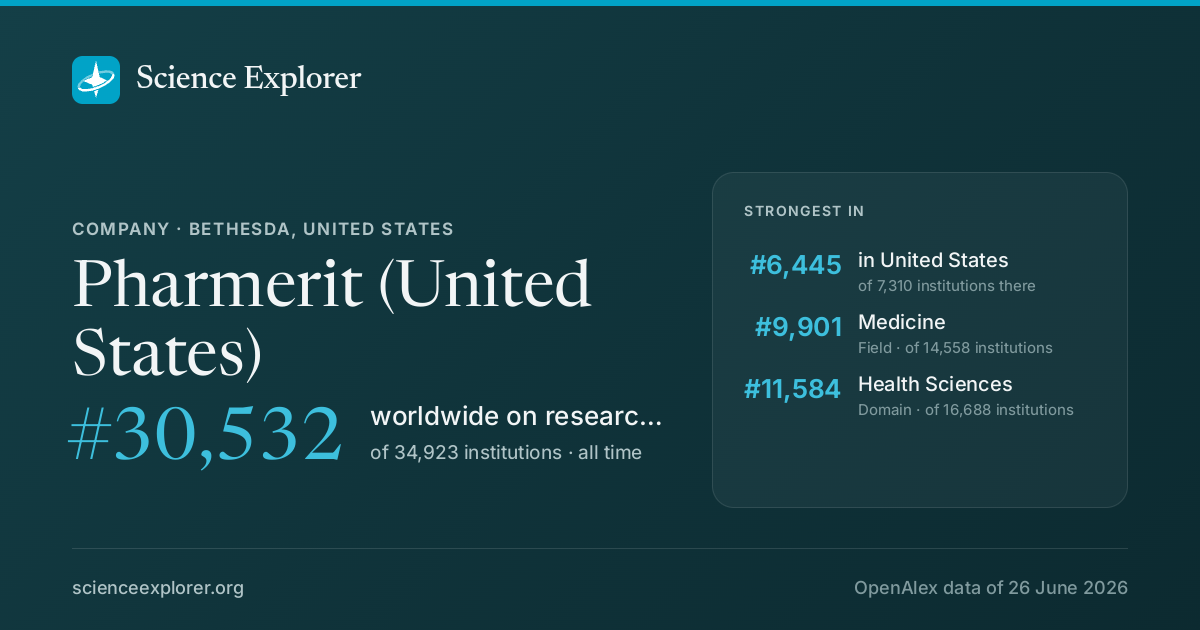
In research, Pharmerit (United States) stands highest in Medicine (#9,901 of 14,558 worldwide) and Health Sciences (#11,584 of 16,688 worldwide), over all time.
- World rank, all time
- #30,532 of 34,923
- Rank in United States
- #6,445 of 7,310
- Research works
- 260 ▼ 97% vs 2018-21
- Citations
- 3.7k 14.2 per fractional work
- Top-10% rate
- 5.9% all institutions 10.0%
- vs its own fields
- 0.86× 1.00× is exactly expected
- Open access
- 42% world 40%
- International
- 32% world 18%
What is Pharmerit (United States) known for in research?
The fields where it stands highest, over all time, ranked among every institution above the floor in each field.
| Field | World rank | Where that sits | Top-10% rate | Works |
|---|---|---|---|---|
| MedicineField | #9,901 of 14,558 | 7.8% | 177 | |
| Health SciencesDomain | #11,584 of 16,688 | 7.7% | 187 |
Each strip is that field's whole ranked pool, with the notch where Pharmerit (United States) sits in it, in the colour of the band that rank falls in. The track under the rate is the rate itself: it carries no average mark, because the average differs by field (from about 6% in Dentistry to 21% in Economics).
Which fields of science does Pharmerit (United States) work in?
In all years, 72% of research at Pharmerit (United States) is in Health Sciences, 14% in Social Sciences. Its largest fields are Medicine (68%), Economics, Econometrics and Finance (9%), Biochemistry, Genetics and Molecular Biology (5%). It does 3.0× the world's share of Health Sciences.
Each ring splits the one inside it: the four domains of science, their fields, their subfields. Size is fractional works in all years. Every slice is a page; the interactive view zooms down to single topics and colours each by how much more of it this institution does than the world.
Its 4 domains and 21 fields, with their numbers
- Health Sciences18772.0%
- Medicine17768.1%
- Health Professions83.1%
- Nursing10.4%
- Veterinary10.3%
- Dentistry00.1%
- Social Sciences3613.7%
- Life Sciences3111.8%
- Physical Sciences62.5%
- Mathematics41.4%
- Computer Science10.5%
- Chemistry10.3%
- Engineering00.2%
- Materials Science00.1%
Field profile
Location quotient across every field it publishes in: outside the ring is more than an institution of this size would be expected to publish, inside it is less.
Rings at 0.5×, 1× and 2×. Widest outward: Medicine, 4.3×. Every wedge is a field page.
All 6 fields, with their numbers
- Medicine4.26×4 works
- Materials Science2.02×0 works
- Psychology1.24×0 works
- Economics, Econometrics and Finance0.77×0 works
- Decision Sciences0.49×0 works
- Social Sciences0.41×0 works
Who are the top researchers at Pharmerit (United States)?
Ranked on the quality score, Marc F Botteman, Yu‐Chen Yeh and Charles Iaconangelo lead among researchers whose main affiliation is Pharmerit (United States).
- 1
Marc F Botteman
 United States · #1,245,457 worldwide
7.4k citations · 272 works
- 2
Yu‐Chen Yeh
United States · #1,330,491 worldwide
833 citations · 42 works
- 3
Charles Iaconangelo
United States · #1,457,455 worldwide
275 citations · 20 works
- 4
Dipen A. Patel
United States · #1,622,320 worldwide
1.6k citations · 60 works
- 5
Jennifer M.L. Stephens
United States · #1,843,520 worldwide
4.3k citations · 154 works
- 6
Yin Wan
United States · #1,938,630 worldwide
1.4k citations · 38 works
- 7
Alexandra Khachatryan
United States · #2,188,284 worldwide
623 citations · 41 works
- 8
Anuj M. Shah
United States · #2,359,143 worldwide
399 citations · 30 works
- 9
Katharina Verleger
United States · #2,445,700 worldwide
166 citations · 25 works
- 10
Sonya J. Snedecor
United States · #2,470,424 worldwide
1.7k citations · 88 works
Which keywords describe research at Pharmerit (United States)?
By fractional works in all years, weighted toward what it does more of than the world: Epidemiology, Quality of Life, Prognostic Factors, Immunotherapy, Cost-effectiveness Analysis, Health Utility Measures, Diagnosis and Rituximab.
- Recombinant Factor VIIa
- Inhibitors
- Population-Based Study
- Staphylococcus aureus
- Breast Cancer
- Cancer Incidence
- Healthcare-Associated Infections
- Genomic Aberrations
- Antiretroviral Therapy
- Guidelines
- Cancer Treatment
- Virulence Factors
- Global Burden
- Financial Toxicity
- Clinical Practice Guidelines
- Treatment
- Management
- Cost-effectiveness Analysis
- Prognostic Factors
- Quality of Life
- Epidemiology
- Diagnosis
- Immunotherapy
- Health Utility Measures
- Clinical Trials
- Rituximab
- Cost of Care
- Biomarkers
- Prostate Cancer
- Antimicrobial Resistance
- Clinical Management
- Therapeutic Targets
- Chronic Lymphocytic Leukemia
- PET Imaging
- Targeted Therapy
- Prophylaxis
- Lymphoma
- Genomic Profiling
- Gene Expression Profiling
- Molecular Profiling
Size is fractional works in all years in the topics tagged with each word; colour is the word's share of this institution's work against its share of the world's. The 40 words are chosen for being large and distinctive. Each links to the topic it comes from most.
All 40 words, with their numbers
- Epidemiology42▲ 4.0×66 topics
- Quality of Life19▲ 5.5×13 topics
- Diagnosis13▲ 5.1×17 topics
- Prognostic Factors13▲ 11×9 topics
- Immunotherapy12▲ 7.3×15 topics
- Cost-effectiveness Analysis12▲ 57×1 topic
- Health Utility Measures12▲ 57×1 topic
- Management11▲ 5.3×11 topics
- Clinical Trials10▲ 6.5×13 topics
- Treatment10▲ 3.1×19 topics
- Rituximab10▲ 25×2 topics
- Clinical Practice Guidelines10▲ 6.8×10 topics
- Cost of Care8▲ 165×1 topic
- Financial Toxicity8▲ 165×1 topic
- Biomarkers8▲ 4.8×11 topics
- Global Burden8▲ 5.4×9 topics
- Prostate Cancer8▲ 19×4 topics
- Virulence Factors7▲ 15×4 topics
- Antimicrobial Resistance7▲ 10×4 topics
- Cancer Treatment7▲ 10×4 topics
- Clinical Management7▲ 12×4 topics
- Guidelines7▲ 5.3×10 topics
- Therapeutic Targets6▲ 11×2 topics
- Antiretroviral Therapy6▲ 11×6 topics
- Chronic Lymphocytic Leukemia6▲ 50×1 topic
- Genomic Aberrations6▲ 50×1 topic
- PET Imaging6▲ 11×4 topics
- Healthcare-Associated Infections6▲ 19×5 topics
- Targeted Therapy6▲ 11×4 topics
- Cancer Incidence6▲ 15×4 topics
- Prophylaxis6▲ 15×3 topics
- Breast Cancer6▲ 7.5×6 topics
- Lymphoma5▲ 14×3 topics
- Staphylococcus aureus5▲ 27×2 topics
- Genomic Profiling5▲ 20×2 topics
- Population-Based Study5▲ 33×2 topics
- Gene Expression Profiling5▲ 19×2 topics
- Inhibitors5▲ 26×2 topics
- Molecular Profiling5▲ 16×2 topics
- Recombinant Factor VIIa5▲ 45×2 topics
Which research topics does Pharmerit (United States) publish most on?
By volume in 2022-now: Myasthenia Gravis and Thymoma, Anesthesia and Pain Management, Advanced Cellulose Research Studies and Spine and Intervertebral Disc Pathology.
Area is fractional works; colour is the subfield each topic belongs to.
- 1 Myasthenia Gravis and Thymoma Neurology 1 works
- 2 Anesthesia and Pain Management Surgery 0 works
- 3 Advanced Cellulose Research Studies Biomaterials 0 works
- 4 Spine and Intervertebral Disc Pathology Pathology and Forensic Medicine 0 works
- 5 Systemic Lupus Erythematosus Research Rheumatology 0 works
- 6 Surgical site infection prevention Surgery 0 works
- 7 Blood groups and transfusion Hematology 0 works
- 8 Hemoglobinopathies and Related Disorders Genetics 0 works
- 9 Iron Metabolism and Disorders Hematology 0 works
- 10 HIV/AIDS Research and Interventions Infectious Diseases 0 works
How open and international is its research?
Against the world's own shares: the tick on each track. Both are shares of its output, so they sit on one scale and can be read against each other as well as against the world.
World: 40% of research is openly available.
World: 18% is written across borders.
How has Pharmerit (United States)'s research output changed?
Output in 2022-2025 was 97% lower than in 2018-2021.
The same series as a ribbon: one cell per year, darker for more. The line above answers how much; this answers when.
Its share of all research
Growing output can still be a shrinking share: all of science grows. This is Pharmerit (United States) as a percentage of every work published that year, 0.000015% in 2024.
Fractional works of Pharmerit (United States) over all fractional works that year. How the balance of science has shifted.
Other research institutions in Bethesda
- National Institutes of Health
- Uniformed Services University of the Health Sciences
- Lockheed Martin (United States)
- Health Affairs
- ORCID
- Pain and Rehabilitation Medicine
- Henry M. Jackson Foundation
- National Foundation for Cancer Research


Share Pharmerit (United States)'s ranking
Badges for a website1Each links back here and updates with every snapshot

Research measures only: rankings here say nothing about teaching, admissions or student experience. Comparable institutions and collaboration partners have tabs of their own, above.
Discussion
Ask a question or share a note about Pharmerit (United States). Keep it to the research: no personal attacks, advertising or links. Any reader can report a post, which collapses it for everyone until it is opened.