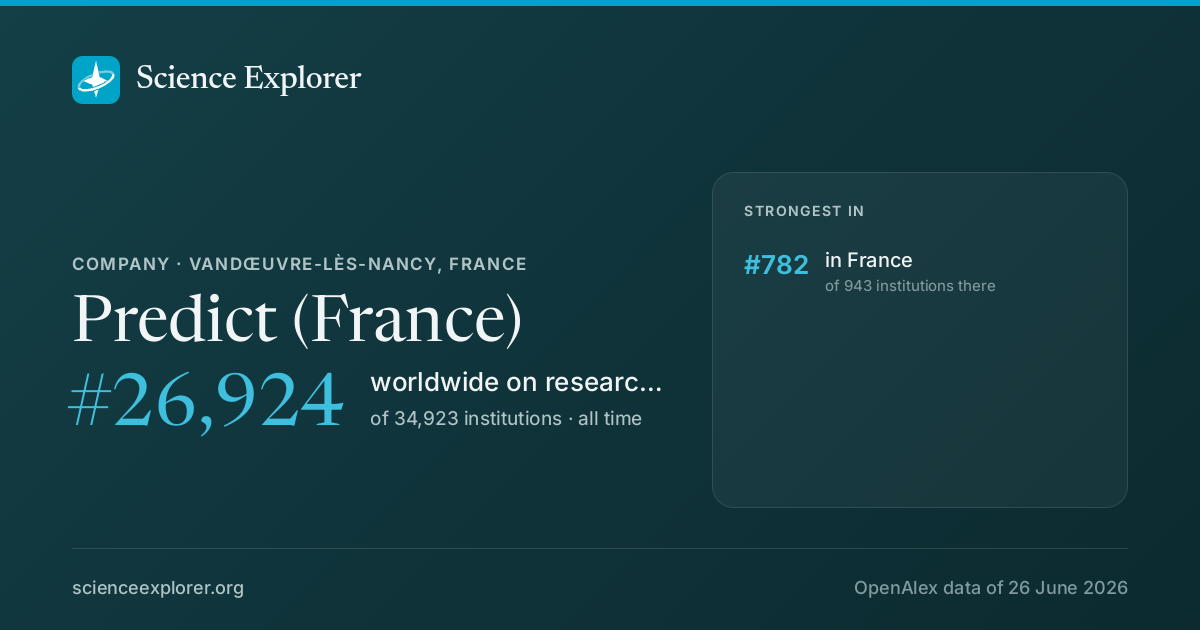
World rank, all time #26,924
of 34,923
Rank in France #782
of 943 Research works 151
▲ 65% vs 2018-21
Citations 2.6k 17.3 per fractional work
Top-10% rate 6.4%
all institutions 10.0%
vs its own fields 1.01×
1.00× is exactly expected
Open access 47%
world 40%
International 40%
world 18%
Which fields of science does Predict (France) work in?
In 2022-now, 38% of research at Predict (France) is in Health Sciences , 27% in Life Sciences . Its largest fields are Medicine (31%), Biochemistry, Genetics and Molecular Biology (13%), Engineering (8%). It does 1.7× the world's share of Life Sciences.
Health Sciences: 17 fractional works · 37.8% of its work Medicine: 14 fractional works · 31.3% of its work Oncology: 2 fractional works · 5.0% of its work Epidemiology: 2 fractional works · 4.3% of its work Infectious Diseases: 1 fractional works · 2.9% of its work Pulmonary and Respiratory Medicine: 1 fractional works · 2.8% of its work Public Health, Environmental and Occupational Health: 1 fractional works · 2.3% of its work Hepatology: 1 fractional works · 2.2% of its work Surgery: 1 fractional works · 1.8% of its work Pediatrics, Perinatology and Child Health: 1 fractional works · 1.6% of its work Rheumatology: 0 fractional works · 1.0% of its work Geriatrics and Gerontology: 0 fractional works · 0.9% of its work Cardiology and Cardiovascular Medicine: 0 fractional works · 0.9% of its work Family Practice: 0 fractional works · 0.7% of its work Anesthesiology and Pain Medicine: 0 fractional works · 0.6% of its work Reproductive Medicine: 0 fractional works · 0.6% of its work Pathology and Forensic Medicine: 0 fractional works · 0.5% of its work Radiology, Nuclear Medicine and Imaging: 0 fractional works · 0.4% of its work Physiology: 0 fractional works · 0.4% of its work Pharmacology: 0 fractional works · 0.3% of its work Emergency Medicine: 0 fractional works · 0.3% of its work Obstetrics and Gynecology: 0 fractional works · 0.3% of its work Dermatology: 0 fractional works · 0.2% of its work Urology: 0 fractional works · 0.2% of its work Smaller subfields together: 0 fractional works · 1.1% of its work Veterinary: 1 fractional works · 3.0% of its work Small Animals: 1 fractional works · 3.0% of its work Health Professions: 1 fractional works · 2.6% of its work General Health Professions: 1 fractional works · 1.9% of its work Speech and Hearing: 0 fractional works · 0.4% of its work Emergency Medical Services: 0 fractional works · 0.2% of its work Smaller subfields together: 0 fractional works · 0.0% of its work Nursing: 0 fractional works · 0.5% of its work Nutrition and Dietetics: 0 fractional works · 0.4% of its work Smaller subfields together: 0 fractional works · 0.1% of its work Dentistry: 0 fractional works · 0.4% of its work Periodontics: 0 fractional works · 0.4% of its work Life Sciences: 12 fractional works · 27.5% of its work Biochemistry, Genetics and Molecular Biology: 6 fractional works · 12.9% of its work Molecular Biology: 2 fractional works · 5.6% of its work Genetics: 2 fractional works · 3.6% of its work Cancer Research: 1 fractional works · 1.6% of its work Endocrinology: 0 fractional works · 1.1% of its work Biochemistry: 0 fractional works · 0.4% of its work Biotechnology: 0 fractional works · 0.3% of its work Smaller subfields together: 0 fractional works · 0.3% of its work Pharmacology, Toxicology and Pharmaceutics: 3 fractional works · 6.7% of its work Pharmacology: 3 fractional works · 6.7% of its work Immunology and Microbiology: 2 fractional works · 3.5% of its work Immunology: 1 fractional works · 2.0% of its work Parasitology: 1 fractional works · 1.5% of its work Agricultural and Biological Sciences: 1 fractional works · 3.3% of its work Food Science: 1 fractional works · 1.6% of its work Ecology, Evolution, Behavior and Systematics: 0 fractional works · 1.0% of its work Plant Science: 0 fractional works · 0.5% of its work Soil Science: 0 fractional works · 0.2% of its work Neuroscience: 0 fractional works · 1.0% of its work Biological Psychiatry: 0 fractional works · 0.7% of its work Neurology: 0 fractional works · 0.2% of its work Smaller subfields together: 0 fractional works · 0.0% of its work Physical Sciences: 11 fractional works · 24.9% of its work Engineering: 3 fractional works · 7.8% of its work Industrial and Manufacturing Engineering: 1 fractional works · 2.4% of its work Automotive Engineering: 1 fractional works · 1.5% of its work Building and Construction: 0 fractional works · 0.8% of its work Mechanical Engineering: 0 fractional works · 0.8% of its work Biomedical Engineering: 0 fractional works · 0.7% of its work Mechanics of Materials: 0 fractional works · 0.4% of its work Civil and Structural Engineering: 0 fractional works · 0.3% of its work Control and Systems Engineering: 0 fractional works · 0.3% of its work Computational Mechanics: 0 fractional works · 0.2% of its work Smaller subfields together: 0 fractional works · 0.2% of its work Computer Science: 3 fractional works · 7.6% of its work Artificial Intelligence: 2 fractional works · 3.6% of its work Signal Processing: 1 fractional works · 1.4% of its work Computer Vision and Pattern Recognition: 0 fractional works · 1.0% of its work Information Systems: 0 fractional works · 0.9% of its work Software: 0 fractional works · 0.2% of its work Computer Networks and Communications: 0 fractional works · 0.2% of its work Smaller subfields together: 0 fractional works · 0.2% of its work Environmental Science: 2 fractional works · 5.0% of its work Global and Planetary Change: 1 fractional works · 2.4% of its work Health, Toxicology and Mutagenesis: 1 fractional works · 1.7% of its work Ecology: 0 fractional works · 0.4% of its work Environmental Engineering: 0 fractional works · 0.2% of its work Smaller subfields together: 0 fractional works · 0.3% of its work Chemistry: 1 fractional works · 1.5% of its work Organic Chemistry: 0 fractional works · 0.7% of its work Physical and Theoretical Chemistry: 0 fractional works · 0.7% of its work Smaller subfields together: 0 fractional works · 0.0% of its work Materials Science: 0 fractional works · 0.8% of its work Polymers and Plastics: 0 fractional works · 0.4% of its work Materials Chemistry: 0 fractional works · 0.3% of its work Smaller subfields together: 0 fractional works · 0.1% of its work Mathematics: 0 fractional works · 0.8% of its work Modeling and Simulation: 0 fractional works · 0.4% of its work Statistics and Probability: 0 fractional works · 0.4% of its work Earth and Planetary Sciences: 0 fractional works · 0.6% of its work Atmospheric Science: 0 fractional works · 0.6% of its work Physics and Astronomy: 0 fractional works · 0.5% of its work Atomic and Molecular Physics, and Optics: 0 fractional works · 0.4% of its work Smaller subfields together: 0 fractional works · 0.1% of its work Chemical Engineering: 0 fractional works · 0.3% of its work Fluid Flow and Transfer Processes: 0 fractional works · 0.3% of its work Social Sciences: 4 fractional works · 9.8% of its work Social Sciences: 1 fractional works · 2.7% of its work Sociology and Political Science: 1 fractional works · 2.1% of its work Health: 0 fractional works · 0.4% of its work Smaller subfields together: 0 fractional works · 0.2% of its work Arts and Humanities: 1 fractional works · 2.2% of its work Language and Linguistics: 1 fractional works · 1.5% of its work Philosophy: 0 fractional works · 0.7% of its work Economics, Econometrics and Finance: 1 fractional works · 2.2% of its work Finance: 1 fractional works · 1.5% of its work Economics and Econometrics: 0 fractional works · 0.7% of its work Decision Sciences: 1 fractional works · 1.9% of its work Management Science and Operations Research: 1 fractional works · 1.6% of its work Statistics, Probability and Uncertainty: 0 fractional works · 0.4% of its work Psychology: 0 fractional works · 0.6% of its work Clinical Psychology: 0 fractional works · 0.4% of its work Smaller subfields together: 0 fractional works · 0.1% of its work Business, Management and Accounting: 0 fractional works · 0.2% of its work Health Sciences Medicine Veterinary Health Pr… Life Sciences Biochemistry Pharmacol… Immunolog… Agricultu… Physical Sciences Engineering Computer Science Environme… Chemistry Social… Social Sc… Arts and… Economics Decision… ALL ITS WORK Predict (France) 44 fractional works, 2022-now 27% 25% 38% 10%
Each ring splits the one inside it: the four domains of science, their fields, their subfields. Size is fractional works in 2022-now. Every slice is a page; the interactive view zooms down to single topics and colours each by how much more of it this institution does than the world.
Its 4 domains and 25 fields, with their numbers 14 31.3% 1 3.0% 1 2.6% 0 0.5% 0 0.4% 6 12.9% 3 6.7% 2 3.5% 1 3.3% 0 1.0% 3 7.8% 3 7.6% 2 5.0% 1 1.5% 0 0.8% 0 0.8% 0 0.6% 0 0.5% 0 0.3% 1 2.7% 1 2.2% 1 2.2% 1 1.9% 0 0.6% 0 0.2% All of science, and how each field's share has moved since 1950: the Science domain explorer
Field profile
Location quotient across every field it publishes in: outside the ring is more than an institution of this size would be expected to publish, inside it is less.
Agricultural and Biological Sciences: 0.71× its world share, 2 works Agricultural and Bio… Biochemistry, Genetics and Molecular Biology: 2.42× its world share, 6 works Biochemistry, Geneti… Immunology and Microbiology: 3.49× its world share, 2 works Immunology and Micro… Neuroscience: 0.62× its world share, 0 works Neuroscience Pharmacology, Toxicology and Pharmaceutics: 19.14× its world share, 3 works Pharmacology, Toxico… Chemical Engineering: 0.80× its world share, 0 works Chemical Engineering Chemistry: 0.96× its world share, 1 works Chemistry Computer Science: 0.98× its world share, 3 works Computer Science Earth and Planetary Sciences: 0.40× its world share, 0 works Earth and Planetary … Engineering: 0.52× its world share, 4 works Engineering Environmental Science: 1.00× its world share, 2 works Environmental Science Materials Science: 0.23× its world share, 0 works Materials Science Mathematics: 0.68× its world share, 0 works Mathematics Physics and Astronomy: 0.21× its world share, 0 works Physics and Astronomy Dentistry: 0.82× its world share, 0 works Dentistry Health Professions: 0.98× its world share, 1 works Health Professions Medicine: 1.63× its world share, 14 works Medicine Nursing: 1.08× its world share, 0 works Nursing Veterinary: 22.07× its world share, 1 works Veterinary Arts and Humanities: 0.78× its world share, 1 works Arts and Humanities Business, Management and Accounting: 0.06× its world share, 0 works Business, Management… Decision Sciences: 2.00× its world share, 1 works Decision Sciences Economics, Econometrics and Finance: 1.04× its world share, 1 works Economics, Econometr… Psychology: 0.19× its world share, 0 works Psychology Social Sciences: 0.21× its world share, 1 works Social Sciences 1× world share
Rings at 0.5×, 1× and 2×. Widest outward: Veterinary , 22.1×. Every wedge is a field page.
All 25 fields, with their numbers Veterinary 22.07× 1 works Pharmacology, Toxicology and Pharmaceutics 19.14× 3 works Immunology and Microbiology 3.49× 2 works Biochemistry, Genetics and Molecular Biology 2.42× 6 works Decision Sciences 2.00× 1 works Medicine 1.63× 14 works Nursing 1.08× 0 works Economics, Econometrics and Finance 1.04× 1 works Environmental Science 1.00× 2 works Computer Science 0.98× 3 works Health Professions 0.98× 1 works Chemistry 0.96× 1 works Dentistry 0.82× 0 works Chemical Engineering 0.80× 0 works Arts and Humanities 0.78× 1 works Agricultural and Biological Sciences 0.71× 2 works Mathematics 0.68× 0 works Neuroscience 0.62× 0 works Engineering 0.52× 4 works Earth and Planetary Sciences 0.40× 0 works Materials Science 0.23× 0 works Physics and Astronomy 0.21× 0 works Social Sciences 0.21× 1 works Psychology 0.19× 0 works Business, Management and Accounting 0.06× 0 works
Who are the top researchers at Predict (France)?
Ranked on the quality score, Jean Baptiste Leger , Jean-Baptiste Léger and Flavien Peysson lead among researchers whose main affiliation is Predict (France).
1
Jean Baptiste Leger
France · #3,155,386 worldwide299 citations · 17 works
2
Jean-Baptiste Léger
France · #3,718,331 worldwide178 citations · 40 works
3
Flavien Peysson
France · #4,558,764 worldwide222 citations · 33 works
4
Michael Hertl
France · #4,977,512 worldwide33 citations · 16 works
5
Hong Tuan Duong
France · #5,228,103 worldwide178 citations · 19 works
All ranked researchers at Predict (France)
What are the most cited papers from Predict (France)?
The most cited paper from Predict (France) is "The Drought Monitor" (Mark D. Svoboda, Doug LeComte, Mike Hayes et al., 2002), with 837 citations. Next come "Arctic climate change: observed and modelled temperature and sea-ice variability" (683) and "Defining Desirable Central Nervous System Drug Space through the Alignment of Molecular Properties, in Vitro ADME, and Safety Attributes" (492).
Most cited papers
# Paper Released Citations 1
The Drought Monitor
Mark D. Svoboda, Doug LeComte, Mike Hayes et al. · Bulletin of the American Meteorological Society
Open access Aug 2002
837 2
Arctic climate change: observed and modelled temperature and sea-ice variability
Ola M. Johannessen, Lennart O. Bengtsson, Martin W. Miles et al. · Tellus A Dynamic Meteorology and Oceanography
Open access 9 Jul 2004
683 3
Defining Desirable Central Nervous System Drug Space through the Alignment of Molecular Properties, in Vitro ADME, and Safety Attributes
Travis T. Wager, Ramalakshmi Yegna Chandrasekaran, Xinjun Hou et al. · ACS Chemical Neuroscience
Open access 25 Mar 2010
492 4
The role of ecosystem-atmosphere interactions in simulated Amazonian precipitation decrease and forest dieback under global climate warming
Richard Betts, Peter M. Cox, Matthew David Collins et al. · Theoretical and Applied Climatology
6 May 2004
481 5
Tanycytic VEGF-A Boosts Blood-Hypothalamus Barrier Plasticity and Access of Metabolic Signals to the Arcuate Nucleus in Response to Fasting
Fanny Langlet, Barry E. Levin, Serge H. Luquet et al. · Cell Metabolism
Open access Apr 2013
390
All 59 most cited papers, with filters and sorting
Which keywords describe research at Predict (France)?
By fractional works in 2022-now, weighted toward what it does more of than the world: Epidemiology , Biomarkers, Pathogenesis, Oxidative Stress, Mitochondrial Dysfunction, Liver Transplantation , Drug-Induced Liver Injury and Hepatotoxicity.
Size is fractional works in 2022-now in the topics tagged with each word; colour is the word's share of this institution's work against its share of the world's. The 32 words are chosen for being large and distinctive. Each links to the topic it comes from most.
All 32 words, with their numbers Epidemiology 5 ▲ 2.9× 30 topics Oxidative Stress 3 ▲ 4.5× 9 topics Deep Learning 3 ▲ 2.1× 18 topics Biomarkers 3 ▲ 9.9× 9 topics Pathogenesis 3 ▲ 12× 9 topics Inflammation 3 ▲ 2.8× 16 topics Diagnosis 2 ▲ 4.5× 11 topics Liver Transplantation 2 ▲ 33× 2 topics Mitochondrial Dysfunction 2 ▲ 14× 2 topics Cancer 2 ▲ 2.8× 12 topics Drug-Induced Liver Injury 2 ▲ 135× 1 topic Hepatotoxicity 2 ▲ 77× 1 topic Public Health 2 ▲ 2.6× 12 topics Treatment 2 ▲ 3.1× 10 topics Inflammatory Bowel Disease 2 ▲ 28× 3 topics Neural Networks 1 ▲ 2.1× 6 topics ARRIVE Guidelines 1 ▲ 250× 1 topic Animal Research Reporting 1 ▲ 250× 1 topic Machine Learning 1 ◆ 0.87× 13 topics Risk Perception 1 ▲ 11× 3 topics Virulence Factors 1 ▲ 20× 4 topics Climate Change 1 ◆ 0.97× 8 topics Clinical Practice Guidelines 1 ▲ 5.0× 8 topics Food Safety 1 ▲ 9.7× 3 topics Time Series 1 ▲ 15× 3 topics Genetic Variation 1 ▲ 11× 2 topics Genetics 1 ▲ 3.4× 4 topics Quality of Life 1 ▲ 1.73× 8 topics Chemotherapy 1 ▲ 3.3× 10 topics Cytochrome P450 1 ▲ 69× 1 topic Pharmacogenetics 1 ▲ 112× 1 topic Pharmacokinetics 1 ▲ 8.7× 2 topics
How open and international is its research?
Against the world's own shares: the tick on each track. Both are shares of its output, so they
sit on one scale and can be read against each other as well as against the world.
47% 53%
47.0% 53.0%
World: 40% of research is openly available.
40% 60%
40.0% 60.0%
World: 18% is written across borders.
How has Predict (France)'s research output changed?
Output in 2022-2025 was 65% higher than in 2018-2021.
still counting 1990 2000 2010 2020
The same series as a ribbon: one cell per year, darker for more. The line above answers how much ; this answers when .
Its share of all research
still counting 0.00020% 0.00040% Predict (France) 0.00022% in 2025 1980 1990 2000 2010 2020 Fractional works of Predict (France) over all fractional works that year. How the balance of science has shifted .
Share Predict (France)'s ranking
A card with Predict (France)'s standing and the fields it leads in, for a post or a slide. A link to this page previews as the same card.
Badges for a website 1 Each links back here and updates with every snapshot
 France · #3,155,386 worldwide
299 citations · 17 works