- World rank, all time
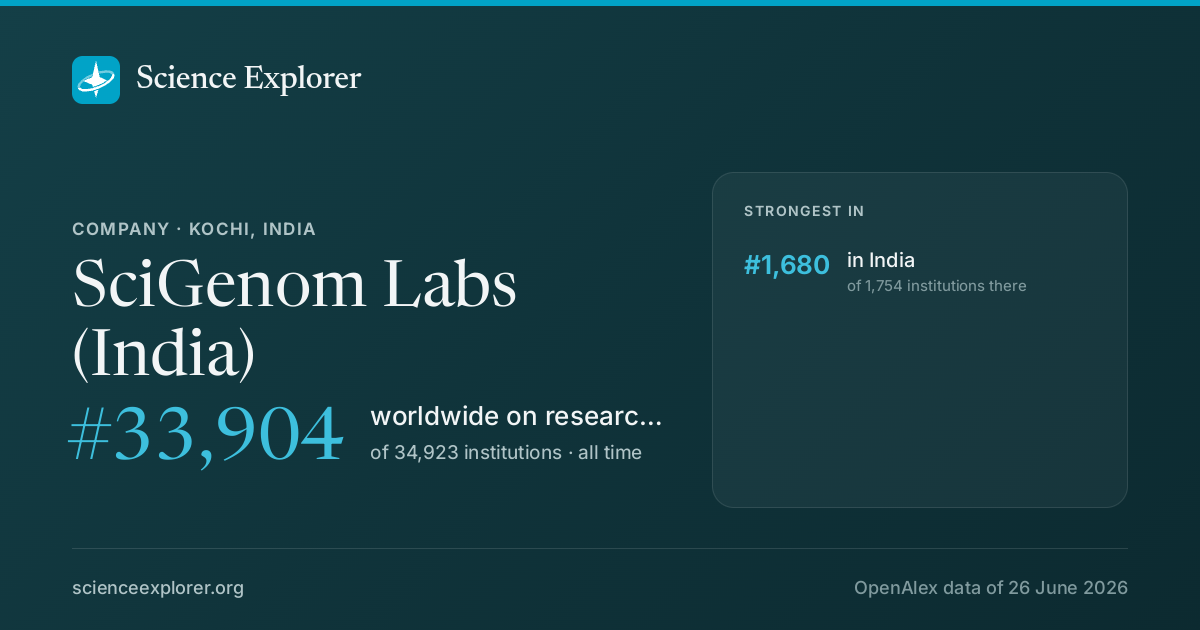
- #33,904 of 34,923
- Rank in India
- #1,680 of 1,754
- Research works
- 162 ▼ 15% vs 2018-21
- Citations
- 1.5k 9.3 per fractional work
- Top-10% rate
- 4.4% all institutions 10.0%
- vs its own fields
- 0.85× 1.00× is exactly expected
- Open access
- 64% world 40%
- International
- 20% world 18%
Which fields of science does SciGenom Labs (India) work in?
In 2022-now, 43% of research at SciGenom Labs (India) is in Life Sciences, 38% in Health Sciences. Its largest fields are Medicine (37%), Biochemistry, Genetics and Molecular Biology (30%), Engineering (9%). It does 2.6× the world's share of Life Sciences.
Each ring splits the one inside it: the four domains of science, their fields, their subfields. Size is fractional works in 2022-now. Every slice is a page; the interactive view zooms down to single topics and colours each by how much more of it this institution does than the world.
Its 4 domains and 21 fields, with their numbers
- Life Sciences2643.0%
- Health Sciences2338.3%
- Medicine2236.6%
- Dentistry00.5%
- Health Professions00.5%
- Nursing00.4%
- Veterinary00.2%
- Physical Sciences1016.0%
- Engineering59.0%
- Computer Science34.8%
- Environmental Science11.0%
- Materials Science00.5%
- Physics and Astronomy00.4%
- Chemistry00.3%
- Mathematics00.1%
- Social Sciences22.7%
- Business, Management and Accounting11.1%
- Social Sciences00.8%
- Psychology00.6%
- Decision Sciences00.1%
Field profile
Location quotient across every field it publishes in: outside the ring is more than an institution of this size would be expected to publish, inside it is less.
Rings at 0.5×, 1× and 2×. Widest outward: Immunology and Microbiology, 7.3×. Every wedge is a field page.
All 21 fields, with their numbers
- Immunology and Microbiology7.31×4 works
- Biochemistry, Genetics and Molecular Biology5.60×18 works
- Medicine1.90×22 works
- Pharmacology, Toxicology and Pharmaceutics1.43×0 works
- Neuroscience1.38×1 works
- Veterinary1.35×0 works
- Dentistry1.14×0 works
- Nursing0.90×0 works
- Agricultural and Biological Sciences0.65×2 works
- Computer Science0.62×3 works
- Engineering0.60×5 works
- Business, Management and Accounting0.34×1 works
- Environmental Science0.21×1 works
- Health Professions0.21×0 works
- Psychology0.21×0 works
- Chemistry0.18×0 works
- Physics and Astronomy0.17×0 works
- Materials Science0.13×0 works
- Decision Sciences0.10×0 works
- Social Sciences0.07×0 works
- Mathematics0.06×0 works
- Immunology and Microbiology 7.3×
- Biochemistry, Genetics and Molecular Biology 5.6×
- Medicine 1.9×
- Pharmacology, Toxicology and Pharmaceutics 1.4×
- Neuroscience 1.4×
- Veterinary 1.4×
- Dentistry 1.1×
- Nursing 0.9×
- Agricultural and Biological Sciences 0.7×
- Computer Science 0.6×
- Engineering 0.6×
- Business, Management and Accounting 0.3×
- Environmental Science 0.2×
- Health Professions 0.2×
- Psychology 0.2×
- Chemistry 0.2×
- Physics and Astronomy 0.2×
- Materials Science 0.1×
- Decision Sciences 0.1×
- Social Sciences 0.1×
- Mathematics 0.1×
Who are the top researchers at SciGenom Labs (India)?
Ranked on the quality score, Somasekar Seshagiri, Eric W. Stawiski and Subhra Chaudhuri lead among researchers whose main affiliation is SciGenom Labs (India).
- 1
Somasekar Seshagiri
 India · #13,510 worldwide
27k citations · 249 works
- 2
Eric W. Stawiski
India · #53,783 worldwide
9.8k citations · 123 works
- 3
Subhra Chaudhuri
India · #85,987 worldwide
6.8k citations · 42 works
- 4
Sameer Phalke
India · #164,266 worldwide
3k citations · 39 works
- 5
Ravi Kr Gupta
India · #500,251 worldwide
3.7k citations · 127 works
- 6
Amitabha Chaudhuri
India · #774,799 worldwide
1.7k citations · 41 works
- 7
Vedam Lakshmi Ramprasad
India · #829,714 worldwide
3.1k citations · 125 works
- 8
Papia Chakraborty
India · #854,051 worldwide
966 citations · 26 works
- 9
Kellen Schneider
India · #949,682 worldwide
975 citations · 17 works
- 10
Kushal Suryamohan
India · #1,226,715 worldwide
1.5k citations · 34 works
Which keywords describe research at SciGenom Labs (India)?
By fractional works in 2022-now, weighted toward what it does more of than the world: Prenatal Diagnosis, Cancer Risk, Genetic Testing, Prognostic Factors, Cell-Free DNA, Genetic Variants, Clinical Genomics and Sequence Interpretation.
- Treatment
- Genomic Rearrangements
- DNA Methylation
- Clinical Practice Guidelines
- Population Genetics
- Immunotherapy
- Ovarian Cancer
- Autoimmunity
- Electric Vehicles
- Maternal Plasma DNA Sequencing
- Genetic Variation
- Chemotherapy
- Metabolic Syndrome
- Genetic Mutations
- Inflammation
- Cancer
- Oxidative Stress
- Genetic Testing
- Cell-Free DNA
- Prenatal Diagnosis
- Epidemiology
- Cancer Risk
- Gene Expression
- Genetic Variants
- Prognostic Factors
- Clinical Genomics
- Sequence Interpretation
- Innate Immunity
- Precision Medicine
- Aneuploidy Screening
- Genetics
- Mitochondrial Dysfunction
- Neurodevelopmental Disorders
- Breast Cancer
- Healthcare
- Molecular Characterization
- Stem Cells
- Copy Number Variation
- Epigenetic Regulation
- Immunity
Size is fractional works in 2022-now in the topics tagged with each word; colour is the word's share of this institution's work against its share of the world's. The 40 words are chosen for being large and distinctive. Each links to the topic it comes from most.
All 40 words, with their numbers
- Epidemiology4▲ 1.68×23 topics
- Prenatal Diagnosis3▲ 30×4 topics
- Cancer Risk2▲ 16×4 topics
- Cell-Free DNA2▲ 35×2 topics
- Gene Expression2▲ 5.6×10 topics
- Genetic Testing2▲ 30×3 topics
- Genetic Variants2▲ 19×2 topics
- Oxidative Stress2▲ 2.1×15 topics
- Prognostic Factors2▲ 8.0×7 topics
- Cancer2▲ 2.5×15 topics
- Clinical Genomics2▲ 86×1 topic
- Inflammation2▲ 1.54×16 topics
- Sequence Interpretation2▲ 86×1 topic
- Genetic Mutations2▲ 7.2×11 topics
- Innate Immunity2▲ 9.7×6 topics
- Metabolic Syndrome2▲ 3.9×8 topics
- Precision Medicine2▲ 6.2×4 topics
- Chemotherapy2▲ 3.6×6 topics
- Aneuploidy Screening1▲ 88×1 topic
- Genetic Variation1▲ 11×5 topics
- Genetics1▲ 3.2×7 topics
- Maternal Plasma DNA Sequencing1▲ 88×1 topic
- Mitochondrial Dysfunction1▲ 7.8×7 topics
- Electric Vehicles1▲ 7.6×2 topics
- Neurodevelopmental Disorders1▲ 16×4 topics
- Autoimmunity1▲ 14×2 topics
- Breast Cancer1▲ 7.7×3 topics
- Ovarian Cancer1▲ 21×2 topics
- Healthcare1▲ 1.57×4 topics
- Immunotherapy1▲ 2.6×8 topics
- Molecular Characterization1▲ 10.0×2 topics
- Population Genetics1▲ 13×5 topics
- Stem Cells1▲ 6.7×5 topics
- Clinical Practice Guidelines1▲ 3.1×4 topics
- Copy Number Variation1▲ 105×1 topic
- DNA Methylation1▲ 15×2 topics
- Epigenetic Regulation1▲ 7.9×4 topics
- Genomic Rearrangements1▲ 93×1 topic
- Immunity1▲ 4.2×3 topics
- Treatment1▲ 1.36×8 topics
Which research topics does SciGenom Labs (India) publish most on?
By volume in 2022-now: Genomics and Rare Diseases, Prenatal Screening and Diagnostics, Genetic factors in colorectal cancer and Genomic variations and chromosomal abnormalities.
Area is fractional works; colour is the subfield each topic belongs to.
- 1 Genomics and Rare Diseases Genetics 2 works
- 2 Prenatal Screening and Diagnostics Pediatrics, Perinatology and Child Health 1 works
- 3 Genetic factors in colorectal cancer Pathology and Forensic Medicine 1 works
- 4 Genomic variations and chromosomal abnormalities Genetics 1 works
- 5 BRCA gene mutations in cancer Genetics 1 works
- 6 Acute Myeloid Leukemia Research Hematology 1 works
- 7 Immunotherapy and Immune Responses Immunology 1 works
- 8 T-cell and B-cell Immunology Immunology 1 works
- 9 Cancer Genomics and Diagnostics Cancer Research 1 works
- 10 Genetic Syndromes and Imprinting Genetics 1 works
How open and international is its research?
Against the world's own shares: the tick on each track. Both are shares of its output, so they sit on one scale and can be read against each other as well as against the world.
World: 40% of research is openly available.
World: 18% is written across borders.
How has SciGenom Labs (India)'s research output changed?
Output in 2022-2025 was 15% lower than in 2018-2021.
The same series as a ribbon: one cell per year, darker for more. The line above answers how much; this answers when.
Its share of all research
Growing output can still be a shrinking share: all of science grows. This is SciGenom Labs (India) as a percentage of every work published that year, 0.00022% in 2024.
Fractional works of SciGenom Labs (India) over all fractional works that year. How the balance of science has shifted.
Other research institutions in Kochi
- Cochin University of Science and Technology
- Amrita Institute of Medical Sciences and Research Centre
- Sacred Heart College
- Rajagiri Hospital
- General Hospital Ernakulam
- Kerala University of Fisheries and Ocean Studies
- Aster Medcity
- Malankara Orthodox Syrian Church Medical College Hospital
Share SciGenom Labs (India)'s ranking
Badges for a website1Each links back here and updates with every snapshot

Research measures only: rankings here say nothing about teaching, admissions or student experience. Comparable institutions and collaboration partners have tabs of their own, above.
Discussion
Ask a question or share a note about SciGenom Labs (India). Posts are plain text and can be reported.