Science Explorer Back to mapMap
Discussion
Company · Jerusalem · Israel

Tissue Dynamics (Israel)

In research, Tissue Dynamics (Israel) stands highest in Health Sciences (#6,820 of 16,688 worldwide) and Medicine (#6,059 of 14,558 worldwide), over all time.

World rank, all time
#13,004
of 34,923
Rank in Israel
#62
of 125
Research works
327
▲ 88% vs 2018-21
Citations
6.8k
20.8 per fractional work
Top-10% rate
10.9%
all institutions 10.0%
vs its own fields
0.90×
1.00× is exactly expected
Open access
57%
world 40%
International
49%
world 18%

What is Tissue Dynamics (Israel) known for in research?

The fields where it stands highest, over all time, ranked among every institution above the floor in each field.

FieldWorld rankWhere that sitsTop-10% rateWorks
Health SciencesDomain #6,820 of 16,688 10.7%144
MedicineField #6,059 of 14,558 10.9%132

Each strip is that field's whole ranked pool, with the notch where Tissue Dynamics (Israel) sits in it, in the colour of the band that rank falls in. The track under the rate is the rate itself: it carries no average mark, because the average differs by field (from about 6% in Dentistry to 21% in Economics).

Which fields of science does Tissue Dynamics (Israel) work in?

In 2022-now, 32% of research at Tissue Dynamics (Israel) is in Health Sciences, 31% in Physical Sciences. Its largest fields are Medicine (30%), Biochemistry, Genetics and Molecular Biology (24%), Engineering (9%). It does 1.9× the world's share of Life Sciences.

Health Sciences: 23 fractional works · 31.9% of its workMedicine: 22 fractional works · 30.2% of its workSurgery: 4 fractional works · 5.3% of its workPathology and Forensic Medicine: 2 fractional works · 3.0% of its workPulmonary and Respiratory Medicine: 2 fractional works · 2.6% of its workRadiology, Nuclear Medicine and Imaging: 2 fractional works · 2.5% of its workOncology: 2 fractional works · 2.5% of its workPublic Health, Environmental and Occupational Health: 1 fractional works · 1.6% of its workRheumatology: 1 fractional works · 1.3% of its workEpidemiology: 1 fractional works · 1.3% of its workUrology: 1 fractional works · 1.2% of its workGenetics: 1 fractional works · 1.1% of its workPhysiology: 1 fractional works · 0.9% of its workCardiology and Cardiovascular Medicine: 1 fractional works · 0.7% of its workPharmacology: 1 fractional works · 0.7% of its workHematology: 0 fractional works · 0.7% of its workReproductive Medicine: 0 fractional works · 0.6% of its workPediatrics, Perinatology and Child Health: 0 fractional works · 0.6% of its workOrthopedics and Sports Medicine: 0 fractional works · 0.5% of its workInfectious Diseases: 0 fractional works · 0.4% of its workRehabilitation: 0 fractional works · 0.4% of its workEndocrinology, Diabetes and Metabolism: 0 fractional works · 0.3% of its workHepatology: 0 fractional works · 0.3% of its workCritical Care and Intensive Care Medicine: 0 fractional works · 0.3% of its workDermatology: 0 fractional works · 0.3% of its workEmergency Medicine: 0 fractional works · 0.2% of its workTransplantation: 0 fractional works · 0.2% of its workNephrology: 0 fractional works · 0.2% of its workSmaller subfields together: 0 fractional works · 0.4% of its workHealth Professions: 1 fractional works · 0.8% of its workOccupational Therapy: 0 fractional works · 0.4% of its workGeneral Health Professions: 0 fractional works · 0.3% of its workSmaller subfields together: 0 fractional works · 0.2% of its workDentistry: 0 fractional works · 0.5% of its workOral Surgery: 0 fractional works · 0.4% of its workSmaller subfields together: 0 fractional works · 0.1% of its workVeterinary: 0 fractional works · 0.2% of its workSmall Animals: 0 fractional works · 0.2% of its workNursing: 0 fractional works · 0.1% of its workPhysical Sciences: 22 fractional works · 31.5% of its workEngineering: 6 fractional works · 8.9% of its workBiomedical Engineering: 4 fractional works · 5.7% of its workAutomotive Engineering: 0 fractional works · 0.7% of its workMechanical Engineering: 0 fractional works · 0.7% of its workElectrical and Electronic Engineering: 0 fractional works · 0.7% of its workIndustrial and Manufacturing Engineering: 0 fractional works · 0.5% of its workComputational Mechanics: 0 fractional works · 0.3% of its workMechanics of Materials: 0 fractional works · 0.2% of its workSmaller subfields together: 0 fractional works · 0.2% of its workMaterials Science: 4 fractional works · 5.6% of its workBiomaterials: 2 fractional works · 2.4% of its workMaterials Chemistry: 1 fractional works · 1.8% of its workPolymers and Plastics: 0 fractional works · 0.5% of its workSurfaces, Coatings and Films: 0 fractional works · 0.4% of its workElectronic, Optical and Magnetic Materials: 0 fractional works · 0.3% of its workComputer Science: 3 fractional works · 4.1% of its workInformation Systems: 1 fractional works · 1.4% of its workArtificial Intelligence: 1 fractional works · 1.2% of its workComputer Science Applications: 1 fractional works · 0.7% of its workComputer Vision and Pattern Recognition: 0 fractional works · 0.3% of its workComputational Theory and Mathematics: 0 fractional works · 0.3% of its workSmaller subfields together: 0 fractional works · 0.2% of its workPhysics and Astronomy: 3 fractional works · 3.6% of its workAtomic and Molecular Physics, and Optics: 2 fractional works · 2.4% of its workRadiation: 0 fractional works · 0.5% of its workStatistical and Nonlinear Physics: 0 fractional works · 0.3% of its workSmaller subfields together: 0 fractional works · 0.4% of its workChemistry: 2 fractional works · 3.2% of its workSpectroscopy: 1 fractional works · 1.5% of its workOrganic Chemistry: 1 fractional works · 1.3% of its workSmaller subfields together: 0 fractional works · 0.4% of its workEarth and Planetary Sciences: 1 fractional works · 1.9% of its workPaleontology: 1 fractional works · 0.8% of its workAtmospheric Science: 1 fractional works · 0.8% of its workGeology: 0 fractional works · 0.2% of its workSmaller subfields together: 0 fractional works · 0.1% of its workEnvironmental Science: 1 fractional works · 1.8% of its workEcology: 0 fractional works · 0.7% of its workGlobal and Planetary Change: 0 fractional works · 0.6% of its workEnvironmental Engineering: 0 fractional works · 0.5% of its workSmaller subfields together: 0 fractional works · 0.1% of its workEnergy: 1 fractional works · 1.4% of its workRenewable Energy, Sustainability and the Environment: 1 fractional works · 1.4% of its workChemical Engineering: 1 fractional works · 1.0% of its workCatalysis: 0 fractional works · 0.6% of its workBioengineering: 0 fractional works · 0.2% of its workSmaller subfields together: 0 fractional works · 0.1% of its workMathematics: 0 fractional works · 0.1% of its workLife Sciences: 21 fractional works · 29.7% of its workBiochemistry, Genetics and Molecular Biology: 17 fractional works · 24.3% of its workMolecular Biology: 11 fractional works · 15.7% of its workCell Biology: 2 fractional works · 2.6% of its workGenetics: 1 fractional works · 1.5% of its workBiophysics: 1 fractional works · 1.5% of its workStructural Biology: 1 fractional works · 1.0% of its workCancer Research: 0 fractional works · 0.6% of its workMolecular Medicine: 0 fractional works · 0.6% of its workBiotechnology: 0 fractional works · 0.3% of its workAging: 0 fractional works · 0.2% of its workSmaller subfields together: 0 fractional works · 0.2% of its workNeuroscience: 2 fractional works · 2.8% of its workCellular and Molecular Neuroscience: 1 fractional works · 1.1% of its workSensory Systems: 1 fractional works · 0.9% of its workCognitive Neuroscience: 0 fractional works · 0.3% of its workNeurology: 0 fractional works · 0.2% of its workSmaller subfields together: 0 fractional works · 0.3% of its workImmunology and Microbiology: 1 fractional works · 1.4% of its workImmunology: 1 fractional works · 1.0% of its workMicrobiology: 0 fractional works · 0.4% of its workAgricultural and Biological Sciences: 1 fractional works · 1.3% of its workEcology, Evolution, Behavior and Systematics: 0 fractional works · 0.7% of its workPlant Science: 0 fractional works · 0.4% of its workSmaller subfields together: 0 fractional works · 0.2% of its workSocial Sciences: 5 fractional works · 6.9% of its workSocial Sciences: 3 fractional works · 4.8% of its workEducation: 1 fractional works · 1.9% of its workSociology and Political Science: 1 fractional works · 1.0% of its workCultural Studies: 1 fractional works · 0.9% of its workLaw: 0 fractional works · 0.7% of its workPolitical Science and International Relations: 0 fractional works · 0.2% of its workSmaller subfields together: 0 fractional works · 0.1% of its workDecision Sciences: 1 fractional works · 1.2% of its workGeneral Decision Sciences: 1 fractional works · 0.9% of its workStatistics, Probability and Uncertainty: 0 fractional works · 0.2% of its workPsychology: 1 fractional works · 0.9% of its workDevelopmental and Educational Psychology: 0 fractional works · 0.7% of its workExperimental and Cognitive Psychology: 0 fractional works · 0.2% of its workALL ITS WORKTissue Dynamics(Israel)71fractional works, 2022-now
Life Sciences30%Physical Sciences31%Health Sciences32%Social Sciences7%

Each ring splits the one inside it: the four domains of science, their fields, their subfields. Size is fractional works in 2022-now. Every slice is a page; the interactive view zooms down to single topics and colours each by how much more of it this institution does than the world.

Its 4 domains and 22 fields, with their numbers
    1. Medicine2230.2%
    2. Health Professions10.8%
    3. Dentistry00.5%
    4. Veterinary00.2%
    5. Nursing00.1%
    1. Engineering68.9%
    2. Materials Science45.6%
    3. Computer Science34.1%
    4. Physics and Astronomy33.6%
    5. Chemistry23.2%
    6. Earth and Planetary Sciences11.9%
    7. Environmental Science11.8%
    8. Energy11.4%
    9. Chemical Engineering11.0%
    10. Mathematics00.1%
    1. Biochemistry, Genetics and Molecular Biology1724.3%
    2. Neuroscience22.8%
    3. Immunology and Microbiology11.4%
    4. Agricultural and Biological Sciences11.3%
    1. Social Sciences34.8%
    2. Decision Sciences11.2%
    3. Psychology10.9%
All of science, and how each field's share has moved since 1950: the Science domain explorer

Field profile

Location quotient across every field it publishes in: outside the ring is more than an institution of this size would be expected to publish, inside it is less.

Agricultural and Biological Sciences: 0.27× its world share, 1 worksAgricultural and Bio…Biochemistry, Genetics and Molecular Biology: 4.55× its world share, 17 worksBiochemistry, Geneti…Immunology and Microbiology: 1.38× its world share, 1 worksImmunology and Micro…Neuroscience: 1.73× its world share, 2 worksNeuroscienceChemical Engineering: 2.85× its world share, 1 worksChemical EngineeringChemistry: 2.02× its world share, 2 worksChemistryComputer Science: 0.53× its world share, 3 worksComputer ScienceEarth and Planetary Sciences: 1.20× its world share, 1 worksEarth and Planetary …Energy: 1.55× its world share, 1 worksEnergyEngineering: 0.59× its world share, 6 worksEngineeringEnvironmental Science: 0.37× its world share, 1 worksEnvironmental ScienceMaterials Science: 1.59× its world share, 4 worksMaterials ScienceMathematics: 0.10× its world share, 0 worksMathematicsPhysics and Astronomy: 1.60× its world share, 2 worksPhysics and AstronomyDentistry: 1.07× its world share, 0 worksDentistryHealth Professions: 0.31× its world share, 1 worksHealth ProfessionsMedicine: 1.57× its world share, 22 worksMedicineNursing: 0.19× its world share, 0 worksNursingVeterinary: 1.72× its world share, 0 worksVeterinaryDecision Sciences: 1.21× its world share, 1 worksDecision SciencesPsychology: 0.30× its world share, 1 worksPsychologySocial Sciences: 0.38× its world share, 3 worksSocial Sciences1×world share
more than its size predictsabout as predictedless

Rings at 0.5×, 1× and 2×. Widest outward: Biochemistry, Genetics and Molecular Biology, 4.5×. Every wedge is a field page.

All 22 fields, with their numbers
  1. Biochemistry, Genetics and Molecular Biology4.55×17 works
  2. Chemical Engineering2.85×1 works
  3. Chemistry2.02×2 works
  4. Neuroscience1.73×2 works
  5. Veterinary1.72×0 works
  6. Physics and Astronomy1.60×2 works
  7. Materials Science1.59×4 works
  8. Medicine1.57×22 works
  9. Energy1.55×1 works
  10. Immunology and Microbiology1.38×1 works
  11. Decision Sciences1.21×1 works
  12. Earth and Planetary Sciences1.20×1 works
  13. Dentistry1.07×0 works
  14. Engineering0.59×6 works
  15. Computer Science0.53×3 works
  16. Social Sciences0.38×3 works
  17. Environmental Science0.37×1 works
  18. Health Professions0.31×1 works
  19. Psychology0.30×1 works
  20. Agricultural and Biological Sciences0.27×1 works
  21. Nursing0.19×0 works
  22. Mathematics0.10×0 works

Who are the top researchers at Tissue Dynamics (Israel)?

Ranked on the quality score, Raa Rolf Pullens and Cwj Cees Oomens lead among researchers whose main affiliation is Tissue Dynamics (Israel).

  1. 1 Raa Rolf Pullens Israel · #4,165,881 worldwide 15 citations · 15 works
  2. 2 Cwj Cees Oomens Israel · #6,773,472 worldwide 86 citations · 103 works
All ranked researchers at Tissue Dynamics (Israel)

What are the most cited papers from Tissue Dynamics (Israel)?

The most cited paper from Tissue Dynamics (Israel) is "PPAR γ insufficiency enhances osteogenesis through osteoblast formation from bone marrow progenitors" (Toru Akune, Shinsuke Ohba, Satoru Kamekura et al., 2004), with 786 citations. Next come "Stimulation of the chemotactic migration of human fibroblasts by transforming growth factor beta." (783) and "Genetic determination of telomere size in humans: a twin study of three age groups." (752).

Most cited papers
#PaperReleasedCitations
1 PPAR γ insufficiency enhances osteogenesis through osteoblast formation from bone marrow progenitors Toru Akune, Shinsuke Ohba, Satoru Kamekura et al. · Journal of Clinical Investigation Open access 15 Mar 2004 786
2 Stimulation of the chemotactic migration of human fibroblasts by transforming growth factor beta. Arnold E. Postlethwaite, Jorma Keski‐Oja, Harold L. Moses et al. · The Journal of Experimental Medicine Open access 1987 783
3 Genetic determination of telomere size in humans: a twin study of three age groups. P. Eline Slagboom, Simone Droog, Dorret Irene Boomsma · PubMed Open access Nov 1994 752
4 Modulation of the alternative complement pathways by beta 1 H globulin. Keith Whaley, Shaun Ruddy · The Journal of Experimental Medicine Open access Nov 1976 584
5 Human fibroblasts synthesize elevated levels of extracellular matrix proteins in response to interleukin 4. Arnold E. Postlethwaite, M A Holness, Hitoshi Katai et al. · Journal of Clinical Investigation Open access Oct 1992 507
All 60 most cited papers, with filters and sorting

Which keywords describe research at Tissue Dynamics (Israel)?

By fractional works in 2022-now, weighted toward what it does more of than the world: Tissue Engineering, Stem Cells, Regenerative Medicine, Wound Healing, Angiogenesis, Fibrosis, Autoantibodies and Drug Delivery.

▲ more of its work than of the world's◆ about the world's share▼ less than the world's

Size is fractional works in 2022-now in the topics tagged with each word; colour is the word's share of this institution's work against its share of the world's. The 40 words are chosen for being large and distinctive. Each links to the topic it comes from most.

All 40 words, with their numbers
  1. Tissue Engineering4▲ 9.3×10 topics
  2. Stem Cells3▲ 16×9 topics
  3. Regenerative Medicine3▲ 15×6 topics
  4. Cancer2▲ 2.6×16 topics
  5. Wound Healing2▲ 13×6 topics
  6. Angiogenesis2▲ 9.3×10 topics
  7. Biomedical Applications2▲ 2.5×9 topics
  8. Drug Delivery2▲ 5.5×7 topics
  9. Autoantibodies2▲ 12×4 topics
  10. Fibrosis2▲ 14×5 topics
  11. Treatment2▲ 2.2×9 topics
  12. Gene Expression2▲ 4.1×8 topics
  13. Hydrogels2▲ 13×4 topics
  14. Biomaterials2▲ 9.8×6 topics
  15. Degenerative Disc Disease2▲ 24×2 topics
  16. Epithelial-Mesenchymal Transition2▲ 24×2 topics
  17. Regeneration2▲ 12×5 topics
  18. Biomarkers2▲ 3.3×7 topics
  19. Endothelial Dysfunction2▲ 8.8×3 topics
  20. Stem Cell Therapy1▲ 21×2 topics
  21. Drug Resistance1▲ 6.4×4 topics
  22. Extracellular Matrix1▲ 9.9×5 topics
  23. Genome Analysis1▲ 19×2 topics
  24. Immunosuppressive Therapy1▲ 9.4×3 topics
  25. Biogenesis1▲ 9.7×3 topics
  26. Cancer Progression1▲ 9.6×7 topics
  27. Cell Culture1▲ 15×2 topics
  28. Clinical Outcomes1▲ 7.6×2 topics
  29. Hypertension1▲ 6.0×6 topics
  30. Surgical Treatment1▲ 8.5×2 topics
  31. TGF-ß Signaling1▲ 26×3 topics
  32. Tumor Metastasis1▲ 30×2 topics
  33. Cancer Stem Cells1▲ 35×1 topic
  34. Interstitial Lung Disease1▲ 23×2 topics
  35. Pulmonary Involvement1▲ 41×1 topic
  36. Stem Cell Niches1▲ 35×1 topic
  37. Systemic Sclerosis1▲ 41×1 topic
  38. Bioelectric Signals1▲ 143×1 topic
  39. Cell Signaling1▲ 9.1×5 topics
  40. Ion Channels1▲ 13×4 topics

Which research topics does Tissue Dynamics (Israel) publish most on?

By volume in 2022-now: Cancer Cells and Metastasis, Systemic Sclerosis and Related Diseases, Spine and Intervertebral Disc Pathology and Planarian Biology and Electrostimulation.

  1. 1 Cancer Cells and Metastasis Oncology 1 works
  2. 2 Systemic Sclerosis and Related Diseases Pathology and Forensic Medicine 1 works
  3. 3 Spine and Intervertebral Disc Pathology Pathology and Forensic Medicine 1 works
  4. 4 Planarian Biology and Electrostimulation Molecular Biology 1 works
  5. 5 Extracellular vesicles in disease Molecular Biology 1 works
  6. 6 3D Printing in Biomedical Research Biomedical Engineering 1 works
  7. 7 Corneal Surgery and Treatments Radiology, Nuclear Medicine and Imaging 1 works
  8. 8 Bone Tissue Engineering Materials Biomedical Engineering 1 works
  9. 9 Mesenchymal stem cell research Genetics 1 works
  10. 10 biodegradable polymer synthesis and properties Biomaterials 1 works

How open and international is its research?

Against the world's own shares: the tick on each track. Both are shares of its output, so they sit on one scale and can be read against each other as well as against the world.

openly available57.1%not open42.9%

World: 40% of research is openly available.

with international co-authors48.6%domestic only51.4%

World: 18% is written across borders.

How has Tissue Dynamics (Israel)'s research output changed?

Output in 2022-2025 was 88% higher than in 2018-2021.

still counting1990200020102020
grewheldshrank

The same series as a ribbon: one cell per year, darker for more. The line above answers how much; this answers when.

Its share of all research

Growing output can still be a shrinking share: all of science grows. This is Tissue Dynamics (Israel) as a percentage of every work published that year, 0.00019% in 2024.

still counting0.00050%0.0010%Tissue Dynamics (Israel)0.00052% in 202519801990200020102020

Fractional works of Tissue Dynamics (Israel) over all fractional works that year. How the balance of science has shifted.

Other research institutions in Jerusalem

All research institutions in Jerusalem

Share Tissue Dynamics (Israel)'s ranking
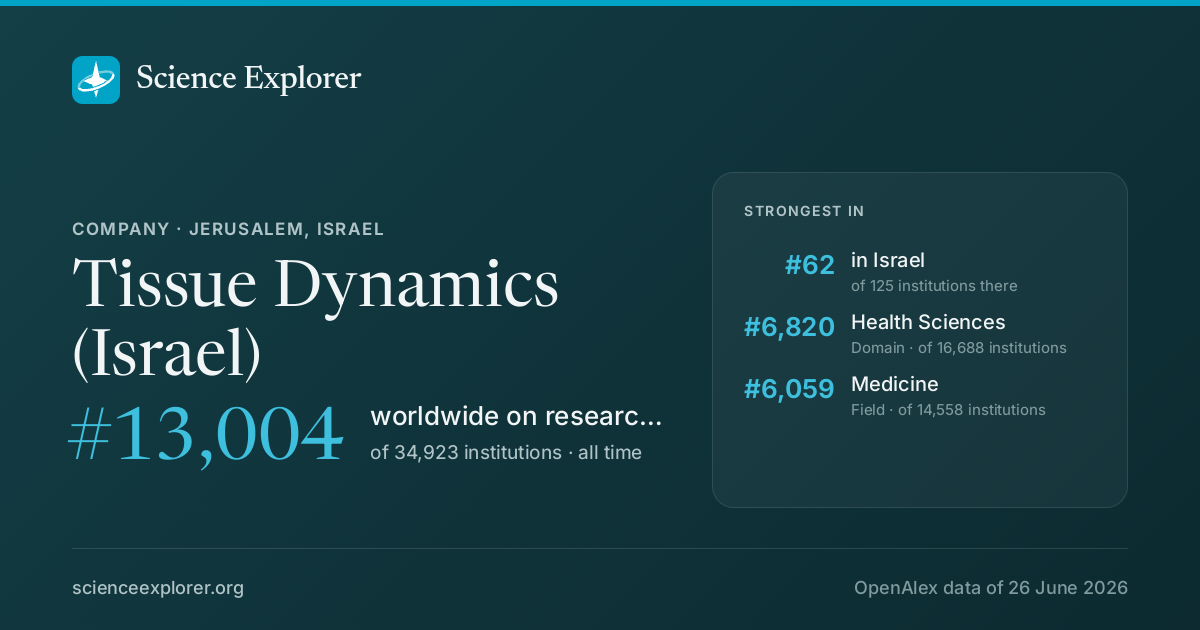
Tissue Dynamics (Israel) on Science Explorer

A card with Tissue Dynamics (Israel)'s standing and the fields it leads in, for a post or a slide. A link to this page previews as the same card.

Download the card

1200 × 630 PNG, sized for social posts, drawn from the latest snapshot.

Badges for a website1Each links back here and updates with every snapshot

Research measures only: rankings here say nothing about teaching, admissions or student experience. Comparable institutions and collaboration partners have tabs of their own, above.

Discussion

Ask a question or share a note about Tissue Dynamics (Israel). Posts are plain text and can be reported.