Science Explorer Back to mapMap
Discussion
University · Philippi · United States

Alderson Broaddus University

World rank, all time
#28,037
of 34,923
Rank in United States
#5,881
of 7,310
Research works
134
▼ 49% vs 2018-21
Citations
2.8k
20.9 per fractional work
Top-10% rate
10.2%
all institutions 10.0%
vs its own fields
0.98×
1.00× is exactly expected
Open access
29%
world 40%
International
18%
world 18%

Which fields of science does Alderson Broaddus University work in?

In all years, 26% of research at Alderson Broaddus University is in Health Sciences, 26% in Physical Sciences. Its largest fields are Medicine (22%), Biochemistry, Genetics and Molecular Biology (17%), Social Sciences (8%). It does 1.5× the world's share of Life Sciences.

Health Sciences: 35 fractional works · 26.0% of its workMedicine: 30 fractional works · 22.4% of its workPathology and Forensic Medicine: 4 fractional works · 3.3% of its workPhysiology: 4 fractional works · 3.2% of its workOncology: 4 fractional works · 3.2% of its workPublic Health, Environmental and Occupational Health: 2 fractional works · 1.8% of its workSurgery: 2 fractional works · 1.7% of its workPsychiatry and Mental health: 2 fractional works · 1.4% of its workNeurology: 2 fractional works · 1.4% of its workPulmonary and Respiratory Medicine: 2 fractional works · 1.2% of its workPharmacology: 2 fractional works · 1.1% of its workBiochemistry: 1 fractional works · 0.8% of its workCardiology and Cardiovascular Medicine: 1 fractional works · 0.5% of its workEndocrinology, Diabetes and Metabolism: 1 fractional works · 0.4% of its workReproductive Medicine: 0 fractional works · 0.3% of its workInfectious Diseases: 0 fractional works · 0.3% of its workComplementary and alternative medicine: 0 fractional works · 0.2% of its workEmergency Medicine: 0 fractional works · 0.2% of its workRheumatology: 0 fractional works · 0.2% of its workDermatology: 0 fractional works · 0.2% of its workRadiology, Nuclear Medicine and Imaging: 0 fractional works · 0.2% of its workSmaller subfields together: 1 fractional works · 0.8% of its workHealth Professions: 4 fractional works · 3.3% of its workGeneral Health Professions: 2 fractional works · 1.3% of its workMedical Laboratory Technology: 1 fractional works · 0.7% of its workRadiological and Ultrasound Technology: 0 fractional works · 0.3% of its workHealth Information Management: 0 fractional works · 0.2% of its workEmergency Medical Services: 0 fractional works · 0.2% of its workSmaller subfields together: 1 fractional works · 0.4% of its workNursing: 0 fractional works · 0.4% of its workNutrition and Dietetics: 0 fractional works · 0.2% of its workSmaller subfields together: 0 fractional works · 0.1% of its workPhysical Sciences: 34 fractional works · 25.6% of its workComputer Science: 11 fractional works · 8.3% of its workArtificial Intelligence: 3 fractional works · 2.1% of its workInformation Systems: 2 fractional works · 1.4% of its workComputer Vision and Pattern Recognition: 2 fractional works · 1.2% of its workHardware and Architecture: 1 fractional works · 1.0% of its workHuman-Computer Interaction: 1 fractional works · 0.8% of its workComputational Theory and Mathematics: 1 fractional works · 0.5% of its workSoftware: 1 fractional works · 0.4% of its workComputer Networks and Communications: 0 fractional works · 0.2% of its workComputer Science Applications: 0 fractional works · 0.2% of its workSignal Processing: 0 fractional works · 0.2% of its workSmaller subfields together: 0 fractional works · 0.1% of its workEnvironmental Science: 7 fractional works · 5.4% of its workEcology: 2 fractional works · 1.3% of its workGlobal and Planetary Change: 2 fractional works · 1.2% of its workEnvironmental Chemistry: 1 fractional works · 0.9% of its workWater Science and Technology: 1 fractional works · 0.5% of its workEnvironmental Engineering: 1 fractional works · 0.4% of its workHealth, Toxicology and Mutagenesis: 0 fractional works · 0.4% of its workPollution: 0 fractional works · 0.3% of its workManagement, Monitoring, Policy and Law: 0 fractional works · 0.2% of its workNature and Landscape Conservation: 0 fractional works · 0.2% of its workEngineering: 5 fractional works · 3.8% of its workControl and Systems Engineering: 1 fractional works · 0.8% of its workElectrical and Electronic Engineering: 1 fractional works · 0.7% of its workMechanics of Materials: 1 fractional works · 0.6% of its workMedia Technology: 1 fractional works · 0.6% of its workComputational Mechanics: 0 fractional works · 0.3% of its workBiomedical Engineering: 0 fractional works · 0.3% of its workAerospace Engineering: 0 fractional works · 0.2% of its workSmaller subfields together: 0 fractional works · 0.3% of its workPhysics and Astronomy: 5 fractional works · 3.4% of its workRadiation: 2 fractional works · 1.5% of its workAtomic and Molecular Physics, and Optics: 1 fractional works · 0.9% of its workStatistical and Nonlinear Physics: 1 fractional works · 0.8% of its workSmaller subfields together: 0 fractional works · 0.2% of its workChemistry: 4 fractional works · 2.6% of its workOrganic Chemistry: 2 fractional works · 1.3% of its workSpectroscopy: 1 fractional works · 0.6% of its workPhysical and Theoretical Chemistry: 0 fractional works · 0.4% of its workAnalytical Chemistry: 0 fractional works · 0.3% of its workMaterials Science: 1 fractional works · 0.9% of its workBiomaterials: 1 fractional works · 0.6% of its workSmaller subfields together: 0 fractional works · 0.3% of its workEarth and Planetary Sciences: 1 fractional works · 0.7% of its workAtmospheric Science: 0 fractional works · 0.2% of its workSmaller subfields together: 1 fractional works · 0.4% of its workMathematics: 1 fractional works · 0.5% of its workStatistics and Probability: 1 fractional works · 0.5% of its workChemical Engineering: 0 fractional works · 0.1% of its workSocial Sciences: 34 fractional works · 25.3% of its workSocial Sciences: 11 fractional works · 8.5% of its workPolitical Science and International Relations: 4 fractional works · 3.4% of its workSociology and Political Science: 3 fractional works · 2.5% of its workEducation: 2 fractional works · 1.5% of its workAnthropology: 0 fractional works · 0.4% of its workUrban Studies: 0 fractional works · 0.4% of its workGender Studies: 0 fractional works · 0.2% of its workSmaller subfields together: 0 fractional works · 0.2% of its workArts and Humanities: 10 fractional works · 7.8% of its workHistory: 3 fractional works · 2.1% of its workHistory and Philosophy of Science: 2 fractional works · 1.6% of its workLiterature and Literary Theory: 2 fractional works · 1.2% of its workPhilosophy: 1 fractional works · 1.0% of its workVisual Arts and Performing Arts: 1 fractional works · 0.9% of its workArcheology: 1 fractional works · 0.7% of its workSmaller subfields together: 0 fractional works · 0.3% of its workPsychology: 7 fractional works · 5.4% of its workDevelopmental and Educational Psychology: 2 fractional works · 1.3% of its workApplied Psychology: 1 fractional works · 1.0% of its workSocial Psychology: 1 fractional works · 0.9% of its workClinical Psychology: 1 fractional works · 0.8% of its workGeneral Psychology: 1 fractional works · 0.7% of its workExperimental and Cognitive Psychology: 1 fractional works · 0.6% of its workDecision Sciences: 4 fractional works · 2.7% of its workStatistics, Probability and Uncertainty: 3 fractional works · 2.0% of its workInformation Systems and Management: 1 fractional works · 0.6% of its workSmaller subfields together: 0 fractional works · 0.1% of its workEconomics, Econometrics and Finance: 1 fractional works · 0.5% of its workEconomics and Econometrics: 0 fractional works · 0.3% of its workSmaller subfields together: 0 fractional works · 0.2% of its workBusiness, Management and Accounting: 1 fractional works · 0.5% of its workManagement Information Systems: 0 fractional works · 0.4% of its workSmaller subfields together: 0 fractional works · 0.1% of its workLife Sciences: 31 fractional works · 23.0% of its workBiochemistry, Genetics and Molecular Biology: 23 fractional works · 16.8% of its workMolecular Biology: 14 fractional works · 10.2% of its workCancer Research: 4 fractional works · 3.0% of its workBiotechnology: 2 fractional works · 1.7% of its workGenetics: 1 fractional works · 0.9% of its workBiochemistry: 0 fractional works · 0.3% of its workPhysiology: 0 fractional works · 0.3% of its workSmaller subfields together: 0 fractional works · 0.3% of its workNeuroscience: 3 fractional works · 2.4% of its workCognitive Neuroscience: 1 fractional works · 1.1% of its workCellular and Molecular Neuroscience: 1 fractional works · 0.5% of its workSensory Systems: 1 fractional works · 0.4% of its workNeurology: 0 fractional works · 0.4% of its workAgricultural and Biological Sciences: 2 fractional works · 1.7% of its workPlant Science: 1 fractional works · 0.6% of its workEcology, Evolution, Behavior and Systematics: 1 fractional works · 0.5% of its workInsect Science: 0 fractional works · 0.3% of its workSoil Science: 0 fractional works · 0.2% of its workSmaller subfields together: 0 fractional works · 0.2% of its workImmunology and Microbiology: 2 fractional works · 1.4% of its workApplied Microbiology and Biotechnology: 2 fractional works · 1.2% of its workSmaller subfields together: 0 fractional works · 0.2% of its workPharmacology, Toxicology and Pharmaceutics: 1 fractional works · 0.7% of its workToxicology: 0 fractional works · 0.3% of its workPharmacology: 0 fractional works · 0.2% of its workSmaller subfields together: 0 fractional works · 0.2% of its workALL ITS WORKAlderson BroaddusUniversity134fractional works, all years
Life Sciences23%Physical Sciences26%Health Sciences26%Social Sciences25%

Each ring splits the one inside it: the four domains of science, their fields, their subfields. Size is fractional works in all years. Every slice is a page; the interactive view zooms down to single topics and colours each by how much more of it this institution does than the world.

Its 4 domains and 23 fields, with their numbers
    1. Medicine3022.4%
    2. Health Professions43.3%
    3. Nursing00.4%
    1. Computer Science118.3%
    2. Environmental Science75.4%
    3. Engineering53.8%
    4. Physics and Astronomy53.4%
    5. Chemistry42.6%
    6. Materials Science10.9%
    7. Earth and Planetary Sciences10.7%
    8. Mathematics10.5%
    9. Chemical Engineering00.1%
    1. Social Sciences118.5%
    2. Arts and Humanities107.8%
    3. Psychology75.4%
    4. Decision Sciences42.7%
    5. Economics, Econometrics and Finance10.5%
    6. Business, Management and Accounting10.5%
    1. Biochemistry, Genetics and Molecular Biology2316.8%
    2. Neuroscience32.4%
    3. Agricultural and Biological Sciences21.7%
    4. Immunology and Microbiology21.4%
    5. Pharmacology, Toxicology and Pharmaceutics10.7%
All of science, and how each field's share has moved since 1950: the Science domain explorer

Field profile

Location quotient across every field it publishes in: outside the ring is more than an institution of this size would be expected to publish, inside it is less.

Agricultural and Biological Sciences: 0.32× its world share, 0 worksAgricultural and Bio…Biochemistry, Genetics and Molecular Biology: 2.06× its world share, 1 worksBiochemistry, Geneti…Neuroscience: 1.74× its world share, 0 worksNeurosciencePharmacology, Toxicology and Pharmaceutics: 4.96× its world share, 0 worksPharmacology, Toxico…Chemistry: 2.86× its world share, 0 worksChemistryEarth and Planetary Sciences: 0.95× its world share, 0 worksEarth and Planetary …Engineering: 0.20× its world share, 0 worksEngineeringPhysics and Astronomy: 3.03× its world share, 1 worksPhysics and AstronomyHealth Professions: 0.57× its world share, 0 worksHealth ProfessionsMedicine: 1.70× its world share, 4 worksMedicineArts and Humanities: 9.34× its world share, 3 worksArts and HumanitiesSocial Sciences: 0.47× its world share, 1 worksSocial Sciences1×world share
more than its size predictsabout as predictedless

Rings at 0.5×, 1× and 2×. Widest outward: Arts and Humanities, 9.3×. Every wedge is a field page.

All 12 fields, with their numbers
  1. Arts and Humanities9.34×3 works
  2. Pharmacology, Toxicology and Pharmaceutics4.96×0 works
  3. Physics and Astronomy3.03×1 works
  4. Chemistry2.86×0 works
  5. Biochemistry, Genetics and Molecular Biology2.06×1 works
  6. Neuroscience1.74×0 works
  7. Medicine1.70×4 works
  8. Earth and Planetary Sciences0.95×0 works
  9. Health Professions0.57×0 works
  10. Social Sciences0.47×1 works
  11. Agricultural and Biological Sciences0.32×0 works
  12. Engineering0.20×0 works

Who are the top researchers at Alderson Broaddus University?

Ranked on the quality score, Yi Chen, Haitao Luo and Charlie W. Starr lead among researchers whose main affiliation is Alderson Broaddus University.

  1. 1 Yi Chen United States · #526,957 worldwide 8.4k citations · 264 works
  2. 2 Haitao Luo United States · #1,189,316 worldwide 1.4k citations · 70 works
  3. 3 Charlie W. Starr United States · #4,706,297 worldwide 4 citations · 22 works
All ranked researchers at Alderson Broaddus University

What are the most cited papers from Alderson Broaddus University?

The most cited paper from Alderson Broaddus University is "A review of the dietary flavonoid, kaempferol on human health and cancer chemoprevention" (Allen Y. Chen, Yi Chen, 2012), with 1,005 citations. Next come "Protein Nanoparticles as Drug Delivery Carriers for Cancer Therapy" (657) and "Broad targeting of angiogenesis for cancer prevention and therapy" (462).

Most cited papers
#PaperReleasedCitations
1 A review of the dietary flavonoid, kaempferol on human health and cancer chemoprevention Allen Y. Chen, Yi Chen · Food Chemistry Open access 28 Dec 2012 1,005
2 Protein Nanoparticles as Drug Delivery Carriers for Cancer Therapy Warangkana Lohcharoenkal, Liying Wang, Yi Chen et al. · BioMed Research International Open access 2014 657
3 Broad targeting of angiogenesis for cancer prevention and therapy Zongwei Wang et al. · Seminars in Cancer Biology Open access 16 Jan 2015 462
4 Designing a broad-spectrum integrative approach for cancer prevention and treatment Keith I. Block et al. · Seminars in Cancer Biology Open access180 authors 18 Nov 2015 302
5 Inhibition of Cell Growth and VEGF Expression in Ovarian Cancer Cells by Flavonoids Haitao Luo, Bing‐Hua Jiang, Sarah M. King et al. · Nutrition and Cancer 13 Nov 2008 222
All 59 most cited papers, with filters and sorting

Which keywords describe research at Alderson Broaddus University?

By fractional works in all years, weighted toward what it does more of than the world: Apoptosis, Antioxidant, Quality Assurance, Cancer Prevention, Anticancer, Crystal Structure, Alzheimer's Disease and Cancer.

▲ more of its work than of the world's◆ about the world's share▼ less than the world's

Size is fractional works in all years in the topics tagged with each word; colour is the word's share of this institution's work against its share of the world's. The 40 words are chosen for being large and distinctive. Each links to the topic it comes from most.

All 40 words, with their numbers
  1. Apoptosis7▲ 14×8 topics
  2. Antioxidant7▲ 7.5×11 topics
  3. Cancer6▲ 3.0×13 topics
  4. Machine Learning5▲ 1.67×12 topics
  5. Quality Assurance5▲ 18×2 topics
  6. Cancer Therapy4▲ 5.0×7 topics
  7. Obesity4▲ 4.3×6 topics
  8. Anticancer4▲ 16×6 topics
  9. Cancer Prevention4▲ 13×5 topics
  10. Crystal Structure4▲ 12×2 topics
  11. Metabolism4▲ 4.5×7 topics
  12. Alzheimer's Disease4▲ 10×3 topics
  13. Anti-inflammatory4▲ 9.4×8 topics
  14. Schizophrenia4▲ 21×2 topics
  15. History4▲ 3.3×6 topics
  16. Cognitive Function3▲ 13×2 topics
  17. Point-of-Care Testing3▲ 79×2 topics
  18. Neuronal Signaling3▲ 89×1 topic
  19. Neuroprotection3▲ 6.5×4 topics
  20. Nicotinic Acetylcholine Receptors3▲ 89×1 topic
  21. Preanalytical Variables3▲ 161×1 topic
  22. Reference Intervals3▲ 161×1 topic
  23. Immunotherapy3▲ 3.7×4 topics
  24. Clinical Trials3▲ 3.7×5 topics
  25. Antimicrobial3▲ 8.7×3 topics
  26. Metastasis3▲ 6.5×5 topics
  27. Cholesterol3▲ 12×3 topics
  28. Medicinal Chemistry3▲ 5.5×5 topics
  29. Biosynthesis3▲ 15×3 topics
  30. Green Tea3▲ 112×1 topic
  31. Measurement Uncertainty3▲ 88×1 topic
  32. Redefinition of SI Units3▲ 88×1 topic
  33. Tea Polyphenols3▲ 112×1 topic
  34. Statins3▲ 24×2 topics
  35. Pharmacology2▲ 5.7×5 topics
  36. Political Philosophy2▲ 18×2 topics
  37. Fatty Acid Synthase2▲ 45×1 topic
  38. Lipid Metabolism2▲ 45×1 topic
  39. American founding2▲ 24×1 topic
  40. Constitutional government2▲ 24×1 topic

Which research topics does Alderson Broaddus University publish most on?

By volume in 2022-now: Themes in Literature Analysis, Classical Antiquity Studies, Historical, Religious, and Philosophical Studies and Religious Studies and Spiritual Practices.

  1. 1 Themes in Literature Analysis Literature and Literary Theory 1 works
  2. 2 Classical Antiquity Studies Anthropology 0 works
  3. 3 Historical, Religious, and Philosophical Studies Archeology 0 works
  4. 4 Religious Studies and Spiritual Practices Philosophy 0 works
  5. 5 Advanced Chemical Physics Studies Atomic and Molecular Physics, and Optics 0 works
  6. 6 Ancient Near East History Archeology 0 works
  7. 7 Multiple Sclerosis Research Studies Pathology and Forensic Medicine 0 works
  8. 8 Biblical Studies and Interpretation Religious studies 0 works
  9. 9 Theology and Philosophy of Evil Philosophy 0 works
  10. 10 Musculoskeletal pain and rehabilitation Pharmacology 0 works

How open and international is its research?

Against the world's own shares: the tick on each track. Both are shares of its output, so they sit on one scale and can be read against each other as well as against the world.

openly available29.3%not open70.7%

World: 40% of research is openly available.

with international co-authors18.4%domestic only81.6%

World: 18% is written across borders.

How has Alderson Broaddus University's research output changed?

Output in 2022-2025 was 49% lower than in 2018-2021.

still counting1990200020102020
grewheldshrank

The same series as a ribbon: one cell per year, darker for more. The line above answers how much; this answers when.

Its share of all research

Growing output can still be a shrinking share: all of science grows. This is Alderson Broaddus University as a percentage of every work published that year, 0.000011% in 2024.

still counting0.00025%0.00050%0.00075%Alderson Broaddus University0.0000085% in 202519801990200020102020

Fractional works of Alderson Broaddus University over all fractional works that year. How the balance of science has shifted.

Share Alderson Broaddus University's ranking
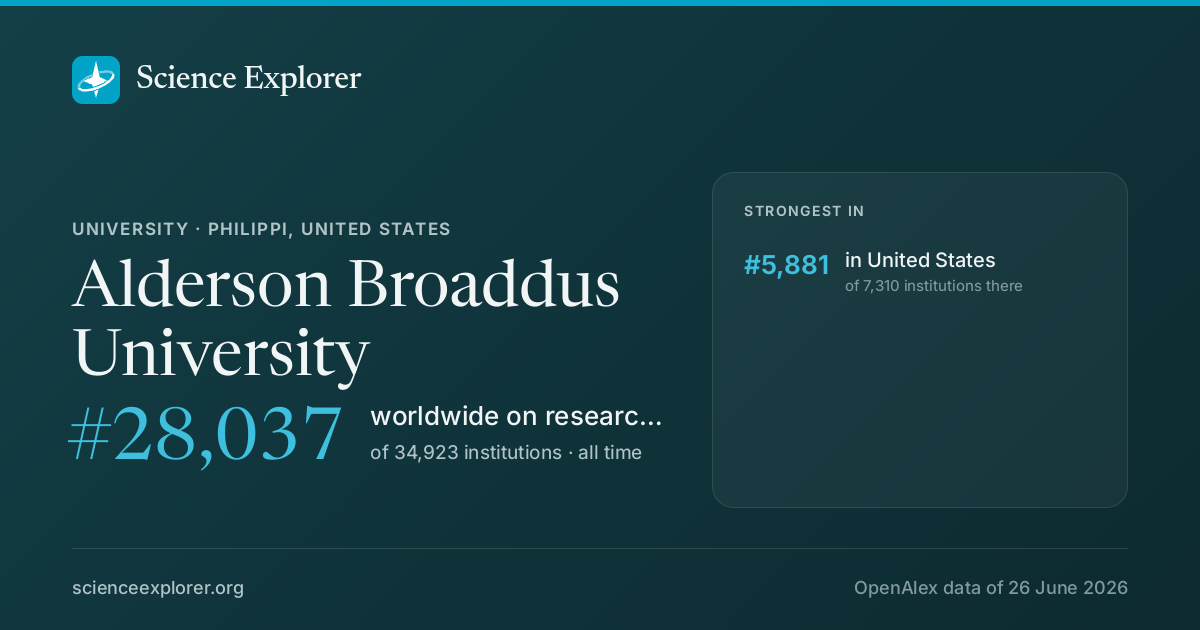
Alderson Broaddus University on Science Explorer

A card with Alderson Broaddus University's standing and the fields it leads in, for a post or a slide. A link to this page previews as the same card.

Download the card

1200 × 630 PNG, sized for social posts, drawn from the latest snapshot.

Badges for a website1Each links back here and updates with every snapshot

Research measures only: rankings here say nothing about teaching, admissions or student experience. Comparable institutions and collaboration partners have tabs of their own, above.

Discussion

Ask a question or share a note about Alderson Broaddus University. Keep it to the research: no personal attacks, advertising or links. Any reader can report a post, which collapses it for everyone until it is opened.
