Science Explorer Back to mapMap
Discussion
Company · Fitzroy · Australia

Genetic Technologies (Australia)

In research, Genetic Technologies (Australia) stands highest in Life Sciences (#5,322 of 11,023 worldwide), over all time. Relative to its size it is most specialised in Biochemistry, Genetics and Molecular Biology and Molecular Biology (Biochemistry, Genetics and Molecular Biology is 7.7× its share of world research).

World rank, 2022-now
#21,629
of 22,385 · #21,983 all time
Rank in Australia
#265
of 270
Research works
264
▲ 180% vs 2018-21
Citations
5k
19.0 per fractional work
Top-10% rate
7.0%
all institutions 10.0%
vs its own fields
0.95×
1.00× is exactly expected
Open access
50%
world 40%
International
54%
world 18%

What is Genetic Technologies (Australia) known for in research?

The fields where it stands highest, over all time, ranked among every institution above the floor in each field.

FieldWorld rankWhere that sitsTop-10% rateWorks
Life SciencesDomain #5,322 of 11,023 7.5%137

Each strip is that field's whole ranked pool, with the notch where Genetic Technologies (Australia) sits in it, in the colour of the band that rank falls in. The track under the rate is the rate itself: it carries no average mark, because the average differs by field (from about 6% in Dentistry to 21% in Economics).

Which fields of science does Genetic Technologies (Australia) work in?

In 2022-now, 55% of research at Genetic Technologies (Australia) is in Life Sciences, 29% in Health Sciences. Its largest fields are Biochemistry, Genetics and Molecular Biology (41%), Medicine (28%), Immunology and Microbiology (6%). It does 3.6× the world's share of Life Sciences.

Life Sciences: 58 fractional works · 55.0% of its workBiochemistry, Genetics and Molecular Biology: 43 fractional works · 41.1% of its workMolecular Biology: 25 fractional works · 23.3% of its workGenetics: 12 fractional works · 11.2% of its workCancer Research: 3 fractional works · 2.8% of its workCell Biology: 2 fractional works · 1.6% of its workAging: 1 fractional works · 0.8% of its workBiochemistry: 0 fractional works · 0.4% of its workMolecular Medicine: 0 fractional works · 0.3% of its workBiophysics: 0 fractional works · 0.2% of its workClinical Biochemistry: 0 fractional works · 0.2% of its workSmaller subfields together: 0 fractional works · 0.4% of its workImmunology and Microbiology: 7 fractional works · 6.4% of its workImmunology: 6 fractional works · 5.8% of its workVirology: 0 fractional works · 0.5% of its workSmaller subfields together: 0 fractional works · 0.1% of its workAgricultural and Biological Sciences: 5 fractional works · 5.1% of its workPlant Science: 2 fractional works · 2.1% of its workFood Science: 1 fractional works · 0.8% of its workAnimal Science and Zoology: 1 fractional works · 0.6% of its workEcology, Evolution, Behavior and Systematics: 0 fractional works · 0.5% of its workSoil Science: 0 fractional works · 0.5% of its workAgronomy and Crop Science: 0 fractional works · 0.3% of its workSmaller subfields together: 0 fractional works · 0.3% of its workNeuroscience: 2 fractional works · 2.3% of its workCellular and Molecular Neuroscience: 1 fractional works · 1.0% of its workNeurology: 1 fractional works · 0.5% of its workCognitive Neuroscience: 0 fractional works · 0.4% of its workSmaller subfields together: 1 fractional works · 0.5% of its workPharmacology, Toxicology and Pharmaceutics: 0 fractional works · 0.1% of its workHealth Sciences: 31 fractional works · 29.0% of its workMedicine: 29 fractional works · 27.5% of its workOncology: 5 fractional works · 4.5% of its workInfectious Diseases: 3 fractional works · 2.4% of its workSurgery: 2 fractional works · 1.9% of its workPublic Health, Environmental and Occupational Health: 2 fractional works · 1.8% of its workPulmonary and Respiratory Medicine: 2 fractional works · 1.7% of its workPathology and Forensic Medicine: 2 fractional works · 1.6% of its workEpidemiology: 2 fractional works · 1.6% of its workDermatology: 1 fractional works · 1.4% of its workGenetics: 1 fractional works · 1.3% of its workPhysiology: 1 fractional works · 1.3% of its workRadiology, Nuclear Medicine and Imaging: 1 fractional works · 1.3% of its workPediatrics, Perinatology and Child Health: 1 fractional works · 1.1% of its workCardiology and Cardiovascular Medicine: 1 fractional works · 1.0% of its workHematology: 1 fractional works · 0.8% of its workNeurology: 1 fractional works · 0.8% of its workReproductive Medicine: 1 fractional works · 0.6% of its workOphthalmology: 0 fractional works · 0.4% of its workEndocrinology, Diabetes and Metabolism: 0 fractional works · 0.3% of its workUrology: 0 fractional works · 0.3% of its workPharmacology: 0 fractional works · 0.2% of its workSmaller subfields together: 1 fractional works · 1.4% of its workHealth Professions: 1 fractional works · 0.8% of its workGeneral Health Professions: 0 fractional works · 0.4% of its workHealth Information Management: 0 fractional works · 0.4% of its workSmaller subfields together: 0 fractional works · 0.1% of its workVeterinary: 0 fractional works · 0.4% of its workSmall Animals: 0 fractional works · 0.4% of its workNursing: 0 fractional works · 0.3% of its workNutrition and Dietetics: 0 fractional works · 0.3% of its workPhysical Sciences: 14 fractional works · 12.9% of its workEngineering: 5 fractional works · 4.8% of its workMechanics of Materials: 1 fractional works · 1.3% of its workAerospace Engineering: 1 fractional works · 1.0% of its workElectrical and Electronic Engineering: 1 fractional works · 0.9% of its workBiomedical Engineering: 1 fractional works · 0.8% of its workMechanical Engineering: 0 fractional works · 0.5% of its workBuilding and Construction: 0 fractional works · 0.2% of its workSmaller subfields together: 0 fractional works · 0.1% of its workMaterials Science: 3 fractional works · 2.7% of its workMaterials Chemistry: 1 fractional works · 1.2% of its workBiomaterials: 1 fractional works · 0.7% of its workPolymers and Plastics: 0 fractional works · 0.5% of its workGeneral Materials Science: 0 fractional works · 0.3% of its workSmaller subfields together: 0 fractional works · 0.1% of its workEnvironmental Science: 3 fractional works · 2.5% of its workEcology: 1 fractional works · 0.8% of its workHealth, Toxicology and Mutagenesis: 0 fractional works · 0.4% of its workNature and Landscape Conservation: 0 fractional works · 0.4% of its workGlobal and Planetary Change: 0 fractional works · 0.3% of its workSmaller subfields together: 1 fractional works · 0.6% of its workChemistry: 1 fractional works · 0.8% of its workSpectroscopy: 0 fractional works · 0.3% of its workOrganic Chemistry: 0 fractional works · 0.2% of its workSmaller subfields together: 0 fractional works · 0.2% of its workComputer Science: 1 fractional works · 0.6% of its workArtificial Intelligence: 1 fractional works · 0.6% of its workSmaller subfields together: 0 fractional works · 0.1% of its workMathematics: 1 fractional works · 0.5% of its workStatistics and Probability: 0 fractional works · 0.3% of its workModeling and Simulation: 0 fractional works · 0.2% of its workChemical Engineering: 0 fractional works · 0.3% of its workCatalysis: 0 fractional works · 0.3% of its workSmaller subfields together: 0 fractional works · 0.0% of its workEarth and Planetary Sciences: 0 fractional works · 0.3% of its workEnergy: 0 fractional works · 0.2% of its workPhysics and Astronomy: 0 fractional works · 0.2% of its workSocial Sciences: 3 fractional works · 3.2% of its workSocial Sciences: 2 fractional works · 1.4% of its workAnthropology: 1 fractional works · 0.6% of its workLinguistics and Language: 0 fractional works · 0.2% of its workSociology and Political Science: 0 fractional works · 0.2% of its workTransportation: 0 fractional works · 0.2% of its workSmaller subfields together: 0 fractional works · 0.2% of its workArts and Humanities: 1 fractional works · 0.9% of its workLiterature and Literary Theory: 0 fractional works · 0.5% of its workArcheology: 0 fractional works · 0.4% of its workEconomics, Econometrics and Finance: 1 fractional works · 0.6% of its workGeneral Economics, Econometrics and Finance: 0 fractional works · 0.4% of its workEconomics and Econometrics: 0 fractional works · 0.2% of its workPsychology: 0 fractional works · 0.2% of its workBusiness, Management and Accounting: 0 fractional works · 0.0% of its workDecision Sciences: 0 fractional works · 0.0% of its workALL ITS WORKGeneticTechnologies…105fractional works, 2022-now
Life Sciences55%Physical Sciences13%Health Sciences29%Social Sciences3%

Each ring splits the one inside it: the four domains of science, their fields, their subfields. Size is fractional works in 2022-now. Every slice is a page; the interactive view zooms down to single topics and colours each by how much more of it this institution does than the world.

Its 4 domains and 25 fields, with their numbers
    1. Biochemistry, Genetics and Molecular Biology4341.1%
    2. Immunology and Microbiology76.4%
    3. Agricultural and Biological Sciences55.1%
    4. Neuroscience22.3%
    5. Pharmacology, Toxicology and Pharmaceutics00.1%
    1. Medicine2927.5%
    2. Health Professions10.8%
    3. Veterinary00.4%
    4. Nursing00.3%
    1. Engineering54.8%
    2. Materials Science32.7%
    3. Environmental Science32.5%
    4. Chemistry10.8%
    5. Computer Science10.6%
    6. Mathematics10.5%
    7. Chemical Engineering00.3%
    8. Earth and Planetary Sciences00.3%
    9. Energy00.2%
    10. Physics and Astronomy00.2%
    1. Social Sciences21.4%
    2. Arts and Humanities10.9%
    3. Economics, Econometrics and Finance10.6%
    4. Psychology00.2%
    5. Business, Management and Accounting00.0%
    6. Decision Sciences00.0%
All of science, and how each field's share has moved since 1950: the Science domain explorer

What does Genetic Technologies (Australia) specialise in?

Where its research is concentrated relative to its size: Biochemistry, Genetics and Molecular Biology takes 7.7× the share of its output that it takes of world research.

  1. Biochemistry, Genetics and Molecular BiologyField · 43.3 works7.7×
  2. Molecular BiologySubfield · 24.5 works7.7×
← less than its size predicts1×more →

Location quotient, a volume reading rather than an impact one. It surfaces small, lopsided specialities.

Field profile

Location quotient across every field it publishes in: outside the ring is more than an institution of this size would be expected to publish, inside it is less.

Agricultural and Biological Sciences: 1.07× its world share, 5 worksAgricultural and Bio…Biochemistry, Genetics and Molecular Biology: 7.71× its world share, 43 worksBiochemistry, Geneti…Immunology and Microbiology: 6.35× its world share, 7 worksImmunology and Micro…Neuroscience: 1.43× its world share, 2 worksNeurosciencePharmacology, Toxicology and Pharmaceutics: 0.18× its world share, 0 worksPharmacology, Toxico…Chemical Engineering: 0.99× its world share, 0 worksChemical EngineeringChemistry: 0.48× its world share, 1 worksChemistryComputer Science: 0.08× its world share, 1 worksComputer ScienceEarth and Planetary Sciences: 0.18× its world share, 0 worksEarth and Planetary …Energy: 0.17× its world share, 0 worksEnergyEngineering: 0.32× its world share, 5 worksEngineeringEnvironmental Science: 0.51× its world share, 3 worksEnvironmental ScienceMaterials Science: 0.76× its world share, 3 worksMaterials ScienceMathematics: 0.45× its world share, 1 worksMathematicsPhysics and Astronomy: 0.07× its world share, 0 worksPhysics and AstronomyHealth Professions: 0.31× its world share, 1 worksHealth ProfessionsMedicine: 1.43× its world share, 29 worksMedicineNursing: 0.53× its world share, 0 worksNursingVeterinary: 2.92× its world share, 0 worksVeterinaryArts and Humanities: 0.31× its world share, 1 worksArts and HumanitiesBusiness, Management and Accounting: 0.01× its world share, 0 worksBusiness, Management…Decision Sciences: 0.03× its world share, 0 worksDecision SciencesEconomics, Econometrics and Finance: 0.30× its world share, 1 worksEconomics, Econometr…Psychology: 0.05× its world share, 0 worksPsychologySocial Sciences: 0.11× its world share, 2 worksSocial Sciences1×world share
more than its size predictsabout as predictedless

Rings at 0.5×, 1× and 2×. Widest outward: Biochemistry, Genetics and Molecular Biology, 7.7×. Every wedge is a field page.

All 25 fields, with their numbers
  1. Biochemistry, Genetics and Molecular Biology7.71×43 works
  2. Immunology and Microbiology6.35×7 works
  3. Veterinary2.92×0 works
  4. Neuroscience1.43×2 works
  5. Medicine1.43×29 works
  6. Agricultural and Biological Sciences1.07×5 works
  7. Chemical Engineering0.99×0 works
  8. Materials Science0.76×3 works
  9. Nursing0.53×0 works
  10. Environmental Science0.51×3 works
  11. Chemistry0.48×1 works
  12. Mathematics0.45×1 works
  13. Engineering0.32×5 works
  14. Health Professions0.31×1 works
  15. Arts and Humanities0.31×1 works
  16. Economics, Econometrics and Finance0.30×1 works
  17. Pharmacology, Toxicology and Pharmaceutics0.18×0 works
  18. Earth and Planetary Sciences0.18×0 works
  19. Energy0.17×0 works
  20. Social Sciences0.11×2 works
  21. Computer Science0.08×1 works
  22. Physics and Astronomy0.07×0 works
  23. Psychology0.05×0 works
  24. Decision Sciences0.03×0 works
  25. Business, Management and Accounting0.01×0 works

Who are the top researchers at Genetic Technologies (Australia)?

Ranked on the quality score, Nicholas M. Murphy, R.J. Densley and Richard L. Allman lead among researchers whose main affiliation is Genetic Technologies (Australia).

  1. 1 Nicholas M. Murphy Australia · #3,638,842 worldwide 531 citations · 28 works
  2. 2 R.J. Densley Australia · #3,804,096 worldwide 346 citations · 17 works
  3. 3 Richard L. Allman Australia · #3,804,097 worldwide 1.5k citations · 131 works
All ranked researchers at Genetic Technologies (Australia)

What are the most cited papers from Genetic Technologies (Australia)?

The most cited paper from Genetic Technologies (Australia) is "Ultrasensitive Genetically Encoded Indicator for Hydrogen Peroxide Identifies Roles for the Oxidant in Cell Migration and Mitochondrial Function" (Valeriy V. Pak et al., 2020), with 462 citations. Next come "DNA Methylation Biomarkers: Cancer and Beyond" (300) and "Genetic variants associated with warfarin dose in African-American individuals: a genome-wide association study" (278).

Most cited papers
#PaperReleasedCitations
1 Ultrasensitive Genetically Encoded Indicator for Hydrogen Peroxide Identifies Roles for the Oxidant in Cell Migration and Mitochondrial Function Valeriy V. Pak et al. · Cell Metabolism Open access Mar 2020 462
2 DNA Methylation Biomarkers: Cancer and Beyond Thomas Mikeska, Jeffrey Mark Craig · Genes Open access 16 Sep 2014 300
3 Genetic variants associated with warfarin dose in African-American individuals: a genome-wide association study Minoli A. Perera et al. · The Lancet Open access 4 Jun 2013 278
4 VDJdb in the pandemic era: a compendium of T cell receptors specific for SARS-CoV-2 Mikhail Goncharov et al. · Nature Methods Open access 15 Aug 2022 250
5 Identification, Replication, and Functional Fine-Mapping of Expression Quantitative Trait Loci in Primary Human Liver Tissue Federico Innocenti, Gregory M. Cooper, Ian B. Stanaway et al. · PLoS Genetics Open access 26 May 2011 211
All 60 most cited papers, with filters and sorting

Which keywords describe research at Genetic Technologies (Australia)?

By fractional works in 2022-now, weighted toward what it does more of than the world: Cancer, Gene Expression, Genome Engineering, RNA-Guided, Genetic Testing, Precision Medicine, Cancer Risk and Genetic Variation.

▲ more of its work than of the world's◆ about the world's share▼ less than the world's

Size is fractional works in 2022-now in the topics tagged with each word; colour is the word's share of this institution's work against its share of the world's. The 40 words are chosen for being large and distinctive. Each links to the topic it comes from most.

All 40 words, with their numbers
  1. Cancer8▲ 5.8×25 topics
  2. Epidemiology6▲ 1.45×35 topics
  3. Gene Expression5▲ 8.2×15 topics
  4. Inflammation5▲ 2.3×28 topics
  5. Oxidative Stress5▲ 2.7×23 topics
  6. Genome Engineering4▲ 55×1 topic
  7. RNA-Guided4▲ 55×1 topic
  8. Precision Medicine4▲ 6.7×5 topics
  9. Genetic Testing3▲ 28×3 topics
  10. Cancer Risk3▲ 14×3 topics
  11. Genetic Variation3▲ 14×5 topics
  12. Immune Response3▲ 5.3×14 topics
  13. Breast Cancer3▲ 11×3 topics
  14. Population Genetics3▲ 20×4 topics
  15. Biomarkers3▲ 3.5×8 topics
  16. Genome-Wide Association2▲ 31×2 topics
  17. Innate Immunity2▲ 7.4×5 topics
  18. Gene Regulation2▲ 23×5 topics
  19. Ovarian Cancer2▲ 25×2 topics
  20. Bioinformatics2▲ 18×3 topics
  21. Capacity Building2▲ 36×2 topics
  22. Immunity2▲ 5.4×7 topics
  23. Vaccine2▲ 5.4×10 topics
  24. Cell-Free DNA2▲ 21×2 topics
  25. Genetic Diversity2▲ 4.8×8 topics
  26. BRCA12▲ 73×1 topic
  27. BRCA22▲ 73×1 topic
  28. Genomics2▲ 6.4×2 topics
  29. Transcriptional Regulation2▲ 12×7 topics
  30. Curriculum2▲ 18×2 topics
  31. Training2▲ 8.5×1 topic
  32. Undergraduate2▲ 65×1 topic
  33. Epigenetics2▲ 38×3 topics
  34. Genetic Variants2▲ 9.4×5 topics
  35. Haplotype Mapping2▲ 48×1 topic
  36. Mendelian Randomization2▲ 48×1 topic
  37. Stem Cells2▲ 6.3×9 topics
  38. Transcription Factors2▲ 13×3 topics
  39. Ethical Issues2▲ 14×4 topics
  40. Gene Therapy2▲ 8.0×3 topics

Which research topics does Genetic Technologies (Australia) publish most on?

By volume in 2022-now: CRISPR and Genetic Engineering, BRCA gene mutations in cancer, Genetics, Bioinformatics, and Biomedical Research and Genetic Associations and Epidemiology.

  1. 1 CRISPR and Genetic Engineering Molecular Biology 4 works
  2. 2 BRCA gene mutations in cancer Genetics 2 works
  3. 3 Genetics, Bioinformatics, and Biomedical Research Molecular Biology 2 works
  4. 4 Genetic Associations and Epidemiology Genetics 2 works
  5. 5 RNA and protein synthesis mechanisms Molecular Biology 2 works
  6. 6 Genomics and Chromatin Dynamics Molecular Biology 1 works
  7. 7 Cancer Genomics and Diagnostics Cancer Research 1 works
  8. 8 Virus-based gene therapy research Genetics 1 works
  9. 9 Genomics and Rare Diseases Genetics 1 works
  10. 10 RNA modifications and cancer Molecular Biology 1 works

How open and international is its research?

Against the world's own shares: the tick on each track. Both are shares of its output, so they sit on one scale and can be read against each other as well as against the world.

openly available49.7%not open50.3%

World: 40% of research is openly available.

with international co-authors53.6%domestic only46.4%

World: 18% is written across borders.

How has Genetic Technologies (Australia)'s research output changed?

Output in 2022-2025 was 180% higher than in 2018-2021.

still counting1990200020102020
grewheldshrank

The same series as a ribbon: one cell per year, darker for more. The line above answers how much; this answers when.

Its share of all research

Growing output can still be a shrinking share: all of science grows. This is Genetic Technologies (Australia) as a percentage of every work published that year, 0.00037% in 2024.

still counting0.0010%0.0020%0.0030%Genetic Technologies (Australia)0.00051% in 202519801990200020102020

Fractional works of Genetic Technologies (Australia) over all fractional works that year. How the balance of science has shifted.

Other research institutions in Fitzroy

All research institutions in Fitzroy

Share Genetic Technologies (Australia)'s ranking
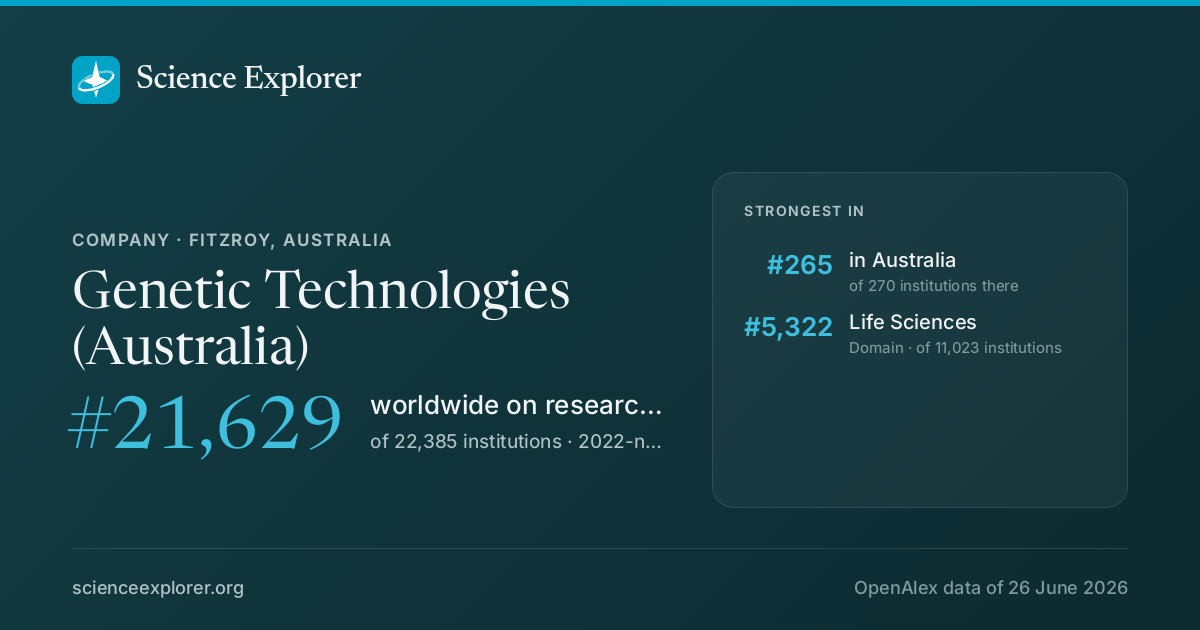
Genetic Technologies (Australia) on Science Explorer

A card with Genetic Technologies (Australia)'s standing and the fields it leads in, for a post or a slide. A link to this page previews as the same card.

Download the card

1200 × 630 PNG, sized for social posts, drawn from the latest snapshot.

Badges for a website1Each links back here and updates with every snapshot

Research measures only: rankings here say nothing about teaching, admissions or student experience. Comparable institutions and collaboration partners have tabs of their own, above.

Discussion

Ask a question or share a note about Genetic Technologies (Australia). Posts are plain text and can be reported.
