Science Explorer Back to mapMap
Discussion
University · Okayama · Japan

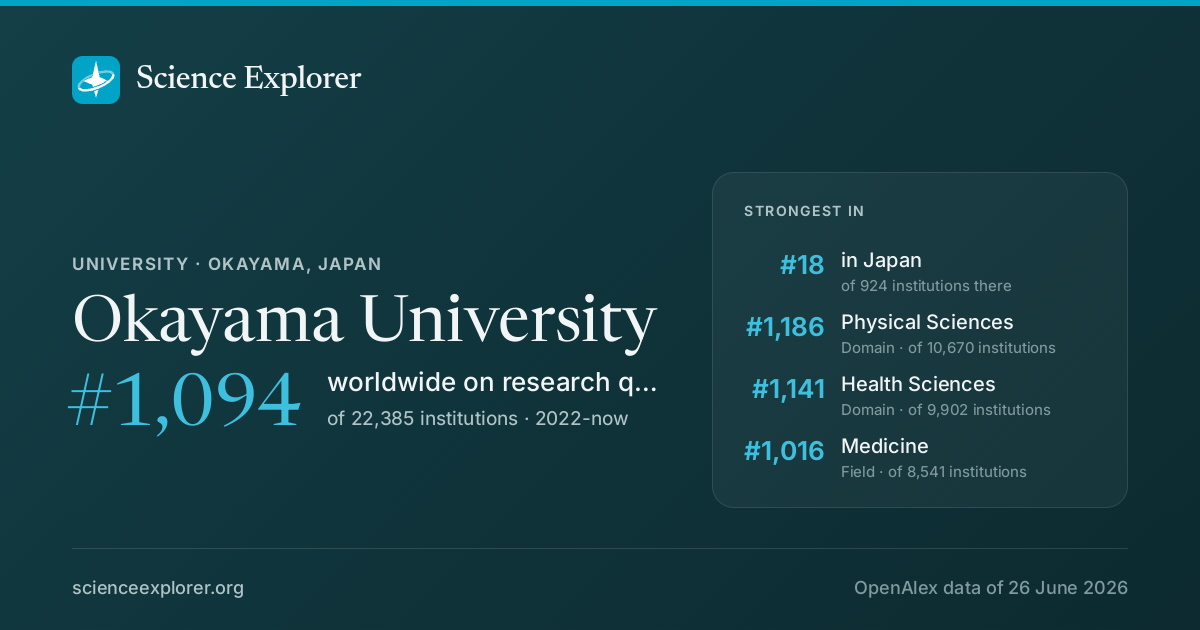
Okayama University

In research, Okayama University stands highest in Physical Sciences (#1,186 of 10,670 worldwide), Health Sciences (#1,141 of 9,902 worldwide) and Medicine (#1,016 of 8,541 worldwide), 2022-now. Relative to its size it is most specialised in Gastroenterology, Periodontics and Pulmonary and Respiratory Medicine (Gastroenterology is 4.1× its share of world research).

World rank, 2022-now
#1,094
of 22,385 · #1,616 all time
Rank in Japan
#18
of 924
Research works
52k
▼ 4% vs 2018-21
Citations
808k
15.4 per fractional work
Top-10% rate
6.2%
all institutions 10.0%
vs its own fields
0.67×
1.00× is exactly expected
Open access
49%
world 40%
International
10%
world 18%

What is Okayama University known for in research?

The fields where it stands highest, 2022-now, ranked among every institution above the floor in each field.

FieldWorld rankWhere that sitsTop-10% rateWorksAll time
Physical SciencesDomain #1,186 of 10,670 3.9%1,655 #1050
Health SciencesDomain #1,141 of 9,902 7.1%2,090 #2734
MedicineField #1,016 of 8,541 7.1%1,924 #2361
Life SciencesDomain #1,084 of 6,403 5.8%1,003 #1842
Agricultural and Biological SciencesField #959 of 3,157 8.5%201 #933
Biochemistry, Genetics and Molecular BiologyField #953 of 2,964 5.0%545 #1517
Plant ScienceSubfield #443 of 1,317 9.1%126 #585
SurgerySubfield #524 of 1,532 7.6%326 #1046
EngineeringField #2,054 of 5,901 3.2%673 #1827
Social SciencesDomain #3,386 of 9,585 7.7%326 #6242

Each strip is that field's whole ranked pool, with the notch where Okayama University sits in it, in the colour of the band that rank falls in. The track under the rate is the rate itself: it carries no average mark, because the average differs by field (from about 6% in Dentistry to 21% in Economics).

Which of those standings moved

The same fields on both windows: where it stood over the whole record, and where it stands in 2022-now. The distance is the story, and it is the one thing the two rank columns above cannot show.

  1. Physical Sciences#1,050 #1,186
  2. Health Sciences#2,734 #1,141
  3. Medicine#2,361 #1,016
  4. Life Sciences#1,842 #1,084
  5. Agricultural and Biological Sciences#933 #959
  6. Biochemistry, Genetics and Molecular Biology#1,517 #953
  7. Plant Science#585 #443
  8. Surgery#1,046 #524
  9. Engineering#1,827 #2,054
  10. Social Sciences#6,242 #3,386
all time2022-now, better2022-now, worse

A dot further right is a better standing. Fields it was not ranked in over the whole record are left out.

Which fields of science does Okayama University work in?

In 2022-now, 42% of research at Okayama University is in Health Sciences, 32% in Physical Sciences. Its largest fields are Medicine (38%), Engineering (13%), Biochemistry, Genetics and Molecular Biology (11%). It does 1.8× the world's share of Health Sciences.

Health Sciences: 2,362 fractional works · 41.5% of its workMedicine: 2,174 fractional works · 38.2% of its workSurgery: 369 fractional works · 6.5% of its workPulmonary and Respiratory Medicine: 272 fractional works · 4.8% of its workOncology: 192 fractional works · 3.4% of its workEpidemiology: 132 fractional works · 2.3% of its workCardiology and Cardiovascular Medicine: 119 fractional works · 2.1% of its workNeurology: 83 fractional works · 1.5% of its workPhysiology: 83 fractional works · 1.5% of its workPublic Health, Environmental and Occupational Health: 80 fractional works · 1.4% of its workRadiology, Nuclear Medicine and Imaging: 76 fractional works · 1.3% of its workRheumatology: 72 fractional works · 1.3% of its workPathology and Forensic Medicine: 66 fractional works · 1.2% of its workInfectious Diseases: 60 fractional works · 1.1% of its workHematology: 43 fractional works · 0.8% of its workGenetics: 42 fractional works · 0.7% of its workEndocrinology, Diabetes and Metabolism: 40 fractional works · 0.7% of its workPediatrics, Perinatology and Child Health: 36 fractional works · 0.6% of its workPsychiatry and Mental health: 32 fractional works · 0.6% of its workNephrology: 32 fractional works · 0.6% of its workGastroenterology: 28 fractional works · 0.5% of its workOphthalmology: 27 fractional works · 0.5% of its workHepatology: 26 fractional works · 0.5% of its workEmergency Medicine: 26 fractional works · 0.4% of its workObstetrics and Gynecology: 25 fractional works · 0.4% of its workPharmacology: 24 fractional works · 0.4% of its workDermatology: 23 fractional works · 0.4% of its workCritical Care and Intensive Care Medicine: 18 fractional works · 0.3% of its workOrthopedics and Sports Medicine: 18 fractional works · 0.3% of its workReproductive Medicine: 17 fractional works · 0.3% of its workOtorhinolaryngology: 16 fractional works · 0.3% of its workImmunology and Allergy: 13 fractional works · 0.2% of its workTransplantation: 12 fractional works · 0.2% of its workUrology: 12 fractional works · 0.2% of its workAnesthesiology and Pain Medicine: 12 fractional works · 0.2% of its workRehabilitation: 12 fractional works · 0.2% of its workSmaller subfields together: 38 fractional works · 0.7% of its workHealth Professions: 86 fractional works · 1.5% of its workGeneral Health Professions: 32 fractional works · 0.6% of its workEmergency Medical Services: 15 fractional works · 0.3% of its workSmaller subfields together: 39 fractional works · 0.7% of its workDentistry: 70 fractional works · 1.2% of its workOral Surgery: 28 fractional works · 0.5% of its workPeriodontics: 24 fractional works · 0.4% of its workOrthodontics: 14 fractional works · 0.2% of its workSmaller subfields together: 4 fractional works · 0.1% of its workNursing: 28 fractional works · 0.5% of its workNutrition and Dietetics: 25 fractional works · 0.4% of its workSmaller subfields together: 2 fractional works · 0.0% of its workVeterinary: 4 fractional works · 0.1% of its workPhysical Sciences: 1,828 fractional works · 32.1% of its workEngineering: 726 fractional works · 12.8% of its workElectrical and Electronic Engineering: 203 fractional works · 3.6% of its workBiomedical Engineering: 171 fractional works · 3.0% of its workMechanical Engineering: 82 fractional works · 1.4% of its workControl and Systems Engineering: 49 fractional works · 0.9% of its workComputational Mechanics: 48 fractional works · 0.8% of its workAerospace Engineering: 40 fractional works · 0.7% of its workMechanics of Materials: 35 fractional works · 0.6% of its workIndustrial and Manufacturing Engineering: 24 fractional works · 0.4% of its workCivil and Structural Engineering: 24 fractional works · 0.4% of its workOcean Engineering: 15 fractional works · 0.3% of its workAutomotive Engineering: 12 fractional works · 0.2% of its workSmaller subfields together: 24 fractional works · 0.4% of its workComputer Science: 342 fractional works · 6.0% of its workArtificial Intelligence: 95 fractional works · 1.7% of its workComputer Vision and Pattern Recognition: 54 fractional works · 1.0% of its workComputer Networks and Communications: 52 fractional works · 0.9% of its workInformation Systems: 46 fractional works · 0.8% of its workComputational Theory and Mathematics: 20 fractional works · 0.4% of its workSignal Processing: 18 fractional works · 0.3% of its workHuman-Computer Interaction: 16 fractional works · 0.3% of its workComputer Science Applications: 14 fractional works · 0.2% of its workHardware and Architecture: 14 fractional works · 0.2% of its workSmaller subfields together: 10 fractional works · 0.2% of its workMaterials Science: 187 fractional works · 3.3% of its workMaterials Chemistry: 104 fractional works · 1.8% of its workElectronic, Optical and Magnetic Materials: 26 fractional works · 0.5% of its workBiomaterials: 24 fractional works · 0.4% of its workPolymers and Plastics: 18 fractional works · 0.3% of its workSmaller subfields together: 14 fractional works · 0.2% of its workChemistry: 143 fractional works · 2.5% of its workOrganic Chemistry: 108 fractional works · 1.9% of its workInorganic Chemistry: 14 fractional works · 0.2% of its workSmaller subfields together: 20 fractional works · 0.4% of its workEnvironmental Science: 140 fractional works · 2.5% of its workEcology: 26 fractional works · 0.5% of its workGlobal and Planetary Change: 22 fractional works · 0.4% of its workEnvironmental Engineering: 18 fractional works · 0.3% of its workHealth, Toxicology and Mutagenesis: 16 fractional works · 0.3% of its workWater Science and Technology: 11 fractional works · 0.2% of its workSmaller subfields together: 46 fractional works · 0.8% of its workPhysics and Astronomy: 122 fractional works · 2.1% of its workAtomic and Molecular Physics, and Optics: 33 fractional works · 0.6% of its workAstronomy and Astrophysics: 31 fractional works · 0.5% of its workCondensed Matter Physics: 22 fractional works · 0.4% of its workRadiation: 15 fractional works · 0.3% of its workNuclear and High Energy Physics: 13 fractional works · 0.2% of its workSmaller subfields together: 8 fractional works · 0.1% of its workEarth and Planetary Sciences: 74 fractional works · 1.3% of its workGeophysics: 33 fractional works · 0.6% of its workAtmospheric Science: 15 fractional works · 0.3% of its workSmaller subfields together: 26 fractional works · 0.5% of its workMathematics: 42 fractional works · 0.7% of its workGeometry and Topology: 12 fractional works · 0.2% of its workSmaller subfields together: 31 fractional works · 0.5% of its workEnergy: 33 fractional works · 0.6% of its workRenewable Energy, Sustainability and the Environment: 32 fractional works · 0.6% of its workSmaller subfields together: 1 fractional works · 0.0% of its workChemical Engineering: 20 fractional works · 0.3% of its workLife Sciences: 1,137 fractional works · 20.0% of its workBiochemistry, Genetics and Molecular Biology: 617 fractional works · 10.9% of its workMolecular Biology: 347 fractional works · 6.1% of its workGenetics: 100 fractional works · 1.8% of its workCancer Research: 49 fractional works · 0.9% of its workCell Biology: 38 fractional works · 0.7% of its workBiotechnology: 23 fractional works · 0.4% of its workEndocrinology: 18 fractional works · 0.3% of its workClinical Biochemistry: 13 fractional works · 0.2% of its workSmaller subfields together: 30 fractional works · 0.5% of its workAgricultural and Biological Sciences: 230 fractional works · 4.0% of its workPlant Science: 144 fractional works · 2.5% of its workEcology, Evolution, Behavior and Systematics: 21 fractional works · 0.4% of its workInsect Science: 20 fractional works · 0.4% of its workFood Science: 18 fractional works · 0.3% of its workSmaller subfields together: 26 fractional works · 0.5% of its workNeuroscience: 147 fractional works · 2.6% of its workCellular and Molecular Neuroscience: 44 fractional works · 0.8% of its workCognitive Neuroscience: 42 fractional works · 0.7% of its workNeurology: 23 fractional works · 0.4% of its workSensory Systems: 12 fractional works · 0.2% of its workEndocrine and Autonomic Systems: 12 fractional works · 0.2% of its workSmaller subfields together: 15 fractional works · 0.3% of its workImmunology and Microbiology: 108 fractional works · 1.9% of its workImmunology: 83 fractional works · 1.5% of its workSmaller subfields together: 25 fractional works · 0.4% of its workPharmacology, Toxicology and Pharmaceutics: 34 fractional works · 0.6% of its workPharmacology: 16 fractional works · 0.3% of its workPharmaceutical Science: 12 fractional works · 0.2% of its workSmaller subfields together: 7 fractional works · 0.1% of its workSocial Sciences: 364 fractional works · 6.4% of its workSocial Sciences: 141 fractional works · 2.5% of its workSociology and Political Science: 44 fractional works · 0.8% of its workEducation: 36 fractional works · 0.6% of its workSmaller subfields together: 61 fractional works · 1.1% of its workPsychology: 111 fractional works · 2.0% of its workSocial Psychology: 36 fractional works · 0.6% of its workClinical Psychology: 29 fractional works · 0.5% of its workExperimental and Cognitive Psychology: 28 fractional works · 0.5% of its workDevelopmental and Educational Psychology: 12 fractional works · 0.2% of its workSmaller subfields together: 6 fractional works · 0.1% of its workEconomics, Econometrics and Finance: 37 fractional works · 0.6% of its workEconomics and Econometrics: 26 fractional works · 0.4% of its workSmaller subfields together: 11 fractional works · 0.2% of its workArts and Humanities: 30 fractional works · 0.5% of its workBusiness, Management and Accounting: 25 fractional works · 0.4% of its workDecision Sciences: 21 fractional works · 0.4% of its workALL ITS WORKOkayamaUniversity5,690fractional works, 2022-now
Life Sciences20%Physical Sciences32%Health Sciences42%Social Sciences6%

Each ring splits the one inside it: the four domains of science, their fields, their subfields. Size is fractional works in 2022-now. Every slice is a page; the interactive view zooms down to single topics and colours each by how much more of it this institution does than the world.

Its 4 domains and 26 fields, with their numbers
  1. Health Sciences2,36241.5%
    1. Medicine2,17438.2%
    2. Health Professions861.5%
    3. Dentistry701.2%
    4. Nursing280.5%
    5. Veterinary40.1%
    1. Engineering72612.8%
    2. Computer Science3426.0%
    3. Materials Science1873.3%
    4. Chemistry1432.5%
    5. Environmental Science1402.5%
    6. Physics and Astronomy1222.1%
    7. Earth and Planetary Sciences741.3%
    8. Mathematics420.7%
    9. Energy330.6%
    10. Chemical Engineering200.3%
  2. Life Sciences1,13720.0%
    1. Biochemistry, Genetics and Molecular Biology61710.9%
    2. Agricultural and Biological Sciences2304.0%
    3. Neuroscience1472.6%
    4. Immunology and Microbiology1081.9%
    5. Pharmacology, Toxicology and Pharmaceutics340.6%
    1. Social Sciences1412.5%
    2. Psychology1112.0%
    3. Economics, Econometrics and Finance370.6%
    4. Arts and Humanities300.5%
    5. Business, Management and Accounting250.4%
    6. Decision Sciences210.4%
All of science, and how each field's share has moved since 1950: the Science domain explorer

What does Okayama University specialise in?

Where its research is concentrated relative to its size: Gastroenterology takes 4.1× the share of its output that it takes of world research.

  1. GastroenterologySubfield · 27.6 works4.1×
  2. PeriodonticsSubfield · 24.2 works3.1×
  3. Pulmonary and Respiratory MedicineSubfield · 272.1 works3.1×
  4. OncologySubfield · 191.9 works3.0×
← less than its size predicts1×more →

Location quotient, a volume reading rather than an impact one. It surfaces small, lopsided specialities.

Field profile

Location quotient across every field it publishes in: outside the ring is more than an institution of this size would be expected to publish, inside it is less.

Agricultural and Biological Sciences: 0.85× its world share, 230 worksAgricultural and Bio…Biochemistry, Genetics and Molecular Biology: 2.03× its world share, 617 worksBiochemistry, Geneti…Immunology and Microbiology: 1.89× its world share, 108 worksImmunology and Micro…Neuroscience: 1.59× its world share, 147 worksNeurosciencePharmacology, Toxicology and Pharmaceutics: 1.70× its world share, 34 worksPharmacology, Toxico…Chemical Engineering: 0.98× its world share, 20 worksChemical EngineeringChemistry: 1.60× its world share, 142 worksChemistryComputer Science: 0.77× its world share, 342 worksComputer ScienceEarth and Planetary Sciences: 0.83× its world share, 74 worksEarth and Planetary …Energy: 0.64× its world share, 33 worksEnergyEngineering: 0.85× its world share, 726 worksEngineeringEnvironmental Science: 0.49× its world share, 140 worksEnvironmental ScienceMaterials Science: 0.94× its world share, 187 worksMaterials ScienceMathematics: 0.63× its world share, 42 worksMathematicsPhysics and Astronomy: 0.96× its world share, 122 worksPhysics and AstronomyDentistry: 2.53× its world share, 70 worksDentistryHealth Professions: 0.57× its world share, 86 worksHealth ProfessionsMedicine: 1.99× its world share, 2,174 worksMedicineNursing: 0.99× its world share, 28 worksNursingVeterinary: 0.58× its world share, 4 worksVeterinaryArts and Humanities: 0.18× its world share, 30 worksArts and HumanitiesBusiness, Management and Accounting: 0.13× its world share, 25 worksBusiness, Management…Decision Sciences: 0.38× its world share, 21 worksDecision SciencesEconomics, Econometrics and Finance: 0.30× its world share, 37 worksEconomics, Econometr…Psychology: 0.64× its world share, 111 worksPsychologySocial Sciences: 0.20× its world share, 141 worksSocial Sciences1×world share
more than its size predictsabout as predictedless

Rings at 0.5×, 1× and 2×. Widest outward: Dentistry, 2.5×. Every wedge is a field page.

All 26 fields, with their numbers
  1. Dentistry2.53×70 works
  2. Biochemistry, Genetics and Molecular Biology2.03×617 works
  3. Medicine1.99×2,174 works
  4. Immunology and Microbiology1.89×108 works
  5. Pharmacology, Toxicology and Pharmaceutics1.70×34 works
  6. Chemistry1.60×142 works
  7. Neuroscience1.59×147 works
  8. Nursing0.99×28 works
  9. Chemical Engineering0.98×20 works
  10. Physics and Astronomy0.96×122 works
  11. Materials Science0.94×187 works
  12. Agricultural and Biological Sciences0.85×230 works
  13. Engineering0.85×726 works
  14. Earth and Planetary Sciences0.83×74 works
  15. Computer Science0.77×342 works
  16. Energy0.64×33 works
  17. Psychology0.64×111 works
  18. Mathematics0.63×42 works
  19. Veterinary0.58×4 works
  20. Health Professions0.57×86 works
  21. Environmental Science0.49×140 works
  22. Decision Sciences0.38×21 works
  23. Economics, Econometrics and Finance0.30×37 works
  24. Social Sciences0.20×141 works
  25. Arts and Humanities0.18×30 works
  26. Business, Management and Accounting0.13×25 works

Who are the top researchers at Okayama University?

Ranked on the quality score, Jian Xiong Feng, Naoki Yamaji and Namiki Mitani‐Ueno lead among researchers whose main affiliation is Okayama University.

  1. 1 Jian Xiong Feng Japan · #1,308 worldwide 47k citations · 363 works
  2. 2 Naoki Yamaji Japan · #1,814 worldwide 30k citations · 203 works
  3. 3 Namiki Mitani‐Ueno Japan · #66,138 worldwide 3.9k citations · 43 works
  4. 4 Kengo Yokosho Japan · #116,086 worldwide 6k citations · 42 works
  5. 5 Sheng Huang Japan · #191,404 worldwide 3.4k citations · 82 works
  6. 6 Jian‐Ren Shen Japan · #206,331 worldwide 24k citations · 479 works
  7. 7 Hideki Kondō Japan · #225,768 worldwide 9.6k citations · 286 works
  8. 8 Kohji Takei Japan · #225,964 worldwide 16k citations · 148 works
  9. 9 Shintaro Munemasa Japan · #250,712 worldwide 9.3k citations · 128 works
  10. 10 Namiki Mitani Japan · #275,181 worldwide 9.3k citations · 25 works
All ranked researchers at Okayama University

What are the most cited papers from Okayama University?

The most cited paper from Okayama University is "Observation of a new particle in the search for the Standard Model Higgs boson with the ATLAS detector at the LHC" (G. Aad et al., 2012), with 10,856 citations. Next come "Pembrolizumab versus Chemotherapy for PD-L1–Positive Non–Small-Cell Lung Cancer" (10,303) and "The ATLAS Experiment at the CERN Large Hadron Collider" (4,271).

Most cited papers
#PaperReleasedCitations
1 Observation of a new particle in the search for the Standard Model Higgs boson with the ATLAS detector at the LHC G. Aad et al. · Physics Letters B Open access2,932 authors 14 Aug 2012 10,856
2 Pembrolizumab versus Chemotherapy for PD-L1–Positive Non–Small-Cell Lung Cancer Martin Reck, Delvys Rodríguez‐Abreu, Andrew George Robinson et al. · New England Journal of Medicine Open access 9 Oct 2016 10,303
3 The ATLAS Experiment at the CERN Large Hadron Collider G. Aad et al. · Journal of Instrumentation Open access2,047 authors 14 Aug 2008 4,271
4 Gefitinib versus cisplatin plus docetaxel in patients with non-small-cell lung cancer harbouring mutations of the epidermal growth factor receptor (WJTOG3405): an open label, randomised phase 3 trial Tetsuya Mitsudomi et al. · The Lancet Oncology 19 Dec 2009 4,130
5 Crystal structure of oxygen-evolving photosystem II at a resolution of 1.9 Å Yasufumi Umena, Keisuke Kawakami, Jian‐Ren Shen et al. · Nature Open access 14 Apr 2011 3,937
All 57 most cited papers, with filters and sorting

Which keywords describe research at Okayama University?

By fractional works in 2022-now, weighted toward what it does more of than the world: Epidemiology, Inflammation, Chemotherapy, Immunotherapy, Oxidative Stress, Prognostic Factors, Cancer and Treatment.

▲ more of its work than of the world's◆ about the world's share▼ less than the world's

Size is fractional works in 2022-now in the topics tagged with each word; colour is the word's share of this institution's work against its share of the world's. The 40 words are chosen for being large and distinctive. Each links to the topic it comes from most.

All 40 words, with their numbers
  1. Epidemiology350▲ 1.54×129 topics
  2. Inflammation254▲ 2.1×81 topics
  3. Oxidative Stress169▲ 1.80×57 topics
  4. Chemotherapy153▲ 3.8×24 topics
  5. Cancer144▲ 1.88×56 topics
  6. Treatment136▲ 1.96×49 topics
  7. Immunotherapy131▲ 3.2×19 topics
  8. Diagnosis111▲ 2.1×41 topics
  9. Quality of Life105▲ 1.27×45 topics
  10. Prognostic Factors101▲ 4.1×14 topics
  11. Clinical Practice Guidelines97▲ 3.1×14 topics
  12. Biomedical Applications93▲ 1.38×35 topics
  13. Tumor Microenvironment88▲ 3.4×8 topics
  14. Genetic Mutations88▲ 3.5×23 topics
  15. Management84▲ 1.86×33 topics
  16. Surgical Management77▲ 3.3×20 topics
  17. Radiotherapy68▲ 3.0×13 topics
  18. Neoadjuvant Therapy64▲ 4.7×5 topics
  19. Clinical Trials63▲ 1.67×19 topics
  20. Gene Expression63▲ 1.75×20 topics
  21. Complications59▲ 2.1×16 topics
  22. Pathogenesis58▲ 2.0×23 topics
  23. Molecular Characterization58▲ 5.7×6 topics
  24. Angiogenesis57▲ 3.0×16 topics
  25. Survival Analysis53▲ 3.4×7 topics
  26. Metastasis50▲ 2.5×12 topics
  27. Surgery50▲ 2.5×11 topics
  28. PET Imaging49▲ 5.2×5 topics
  29. Fibrosis46▲ 4.1×8 topics
  30. Transplantation45▲ 7.6×4 topics
  31. Immunosuppressive Therapy44▲ 4.0×8 topics
  32. Gene Therapy44▲ 4.0×6 topics
  33. Endoscopic Resection43▲ 7.6×2 topics
  34. Adjuvant Therapy40▲ 5.6×2 topics
  35. Mesenchymal Stem Cells39▲ 6.3×3 topics
  36. Gastric Cancer39▲ 6.2×3 topics
  37. Lymphoma38▲ 4.2×4 topics
  38. Molecular Profiling32▲ 5.9×3 topics
  39. Gemcitabine30▲ 7.4×1 topic
  40. Genomic Analyses30▲ 7.4×1 topic

Which research topics does Okayama University publish most on?

By volume in 2022-now: Pancreatic and Hepatic Oncology Research, Gastric Cancer Management and Outcomes, Cancer Immunotherapy and Biomarkers and Transplantation: Methods and Outcomes.

  1. 1 Pancreatic and Hepatic Oncology Research Oncology 30 works
  2. 2 Gastric Cancer Management and Outcomes Pulmonary and Respiratory Medicine 25 works
  3. 3 Cancer Immunotherapy and Biomarkers Oncology 24 works
  4. 4 Transplantation: Methods and Outcomes Surgery 23 works
  5. 5 Lymphoma Diagnosis and Treatment Pathology and Forensic Medicine 19 works
  6. 6 Lung Cancer Treatments and Mutations Pulmonary and Respiratory Medicine 18 works
  7. 7 Esophageal Cancer Research and Treatment Surgery 18 works
  8. 8 Total Knee Arthroplasty Outcomes Surgery 16 works
  9. 9 Virus-based gene therapy research Genetics 16 works
  10. 10 Sarcoma Diagnosis and Treatment Pulmonary and Respiratory Medicine 16 works

How open and international is its research?

Against the world's own shares: the tick on each track. Both are shares of its output, so they sit on one scale and can be read against each other as well as against the world.

openly available48.7%not open51.3%

World: 40% of research is openly available.

with international co-authors10.2%domestic only89.8%

World: 18% is written across borders.

How has Okayama University's research output changed?

Output in 2022-2025 was 4% lower than in 2018-2021.

still counting1990200020102020
grewheldshrank

The same series as a ribbon: one cell per year, darker for more. The line above answers how much; this answers when.

Its share of all research

Growing output can still be a shrinking share: all of science grows. This is Okayama University as a percentage of every work published that year, 0.023% in 2024.

still counting0.050%0.10%0.15%Okayama University0.022% in 202519801990200020102020

Fractional works of Okayama University over all fractional works that year. How the balance of science has shifted.

How much of it reaches the world top 10%

Year by year, against all institutions in the same year.

still counting5%10%15%all institutions10.0% in 2025Okayama University6.5% in 2025200020102020

Of each year's output, the share that reached the world's 10% most cited for its field and year. Peak 7.4% in 2010.

Other research institutions in Okayama

All research institutions in Okayama

Share Okayama University's ranking

Okayama University on Science Explorer

A card with Okayama University's standing and the fields it leads in, for a post or a slide. A link to this page previews as the same card.

Download the card

1200 × 630 PNG, sized for social posts, drawn from the latest snapshot.

Badges for a website1Each links back here and updates with every snapshot

Research measures only: rankings here say nothing about teaching, admissions or student experience. Comparable institutions and collaboration partners have tabs of their own, above.

Discussion

Ask a question or share a note about Okayama University. Posts are plain text and can be reported.