Science Explorer Back to mapMap
Nonprofit · San Diego · United States

Agouron Institute

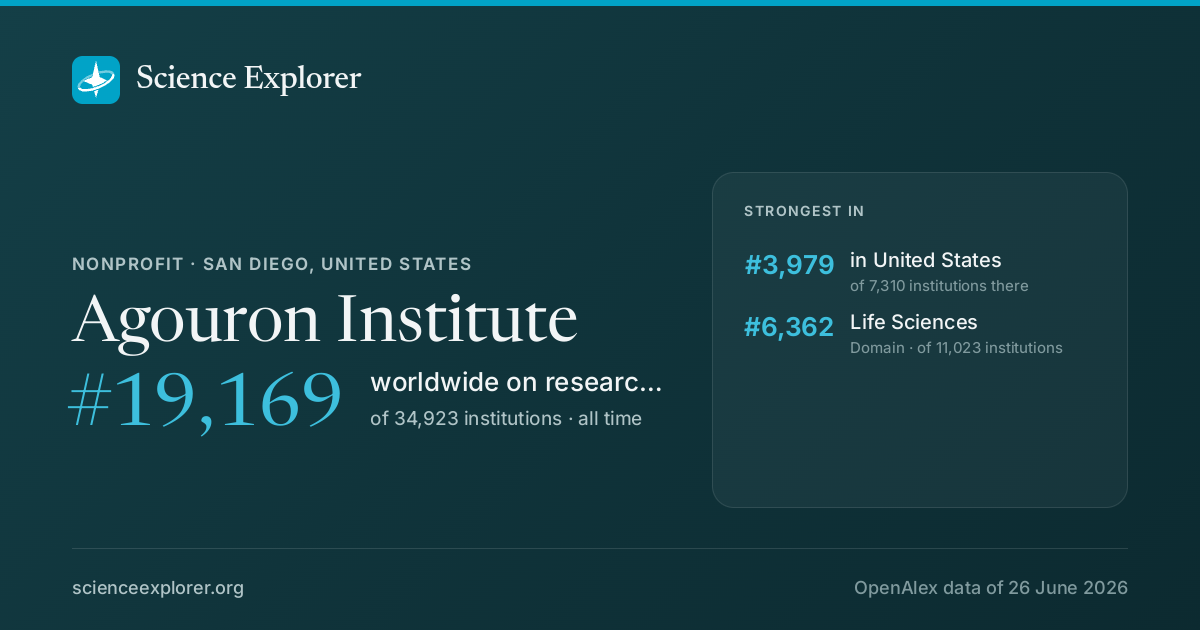
In research, Agouron Institute stands highest in Life Sciences (#6,362 of 11,023 worldwide), over all time.

World rank, all time
#19,169
of 34,923
Rank in United States
#3,979
of 7,310
Research works
352
▼ 28% vs 2018-21
Citations
21k
60.4 per fractional work
Top-10% rate
14.7%
all institutions 10.0%
vs its own fields
1.24×
1.00× is exactly expected
Open access
26%
world 40%
International
6%
world 18%

What is Agouron Institute known for in research?

The fields where it stands highest, over all time, ranked among every institution above the floor in each field.

FieldWorld rankWhere that sitsTop-10% rateWorks
Life SciencesDomain #6,362 of 11,023 18.6%145

Each strip is that field's whole ranked pool, with the notch where Agouron Institute sits in it, in the colour of the band that rank falls in. The track under the rate is the rate itself: it carries no average mark, because the average differs by field (from about 6% in Dentistry to 21% in Economics).

Which fields of science does Agouron Institute work in?

In all years, 41% of research at Agouron Institute is in Life Sciences, 29% in Health Sciences. Its largest fields are Biochemistry, Genetics and Molecular Biology (33%), Medicine (25%), Chemistry (9%). It does 2.6× the world's share of Life Sciences.

Life Sciences: 145 fractional works · 41.2% of its workBiochemistry, Genetics and Molecular Biology: 115 fractional works · 32.7% of its workMolecular Biology: 91 fractional works · 26.0% of its workGenetics: 8 fractional works · 2.2% of its workCancer Research: 4 fractional works · 1.1% of its workBiotechnology: 3 fractional works · 0.8% of its workCell Biology: 2 fractional works · 0.7% of its workEndocrinology: 2 fractional works · 0.5% of its workBiochemistry: 1 fractional works · 0.4% of its workClinical Biochemistry: 1 fractional works · 0.3% of its workMolecular Medicine: 1 fractional works · 0.3% of its workSmaller subfields together: 1 fractional works · 0.4% of its workImmunology and Microbiology: 19 fractional works · 5.3% of its workVirology: 11 fractional works · 3.2% of its workImmunology: 6 fractional works · 1.8% of its workSmaller subfields together: 1 fractional works · 0.2% of its workPharmacology, Toxicology and Pharmaceutics: 6 fractional works · 1.8% of its workPharmacology: 3 fractional works · 0.9% of its workPharmaceutical Science: 2 fractional works · 0.5% of its workToxicology: 1 fractional works · 0.4% of its workNeuroscience: 3 fractional works · 0.8% of its workCellular and Molecular Neuroscience: 2 fractional works · 0.5% of its workSmaller subfields together: 1 fractional works · 0.3% of its workAgricultural and Biological Sciences: 2 fractional works · 0.6% of its workPlant Science: 1 fractional works · 0.2% of its workSmaller subfields together: 1 fractional works · 0.3% of its workHealth Sciences: 103 fractional works · 29.3% of its workMedicine: 88 fractional works · 25.1% of its workInfectious Diseases: 18 fractional works · 5.0% of its workOncology: 13 fractional works · 3.6% of its workRadiology, Nuclear Medicine and Imaging: 8 fractional works · 2.2% of its workCardiology and Cardiovascular Medicine: 7 fractional works · 2.0% of its workPublic Health, Environmental and Occupational Health: 6 fractional works · 1.6% of its workEpidemiology: 5 fractional works · 1.5% of its workPhysiology: 4 fractional works · 1.2% of its workPathology and Forensic Medicine: 2 fractional works · 0.7% of its workHepatology: 2 fractional works · 0.7% of its workRheumatology: 2 fractional works · 0.7% of its workEmergency Medicine: 2 fractional works · 0.6% of its workSurgery: 2 fractional works · 0.6% of its workPulmonary and Respiratory Medicine: 2 fractional works · 0.6% of its workGenetics: 2 fractional works · 0.5% of its workGeriatrics and Gerontology: 2 fractional works · 0.4% of its workOphthalmology: 1 fractional works · 0.4% of its workDermatology: 1 fractional works · 0.4% of its workHematology: 1 fractional works · 0.3% of its workNeurology: 1 fractional works · 0.3% of its workPharmacology: 1 fractional works · 0.3% of its workEndocrinology, Diabetes and Metabolism: 1 fractional works · 0.3% of its workReproductive Medicine: 1 fractional works · 0.3% of its workPediatrics, Perinatology and Child Health: 1 fractional works · 0.3% of its workSmaller subfields together: 3 fractional works · 0.8% of its workHealth Professions: 13 fractional works · 3.8% of its workHealth Information Management: 10 fractional works · 2.7% of its workGeneral Health Professions: 2 fractional works · 0.4% of its workMedical Laboratory Technology: 1 fractional works · 0.3% of its workSmaller subfields together: 1 fractional works · 0.4% of its workDentistry: 1 fractional works · 0.4% of its workOrthodontics: 1 fractional works · 0.3% of its workSmaller subfields together: 0 fractional works · 0.1% of its workPhysical Sciences: 84 fractional works · 23.9% of its workChemistry: 32 fractional works · 9.0% of its workOrganic Chemistry: 24 fractional works · 6.9% of its workPhysical and Theoretical Chemistry: 4 fractional works · 1.1% of its workSpectroscopy: 3 fractional works · 0.9% of its workSmaller subfields together: 0 fractional works · 0.1% of its workComputer Science: 16 fractional works · 4.6% of its workComputational Theory and Mathematics: 7 fractional works · 2.1% of its workArtificial Intelligence: 4 fractional works · 1.1% of its workInformation Systems: 2 fractional works · 0.6% of its workComputer Vision and Pattern Recognition: 2 fractional works · 0.5% of its workSmaller subfields together: 2 fractional works · 0.5% of its workMaterials Science: 15 fractional works · 4.3% of its workMaterials Chemistry: 11 fractional works · 3.1% of its workBiomaterials: 3 fractional works · 0.7% of its workSurfaces, Coatings and Films: 1 fractional works · 0.2% of its workSmaller subfields together: 1 fractional works · 0.2% of its workEngineering: 9 fractional works · 2.7% of its workBiomedical Engineering: 4 fractional works · 1.1% of its workMechanics of Materials: 1 fractional works · 0.3% of its workElectrical and Electronic Engineering: 1 fractional works · 0.3% of its workIndustrial and Manufacturing Engineering: 1 fractional works · 0.3% of its workSmaller subfields together: 2 fractional works · 0.7% of its workPhysics and Astronomy: 5 fractional works · 1.5% of its workAtomic and Molecular Physics, and Optics: 2 fractional works · 0.5% of its workCondensed Matter Physics: 2 fractional works · 0.4% of its workStatistical and Nonlinear Physics: 1 fractional works · 0.3% of its workSmaller subfields together: 1 fractional works · 0.3% of its workEnvironmental Science: 5 fractional works · 1.3% of its workEcology: 3 fractional works · 0.9% of its workSmaller subfields together: 1 fractional works · 0.4% of its workMathematics: 1 fractional works · 0.4% of its workEarth and Planetary Sciences: 1 fractional works · 0.1% of its workEnergy: 0 fractional works · 0.0% of its workSocial Sciences: 20 fractional works · 5.6% of its workSocial Sciences: 6 fractional works · 1.6% of its workSociology and Political Science: 2 fractional works · 0.6% of its workSafety Research: 1 fractional works · 0.2% of its workSmaller subfields together: 3 fractional works · 0.8% of its workBusiness, Management and Accounting: 5 fractional works · 1.5% of its workOrganizational Behavior and Human Resource Management: 2 fractional works · 0.5% of its workManagement Information Systems: 2 fractional works · 0.4% of its workStrategy and Management: 1 fractional works · 0.3% of its workSmaller subfields together: 1 fractional works · 0.2% of its workEconomics, Econometrics and Finance: 3 fractional works · 1.0% of its workEconomics and Econometrics: 3 fractional works · 1.0% of its workDecision Sciences: 3 fractional works · 0.8% of its workInformation Systems and Management: 2 fractional works · 0.6% of its workManagement Science and Operations Research: 1 fractional works · 0.2% of its workPsychology: 2 fractional works · 0.5% of its workExperimental and Cognitive Psychology: 1 fractional works · 0.2% of its workSmaller subfields together: 1 fractional works · 0.3% of its workArts and Humanities: 1 fractional works · 0.3% of its workALL ITS WORKAgouron Institute352fractional works, all years
Life Sciences41%Physical Sciences24%Health Sciences29%Social Sciences6%

Each ring splits the one inside it: the four domains of science, their fields, their subfields. Size is fractional works in all years. Every slice is a page; the interactive view zooms down to single topics and colours each by how much more of it this institution does than the world.

Its 4 domains and 23 fields, with their numbers
    1. Biochemistry, Genetics and Molecular Biology11532.7%
    2. Immunology and Microbiology195.3%
    3. Pharmacology, Toxicology and Pharmaceutics61.8%
    4. Neuroscience30.8%
    5. Agricultural and Biological Sciences20.6%
    1. Medicine8825.1%
    2. Health Professions133.8%
    3. Dentistry10.4%
    1. Chemistry329.0%
    2. Computer Science164.6%
    3. Materials Science154.3%
    4. Engineering92.7%
    5. Physics and Astronomy51.5%
    6. Environmental Science51.3%
    7. Mathematics10.4%
    8. Earth and Planetary Sciences10.1%
    9. Energy00.0%
    1. Social Sciences61.6%
    2. Business, Management and Accounting51.5%
    3. Economics, Econometrics and Finance31.0%
    4. Decision Sciences30.8%
    5. Psychology20.5%
    6. Arts and Humanities10.3%
All of science, and how each field's share has moved since 1950: the Science domain explorer

Field profile

Location quotient across every field it publishes in: outside the ring is more than an institution of this size would be expected to publish, inside it is less.

Agricultural and Biological Sciences: 0.08× its world share, 0 worksAgricultural and Bio…Biochemistry, Genetics and Molecular Biology: 1.67× its world share, 1 worksBiochemistry, Geneti…Immunology and Microbiology: 6.25× its world share, 1 worksImmunology and Micro…Neuroscience: 2.15× its world share, 0 worksNeurosciencePharmacology, Toxicology and Pharmaceutics: 23.07× its world share, 1 worksPharmacology, Toxico…Chemistry: 2.96× its world share, 1 worksChemistryComputer Science: 0.30× its world share, 0 worksComputer ScienceEngineering: 0.66× its world share, 1 worksEngineeringMaterials Science: 0.33× its world share, 0 worksMaterials ScienceMathematics: 3.95× its world share, 1 worksMathematicsPhysics and Astronomy: 0.52× its world share, 0 worksPhysics and AstronomyHealth Professions: 0.88× its world share, 0 worksHealth ProfessionsMedicine: 2.11× its world share, 6 worksMedicineDecision Sciences: 0.80× its world share, 0 worksDecision SciencesEconomics, Econometrics and Finance: 0.36× its world share, 0 worksEconomics, Econometr…Psychology: 0.51× its world share, 0 worksPsychologySocial Sciences: 0.23× its world share, 0 worksSocial Sciences1×world share
more than its size predictsabout as predictedless

Rings at 0.5×, 1× and 2×. Widest outward: Pharmacology, Toxicology and Pharmaceutics, 23.1×. Every wedge is a field page.

All 17 fields, with their numbers
  1. Pharmacology, Toxicology and Pharmaceutics23.07×1 works
  2. Immunology and Microbiology6.25×1 works
  3. Mathematics3.95×1 works
  4. Chemistry2.96×1 works
  5. Neuroscience2.15×0 works
  6. Medicine2.11×6 works
  7. Biochemistry, Genetics and Molecular Biology1.67×1 works
  8. Health Professions0.88×0 works
  9. Decision Sciences0.80×0 works
  10. Engineering0.66×1 works
  11. Physics and Astronomy0.52×0 works
  12. Psychology0.51×0 works
  13. Economics, Econometrics and Finance0.36×0 works
  14. Materials Science0.33×0 works
  15. Computer Science0.30×0 works
  16. Social Sciences0.23×0 works
  17. Agricultural and Biological Sciences0.08×0 works

Who are the top researchers at Agouron Institute?

Ranked on the quality score, A. T. Hagler, Richard C. Ogden and J. Ernest Villafranca lead among researchers whose main affiliation is Agouron Institute.

  1. 1 A. T. Hagler United States · #340,366 worldwide 14k citations · 156 works
  2. 2 Richard C. Ogden United States · #685,973 worldwide 2.7k citations · 41 works
  3. 3 J. Ernest Villafranca United States · #714,387 worldwide 4.8k citations · 58 works
  4. 4 Zdeněk Hostomský United States · #795,563 worldwide 5.8k citations · 86 works
  5. 5 Katherine M. Welsh United States · #805,298 worldwide 3.2k citations · 34 works
  6. 6 Jay F. Davies United States · #1,466,561 worldwide 2.6k citations · 25 works
  7. 7 Krzysztof Appelt United States · #1,481,295 worldwide 4.8k citations · 107 works
  8. 8 Zuzana Hostomska United States · #1,483,966 worldwide 2.1k citations · 19 works
  9. 9 Stephen A. Margosiak United States · #1,806,360 worldwide 1.9k citations · 35 works
  10. 10 Chen‐Chen Kan United States · #2,210,891 worldwide 1.1k citations · 19 works
All ranked researchers at Agouron Institute

What are the most cited papers from Agouron Institute?

The most cited paper from Agouron Institute is "Structure and energetics of ligand binding to proteins: Escherichia coli dihydrofolate reductase‐trimethoprim, a drug‐receptor system" (Pnina Dauber‐Osguthorpe, Victoria A. Roberts, David J. Osguthorpe et al., 1988), with 2,083 citations. Next come "Bacterial bioluminescence: Isolation and genetic analysis of functions from Vibrio fischeri" (915) and "Crystal structures of human calcineurin and the human FKBP12–FK506–calcineurin complex" (765).

Most cited papers
#PaperReleasedCitations
1 Structure and energetics of ligand binding to proteins: Escherichia coli dihydrofolate reductase‐trimethoprim, a drug‐receptor system Pnina Dauber‐Osguthorpe, Victoria A. Roberts, David J. Osguthorpe et al. · Proteins Structure Function and Bioinformatics 1988 2,083
2 Bacterial bioluminescence: Isolation and genetic analysis of functions from Vibrio fischeri JoAnne Engebrecht, Kenneth H. Nealson, Michael R. Silverman · Cell Mar 1983 915
3 Crystal structures of human calcineurin and the human FKBP12–FK506–calcineurin complex Charles R. Kissinger, Hans E. Parge, Daniel R. Knighton et al. · Nature Dec 1995 765
4 Intercellular signalling in Vibrio harveyi: sequence and function of genes regulating expression of luminescence Bonnie L. Bassler, Miriam E. Wright, Richard E. Showalter et al. · Molecular Microbiology Aug 1993 763
5 Multiple signalling systems controlling expression of luminescence in Vibrio harveyi : sequence and function of genes encoding a second sensory pathway Bonnie L. Bassler, Miriam E. Wright, Michael R. Silverman · Molecular Microbiology Jul 1994 709
All 60 most cited papers, with filters and sorting

Which keywords describe research at Agouron Institute?

By fractional works in all years, weighted toward what it does more of than the world: Antiretroviral Therapy, HIV Infection, Immune Response, Drug Resistance, Drug Discovery, Hepatotoxicity, Viral Diseases and Integrase Inhibitors.

▲ more of its work than of the world's◆ about the world's share▼ less than the world's

Size is fractional works in all years in the topics tagged with each word; colour is the word's share of this institution's work against its share of the world's. The 40 words are chosen for being large and distinctive. Each links to the topic it comes from most.

All 40 words, with their numbers
  1. Antiretroviral Therapy30▲ 37×5 topics
  2. Epidemiology23▲ 1.62×33 topics
  3. HIV Infection16▲ 38×2 topics
  4. Immune Response16▲ 7.6×10 topics
  5. Drug Resistance16▲ 14×5 topics
  6. Drug Discovery16▲ 11×8 topics
  7. Hepatotoxicity15▲ 58×2 topics
  8. Viral Diseases15▲ 49×2 topics
  9. Integrase Inhibitors14▲ 99×1 topic
  10. Nucleoside Analogues14▲ 99×1 topic
  11. Medicinal Chemistry13▲ 10×9 topics
  12. Vaccine13▲ 9.2×5 topics
  13. Protein13▲ 24×3 topics
  14. Molecular Dynamics12▲ 14×3 topics
  15. Prediction12▲ 35×2 topics
  16. Enzyme Catalysis12▲ 45×2 topics
  17. HIV12▲ 28×3 topics
  18. AIDS11▲ 62×1 topic
  19. Antibodies11▲ 37×1 topic
  20. Force Field11▲ 56×1 topic
  21. Structure11▲ 45×1 topic
  22. Enzyme Regulation11▲ 61×1 topic
  23. Nucleotide Metabolism11▲ 85×1 topic
  24. Synthesis10▲ 4.9×12 topics
  25. Translation10▲ 13×2 topics
  26. RNA Structure10▲ 28×1 topic
  27. Ribosome10▲ 28×1 topic
  28. Molecular Docking10▲ 19×3 topics
  29. Macromolecular Crystallography9▲ 55×1 topic
  30. Structure Solution9▲ 55×1 topic
  31. Cancer Progression9▲ 11×4 topics
  32. Pharmacokinetics8▲ 8.8×2 topics
  33. Glycosylation7▲ 9.5×3 topics
  34. Immunosuppressive Therapy7▲ 11×4 topics
  35. Viral Infection7▲ 27×2 topics
  36. Cardiovascular Magnetic Resonance7▲ 31×1 topic
  37. Drug Target Identification7▲ 27×1 topic
  38. Myocarditis7▲ 46×1 topic
  39. Virtual Screening7▲ 27×1 topic
  40. Monoclonal Antibodies6▲ 13×3 topics

Which research topics does Agouron Institute publish most on?

By volume in 2022-now: Alzheimer's disease research and treatments, Manufacturing Process and Optimization, Chemical Reactions and Isotopes and Cancer Immunotherapy and Biomarkers.

  1. 1 Alzheimer's disease research and treatments Physiology 2 works
  2. 2 Manufacturing Process and Optimization Industrial and Manufacturing Engineering 1 works
  3. 3 Chemical Reactions and Isotopes Pharmaceutical Science 1 works
  4. 4 Cancer Immunotherapy and Biomarkers Oncology 0 works
  5. 5 Neurological Disorders and Treatments Neurology 0 works
  6. 6 CAR-T cell therapy research Oncology 0 works
  7. 7 Synthesis of Organic Compounds Pharmacology 0 works
  8. 8 HIV/AIDS drug development and treatment Infectious Diseases 0 works
  9. 9 Organophosphorus compounds synthesis Organic Chemistry 0 works
  10. 10 Ferroptosis and cancer prognosis Pulmonary and Respiratory Medicine 0 works

How open and international is its research?

Against the world's own shares: the tick on each track. Both are shares of its output, so they sit on one scale and can be read against each other as well as against the world.

openly available25.9%not open74.1%

World: 40% of research is openly available.

with international co-authors6.4%domestic only93.6%

World: 18% is written across borders.

How has Agouron Institute's research output changed?

Output in 2022-2025 was 28% lower than in 2018-2021.

still counting1990200020102020
grewheldshrank

The same series as a ribbon: one cell per year, darker for more. The line above answers how much; this answers when.

Its share of all research

Growing output can still be a shrinking share: all of science grows. This is Agouron Institute as a percentage of every work published that year, 0.000011% in 2024.

still counting0.0010%0.0020%0.0030%Agouron Institute0.000046% in 202519801990200020102020

Fractional works of Agouron Institute over all fractional works that year. How the balance of science has shifted.

Other research institutions in San Diego

All research institutions in San Diego

Share Agouron Institute's ranking

Agouron Institute on Science Explorer

A card with Agouron Institute's standing and the fields it leads in, for a post or a slide. A link to this page previews as the same card.

Download the card

1200 × 630 PNG, sized for social posts, drawn from the latest snapshot.

Badges for a website1Each links back here and updates with every snapshot

Research measures only: rankings here say nothing about teaching, admissions or student experience. Comparable institutions and collaboration partners have tabs of their own, above.

Discussion

Ask a question or share a note about Agouron Institute. Posts are plain text and can be reported.