Science Explorer Back to mapMap
Discussion
Company · Leiden · Netherlands

Pharming Group (Netherlands)

World rank, all time
#34,403
of 34,923
Rank in Netherlands
#405
of 407
Research works
131
▲ 55% vs 2018-21
Citations
3.3k
25.2 per fractional work
Top-10% rate
7.7%
all institutions 10.0%
vs its own fields
0.90×
1.00× is exactly expected
Open access
32%
world 40%
International
35%
world 18%

Which fields of science does Pharming Group (Netherlands) work in?

In all years, 43% of research at Pharming Group (Netherlands) is in Health Sciences, 38% in Life Sciences. Its largest fields are Medicine (36%), Biochemistry, Genetics and Molecular Biology (26%), Chemistry (8%). It does 2.3× the world's share of Life Sciences.

Health Sciences: 57 fractional works · 43.2% of its workMedicine: 47 fractional works · 35.7% of its workOncology: 7 fractional works · 5.3% of its workHematology: 6 fractional works · 4.9% of its workGenetics: 6 fractional works · 4.6% of its workPhysiology: 3 fractional works · 2.2% of its workSurgery: 3 fractional works · 2.2% of its workPulmonary and Respiratory Medicine: 2 fractional works · 1.8% of its workEndocrinology, Diabetes and Metabolism: 2 fractional works · 1.5% of its workInfectious Diseases: 2 fractional works · 1.5% of its workRheumatology: 1 fractional works · 1.1% of its workPediatrics, Perinatology and Child Health: 1 fractional works · 1.0% of its workPublic Health, Environmental and Occupational Health: 1 fractional works · 0.9% of its workRadiology, Nuclear Medicine and Imaging: 1 fractional works · 0.9% of its workEpidemiology: 1 fractional works · 0.9% of its workNephrology: 1 fractional works · 0.9% of its workPharmacology: 1 fractional works · 0.7% of its workComplementary and alternative medicine: 1 fractional works · 0.6% of its workRehabilitation: 1 fractional works · 0.6% of its workPathology and Forensic Medicine: 1 fractional works · 0.6% of its workTransplantation: 1 fractional works · 0.4% of its workPsychiatry and Mental health: 1 fractional works · 0.4% of its workHepatology: 0 fractional works · 0.4% of its workReproductive Medicine: 0 fractional works · 0.4% of its workCardiology and Cardiovascular Medicine: 0 fractional works · 0.4% of its workNeurology: 0 fractional works · 0.3% of its workBiochemistry: 0 fractional works · 0.3% of its workImmunology and Allergy: 0 fractional works · 0.2% of its workFamily Practice: 0 fractional works · 0.2% of its workSmaller subfields together: 1 fractional works · 0.6% of its workNursing: 5 fractional works · 4.2% of its workNutrition and Dietetics: 5 fractional works · 4.2% of its workHealth Professions: 4 fractional works · 2.8% of its workGeneral Health Professions: 1 fractional works · 0.9% of its workHealth Information Management: 1 fractional works · 0.8% of its workMedical Laboratory Technology: 1 fractional works · 0.5% of its workComplementary and Manual Therapy: 0 fractional works · 0.3% of its workPharmacy: 0 fractional works · 0.3% of its workSmaller subfields together: 0 fractional works · 0.1% of its workVeterinary: 0 fractional works · 0.4% of its workSmall Animals: 0 fractional works · 0.4% of its workDentistry: 0 fractional works · 0.2% of its workLife Sciences: 49 fractional works · 37.6% of its workBiochemistry, Genetics and Molecular Biology: 34 fractional works · 26.1% of its workMolecular Biology: 19 fractional works · 14.5% of its workGenetics: 8 fractional works · 5.9% of its workBiochemistry: 2 fractional works · 1.4% of its workCell Biology: 2 fractional works · 1.3% of its workCancer Research: 1 fractional works · 1.0% of its workBiotechnology: 1 fractional works · 0.7% of its workClinical Biochemistry: 1 fractional works · 0.6% of its workPhysiology: 0 fractional works · 0.4% of its workBiophysics: 0 fractional works · 0.3% of its workImmunology and Microbiology: 9 fractional works · 6.6% of its workImmunology: 8 fractional works · 6.2% of its workMicrobiology: 0 fractional works · 0.2% of its workSmaller subfields together: 0 fractional works · 0.2% of its workNeuroscience: 3 fractional works · 2.5% of its workCellular and Molecular Neuroscience: 2 fractional works · 1.3% of its workNeurology: 1 fractional works · 1.1% of its workSmaller subfields together: 0 fractional works · 0.2% of its workAgricultural and Biological Sciences: 2 fractional works · 1.9% of its workFood Science: 1 fractional works · 1.1% of its workPlant Science: 1 fractional works · 0.4% of its workAgronomy and Crop Science: 0 fractional works · 0.4% of its workPharmacology, Toxicology and Pharmaceutics: 1 fractional works · 0.5% of its workPharmacology: 0 fractional works · 0.4% of its workSmaller subfields together: 0 fractional works · 0.2% of its workPhysical Sciences: 20 fractional works · 15.5% of its workChemistry: 11 fractional works · 8.1% of its workOrganic Chemistry: 9 fractional works · 6.7% of its workSpectroscopy: 1 fractional works · 1.0% of its workAnalytical Chemistry: 0 fractional works · 0.3% of its workSmaller subfields together: 0 fractional works · 0.1% of its workEngineering: 3 fractional works · 2.5% of its workBiomedical Engineering: 3 fractional works · 2.3% of its workSmaller subfields together: 0 fractional works · 0.2% of its workMaterials Science: 3 fractional works · 2.2% of its workMaterials Chemistry: 1 fractional works · 1.1% of its workElectronic, Optical and Magnetic Materials: 1 fractional works · 0.6% of its workBiomaterials: 1 fractional works · 0.5% of its workComputer Science: 1 fractional works · 1.1% of its workComputational Theory and Mathematics: 1 fractional works · 0.5% of its workComputer Networks and Communications: 0 fractional works · 0.3% of its workArtificial Intelligence: 0 fractional works · 0.2% of its workSmaller subfields together: 0 fractional works · 0.1% of its workEnvironmental Science: 1 fractional works · 0.8% of its workHealth, Toxicology and Mutagenesis: 0 fractional works · 0.4% of its workEcology: 0 fractional works · 0.3% of its workSmaller subfields together: 0 fractional works · 0.1% of its workPhysics and Astronomy: 1 fractional works · 0.8% of its workAtomic and Molecular Physics, and Optics: 0 fractional works · 0.3% of its workInstrumentation: 0 fractional works · 0.3% of its workSmaller subfields together: 0 fractional works · 0.2% of its workMathematics: 0 fractional works · 0.0% of its workSocial Sciences: 5 fractional works · 3.7% of its workEconomics, Econometrics and Finance: 2 fractional works · 1.9% of its workEconomics and Econometrics: 2 fractional works · 1.6% of its workSmaller subfields together: 0 fractional works · 0.3% of its workPsychology: 1 fractional works · 0.6% of its workApplied Psychology: 1 fractional works · 0.5% of its workSmaller subfields together: 0 fractional works · 0.1% of its workBusiness, Management and Accounting: 1 fractional works · 0.5% of its workManagement Information Systems: 0 fractional works · 0.4% of its workSmaller subfields together: 0 fractional works · 0.1% of its workSocial Sciences: 0 fractional works · 0.3% of its workDecision Sciences: 0 fractional works · 0.3% of its workInformation Systems and Management: 0 fractional works · 0.3% of its workSmaller subfields together: 0 fractional works · 0.1% of its workArts and Humanities: 0 fractional works · 0.1% of its workALL ITS WORKPharming Group(Netherlands)131fractional works, all years
Life Sciences38%Physical Sciences16%Health Sciences43%Social Sciences4%

Each ring splits the one inside it: the four domains of science, their fields, their subfields. Size is fractional works in all years. Every slice is a page; the interactive view zooms down to single topics and colours each by how much more of it this institution does than the world.

Its 4 domains and 23 fields, with their numbers
    1. Medicine4735.7%
    2. Nursing54.2%
    3. Health Professions42.8%
    4. Veterinary00.4%
    5. Dentistry00.2%
    1. Biochemistry, Genetics and Molecular Biology3426.1%
    2. Immunology and Microbiology96.6%
    3. Neuroscience32.5%
    4. Agricultural and Biological Sciences21.9%
    5. Pharmacology, Toxicology and Pharmaceutics10.5%
    1. Chemistry118.1%
    2. Engineering32.5%
    3. Materials Science32.2%
    4. Computer Science11.1%
    5. Environmental Science10.8%
    6. Physics and Astronomy10.8%
    7. Mathematics00.0%
    1. Economics, Econometrics and Finance21.9%
    2. Psychology10.6%
    3. Business, Management and Accounting10.5%
    4. Social Sciences00.3%
    5. Decision Sciences00.3%
    6. Arts and Humanities00.1%
All of science, and how each field's share has moved since 1950: the Science domain explorer

Field profile

Location quotient across every field it publishes in: outside the ring is more than an institution of this size would be expected to publish, inside it is less.

Biochemistry, Genetics and Molecular Biology: 2.45× its world share, 2 worksBiochemistry, Geneti…Immunology and Microbiology: 16.80× its world share, 2 worksImmunology and Micro…Pharmacology, Toxicology and Pharmaceutics: 1.59× its world share, 0 worksPharmacology, Toxico…Computer Science: 0.14× its world share, 0 worksComputer ScienceEnvironmental Science: 0.12× its world share, 0 worksEnvironmental ScienceMathematics: 0.21× its world share, 0 worksMathematicsPhysics and Astronomy: 1.01× its world share, 0 worksPhysics and AstronomyHealth Professions: 3.13× its world share, 1 worksHealth ProfessionsMedicine: 2.42× its world share, 7 worksMedicineBusiness, Management and Accounting: 0.17× its world share, 0 worksBusiness, Management…Economics, Econometrics and Finance: 4.55× its world share, 1 worksEconomics, Econometr…Social Sciences: 0.02× its world share, 0 worksSocial Sciences1×world share
more than its size predictsabout as predictedless

Rings at 0.5×, 1× and 2×. Widest outward: Immunology and Microbiology, 16.8×. Every wedge is a field page.

All 12 fields, with their numbers
  1. Immunology and Microbiology16.80×2 works
  2. Economics, Econometrics and Finance4.55×1 works
  3. Health Professions3.13×1 works
  4. Biochemistry, Genetics and Molecular Biology2.45×2 works
  5. Medicine2.42×7 works
  6. Pharmacology, Toxicology and Pharmaceutics1.59×0 works
  7. Physics and Astronomy1.01×0 works
  8. Mathematics0.21×0 works
  9. Business, Management and Accounting0.17×0 works
  10. Computer Science0.14×0 works
  11. Environmental Science0.12×0 works
  12. Social Sciences0.02×0 works

Who are the top researchers at Pharming Group (Netherlands)?

Ranked on the quality score, Jan H. Nuijens, Marlieke Geerts and Beatrijs D. Oortwijn lead among researchers whose main affiliation is Pharming Group (Netherlands).

  1. 1 Jan H. Nuijens Netherlands · #604,727 worldwide 4.3k citations · 62 works
  2. 2 Marlieke Geerts Netherlands · #1,461,683 worldwide 1.5k citations · 17 works
  3. 3 Beatrijs D. Oortwijn Netherlands · #1,555,705 worldwide 1.6k citations · 28 works
  4. 4 Anurag Relan Netherlands · #2,013,352 worldwide 1.4k citations · 72 works
  5. 5 Maurice L. M. Mannesse Netherlands · #2,425,820 worldwide 874 citations · 23 works
  6. 6 John Whalen Netherlands · #3,478,733 worldwide 42 citations · 46 works
  7. 7 Mourad Salaheddine Netherlands · #3,661,068 worldwide 563 citations · 20 works
All ranked researchers at Pharming Group (Netherlands)

What are the most cited papers from Pharming Group (Netherlands)?

The most cited paper from Pharming Group (Netherlands) is "Striking oil: Another puzzle?" (Gerben Driesprong, Ben Jacobsen, Benjamin Maat, 2008), with 626 citations. Next come "Long-Term Intravenous Treatment of Pompe Disease With Recombinant Human α-Glucosidase From Milk" (355) and "Large scale production of recombinant human lactoferrin in the milk of transgenic cows" (295).

Most cited papers
#PaperReleasedCitations
1 Striking oil: Another puzzle? Gerben Driesprong, Ben Jacobsen, Benjamin Maat · Journal of Financial Economics 28 Jun 2008 626
2 Long-Term Intravenous Treatment of Pompe Disease With Recombinant Human α-Glucosidase From Milk Johanna M. P. van den Hout et al. · PEDIATRICS May 2004 355
3 Large scale production of recombinant human lactoferrin in the milk of transgenic cows Patrick H.C. van Berkel, Mick M. Welling, Marlieke Geerts et al. · Nature Biotechnology May 2002 295
4 Generation Of Transgenic Dairy Cattle Using ‘in vitro’ Embryo Production Paul Krimpenfort, Adriana Rademakers, Will Eyestone et al. · Nature Biotechnology Sep 1991 274
5 Human Lactoferrin and Peptides Derived from Its N Terminus Are Highly Effective against Infections with Antibiotic-Resistant Bacteria Peter H. Nibbering, Elisabeth Ravensbergen, Mick M. Welling et al. · Infection and Immunity Open access Mar 2001 262
All 60 most cited papers, with filters and sorting

Which keywords describe research at Pharming Group (Netherlands)?

By fractional works in all years, weighted toward what it does more of than the world: Gene Therapy, Gene Expression, Cancer Therapy, Thrombosis, Preterm Infants, Hereditary Angioedema, Kinin Receptor Family and Inflammation.

▲ more of its work than of the world's◆ about the world's share▼ less than the world's

Size is fractional works in all years in the topics tagged with each word; colour is the word's share of this institution's work against its share of the world's. The 40 words are chosen for being large and distinctive. Each links to the topic it comes from most.

All 40 words, with their numbers
  1. Inflammation9▲ 2.8×25 topics
  2. Gene Therapy7▲ 19×4 topics
  3. Gene Expression6▲ 8.1×8 topics
  4. Cancer Therapy6▲ 7.7×8 topics
  5. Cancer6▲ 3.4×17 topics
  6. Thrombosis6▲ 22×4 topics
  7. Oxidative Stress6▲ 2.5×19 topics
  8. Preterm Infants6▲ 29×2 topics
  9. Hereditary Angioedema6▲ 149×1 topic
  10. Kinin Receptor Family6▲ 149×1 topic
  11. Biopharmaceutical Production5▲ 50×2 topics
  12. Genomic Integration5▲ 38×2 topics
  13. Embryonic Stem Cells5▲ 50×2 topics
  14. Innate Immunity5▲ 11×6 topics
  15. Genetic Modification5▲ 94×1 topic
  16. Nutritional Significance5▲ 26×2 topics
  17. Synthesis5▲ 6.2×10 topics
  18. Transgenic Animals5▲ 94×1 topic
  19. Probiotics5▲ 14×2 topics
  20. Human Milk Composition4▲ 111×1 topic
  21. Necrotizing Enterocolitis4▲ 111×1 topic
  22. Cell Death4▲ 15×2 topics
  23. Regulation4▲ 4.9×7 topics
  24. DNA Repair4▲ 118×2 topics
  25. Inhibitors4▲ 40×2 topics
  26. Efficacy4▲ 58×2 topics
  27. Recombinant Factor VIIa4▲ 64×2 topics
  28. Factor VIII3▲ 149×1 topic
  29. Hemophilia3▲ 149×1 topic
  30. BRCA Mutation3▲ 149×1 topic
  31. PARP Inhibitors3▲ 149×1 topic
  32. Heterocyclic Compounds3▲ 15×3 topics
  33. Complement3▲ 103×1 topic
  34. Immune3▲ 103×1 topic
  35. Anticancer Agents3▲ 8.5×4 topics
  36. Medicinal Chemistry3▲ 5.8×4 topics
  37. Biological Evaluation3▲ 16×4 topics
  38. Transcriptional Regulation2▲ 7.7×5 topics
  39. Genome Engineering2▲ 30×1 topic
  40. RNA-Guided2▲ 30×1 topic

Which research topics does Pharming Group (Netherlands) publish most on?

By volume in 2022-now: Immunodeficiency and Autoimmune Disorders, Coagulation, Bradykinin, Polyphosphates, and Angioedema, Health Systems, Economic Evaluations, Quality of Life and Hemophilia Treatment and Research.

  1. 1 Immunodeficiency and Autoimmune Disorders Immunology 2 works
  2. 2 Coagulation, Bradykinin, Polyphosphates, and Angioedema Genetics 1 works
  3. 3 Health Systems, Economic Evaluations, Quality of Life Economics and Econometrics 1 works
  4. 4 Hemophilia Treatment and Research Hematology 1 works
  5. 5 Autoimmune and Inflammatory Disorders Research Hematology 1 works
  6. 6 Quality and Safety in Healthcare Medical Laboratory Technology 1 works
  7. 7 Chronic Lymphocytic Leukemia Research Genetics 1 works
  8. 8 Pharmaceutical studies and practices Pediatrics, Perinatology and Child Health 0 works
  9. 9 Genomics and Rare Diseases Genetics 0 works
  10. 10 Blood disorders and treatments Genetics 0 works

How open and international is its research?

Against the world's own shares: the tick on each track. Both are shares of its output, so they sit on one scale and can be read against each other as well as against the world.

openly available32.1%not open67.9%

World: 40% of research is openly available.

with international co-authors34.9%domestic only65.1%

World: 18% is written across borders.

How has Pharming Group (Netherlands)'s research output changed?

Output in 2022-2025 was 55% higher than in 2018-2021.

still counting1990200020102020
grewheldshrank

The same series as a ribbon: one cell per year, darker for more. The line above answers how much; this answers when.

Its share of all research

Growing output can still be a shrinking share: all of science grows. This is Pharming Group (Netherlands) as a percentage of every work published that year, 0.000083% in 2024.

still counting0.00020%0.00040%0.00060%Pharming Group (Netherlands)0.000069% in 20251990200020102020

Fractional works of Pharming Group (Netherlands) over all fractional works that year. How the balance of science has shifted.

Other research institutions in Leiden

All research institutions in Leiden

Share Pharming Group (Netherlands)'s ranking
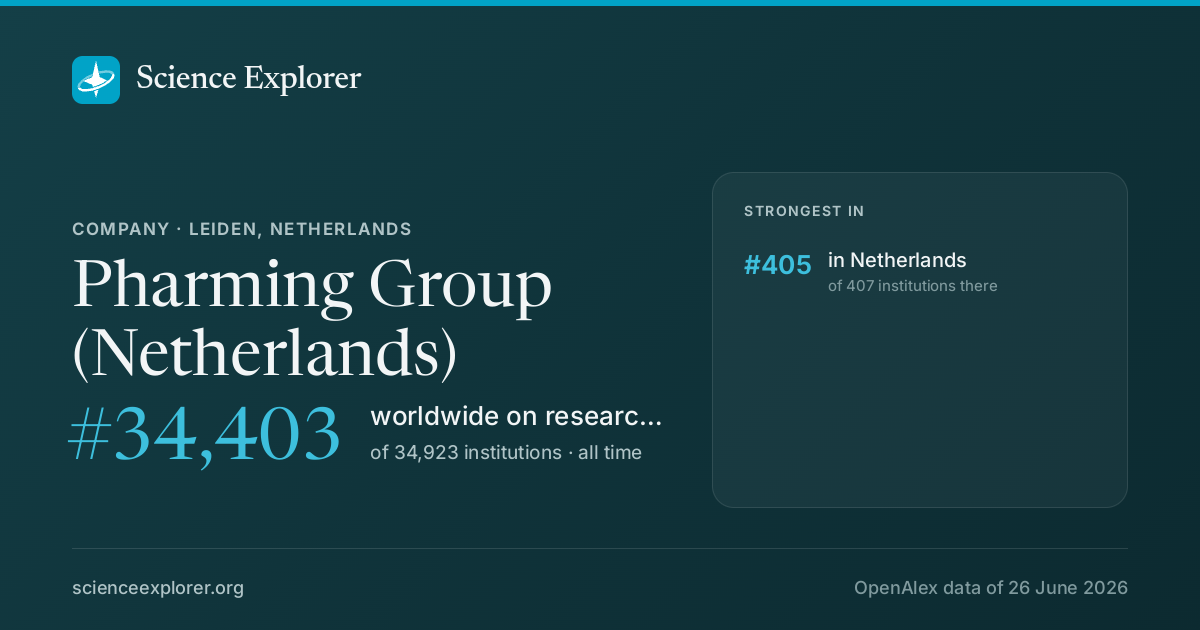
Pharming Group (Netherlands) on Science Explorer

A card with Pharming Group (Netherlands)'s standing and the fields it leads in, for a post or a slide. A link to this page previews as the same card.

Download the card

1200 × 630 PNG, sized for social posts, drawn from the latest snapshot.

Badges for a website1Each links back here and updates with every snapshot

Research measures only: rankings here say nothing about teaching, admissions or student experience. Comparable institutions and collaboration partners have tabs of their own, above.

Discussion

Ask a question or share a note about Pharming Group (Netherlands). Posts are plain text and can be reported.