Science Explorer Back to mapMap
Discussion
Company · Arlington · United States

Rosetta Stone (United States)

World rank, all time
#20,051
of 34,923
Rank in United States
#4,155
of 7,310
Research works
220
▼ 56% vs 2018-21
Citations
36k
163.1 per fractional work
Top-10% rate
6.1%
all institutions 10.0%
vs its own fields
1.40×
1.00× is exactly expected
Open access
45%
world 40%
International
19%
world 18%

Which fields of science does Rosetta Stone (United States) work in?

In all years, 54% of research at Rosetta Stone (United States) is in Life Sciences, 16% in Physical Sciences. Its largest fields are Biochemistry, Genetics and Molecular Biology (48%), Medicine (13%), Social Sciences (6%). It does 3.4× the world's share of Life Sciences.

Life Sciences: 119 fractional works · 54.1% of its workBiochemistry, Genetics and Molecular Biology: 105 fractional works · 47.9% of its workMolecular Biology: 75 fractional works · 34.2% of its workGenetics: 18 fractional works · 8.3% of its workCancer Research: 8 fractional works · 3.8% of its workCell Biology: 3 fractional works · 1.2% of its workSmaller subfields together: 1 fractional works · 0.4% of its workImmunology and Microbiology: 5 fractional works · 2.3% of its workImmunology: 4 fractional works · 1.7% of its workVirology: 1 fractional works · 0.3% of its workMicrobiology: 0 fractional works · 0.2% of its workSmaller subfields together: 0 fractional works · 0.1% of its workNeuroscience: 4 fractional works · 1.8% of its workSensory Systems: 2 fractional works · 0.8% of its workEndocrine and Autonomic Systems: 1 fractional works · 0.4% of its workCognitive Neuroscience: 1 fractional works · 0.3% of its workSmaller subfields together: 0 fractional works · 0.2% of its workAgricultural and Biological Sciences: 3 fractional works · 1.6% of its workPlant Science: 2 fractional works · 1.1% of its workSoil Science: 0 fractional works · 0.2% of its workSmaller subfields together: 0 fractional works · 0.2% of its workPharmacology, Toxicology and Pharmaceutics: 1 fractional works · 0.6% of its workPharmacology: 1 fractional works · 0.5% of its workSmaller subfields together: 0 fractional works · 0.2% of its workPhysical Sciences: 35 fractional works · 15.8% of its workComputer Science: 13 fractional works · 6.1% of its workArtificial Intelligence: 4 fractional works · 1.9% of its workComputational Theory and Mathematics: 3 fractional works · 1.4% of its workComputer Networks and Communications: 2 fractional works · 0.7% of its workInformation Systems: 1 fractional works · 0.6% of its workComputer Science Applications: 1 fractional works · 0.5% of its workHardware and Architecture: 1 fractional works · 0.4% of its workComputer Vision and Pattern Recognition: 1 fractional works · 0.4% of its workSmaller subfields together: 0 fractional works · 0.2% of its workEngineering: 10 fractional works · 4.6% of its workOcean Engineering: 2 fractional works · 1.1% of its workMedia Technology: 2 fractional works · 1.0% of its workBiomedical Engineering: 2 fractional works · 0.7% of its workElectrical and Electronic Engineering: 1 fractional works · 0.6% of its workMechanical Engineering: 1 fractional works · 0.6% of its workIndustrial and Manufacturing Engineering: 0 fractional works · 0.2% of its workSmaller subfields together: 1 fractional works · 0.3% of its workEnvironmental Science: 4 fractional works · 1.8% of its workHealth, Toxicology and Mutagenesis: 2 fractional works · 0.8% of its workEcology: 1 fractional works · 0.3% of its workWater Science and Technology: 0 fractional works · 0.2% of its workSmaller subfields together: 1 fractional works · 0.5% of its workEarth and Planetary Sciences: 3 fractional works · 1.2% of its workPaleontology: 1 fractional works · 0.4% of its workGeophysics: 1 fractional works · 0.3% of its workOceanography: 1 fractional works · 0.3% of its workSmaller subfields together: 0 fractional works · 0.1% of its workPhysics and Astronomy: 2 fractional works · 0.8% of its workAstronomy and Astrophysics: 1 fractional works · 0.6% of its workNuclear and High Energy Physics: 0 fractional works · 0.2% of its workSmaller subfields together: 0 fractional works · 0.0% of its workChemistry: 1 fractional works · 0.6% of its workSpectroscopy: 1 fractional works · 0.5% of its workSmaller subfields together: 0 fractional works · 0.1% of its workMathematics: 1 fractional works · 0.5% of its workStatistics and Probability: 1 fractional works · 0.3% of its workSmaller subfields together: 0 fractional works · 0.2% of its workMaterials Science: 0 fractional works · 0.2% of its workSocial Sciences: 34 fractional works · 15.4% of its workSocial Sciences: 14 fractional works · 6.3% of its workEducation: 6 fractional works · 2.8% of its workAnthropology: 2 fractional works · 0.8% of its workLaw: 2 fractional works · 0.7% of its workSociology and Political Science: 1 fractional works · 0.6% of its workPolitical Science and International Relations: 1 fractional works · 0.6% of its workDevelopment: 0 fractional works · 0.2% of its workSmaller subfields together: 1 fractional works · 0.5% of its workArts and Humanities: 6 fractional works · 2.8% of its workLiterature and Literary Theory: 2 fractional works · 1.0% of its workLanguage and Linguistics: 2 fractional works · 0.9% of its workHistory: 1 fractional works · 0.5% of its workVisual Arts and Performing Arts: 1 fractional works · 0.5% of its workSmaller subfields together: 0 fractional works · 0.1% of its workPsychology: 5 fractional works · 2.4% of its workDevelopmental and Educational Psychology: 2 fractional works · 0.9% of its workClinical Psychology: 1 fractional works · 0.6% of its workExperimental and Cognitive Psychology: 1 fractional works · 0.5% of its workSocial Psychology: 1 fractional works · 0.3% of its workSmaller subfields together: 0 fractional works · 0.2% of its workBusiness, Management and Accounting: 4 fractional works · 2.0% of its workAccounting: 2 fractional works · 0.9% of its workBusiness and International Management: 1 fractional works · 0.5% of its workOrganizational Behavior and Human Resource Management: 1 fractional works · 0.3% of its workStrategy and Management: 0 fractional works · 0.2% of its workSmaller subfields together: 0 fractional works · 0.2% of its workEconomics, Econometrics and Finance: 3 fractional works · 1.3% of its workEconomics and Econometrics: 2 fractional works · 0.8% of its workFinance: 1 fractional works · 0.3% of its workSmaller subfields together: 0 fractional works · 0.2% of its workDecision Sciences: 1 fractional works · 0.5% of its workManagement Science and Operations Research: 1 fractional works · 0.3% of its workSmaller subfields together: 1 fractional works · 0.3% of its workHealth Sciences: 32 fractional works · 14.6% of its workMedicine: 28 fractional works · 12.6% of its workPhysiology: 4 fractional works · 1.9% of its workEpidemiology: 4 fractional works · 1.6% of its workOncology: 3 fractional works · 1.3% of its workSurgery: 2 fractional works · 0.8% of its workRadiology, Nuclear Medicine and Imaging: 2 fractional works · 0.8% of its workEndocrinology, Diabetes and Metabolism: 2 fractional works · 0.7% of its workPublic Health, Environmental and Occupational Health: 1 fractional works · 0.7% of its workCardiology and Cardiovascular Medicine: 1 fractional works · 0.6% of its workPulmonary and Respiratory Medicine: 1 fractional works · 0.5% of its workInfectious Diseases: 1 fractional works · 0.4% of its workPathology and Forensic Medicine: 1 fractional works · 0.4% of its workOphthalmology: 1 fractional works · 0.3% of its workPediatrics, Perinatology and Child Health: 1 fractional works · 0.3% of its workRehabilitation: 1 fractional works · 0.3% of its workRheumatology: 0 fractional works · 0.2% of its workSmaller subfields together: 4 fractional works · 1.7% of its workHealth Professions: 2 fractional works · 1.0% of its workGeneral Health Professions: 1 fractional works · 0.6% of its workSpeech and Hearing: 0 fractional works · 0.2% of its workSmaller subfields together: 0 fractional works · 0.1% of its workNursing: 2 fractional works · 0.8% of its workNutrition and Dietetics: 2 fractional works · 0.8% of its workDentistry: 0 fractional works · 0.2% of its workVeterinary: 0 fractional works · 0.1% of its workALL ITS WORKRosetta Stone(United States)220fractional works, all years
Life Sciences54%Physical Sciences16%Health Sciences15%Social Sciences15%

Each ring splits the one inside it: the four domains of science, their fields, their subfields. Size is fractional works in all years. Every slice is a page; the interactive view zooms down to single topics and colours each by how much more of it this institution does than the world.

Its 4 domains and 24 fields, with their numbers
    1. Biochemistry, Genetics and Molecular Biology10547.9%
    2. Immunology and Microbiology52.3%
    3. Neuroscience41.8%
    4. Agricultural and Biological Sciences31.6%
    5. Pharmacology, Toxicology and Pharmaceutics10.6%
    1. Computer Science136.1%
    2. Engineering104.6%
    3. Environmental Science41.8%
    4. Earth and Planetary Sciences31.2%
    5. Physics and Astronomy20.8%
    6. Chemistry10.6%
    7. Mathematics10.5%
    8. Materials Science00.2%
    1. Social Sciences146.3%
    2. Arts and Humanities62.8%
    3. Psychology52.4%
    4. Business, Management and Accounting42.0%
    5. Economics, Econometrics and Finance31.3%
    6. Decision Sciences10.5%
    1. Medicine2812.6%
    2. Health Professions21.0%
    3. Nursing20.8%
    4. Dentistry00.2%
    5. Veterinary00.1%
All of science, and how each field's share has moved since 1950: the Science domain explorer

Field profile

Location quotient across every field it publishes in: outside the ring is more than an institution of this size would be expected to publish, inside it is less.

Agricultural and Biological Sciences: 0.22× its world share, 0 worksAgricultural and Bio…Biochemistry, Genetics and Molecular Biology: 2.20× its world share, 1 worksBiochemistry, Geneti…Immunology and Microbiology: 2.39× its world share, 0 worksImmunology and Micro…Neuroscience: 1.65× its world share, 0 worksNeuroscienceComputer Science: 0.31× its world share, 0 worksComputer ScienceEarth and Planetary Sciences: 0.38× its world share, 0 worksEarth and Planetary …Engineering: 0.04× its world share, 0 worksEngineeringEnvironmental Science: 0.65× its world share, 0 worksEnvironmental ScienceHealth Professions: 0.93× its world share, 0 worksHealth ProfessionsMedicine: 0.71× its world share, 1 worksMedicineArts and Humanities: 4.63× its world share, 1 worksArts and HumanitiesBusiness, Management and Accounting: 0.41× its world share, 0 worksBusiness, Management…Economics, Econometrics and Finance: 4.99× its world share, 1 worksEconomics, Econometr…Psychology: 1.75× its world share, 0 worksPsychologySocial Sciences: 2.25× its world share, 2 worksSocial Sciences1×world share
more than its size predictsabout as predictedless

Rings at 0.5×, 1× and 2×. Widest outward: Economics, Econometrics and Finance, 5.0×. Every wedge is a field page.

All 15 fields, with their numbers
  1. Economics, Econometrics and Finance4.99×1 works
  2. Arts and Humanities4.63×1 works
  3. Immunology and Microbiology2.39×0 works
  4. Social Sciences2.25×2 works
  5. Biochemistry, Genetics and Molecular Biology2.20×1 works
  6. Psychology1.75×0 works
  7. Neuroscience1.65×0 works
  8. Health Professions0.93×0 works
  9. Medicine0.71×1 works
  10. Environmental Science0.65×0 works
  11. Business, Management and Accounting0.41×0 works
  12. Earth and Planetary Sciences0.38×0 works
  13. Computer Science0.31×0 works
  14. Agricultural and Biological Sciences0.22×0 works
  15. Engineering0.04×0 works

Who are the top researchers at Rosetta Stone (United States)?

Ranked on the quality score, Guy Cavet, Julja Burchard and Yudong D. He lead among researchers whose main affiliation is Rosetta Stone (United States).

  1. 1 Guy Cavet United States · #113,682 worldwide 12k citations · 99 works
  2. 2 Julja Burchard United States · #142,830 worldwide 13k citations · 76 works
  3. 3 Yudong D. He United States · #198,604 worldwide 26k citations · 88 works
  4. 4 Michele A. Cleary United States · #206,687 worldwide 13k citations · 138 works
  5. 5 Janell M. Schelter United States · #227,998 worldwide 14k citations · 44 works
  6. 6 John C. Castle United States · #406,309 worldwide 14k citations · 81 works
  7. 7 Michael O. Carleton United States · #496,000 worldwide 6.3k citations · 65 works
  8. 8 Roland B. Stoughton United States · #523,596 worldwide 11k citations · 43 works
  9. 9 Philip W. Garrett-Engele United States · #578,484 worldwide 13k citations · 31 works
  10. 10 Christopher D. Armour United States · #601,230 worldwide 6.7k citations · 22 works
All ranked researchers at Rosetta Stone (United States)

What are the most cited papers from Rosetta Stone (United States)?

The most cited paper from Rosetta Stone (United States) is "Gene expression profiling predicts clinical outcome of breast cancer" (Laura van ‘t Veer, Hongyue A. Dai, Marc J. van de Vijver et al., 2002), with 9,661 citations. Next come "A Gene-Expression Signature as a Predictor of Survival in Breast Cancer" (6,562) and "Microarray analysis shows that some microRNAs downregulate large numbers of target mRNAs" (4,816).

Most cited papers
#PaperReleasedCitations
1 Gene expression profiling predicts clinical outcome of breast cancer Laura van ‘t Veer, Hongyue A. Dai, Marc J. van de Vijver et al. · Nature Open access 2002 9,661
2 A Gene-Expression Signature as a Predictor of Survival in Breast Cancer Marc J. van de Vijver et al. · New England Journal of Medicine Open access 18 Dec 2002 6,562
3 Microarray analysis shows that some microRNAs downregulate large numbers of target mRNAs Lee P. Lim, Nelson C. Lau, Philip W. Garrett-Engele et al. · Nature 30 Jan 2005 4,816
4 Functional profiling of the Saccharomyces cerevisiae genome Guri N. Giaever et al. · Nature 25 Jul 2002 4,557
5 Functional Characterization of the S. cerevisiae Genome by Gene Deletion and Parallel Analysis Elizabeth A. Winzeler et al. · Science 6 Aug 1999 4,050
All 60 most cited papers, with filters and sorting

Which keywords describe research at Rosetta Stone (United States)?

By fractional works in all years, weighted toward what it does more of than the world: Gene Expression, Data Analysis, Normalization, Machine Learning, Bioinformatics, Feature Selection, Genetic Variation and Differential Expression.

▲ more of its work than of the world's◆ about the world's share▼ less than the world's

Size is fractional works in all years in the topics tagged with each word; colour is the word's share of this institution's work against its share of the world's. The 40 words are chosen for being large and distinctive. Each links to the topic it comes from most.

All 40 words, with their numbers
  1. Gene Expression34▲ 25×13 topics
  2. Machine Learning19▲ 4.0×12 topics
  3. Data Analysis18▲ 26×3 topics
  4. Normalization18▲ 114×2 topics
  5. Bioinformatics14▲ 54×4 topics
  6. Feature Selection13▲ 32×2 topics
  7. Genetic Variation12▲ 18×7 topics
  8. Differential Expression12▲ 191×1 topic
  9. Microarray12▲ 191×1 topic
  10. Cancer10▲ 3.2×18 topics
  11. Gene Set Enrichment Analysis9▲ 128×1 topic
  12. Protein-Protein Interaction Networks9▲ 128×1 topic
  13. Population Genetics8▲ 22×4 topics
  14. Genome-Wide Association8▲ 41×2 topics
  15. Marker-Assisted Selection8▲ 35×2 topics
  16. Regulation7▲ 5.4×9 topics
  17. Biomarkers7▲ 4.9×4 topics
  18. Metastasis6▲ 8.5×6 topics
  19. Biogenesis6▲ 24×2 topics
  20. Quantitative6▲ 22×1 topic
  21. Real-Time PCR6▲ 62×1 topic
  22. Genetic Mapping6▲ 27×2 topics
  23. Quantitative Trait Loci6▲ 35×2 topics
  24. Crop Improvement5▲ 44×1 topic
  25. Genome-wide Association Studies5▲ 77×1 topic
  26. Haplotype Mapping5▲ 96×1 topic
  27. Mendelian Randomization5▲ 96×1 topic
  28. Metabolic Regulation5▲ 8.6×4 topics
  29. MicroRNA5▲ 23×2 topics
  30. Therapeutics5▲ 17×2 topics
  31. Dysregulation5▲ 39×1 topic
  32. Targeting5▲ 39×1 topic
  33. Translation5▲ 11×2 topics
  34. Gene Therapy5▲ 8.4×2 topics
  35. Gene Silencing5▲ 18×2 topics
  36. RNA Interference5▲ 19×1 topic
  37. siRNA Delivery5▲ 28×1 topic
  38. DNA nanotechnology5▲ 20×1 topic
  39. Cancer Progression4▲ 8.2×5 topics
  40. Ribosome4▲ 19×1 topic

Which research topics does Rosetta Stone (United States) publish most on?

By volume in 2022-now: German Literature and Culture Studies, Educational and Social Studies, Education and Technology Integration and Dutch Social and Cultural Studies.

  1. 1 German Literature and Culture Studies Literature and Literary Theory 0 works
  2. 2 Educational and Social Studies Education 0 works
  3. 3 Education and Technology Integration Education 0 works
  4. 4 Dutch Social and Cultural Studies Education 0 works
  5. 5 Financial Markets and Investment Strategies Finance 0 works
  6. 6 Italian Fascism and Post-war Society Sociology and Political Science 0 works
  7. 7 Historical and Literary Analyses Literature and Literary Theory 0 works
  8. 8 Collaborative Teaching and Inclusion Education 0 works
  9. 9 Color perception and design Social Psychology 0 works
  10. 10 Mitochondrial Function and Pathology Molecular Biology 0 works

How open and international is its research?

Against the world's own shares: the tick on each track. Both are shares of its output, so they sit on one scale and can be read against each other as well as against the world.

openly available44.7%not open55.3%

World: 40% of research is openly available.

with international co-authors19.3%domestic only80.7%

World: 18% is written across borders.

How has Rosetta Stone (United States)'s research output changed?

Output in 2022-2025 was 56% lower than in 2018-2021.

still counting1990200020102020
grewheldshrank

The same series as a ribbon: one cell per year, darker for more. The line above answers how much; this answers when.

Its share of all research

Growing output can still be a shrinking share: all of science grows. This is Rosetta Stone (United States) as a percentage of every work published that year, 0.000024% in 2024.

still counting0.00050%0.0010%Rosetta Stone (United States)0.000033% in 202519801990200020102020

Fractional works of Rosetta Stone (United States) over all fractional works that year. How the balance of science has shifted.

Other research institutions in Arlington

All research institutions in Arlington

Share Rosetta Stone (United States)'s ranking
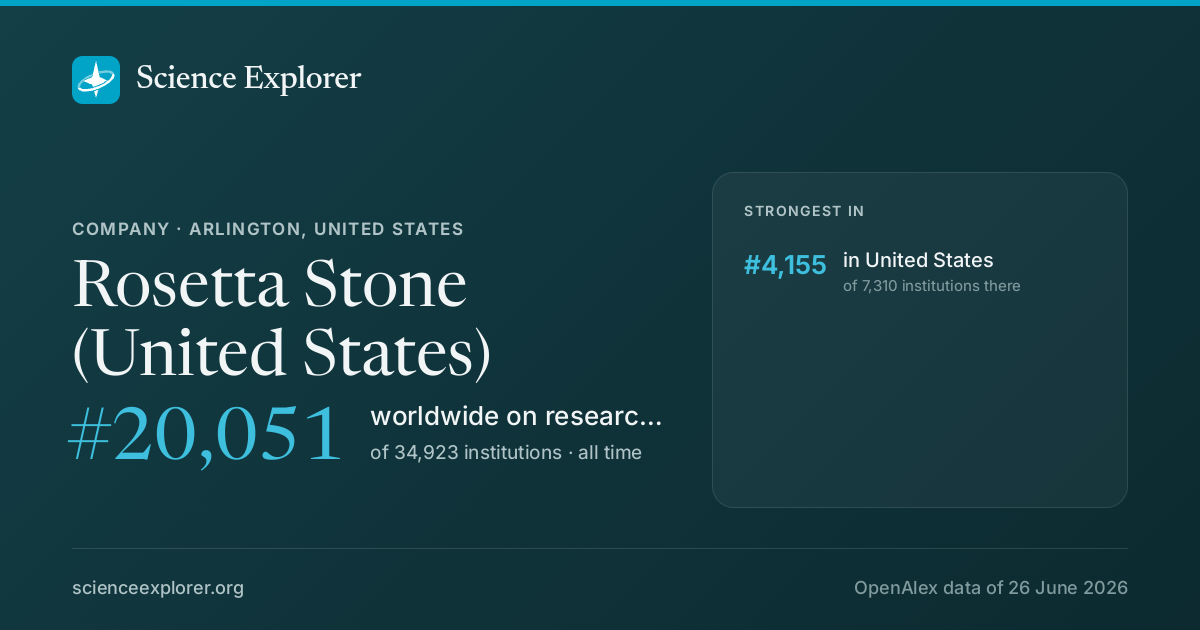
Rosetta Stone (United States) on Science Explorer

A card with Rosetta Stone (United States)'s standing and the fields it leads in, for a post or a slide. A link to this page previews as the same card.

Download the card

1200 × 630 PNG, sized for social posts, drawn from the latest snapshot.

Badges for a website1Each links back here and updates with every snapshot

Research measures only: rankings here say nothing about teaching, admissions or student experience. Comparable institutions and collaboration partners have tabs of their own, above.

Discussion

Ask a question or share a note about Rosetta Stone (United States). Keep it to the research: no personal attacks, advertising or links. Any reader can report a post, which collapses it for everyone until it is opened.